
A peptide storage case can keep research vials cold without a fridge for a limited transfer period if it contains a suitable cooling source and its loaded configuration has been verified against the lot’s storage requirements. An insulated case alone slows warming; it does not generate cooling, establish peptide stability, or replace temperature-controlled storage.
- Can a peptide storage case keep vials cold without a fridge? Temporarily, with suitable cooling and documented temperature verification.
- Insulation slows heat transfer; cold packs supply cooling, and a temperature logger records exposure.
- Simple Life Science serves qualified laboratories sourcing research peptides, bulk peptide API, and custom synthesis services.
- Use lot-level storage requirements and acceptance criteria, not a case label, to approve a laboratory transfer.
Why this matters
Your research requirement is not simply to keep a vial cool to the touch. It is to maintain the material within its documented storage conditions while preserving its identity, provenance, and suitability for the intended laboratory work. A case that protects glass from impact does not necessarily control temperature.
For 2026 laboratory procurement, separate the carrying accessory from the temperature-control system. The case, cooling material, vial arrangement, monitoring device, and transfer conditions together determine performance. Approve that configuration rather than treating an accessory description as evidence.
The storage case to cold-chain compliance log workflow addresses the recordkeeping side of this distinction. Your transfer record should connect the case configuration and temperature history to the specific material moved—not merely record that a case was used.
Can a peptide storage case keep vials cold without a fridge?
Yes, temporarily—but only a verified cooling configuration establishes whether it meets the research material’s requirements. A passive case uses insulation to slow heat exchange with its surroundings. Add conditioned cooling material, and the system can absorb incoming heat until its cooling capacity is exhausted.
A powered portable unit is different: it removes heat while operating. Its performance still depends on its temperature-control capability, power supply, loading arrangement, and documented operating limits. Neither design creates a universal storage condition suitable for every peptide.
| Configuration | What it does | Best for | Main limitation | Evidence to request |
|---|---|---|---|---|
| Insulated case alone | Slows heat exchange and protects the contents physically | Vial organization and transfers supported by material-specific exposure allowances | Supplies no cooling and eventually approaches ambient temperature | Construction details and a justified exposure allowance |
| Insulated case with conditioned cold packs | Uses stored cooling capacity to limit warming | Defined laboratory transfers within a verified handling window | Performance depends on preparation, loading, and surrounding conditions | Temperature profile for the actual packing configuration |
| Powered portable cooling unit | Removes heat while power and temperature control remain effective | Transfers requiring active temperature control | Depends on power continuity and demonstrated control performance | Operating specifications, temperature mapping, and monitoring records |
These are equipment categories, not interchangeable storage approvals. Select the category only after defining the lot’s requirements and the transfer conditions. A temperature trace provides evidence about exposure; it does not, by itself, demonstrate chemical integrity.
Insulated case alone: protection, not refrigeration
An insulated case reduces the rate of heat transfer between the surroundings and its contents. If you load it with already-cold vials, insulation slows their warming. If you load it with room-temperature vials, insulation does not make them cold.
Best for: physical organization and transfers justified by written material requirements. The practical advantages are separation of vials, reduced movement, and a defined carrying arrangement. Its limitation is fundamental: without a cooling source, the case has no means of removing incoming heat.
Do not confuse a rigid shell, padded insert, or dark interior with thermal qualification. Those features address different handling needs. For a temperature-sensitive transfer, request evidence that covers the thermal configuration rather than relying on photographs or the word insulated.
A case-only arrangement is acceptable only when the material’s documented exposure allowance supports the planned journey. Do not convert a convenient carrying arrangement into an undocumented exception to the storage instruction.
Case with cold packs: temporary passive cooling
Cold packs supply a finite cooling reserve. The case’s insulation slows the heat entering the system, while the cooling material absorbs that heat. Preparation and placement therefore matter as much as the outer container.
Best for: a defined transfer with a verified packing arrangement and temperature record. Passive cooling does not require power during the journey. Its limitation is that the cooling reserve is consumed, and opening the case changes the conditions used to establish its performance.
Direct contact with a frozen pack can create a colder local environment than the rest of the case. If the material has a lower temperature limit, preventing excessive cooling is part of the requirement—not an optional precaution. Use the separation and placement specified by the verified packing arrangement.
Do not assume that adding more frozen material improves suitability. A packing change can alter the temperature distribution around the vials. Evaluate the revised configuration against both the upper and lower acceptance limits before adopting it.
Powered cooling: active control with a power dependency
A powered portable cooling unit removes heat rather than relying entirely on a previously chilled load. That makes it a different equipment choice from a passive storage case, even when both are marketed for carrying laboratory vials.
Best for: transfers that require active control and have a dependable power plan. The advantage is continued heat removal during operation. The limitation is dependence on power, controller performance, airflow, and the unit’s ability to maintain the required conditions under the planned load.
A displayed setpoint is a control instruction, not proof of the temperature at every vial position. Review measured temperatures within the loaded compartment. Confirm that the monitoring arrangement represents the material location rather than a convenient empty space near the controller.
For a 2026 equipment review, request operating limits and relevant performance records. Also define the response to loss of power before using the unit for a research transfer. Active cooling does not eliminate the need for a documented handoff into approved storage.
Why cold-holding performance varies
A storage case does not have a single useful cold-holding duration independent of its contents and surroundings. These physical factors determine whether a configuration meets your defined requirement:
- Ambient exposure: The surrounding temperature and exposure to direct sunlight affect the heat entering the case.
- Starting conditions: The initial temperatures of the vials, case, and cooling material influence the temperature profile after packing.
- Cooling material: Its thermal properties, preparation, and placement determine the available cooling reserve and local cold spots.
- Loaded arrangement: Vial positions, separators, and occupied space affect heat transfer and temperature distribution.
- Opening frequency: Opening the lid exchanges air with the surroundings and changes the tested conditions.
- Acceptance limits: A configuration suitable for one permitted temperature band is not automatically suitable for another.
These factors explain why an accessory’s advertised duration is not enough. Request the conditions behind that claim and compare them with your actual transfer. Where the conditions differ, obtain relevant evidence rather than extending the claim by assumption.
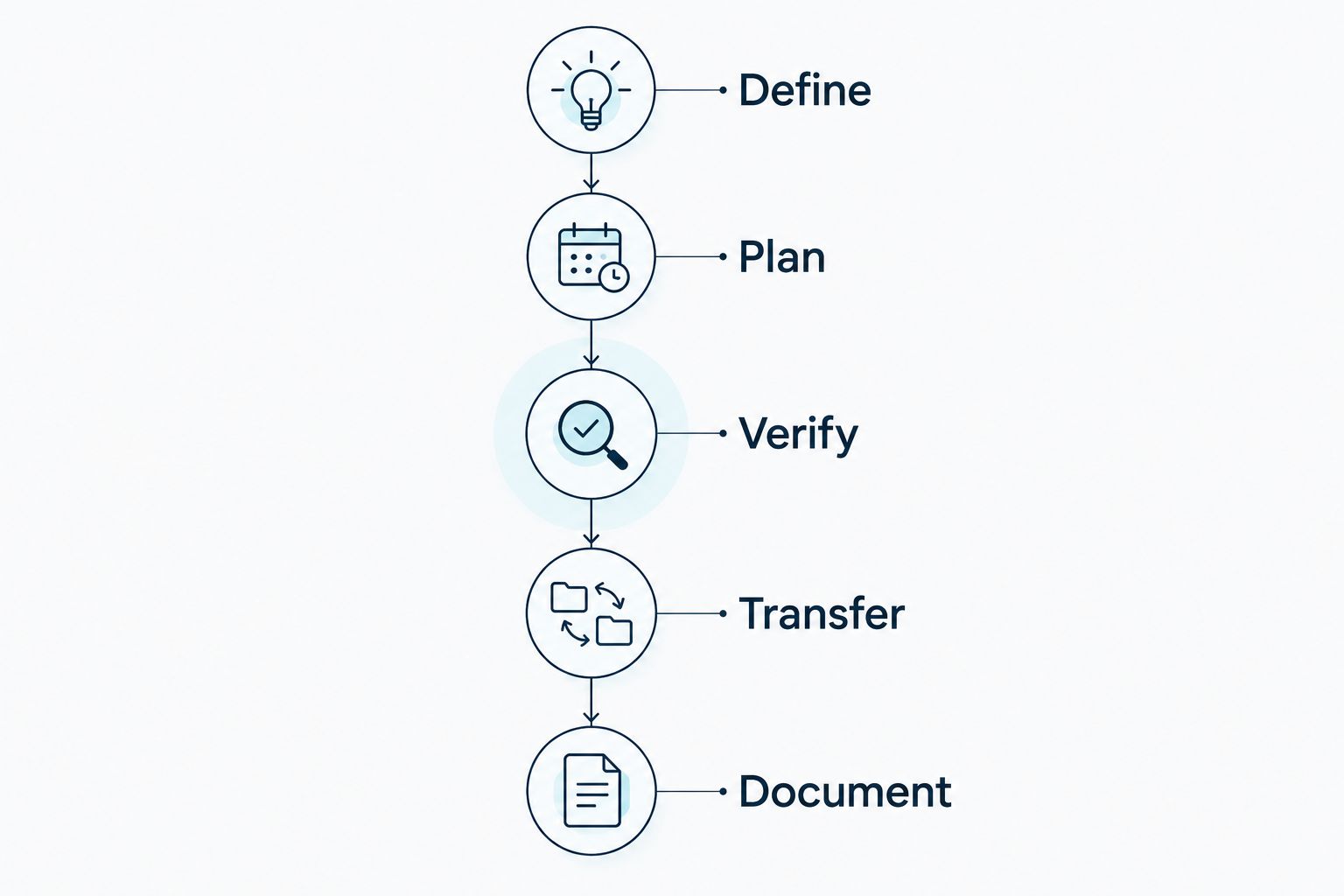
Define, Plan, Verify, Transfer, Document
Use a staged review to turn a carrying case into a documented laboratory handling configuration. This sequence applies whether you are moving a research vial between buildings, receiving material at a laboratory, or arranging a transfer between institutional teams.
Define
Write down the material identity, lot reference, physical form, and applicable storage requirements. Distinguish lyophilized material from a prepared research solution; the same compound name does not establish equivalent stability in different forms.
Record the permitted temperature conditions and any supported exposure allowance. If the documentation does not define an allowance outside normal storage, do not create one from a generic peptide article. Resolve the requirement with the responsible scientific or quality reviewer before planning the transfer.
Plan
Specify the transfer route, expected handling conditions, case configuration, cooling preparation, vial arrangement, and receiving location. Include foreseeable waiting periods at collection and receipt. The transfer does not end simply because the case arrives at the destination.
Assign responsibility for packing, monitoring, and handoff. State what happens if the receiving storage equipment is unavailable or the temperature record cannot be retrieved. A written contingency prevents an improvised handling decision at the point of receipt.
Verify
Evaluate the complete loaded configuration under conditions relevant to the intended transfer. Use representative containers or a justified substitute arrangement for the assessment. Check monitoring locations against temperature distribution rather than selecting a position solely because it is easy to access.
Define acceptance criteria before reviewing the temperature trace. Include the permitted conditions, the monitoring requirements, and the handling assumptions that must remain unchanged. Verification should establish a usable operating boundary, not merely show that the case felt cold after packing.
Transfer
Pack according to the approved arrangement and start the temperature record at the defined point. Keep the case closed except for planned access. Record deviations such as an unexpected delay, changed packing arrangement, or interrupted power supply.
At receipt, connect the temperature record to the material identification before accepting the transfer. Move the vials into the designated storage equipment using the approved handling procedure. Keep unresolved material separate from accepted stock pending review.
Document
Retain the configuration reference, material identifiers, monitoring-device reference, temperature trace, transfer timestamps, and acceptance decision. Link those records to the receiving laboratory’s inventory or research record.
For a 2026 transfer record, preserve the underlying data as well as the summary decision. A screenshot showing one acceptable reading cannot substitute for the exposure history used to approve the material.
Does lyophilized material need the same handling as a solution?
Lyophilized material and a prepared research solution require separate storage assessments. Lyophilization removes water from the preparation, but the physical form alone does not establish an approved room-temperature exposure or a universal shelf life.
Review the compound-specific documentation, formulation information, container closure, and applicable stability evidence. For solutions, the solvent and preparation conditions also belong in the assessment. Do not transfer an allowance established for an unopened lyophilized lot to a solution prepared from it.
Use the current lot record as the handling reference. A general discussion of peptide chemistry can explain relevant degradation pathways, but it cannot authorize an exposure window for your material. Keep chemistry background separate from the acceptance decision.
How long will a case keep research vials cold?
A case keeps research vials within specification only for the interval demonstrated under the relevant packing and environmental conditions. There is no universal duration for the category peptide storage case.
Ask for the temperature profile, not just an endpoint reading. Review where the sensors were placed, what the case contained, how the cooling material was prepared, and whether the lid remained closed. Without those conditions, a duration claim cannot establish suitability for your transfer.
For 2026 procurement documents, specify the required transfer window as a project requirement rather than copying an accessory claim. The supplier or responsible laboratory team must then provide evidence that addresses that requirement.
What the temperature record does—and does not—prove
A suitable temperature record demonstrates the measured exposure at the monitoring locations. It supports comparison against predefined handling criteria. It does not directly measure peptide identity, purity, moisture content, or degradation products.
A certificate of analysis serves a different purpose. Analytical findings associated with a lot do not establish what happened during a subsequent transfer. Likewise, an acceptable temperature trace does not replace the analytical characterization required by your research specification.
Simple Life Science supplies research peptides, bulk peptide API, and custom synthesis and analytical services to qualified laboratory researchers and institutional buyers. For those purchases, separate the material specification, analytical deliverables, and transfer acceptance requirements in your written scope. Do not assume that one document answers all three questions.
The research peptide offering at Simple Life Science is intended for qualified laboratory researchers and institutional buyers. Storage-case suitability remains a separate technical decision requiring evidence about the selected configuration and the specific material.
FAQ
Can a peptide storage case keep vials cold without a fridge?
Yes, temporarily, when the case includes suitable cooling material and the complete packing configuration meets the lot’s documented temperature requirements. An insulated case alone slows warming but does not generate cooling.
Can I use a peptide storage case for permanent laboratory storage?
A passive peptide storage case is not a substitute for temperature-controlled storage when the material requires refrigeration or freezing. Its finite cooling reserve must be replenished, and performance depends on the packing and surroundings.
Is a cold pack enough to approve a research vial transfer?
A cold pack alone does not establish an acceptable transfer. Approve the complete configuration using defined temperature limits, relevant performance evidence, and a documented monitoring arrangement.
Should research vials touch frozen cold packs?
Follow the separation and placement requirements established for the verified configuration. Direct contact can create local temperatures below the material’s permitted lower limit.
Does a temperature logger prove that a peptide has not degraded?
A temperature logger records exposure, not chemical integrity. Assess the record against material-specific stability evidence and use analytical review where the acceptance decision requires it.
What should I do if the case temperature goes outside specification?
Keep the affected material separate from accepted stock and submit the exposure record for scientific or quality review. Do not approve it solely because the vial remains visually unchanged.
Does Simple Life Science sell research peptides for laboratory buyers?
Simple Life Science sells lyophilized research peptides, bulk peptide API, and custom synthesis and analytical services to qualified laboratory researchers and institutional buyers. Define the material, documentation, and handling requirements in the purchasing scope.
One last thing
A case can keep vials cold and still fail the specification by keeping them too cold. Evaluate the lower limit as carefully as the upper limit whenever the material documentation defines both. Cooling capacity is not the same as controlled temperature.
Before your next 2026 laboratory transfer, write a single acceptance statement identifying the material, permitted conditions, approved configuration, and required record. If that statement cannot be completed, resolve the handling requirement before packing. The useful deliverable is an accepted exposure history connected to the lot—not a cold case at arrival.
Related guides
- Peptide storage cases for laboratory use
- How lyophilized peptides are shipped to stay stable in transit
- Refrigeration requirements before peptide reconstitution
For laboratory research use only. Not for human or veterinary use. Not intended to diagnose, treat, cure, or prevent any disease.

