
Lyophilized (freeze-dried) research peptides and reconstituted peptide solutions carry different storage requirements, and confusing the two is the most common documentation error in inbound peptide shipments. This page sets out when refrigeration applies to the lyophilized state, when it doesn't, and what a lot record should confirm before a vial goes into service.
- Lyophilized peptides do not need refrigeration before reconstitution for standard shipping and short-term hold in 2026.
- Refrigerated storage (2-8°C) or freezer storage (-20°C) extends retained shelf life and is standard for lot archiving.
- Reconstitution is the point where cold-chain and bacteriostatic water handling actually start to matter, not before.
- Moisture ingress and light exposure degrade lyophilized cake faster than a few days at room temperature ever will.
- Simple Life Science ships lyophilized peptides with lot documentation stating the storage condition confirmed at dispatch.
Why this matters
A lyophilized peptide is a solid, freeze-dried cake, not a solution — the water that would drive hydrolysis and microbial growth has already been removed. That's why the question "do lyophilized peptides need refrigeration before reconstitution" gets asked so often: procurement teams and lab managers assume the answer mirrors reconstituted-solution rules, and it doesn't. Getting this wrong either wastes a freezer slot on material that ships fine at ambient temperature, or leaves a moisture-sensitive lot sitting on a bench past its documented hold window. The sourcing guide for procurement teams covers how this fits into a broader intake and storage decision.
No — properly lyophilized peptides do not require refrigeration before reconstitution for typical transit and short-term hold at room temperature. The freeze-dried state is chemically more stable than a reconstituted solution because there's no free water available to drive oxidation, deamidation, or hydrolysis at a meaningful rate. The caveat: extended hold periods, elevated ambient temperature, direct light, and moisture ingress through a compromised seal all shorten that window, which is why refrigerated or frozen storage is still the standard recommendation for anything held longer than a short transit period.
Do lyophilized peptides need refrigeration before reconstitution?
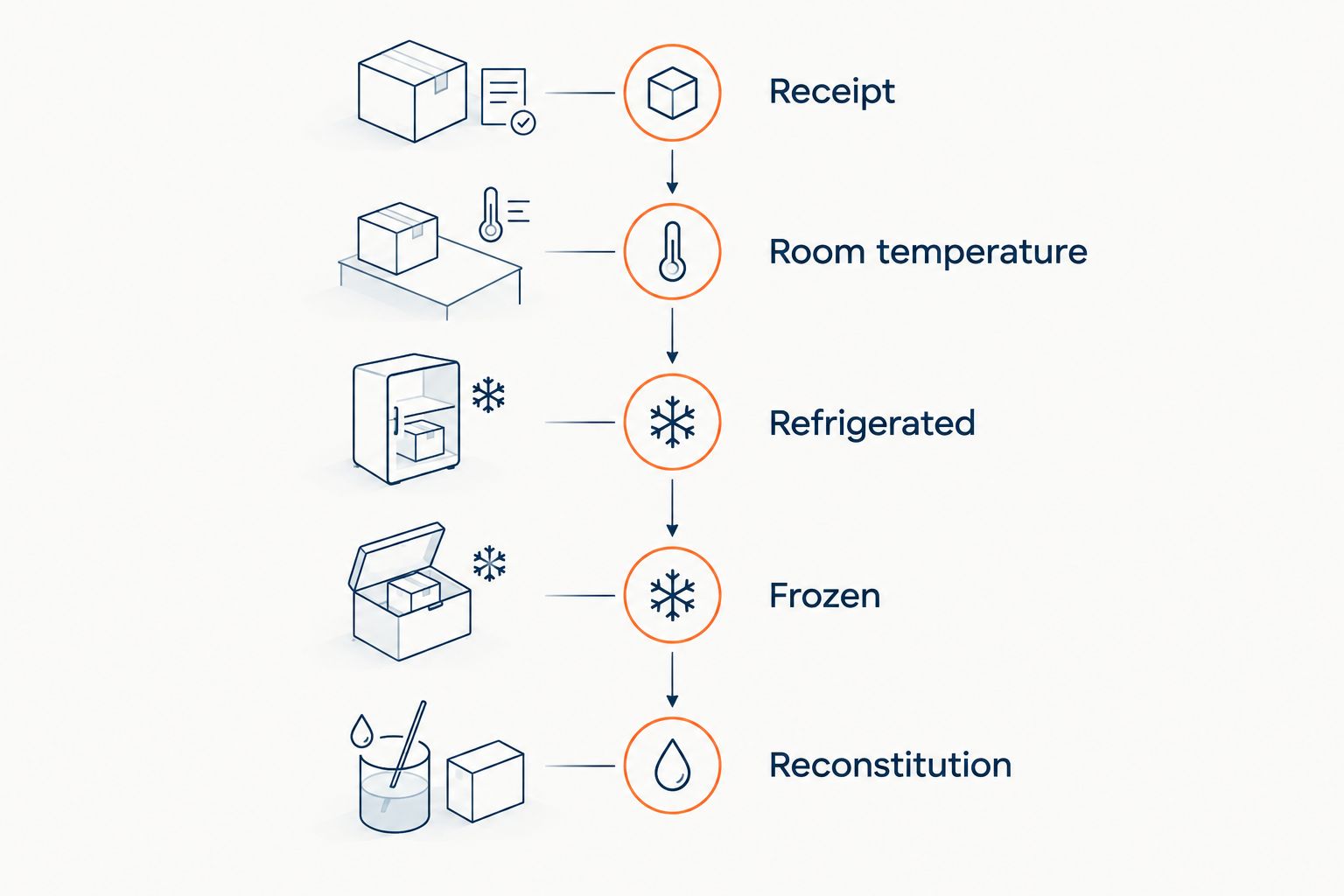
The table below breaks out the three storage conditions researchers actually use for lyophilized peptide vials, and what each one is appropriate for.
| Storage condition | Typical use case | Stability note |
|---|---|---|
| Room temperature (20-25°C) | Transit, short bench hold before reconstitution | Acceptable for brief periods; not recommended for retained lots |
| Refrigerated (2-8°C) | Standard lot storage between receipt and use | Baseline recommendation for lyophilized material held more than a few days |
| Frozen (-20°C) | Long-term archival, retained samples, reference standards | Slowest degradation rate; requires desiccant and moisture-protected packaging |
Each condition assumes the vial is sealed, desiccated, and protected from light — a lyophilized peptide left open to ambient humidity degrades regardless of temperature.
Room temperature storage (20-25°C): short-term only
A sealed, lyophilized peptide vial tolerates room temperature for the duration of standard ground or air shipping and for a short bench hold before reconstitution. This is the condition most lyophilized peptide orders actually travel in — cold-chain shipping is reserved for reconstituted solutions and temperature-sensitive formulations, not the freeze-dried cake itself. Verdict: acceptable for transit and same-week use, not for retained storage.
Refrigerated storage (2-8°C): standard for lot retention
Once a lyophilized peptide is logged into inventory and won't be reconstituted immediately, refrigeration at 2-8°C is the documented baseline. This is the condition referenced in most certificates of analysis and lot records for peptides intended for use across weeks rather than days. Verdict: standard practice for any lot with an open-ended use timeline.
Frozen storage (-20°C): longest hold for retained samples
For reference standards, retained samples, or material held for extended periods before scheduled use, freezer storage at -20°C gives the longest documented stability window. This is the condition used for archival retains tied to a lot record rather than active-use inventory. Verdict: appropriate for long-term retention, unnecessary for near-term use.
Why refrigeration needs vary
Not every lyophilized peptide behaves the same way once it leaves the freezer. The factors below determine how strict the storage condition needs to be for a given lot:
- Sequence composition — peptides containing methionine, cysteine, or tryptophan are more oxidation-prone and benefit from stricter cold storage even in the lyophilized state.
- Packaging integrity — a vial with an intact rubber stopper and vacuum seal resists moisture ingress far better than one that's been opened and reclosed.
- Desiccant presence — lyophilized cakes are hygroscopic; desiccant in the shipping and storage container reduces moisture uptake between opening events.
- Light exposure — some sequences are photosensitive and degrade faster under ambient light regardless of temperature, which is why amber vials and opaque packaging matter.
- Hold duration before use — a vial reconstituted within days of receipt has a wider margin for room-temperature hold than one sitting in inventory for months.
- Formulation additives — buffer salts or excipients included in the lyophilization cake can shift stability behavior compared to a plain peptide-only cake.
A lot record that documents storage condition at each handling step — receipt, hold, reconstitution — gives a research team the basis to confirm a vial was within spec at time of use, which matters more for audit purposes than the temperature number alone.
Confirm storage requirements before ordering
Review lot documentation and storage guidance by peptide.
Related questions
Does reconstituted peptide need refrigeration?
Yes — once a lyophilized peptide is reconstituted with bacteriostatic or sterile water, refrigeration at 2-8°C is standard practice for the remainder of its use window. The reconstituted peptide stability page covers the specific hold windows by water type and additive.
How can you tell if a lyophilized peptide has degraded?
Visual and documentation checks are the first line of review: cake collapse, discoloration, or a certificate of analysis showing the lot outside its acceptance criteria are the usual flags. The degradation indicators guide walks through what a lab should check before reconstituting a vial that's been in storage for an extended period.
Should lyophilized peptides be stored with desiccant?
Yes — desiccant reduces moisture uptake in a hygroscopic lyophilized cake, and it matters more in humid climates or when a vial is opened and reclosed repeatedly rather than used in a single session. This is a packaging detail, not a temperature substitute; desiccant doesn't replace refrigeration for extended holds.
Preguntas frecuentes
Do lyophilized peptides need refrigeration before reconstitution?
No, not for standard shipping or short-term bench hold — the freeze-dried state is chemically stable without added water. Refrigeration at 2-8°C becomes the standard once a lot is held for more than a few days before use.
Can lyophilized peptides sit at room temperature during shipping?
Yes, sealed and desiccated lyophilized peptide vials tolerate room temperature (20-25°C) for the duration of standard shipping. Extended room-temperature hold beyond transit is where documentation should shift to a refrigerated recommendation.
What temperature should lyophilized peptides be stored at long-term?
Long-term retained lots are typically stored at -20°C, while active-use inventory is stored at 2-8°C. The choice depends on whether the vial is a working sample or an archival retain tied to a lot record.
Does light exposure affect lyophilized peptide stability?
Yes, certain sequences are photosensitive and degrade under ambient light independent of temperature. Amber vials and opaque secondary packaging address this separately from cold-chain handling.
Is bacteriostatic water the same as sterile water for reconstitution?
No, they differ in composition and intended reuse — the [bacteriostatic water comparison](https://simplelifescience.com/is-bacteriostatic-water-the-same-as-sterile-water/) covers when each applies. This distinction only becomes relevant after the lyophilized peptide is reconstituted, not before.
How long does opened bacteriostatic water stay usable?
Usability windows for opened bacteriostatic water depend on storage condition and handling after the seal is broken, detailed on the [opened bacteriostatic water guide](https://simplelifescience.com/how-long-does-opened-bacteriostatic-water-stay-usable/). This applies to the reconstitution step, separate from lyophilized vial storage.
Should a lyophilized peptide be reconstituted immediately after receipt?
Not necessarily — a lyophilized peptide can be logged into refrigerated or frozen storage and reconstituted when the research schedule calls for it. Immediate reconstitution is only required if there’s no cold storage available for interim hold.
Does moisture exposure matter more than temperature for lyophilized peptides?
Moisture ingress through a compromised seal degrades a lyophilized cake regardless of storage temperature, making packaging integrity as important as the refrigeration decision itself.
One last thing
The detail most labs miss isn't the refrigeration question at all — it's that repeated freeze-thaw cycling of a reconstituted solution does more damage than a few days of room-temperature transit ever does to the lyophilized cake. Teams that over-manage the lyophilized state and under-manage post-reconstitution freeze-thaw cycles end up with the stability problem backwards. The fix is documentation at the reconstitution step, not tighter cold-chain rules before it.
Related guides
- Lyophilized peptides for university labs: complete guide
- Quality documentation to audit-ready QC records

