
Reconstitution protocols for lyophilized research peptides specify a single diluent, and the question of whether bacteriostatic water can be mixed with saline comes up often among labs trying to stretch supply or adjust preservative strength. This page covers what separates the two diluents and what a documented reconstitution record requires in 2026.
- Bacteriostatic water and saline are not standard interchangeable diluents for research peptide reconstitution.
- Mixing them dilutes the 0.9% benzyl alcohol preservative in bacteriostatic water below its labeled concentration.
- Saline (0.9% Sodium Chloride, USP) carries no antimicrobial preservative unless separately labeled bacteriostatic.
- Written protocols and lot records specify one diluent per reconstitution, not a blend of two.
- Simple Life Science documents bacteriostatic water as a single defined-specification diluent for research use.
Why this matters
A reconstitution log ties a peptide lot to one specified diluent lot. That pairing is what makes a certificate of analysis, a stability note, or a punchout catalog line item mean anything when an auditor or a lab manager reviews it later in 2026.
When two diluents get combined without a written specification behind the mix, the resulting solution has no compendial monograph, no stability data, and no defined preservative concentration. That's a documentation gap, not a shortcut.
Bacteriostatic water and saline cannot be substituted for each other or combined and still meet a defined reconstitution specification. Bacteriostatic Water for Injection, USP, contains 0.9% benzyl alcohol as an antimicrobial preservative. 0.9% Sodium Chloride Injection, USP carries no preservative unless the label states otherwise, so blending the two dilutes the benzyl alcohol concentration below the range it was validated at and creates an undocumented solution with no established stability record.
Can bacteriostatic water be mixed with saline for reconstitution?
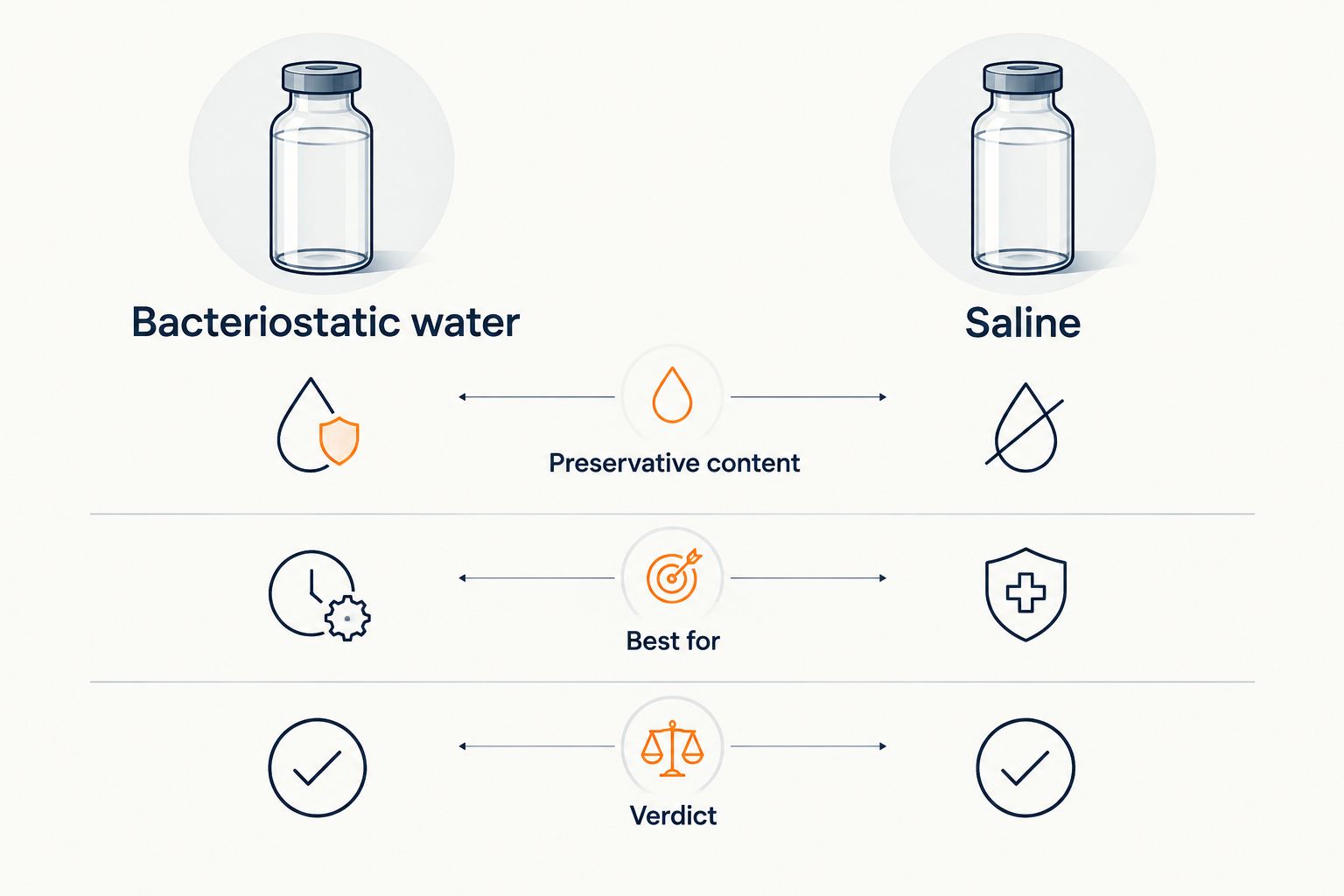
The short answer sits above. The table below lays out what each diluent is specified for and where a written protocol would call for one over the other.
| Diluent | Preservative content | Best for | Verdict |
|---|---|---|---|
| Bacteriostatic Water for Injection, USP | 0.9% benzyl alcohol | Reconstitution protocols requiring multiple draws over a defined use period | Use per written specification |
| 0.9% Sodium Chloride Injection, USP (saline) | None, unless separately labeled bacteriostatic | Single-draw dilution steps or protocols with no preservative requirement | Use only when protocol specifies saline |
| Bacteriostatic water blended with saline | Diluted below the labeled 0.9% concentration | No standard research application identified | Avoid — undocumented specification |
Neither diluent is a general-purpose substitute for the other. How much bacteriostatic water to add per vial is a separate specification question that depends on the peptide lot's defined concentration target, not on whether saline is available as a stand-in.
Why mixing bacteriostatic water and saline isn't a defined specification
A handful of factors explain why combining the two diluents falls outside standard reconstitution practice rather than being a matter of preference:
- Preservative concentration threshold. Benzyl alcohol is validated as an antimicrobial preservative at 0.9% in bacteriostatic water; diluting it with saline drops that concentration below the range any stability or preservative-effectiveness data covers.
- No compendial monograph for the blend. USP monographs exist separately for Bacteriostatic Water for Injection and for 0.9% Sodium Chloride Injection. There is no monograph, and no established acceptance criteria, for a combined diluent.
- Osmolarity is unaddressed by either label. Bacteriostatic water is formulated as a reconstitution diluent independent of saline's electrolyte content; combining the two changes tonicity in a way neither product's specification accounts for.
- Lot records reference one diluent, not two. A certificate of analysis and a reconstitution log cite a single diluent lot number. Mixing diluents breaks that one-to-one traceability.
- Analytical characterization sets concentration against one solvent. Peptide concentration and purity work on a lyophilized lot is referenced to a defined diluent; substituting a blend invalidates that reference point.
- Procurement systems treat them as separate SKUs. Institutional catalogs and punchout systems list bacteriostatic water and saline as distinct line items with distinct specifications, not a combined product.
Simple Life Science supplies bacteriostatic water as a single, defined-specification diluent rather than a pre-mixed solution, which keeps the reconstitution record tied to one product and one lot.
Can saline be used instead of bacteriostatic water for peptide reconstitution?
Saline can be used when a written protocol specifically calls for 0.9% Sodium Chloride Injection, USP, but it carries no antimicrobial preservative unless separately labeled bacteriostatic. Protocols built around preservative-free saline typically specify single-use or same-day handling rather than the multi-draw use period bacteriostatic water supports.
Does combining diluents change a peptide's documented stability?
Yes — stability and potency data on file for a lyophilized peptide lot are generated against one specified diluent, and introducing a second diluent creates a condition outside that documentation. Any deviation from the specified diluent belongs in the protocol record as a change, not as an interchangeable substitution.
What's the actual difference between bacteriostatic water and normal saline?
Bacteriostatic Water for Injection, USP, contains 0.9% benzyl alcohol as an antimicrobial preservative, while 0.9% Sodium Chloride Injection, USP, contains none unless the label states otherwise. That preservative concentration is what allows bacteriostatic water to support multiple draws over a defined period in 2026 research protocols; saline without it typically doesn't.
“A reconstitution record names one diluent and one lot number — not a mixture of two.”
Review documentation before you reconstitute
Check defined specifications and lot records ahead of any protocol change.
Preguntas frecuentes
Can bacteriostatic water be mixed with saline for reconstitution?
No — mixing bacteriostatic water with saline is not a standard specification and dilutes the 0.9% benzyl alcohol preservative below its validated concentration. Written reconstitution protocols specify one diluent, not a blend.
Is saline an acceptable substitute for bacteriostatic water?
Saline is acceptable only when a written protocol specifically calls for 0.9% Sodium Chloride Injection, USP. It carries no antimicrobial preservative unless separately labeled, so it doesn’t support the same multi-draw use period.
Does mixing diluents void a peptide’s documented stability?
Yes — stability data on file references one specified diluent, and combining diluents creates a condition outside that documentation. Treat any diluent change as a protocol deviation to log, not an equivalent substitution.
How much benzyl alcohol is in bacteriostatic water?
Bacteriostatic Water for Injection, USP contains 0.9% benzyl alcohol as an antimicrobial preservative. That concentration is what the compendial monograph and stability data are built around.
Is 0.9% saline the same concentration as bacteriostatic water’s preservative?
No — 0.9% refers to sodium chloride content in saline and 0.9% benzyl alcohol in bacteriostatic water; they’re two unrelated specifications that happen to share a number.
What happens if a reconstitution log doesn’t match the specified diluent?
The record no longer traces back to a defined lot specification, which breaks documentation continuity for any later analytical review. That’s the core reason mixed-diluent reconstitution is avoided.
Can bacteriostatic water be reused across multiple vials?
Bacteriostatic water’s 0.9% benzyl alcohol preservative is what supports multiple draws within a defined use period, but the specific handling still follows the written protocol for that lot. Reuse windows are a separate documentation question from diluent compatibility.
Is bacteriostatic water sterile like saline?
Both Bacteriostatic Water for Injection, USP and 0.9% Sodium Chloride Injection, USP are sterile products under their respective monographs. The difference is the added antimicrobial preservative in bacteriostatic water, not sterility.
One last thing
The number that trips people up is the shared "0.9%" — 0.9% benzyl alcohol in bacteriostatic water and 0.9% sodium chloride in saline are unrelated specifications that happen to use the same figure. Treating them as equivalent, or blendable, because the numbers match is the most common misreading behind this question in 2026.
For a defined reconstitution record, keep the diluent single-sourced and match it to the written protocol on file — that's the entire distinction bacteriostatic water and saline compatibility comes down to.
Related guides
- How long does opened bacteriostatic water stay usable?
- Can bacteriostatic water be reused after the vial is opened?
- Best bacteriostatic water for peptide reconstitution in 2026

