
A lyophilized peptide typically remains chemically stable at room temperature for roughly 2 to 4 weeks in 2026, based on general peptide storage documentation published by manufacturers and analytical labs. Sequences containing methionine, cysteine, tryptophan, or asparagine/glutamine residues degrade faster — often within days to two weeks — because those side chains oxidize or deaminate at ambient temperature. The written specification and lot-level certificate of analysis for a given peptide define its actual stability window, not a single universal number.
- Lyophilized peptides generally hold for 2 to 4 weeks at room temperature before degradation risk climbs in 2026.
- Oxidation-prone residues (Met, Cys, Trp, Asn/Gln) can shorten that window to under 2 weeks.
- Once reconstituted, a peptide is no longer room-temperature stable — refrigeration and a defined use window apply.
- The certificate of analysis for the specific lot, not a general rule, sets the real stability figure.
Why this matters
Research labs receive lyophilized material in transit, during weekend deliveries, or ahead of a freezer slot opening up. Knowing the realistic room-temperature window prevents a lab from either discarding usable material too early or running a study on a peptide that has already started to degrade. Procurement teams sourcing across multiple suppliers need this baked into their peptide sourcing decisions, since storage tolerance affects shipping method and acceptance testing on arrival.
Most of the risk during that 2-to-4-week window is not heat alone — it's moisture uptake into the freeze-dried cake, which accelerates every other degradation pathway.
How long do lyophilized peptides last at room temperature?
Stability depends on sequence chemistry, purity, and how well the vial stayed sealed and dry. The table below breaks down the general pattern documented across peptide storage literature.
| Peptide characteristic | Typical room-temp stability | Recommended practice |
|---|---|---|
| Short, high-purity sequence, no oxidation-prone residues | 2 to 4 weeks | Move to freezer on receipt; treat room temp as a transit allowance, not a storage plan |
| Sequence with Met, Cys, Trp, or Asn/Gln residues | Days to under 2 weeks | Freeze immediately; do not hold at ambient temperature for testing prep |
| Reconstituted in bacteriostatic water | Not room-temp stable | Refrigerate; treat as a short, defined use window (see below) |
| Bulk API, sealed and desiccated | Comparable to the high-purity range above | Confirm handling instructions on the lot documentation before ambient exposure |
Short, high-purity peptides: stable roughly 2 to 4 weeks at room temperature
A short sequence with high purity and no oxidation-prone side chains holds up the longest at ambient conditions. The freeze-dried cake resists moisture reasonably well when the vial seal is intact, and the amino acid composition doesn't offer an easy oxidation or deamidation pathway. Verdict: acceptable for short shipping and handling windows, not for extended bench storage.
Peptides with oxidation-prone residues: stable under 2 weeks at room temperature
Methionine and cysteine oxidize readily at ambient temperature and normal atmospheric oxygen exposure. Tryptophan degrades under light exposure, and asparagine/glutamine residues are prone to deamidation even in the dry state, just more slowly than in solution. A peptide carrying any of these residues should move to frozen storage as soon as it's received. Verdict: freeze on arrival — don't stage these on a bench overnight.
Once reconstituted: stable up to 28 days, and only refrigerated
Reconstitution changes the stability profile entirely. Bacteriostatic water's benzyl alcohol preservative is commonly documented as effective for up to 28 days under refrigeration, mirroring the USP multi-dose vial guideline used broadly across pharmaceutical compounding. Room temperature is not part of that guidance — how long reconstituted peptide lasts in bacteriostatic water is governed by refrigeration, not ambient storage. Verdict: refrigerate immediately after reconstitution; room-temperature storage voids the stability assumption entirely.
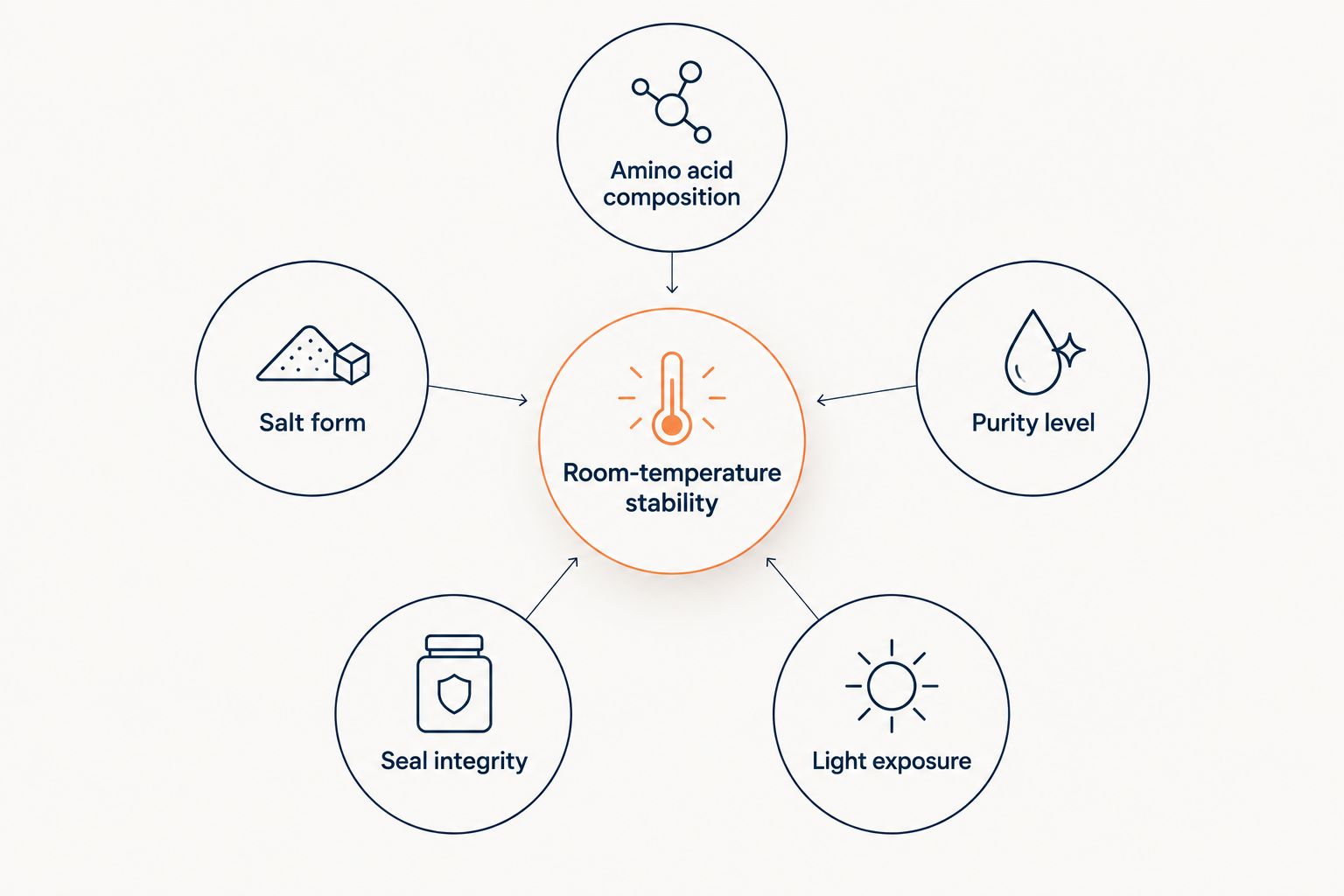
Why room-temperature stability varies
- Amino acid composition — Met, Cys, Trp, Asn, and Gln residues each open a distinct degradation pathway at ambient temperature.
- Salt form — TFA and acetate salts behave differently once moisture is introduced, which affects how they hold up outside cold storage.
- Purity level at lyophilization — higher purity generally means fewer reactive impurities accelerating breakdown.
- Vial seal integrity and desiccant — a compromised seal lets ambient humidity into the cake, which is the single biggest driver of early degradation.
- Light exposure — tryptophan-containing sequences are photosensitive; storage in amber vials or dark packaging slows this.
- How the peptide was stored before reconstitution — see how peptides should be stored before reconstitution for the handling steps that protect the lyophilized cake before it's ever put into solution.
Simple Life Science documents lot-specific storage handling on the certificate of analysis for each lyophilized peptide it ships, so the room-temperature window for a given lot is a matter of record rather than estimation.
Review lot-level QC documentation
Confirm storage handling and analytical results before scheduling a study.
How can you tell if a lyophilized peptide has degraded?
Visual cues alone are unreliable — a degraded lyophilized peptide often looks identical to a stable one. Confirming degradation requires analytical review against the original certificate of analysis, covering purity by HPLC and mass confirmation, rather than a visual check of the cake.
Is lyophilized peptide storage different from reconstituted peptide storage?
Yes — lyophilized (dry) peptide tolerates brief ambient exposure measured in weeks, while reconstituted peptide in solution is measured in days to a few weeks under refrigeration only. Once water is added, the degradation clock runs on a completely different timeline and room temperature is no longer an option.
Does bulk peptide API follow the same room-temperature rules?
Bulk peptide API generally follows the same chemistry-driven rules as smaller lyophilized lots, since stability is a function of sequence and purity rather than quantity. Institutional buyers ordering bulk API should still confirm handling instructions against the specific lot's documentation rather than assume uniform behavior across sequences.
Preguntas frecuentes
How long do lyophilized peptides last at room temperature in 2026?
Most lyophilized peptides remain stable at room temperature for 2 to 4 weeks in 2026, though sequences with oxidation-prone residues can degrade in under 2 weeks. The certificate of analysis for the specific lot defines the actual window.
Do all lyophilized peptides have the same room-temperature stability?
No — sequences containing methionine, cysteine, tryptophan, or asparagine/glutamine degrade faster than short, high-purity sequences without those residues. Salt form and vial seal integrity also affect the timeline.
Is it safe to leave a lyophilized peptide out overnight?
A single overnight exposure at room temperature falls well within the 2-to-4-week general stability window for most sequences, but oxidation-prone peptides should still move to frozen storage as soon as possible.
Does reconstituted peptide last as long as lyophilized peptide at room temperature?
No — reconstituted peptide is not room-temperature stable at all and requires refrigeration, with a documented use window of up to 28 days under cold storage.
What degrades a lyophilized peptide fastest at room temperature?
Moisture uptake into the freeze-dried cake is the fastest driver of degradation, followed by oxidation of methionine, cysteine, or tryptophan residues if the sequence contains them.
Should lyophilized peptides be frozen immediately on arrival?
Freezing on arrival is the safest default, especially for sequences with oxidation-prone residues, even though many peptides tolerate 2 to 4 weeks at room temperature.
Does purity affect room-temperature stability?
Yes — higher-purity lyophilized peptides generally hold up longer at room temperature because there are fewer reactive impurities to accelerate breakdown.
One last thing
The 2-to-4-week room-temperature figure gets treated as a fixed rule, but the real variable is moisture, not the calendar. A lyophilized peptide sealed tightly with intact desiccant in a low-humidity lab can outperform that range; the same sequence in a poorly resealed vial in a humid room can degrade well before the two-week mark. Check the seal and the lot's certificate of analysis before trusting a general timeframe in 2026.
Related guides

