
Opened bacteriostatic water stays usable for up to 28 days after the first needle puncture, provided the vial is kept refrigerated or at controlled room temperature and the rubber septum hasn't been damaged between draws. That 28-day window covers the water itself — once a peptide is dissolved into it, the resulting solution runs on a separate, usually shorter clock tied to that specific peptide's own stability profile, not to the diluent.
- Opened bacteriostatic water (0.9% benzyl alcohol) stays usable for 28 days after first puncture in 2026.
- Preservative-free sterile water has no such window — discard unused volume the same day it’s opened.
- The 28-day rule applies to the water only; a reconstituted peptide solution has its own, often shorter stability clock.
- Septum condition, draw frequency, and storage temperature all shorten the practical window below 28 days.
Why this matters for lab records
A punctured vial of bacteriostatic water isn't a sealed reagent anymore — it's an open system with a documented start date. Labs that track reconstitution events, freezer logs, or audit-ready QC records need that first-puncture date recorded the moment the septum is broken, not estimated later from memory.
This also matters because two different clocks get confused constantly: the water's own 28-day usable window, and the stability window of a peptide once it's reconstituted in that water. Those are not the same number, and treating them as interchangeable is the single most common documentation error in reconstitution logs reviewed in 2026.
How long does opened bacteriostatic water stay usable?
The answer depends on what's in the vial and whether it's been punctured. The table below breaks down the four states a research lab actually encounters.
| Vial state | Usable window | Storage condition |
|---|---|---|
| Unopened, sealed vial | Until the printed expiration date | Room temperature, protected from light |
| Opened / first puncture, bacteriostatic (0.9% benzyl alcohol) | Up to 28 days | Refrigerated or room temperature, septum intact |
| Preservative-free sterile water, opened | Same day only | Single use, discard remainder |
| Reconstituted peptide solution (peptide + bacteriostatic water) | Separate, peptide-specific clock | Refrigerated, protected from light |
The 28-day figure is the standard multi-dose window that applies once a benzyl-alcohol-preserved diluent is punctured — it's the water's own shelf clock, independent of what gets dissolved in it later.
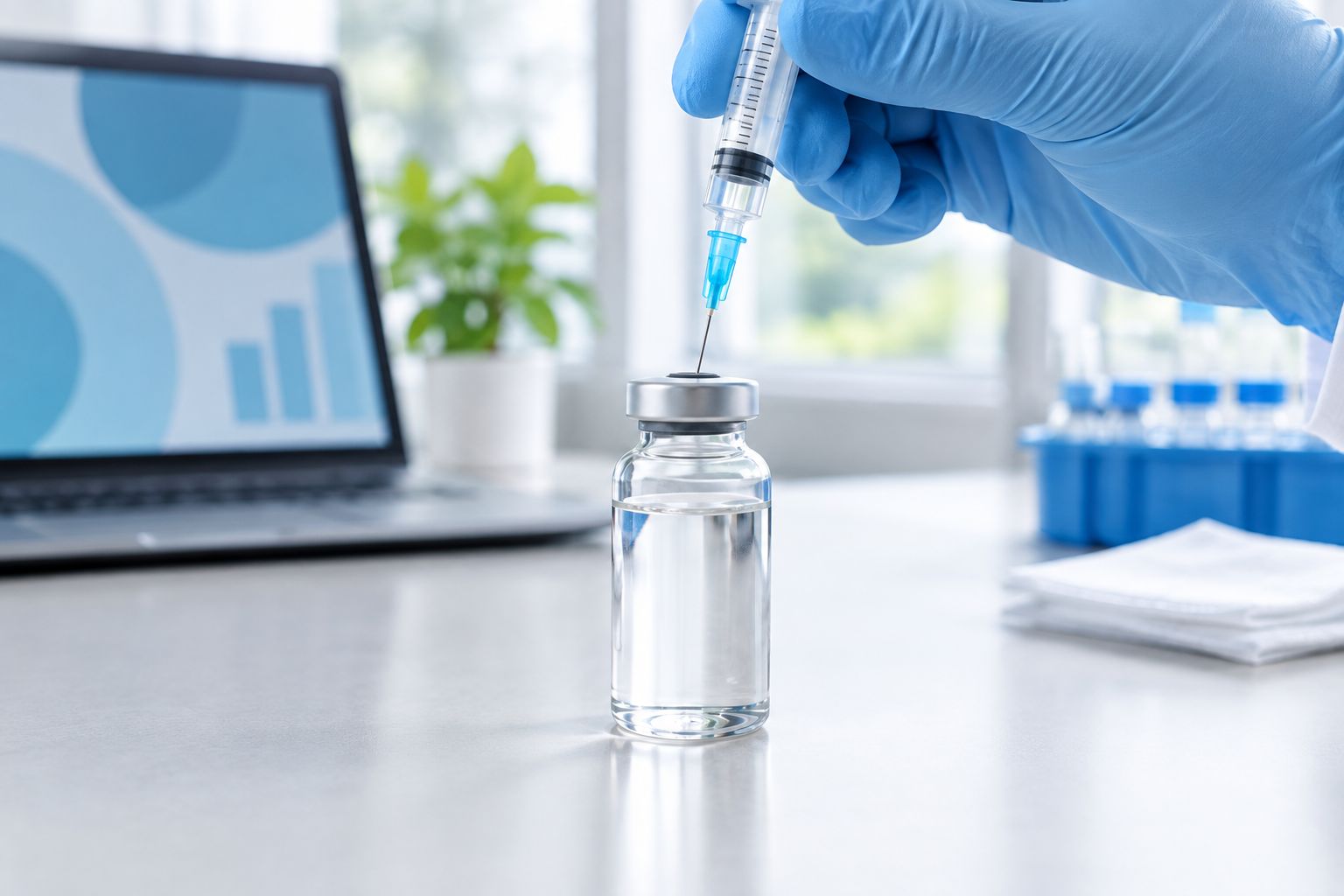
Bacteriostatic water (0.9% benzyl alcohol): 28 days after first puncture
Bacteriostatic water carries 0.9% benzyl alcohol as an antimicrobial preservative, which is why it's rated for repeated draws rather than single use. That 0.9% concentration inhibits bacterial growth between punctures but doesn't sterilize the solution indefinitely — as of 2026, the 28-day convention after first puncture is still the standard reference point used across compounding and research settings.
A lab drawing from the same vial multiple times a week should log the first-puncture date on the vial label itself, not just in a digital system that might not travel with the vial into a shared fridge. Formulations vary slightly by manufacturer and concentration, and a side-by-side comparison of bacteriostatic water options used for peptide reconstitution is useful before standardizing on one source across a lab.
Preservative-free sterile water: single use, discard within hours
Sterile water without an antimicrobial preservative carries no protection against microbial growth once the seal is broken. It's built for one draw, one use, and disposal — there is no 28-day window, no refrigeration extension, and no partial-use carryover to a second day.
Some protocols specifically call for preservative-free water because benzyl alcohol interferes with a particular assay or downstream process. In those cases, the tradeoff is explicit: you gain a preservative-free diluent and lose the multi-draw window entirely.
Why the usable window varies
The 28-day figure is a ceiling, not a guarantee. Several factors push the practical window shorter:
- Preservative concentration — 0.9% benzyl alcohol inhibits microbial growth but degrades in effectiveness over time, not just at day 29.
- Septum integrity — off-center or repeated punctures through the same spot on the rubber stopper increase the chance of an imperfect reseal.
- Storage temperature — refrigeration slows any residual microbial activity; room-temperature storage above typical lab conditions shortens the practical window.
- Draw frequency — a vial drawn from daily accumulates more puncture events and more exposure risk than one drawn from twice.
- Sterile technique per draw — swabbing the septum with alcohol before each draw matters more day-to-day than the calendar date printed on the log.
Lab records dated 2026 that track puncture events, not just calendar days, catch contamination risk earlier than records that only note "opened on X."
“If a vial has been punctured more than a handful of times, treat the 28-day window as optimistic — contamination risk climbs faster than the calendar does.”
That's the practical takeaway procurement and QC teams apply when auditing reconstitution logs: the date on the label is a ceiling, and the puncture count is the real variable.
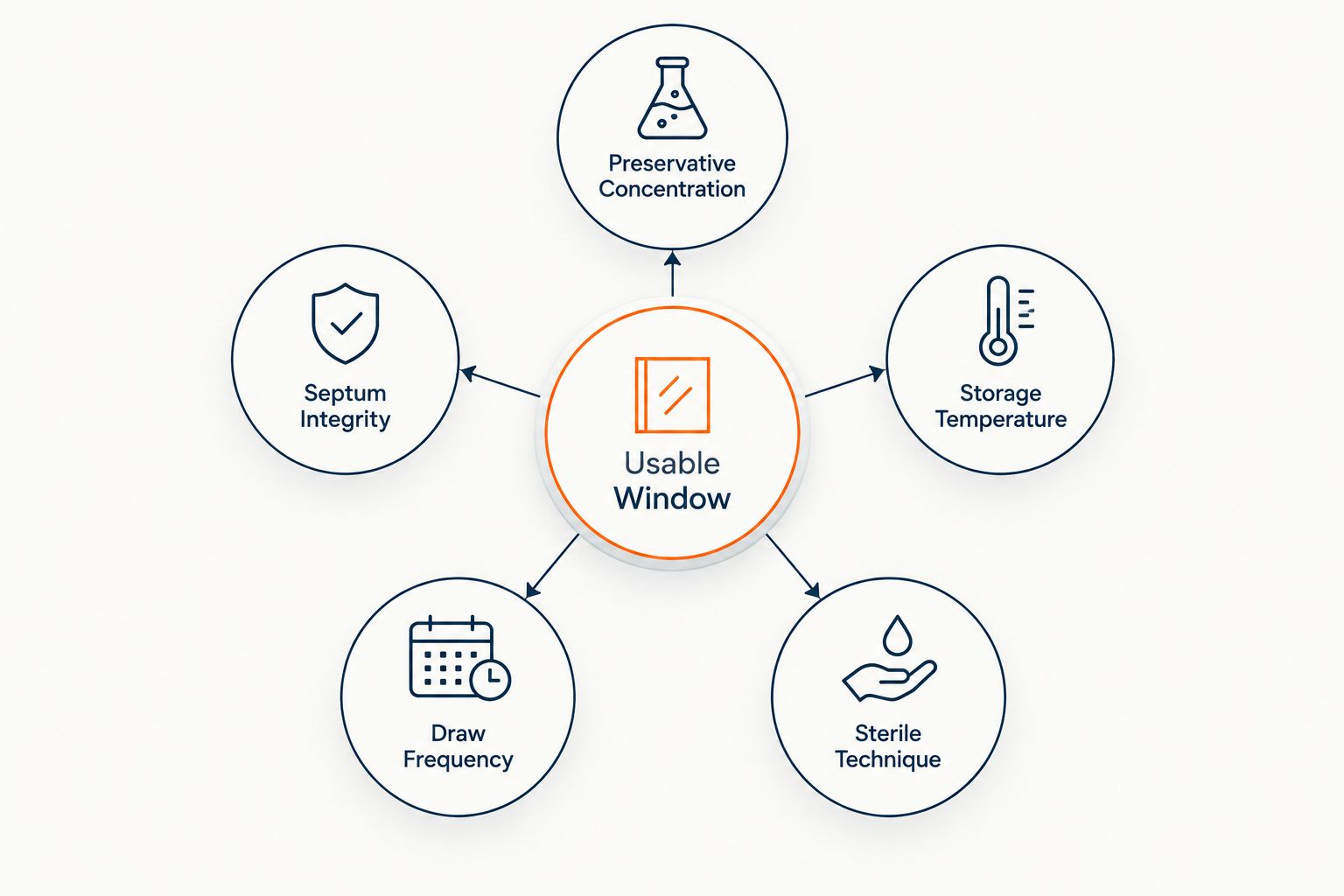
Each of these factors is why two labs can open bacteriostatic water on the same day and reasonably reach different conclusions about when to discard it — one variable rarely tells the whole story on its own.
Need current lot documentation?
Request specifications and QC records before your next reconstitution run.
Related questions on bacteriostatic water usability
Does refrigerating bacteriostatic water extend the 28-day window?
Refrigeration does not extend the 28-day window past its standard limit — it slows the rate of any residual microbial activity within that window, which is why refrigerated storage is the more conservative choice between the two acceptable conditions. Room-temperature storage is within the same 28-day range but leaves less margin if other factors, like draw frequency, are working against the vial at the same time.
Can bacteriostatic water be used after the vial's printed expiration date, even unopened?
An unopened vial's usable life ends at the printed expiration date regardless of the 28-day post-puncture rule — that date applies to the sealed, unpunctured state and is set independently of the multi-dose window. Once a vial passes its printed date, the 28-day clock never starts, because the vial should not be punctured at all.
What's the difference between opened bacteriostatic water and a reconstituted peptide solution?
Opened bacteriostatic water is the diluent alone, tracked on its own 28-day post-puncture clock; a reconstituted peptide solution is that same water combined with a peptide, and it follows a separate stability timeline specific to the peptide involved. Confusing the two is the most common error in reconstitution logs, and it's why the water's puncture date and the reconstitution date should be recorded as two distinct fields, not one.
Preguntas frecuentes
How long does opened bacteriostatic water stay usable?
Opened bacteriostatic water stays usable for up to 28 days after the first puncture in 2026, provided it’s stored refrigerated or at controlled room temperature with the septum intact. That window applies to the water only, not to any peptide dissolved into it afterward.
Is bacteriostatic water the same as preservative-free sterile water?
No. Bacteriostatic water contains 0.9% benzyl alcohol as a preservative and supports up to 28 days of multi-dose use, while preservative-free sterile water has no such protection and must be discarded the same day it’s opened.
Does the 28-day window reset if bacteriostatic water is refrigerated partway through?
No, the 28-day window is measured from the first puncture date and does not reset with a change in storage condition. Refrigeration is a recommended condition within that window, not a way to extend it.
Can bacteriostatic water be reused across multiple reconstitution events within the 28 days?
Yes, that’s the intended use case for a multi-dose vial preserved with 0.9% benzyl alcohol, provided each draw uses sterile technique and the septum stays intact. Repeated draws without proper technique shorten the practical window well below 28 days.
How do labs track the 28-day window in QC or audit records?
Labs record the first-puncture date directly on the vial label and in the corresponding lot or reconstitution log, treating that date as the start of the 28-day clock. Audit-ready records log puncture date, storage condition, and draw count separately rather than a single generic ‘opened’ timestamp.
Should bacteriostatic water be discarded before 28 days if the vial looks cloudy?
Yes, visible cloudiness, particulate matter, or discoloration is a reason to discard a vial regardless of how many days remain in the 28-day window. Visual inspection before each draw takes priority over the calendar date.
Does bacteriostatic water volume in the vial affect how long it stays usable?
The 28-day window is set by the preservative concentration and first-puncture date, not by remaining volume, so a nearly empty vial and a nearly full vial share the same expiration point once punctured. Smaller remaining volumes do get drawn from more frequently near the end of use, which raises the practical contamination risk described above.
One last thing
The number labs get wrong most often isn't the 28 days itself — it's assuming that number transfers to the peptide once it's dissolved. It doesn't. Simple Life Science treats those as two separate entries on a reconstitution log: one date for when the bacteriostatic water vial was first punctured, and a second date for when a specific peptide lot was reconstituted into it, because reconstituted peptide stability in bacteriostatic water is governed by the peptide, not the diluent's own 28-day rating.
Related guides
- How much bacteriostatic water to add per vial
- Refrigerated stability of reconstituted peptides
- Is it safe to reconstitute peptides with tap water

