
Lyophilized peptides are shipped to stay stable by keeping each vial sealed and dry, protecting it from physical damage, and applying temperature controls required by the written specification for that material. The seal and shipment record matter as much as the packaging: a dry-looking vial alone cannot establish that a lot still meets its acceptance criteria.
- How are lyophilized peptides shipped to stay stable? In sealed, moisture-protected packaging under the lot’s specified transit conditions.
- Temperature control is specification-dependent; lyophilization alone does not establish permission for ambient shipping.
- Simple Life Science is best considered by qualified research buyers who require defined peptide specifications and lot-level documentation.
- On receipt, check package condition, vial identity and records before releasing a research lot for use.
Why this matters
Lyophilization removes water during manufacture, but it does not make a peptide indifferent to moisture, heat or a damaged closure. A transit decision therefore belongs in the purchase specification, not in a general rule about all freeze-dried materials.
For institutional purchasing in 2026, the practical question is whether the shipment preserves the conditions under which the lot was accepted. A peptide sourcing guide for procurement teams provides related context for specifying records before an order is placed. Shipping instructions should identify the material and its applicable documents, rather than rely on the word lyophilized as a stability claim.
How are lyophilized peptides shipped to stay stable in transit?
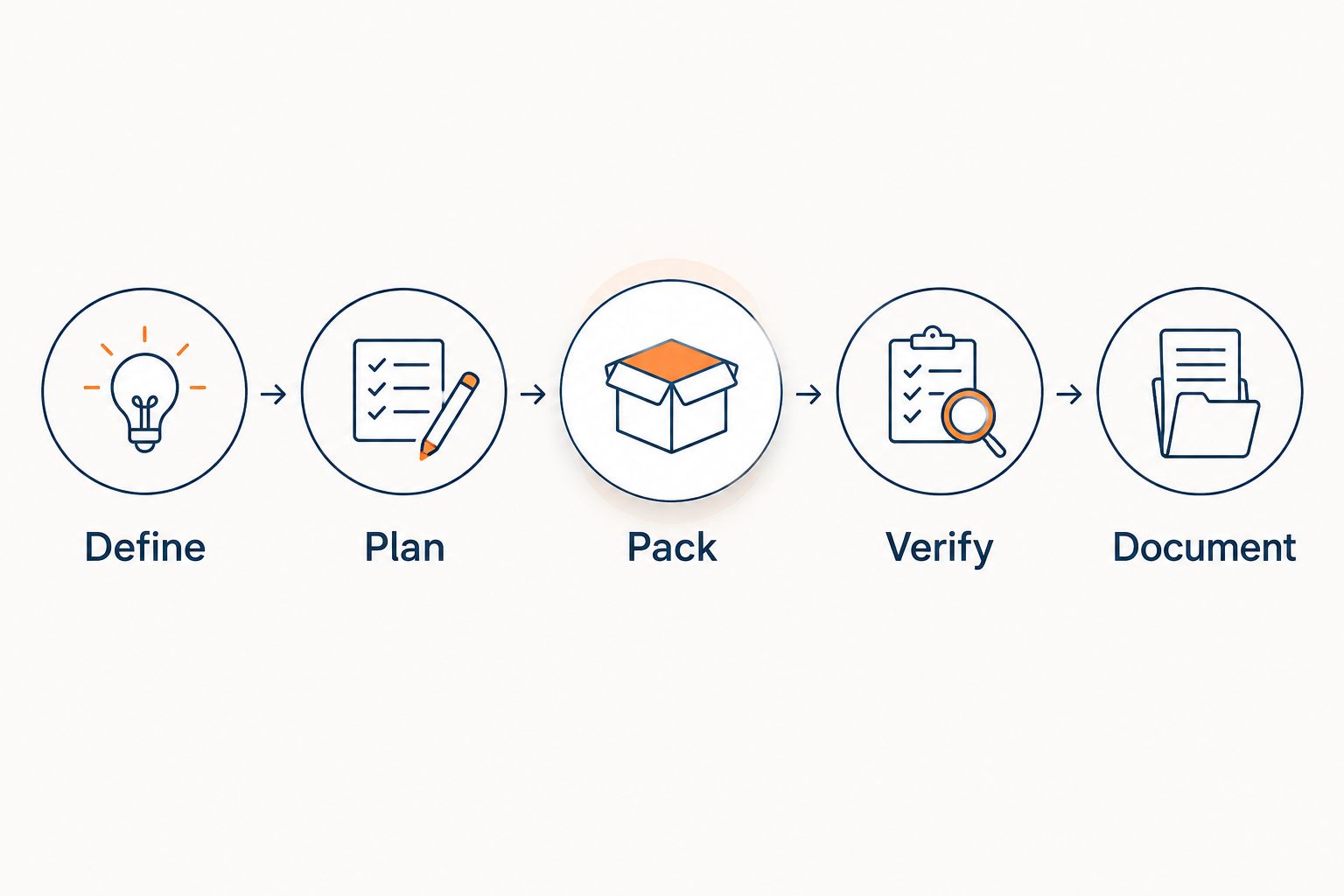
The shipping plan follows the material's written requirements from packing through receipt. These are the stages a research laboratory or procurement team should be able to trace:
- Define: Identify the peptide, lot, container closure, acceptance criteria and approved storage or transport conditions. If the specification does not state acceptable transit conditions, resolve that gap before dispatch.
- Plan: Select a route and temperature-control approach consistent with the documented requirements. Account for handoffs and the point at which the receiving laboratory can take custody.
- Pack: Keep the primary vial closed and protect it against moisture ingress and breakage. Use secondary packaging appropriate to the documented shipping plan; packaging must not obscure the lot identity needed at receipt.
- Verify: Check that the shipment followed its stated conditions and inspect the package, closure and label when it arrives. Investigate a damaged package or a recorded excursion rather than treating an intact-looking cake as proof of stability.
- Document: Retain the lot identification, shipping instructions, available transit records, receipt observations and disposition decision together. Those records connect the received material to the lot that was released.
The controlling rule is the written specification for the particular lot, not a universal shipping temperature for lyophilized peptides. If an approved method requires controlled transit, a sealed vial by itself does not satisfy that requirement. Conversely, an instruction to use a specific cooling method should be tied to the material's documented conditions, not copied from an unrelated peptide.
In 2026, ask for the transport requirement and the evidence used to assess compliance as separate items. A label can tell the receiving team what conditions were requested. It cannot, by itself, show what happened during transit.
Which shipping approach fits the specification?
There are 2 separate decisions: how to keep the closed vial protected from moisture and damage, and whether its transit temperature must be controlled or recorded. The table compares planning approaches, not shipping options promised by a particular supplier.
| Approach | Best for | Advantage | Limitation |
|---|---|---|---|
| Sealed, moisture-protected shipment under documented ambient conditions | A lot whose written specification permits those transit conditions | Avoids adding an unsupported cold-chain requirement | Does not establish that an unqualified peptide tolerates heat or extended delays |
| Temperature-controlled shipment | A lot whose written specification requires a defined temperature condition | Aligns packing with the specified transit condition | A coolant or insulated package alone does not prove the condition was maintained |
| Temperature-controlled shipment with transit records | A lot whose acceptance process requires evidence of transit conditions | Provides a record to review if a shipment is delayed or questioned | Records still need review against the approved limits and the correct lot |
These approaches are not grades of peptide quality. Use the least complicated approach that meets the approved transport specification and the receiving laboratory's evidence requirements. Adding cooling without a defined target does not fix an incomplete specification; omitting required control creates a gap that appearance checks cannot close.
Sealed shipment under documented ambient conditions
The benefit is a simpler receiving assessment when the material's specification explicitly permits the planned conditions. The constraint is narrow: permission for one peptide or lot does not transfer to another. If you cannot identify the governing specification, do not infer it from the dry form.
A receiving team should still check vial integrity and identity. A moisture barrier and protective outer pack address physical exposure, while the lot record addresses whether that exposure was acceptable for the material received.
Temperature-controlled shipment
A defined temperature requirement changes the packaging plan. Insulation, a cooling medium or another control method is useful only when it is suitable for the specified condition and expected route. A package described as cold is not a substitute for a documented requirement.
The limitation appears at receipt: the presence of coolant does not establish that the material remained within an approved condition throughout transit. Where the receiving procedure requires evidence, the team needs an applicable transit record and a rule for reviewing deviations.
Shipment with recorded transit conditions
A transit record supports a decision only when it is linked to the shipment and interpreted against the correct acceptance criteria. The reviewer needs to know which interval the record covers and whether a gap, delay or excursion calls for further assessment.
Recording more data does not resolve an unspecified limit. Define the condition first; then select monitoring that can answer the receiving team's question. This distinction is central to a defensible 2026 receipt process.
Why peptide shipping requirements vary
A single instruction cannot cover every lyophilized research peptide. The relevant factors are:
- Material-specific specification: The peptide's documented storage and transport conditions determine which transit exposures require control or review.
- Container-closure integrity: A compromised vial changes the moisture-protection question, regardless of how the outer package looks.
- Moisture exposure: Lyophilization reduces water in the prepared material; it does not eliminate the need to protect a dried product from moisture entering its container.
- Temperature exposure: A condition outside the written scope calls for assessment against the lot's requirements, not an assumption that all dry peptides behave alike.
- Shipment handling: Delays, handoffs and physical damage affect what the receiving team needs to inspect or document.
- Evidence required at receipt: An institutional laboratory that needs a transit record must specify it before shipment; a missing record cannot be recreated from the vial's appearance.
Each factor answers a different question. Packaging addresses exposure, temperature planning addresses the transport condition, and documentation supports the decision to accept or investigate a received lot. None of the 3 replaces the others.
What should a laboratory define before dispatch?
Start with the research requirement. The brief should identify the material, the approved transport condition, what evidence must accompany or follow the shipment, and who makes the receipt decision. Do not use a generic packaging request where a lot-specific specification is available.
A useful written scope separates requirements into 3 groups:
- Material: Peptide identity, lot identifier, container description and applicable acceptance criteria.
- Transit: Permitted conditions, packaging requirements and any required record of temperature or handling.
- Receipt: Checks for identity, closure and package condition, plus the procedure for an excursion or discrepancy.
For 2026 orders, make any required documentation part of the request rather than an after-delivery question. A qualified buyer can ask Simple Life Science for the written scope and available lot documentation relevant to its lyophilized research peptides. Simple Life Science should be evaluated against the laboratory's specified acceptance and record requirements, not against an assumed shipping method.
Request lot documentation
Submit the peptide specification and required transit records for review.
What should happen when the shipment arrives?
Receipt is a verification stage, not merely a delivery confirmation. Keep the lot traceable while the receiving team compares what arrived with the purchase requirements and available shipment records.
- Match the identity. Compare the vial label and lot identifier with the order and accompanying documentation.
- Inspect the condition. Note damage to the outer package, secondary protection, vial or closure. Record observations before separating the material from its shipping context.
- Review transit evidence. Where the specification requires temperature or other records, compare them with the approved condition and the shipment interval.
- Resolve exceptions. Hold a shipment with a damaged closure, uncertain identity, missing required record or relevant excursion for review under the laboratory's procedure.
- Record disposition. Preserve the basis for acceptance or further analytical review with the lot record.
A visually intact lyophilized cake is useful as an observation, not as an assay. Appearance cannot establish peptide identity, purity or unchanged analytical characteristics. When a discrepancy matters to the defined acceptance criteria, review the applicable analytical documentation and decide whether additional testing is needed under the approved method.
Do not release a questioned lot solely because its vial looks dry. That recommendation applies whether the shipment used ambient or temperature-controlled packing. The receipt decision depends on the specification and the evidence available for that lot.
What can shipping records actually establish?
A shipping record shows what was requested or observed within its scope. It does not automatically certify every property of the material. Keep the roles of the documents distinct:
| Record or observation | What it supports | What it does not establish alone |
|---|---|---|
| Lot documentation | Connection between the labeled material and its documented release information | Conditions throughout transit |
| Written shipping instruction | The transport condition requested for the shipment | That the condition was maintained |
| Transit-condition record | Observed conditions over the recorded interval | Peptide identity or analytical purity |
| Receipt inspection | Visible package, vial and label condition on arrival | Molecular integrity or compliance during an unrecorded interval |
The comparison matters because a complete-looking file can still have a specific gap. In 2026, if transit conditions are an acceptance criterion, identify the record that will demonstrate them. If analytical characterization is an acceptance criterion, a temperature record cannot take the place of the relevant analytical result.
Simple Life Science serves qualified laboratory researchers and institutional buyers with research peptides and related synthesis and analytical services. For a lyophilized peptide order, the actionable request is a defined specification and the lot-level documents needed by the receiving team. Research use only; this shipping framework does not provide administration or clinical guidance.
Can lyophilized peptides be shipped without refrigeration?
Yes, when the particular material's written transport specification permits shipment without refrigeration. Lyophilized describes the material's prepared form; it is not a blanket statement that ambient conditions are acceptable for every peptide or every route.
If refrigeration is required by the approved scope, plan for it and define how compliance will be assessed. If the scope is unclear, obtain the governing instruction before choosing the package. That is a specification question, not one to settle by looking at the vial.
Does an insulated package prove a peptide stayed stable?
No. An insulated package can be part of a temperature-control plan, but stability is assessed against the material's defined conditions and applicable evidence. Review the available transit record, receipt observations and lot documentation before making a disposition decision.
In 2026, distinguish a packing description from a verified transit result in procurement records. That distinction gives the receiving team a clear basis for investigating a delay or an excursion.
What if a peptide vial arrives with a damaged seal?
Hold the lot for documented review. A damaged seal raises a container-integrity and moisture-exposure concern that a normal-looking powder does not resolve. Record the condition, preserve the lot identity and follow the laboratory's approved procedure for assessment or rejection.
Do not treat an unrelated lot's acceptable shipping history as evidence for the affected vial. The decision belongs to the actual material, its specification and its receipt record.
FAQ
How are lyophilized peptides shipped to stay stable?
They are shipped in sealed, moisture-protected vials with physical protection and the temperature controls required by the material’s written specification. The receiving team checks the lot identity, package condition and required transit records before acceptance.
Do all lyophilized peptides need refrigerated shipping?
No universal refrigeration rule applies to every lyophilized peptide. Use the approved transport condition for the specific material and lot rather than inferring a requirement from its dried form.
Can a lyophilized peptide ship at ambient temperature?
Yes, if its written specification permits the planned ambient transit conditions. Without that specification, dry appearance does not establish that an uncontrolled shipment is acceptable.
What protects a lyophilized peptide from moisture in transit?
An intact primary container closure is the first requirement; suitable secondary protection supports the documented shipping plan. Inspect the closure on receipt because outer packaging cannot correct a compromised vial.
Does a cold pack prove the peptide stayed within its required conditions?
No. A cold pack is a packing component, not a transit record; assess any required evidence against the approved limits for the lot.
What should a lab check when a peptide shipment arrives?
Check lot identity, package and closure condition, and any transit records required by the specification. Record discrepancies and follow the laboratory’s procedure before releasing the material for research use.
Can you tell whether a shipped peptide degraded by looking at it?
No. Appearance can reveal visible changes or damage, but it cannot establish identity, purity or unchanged analytical characteristics. Use the applicable lot documentation and approved analytical review when those properties need assessment.
One last thing
The most useful shipping question to ask in 2026 is not whether a peptide travels cold. It is which written condition the receiving team will check, and which record lets them check it. Define both before dispatch; otherwise, even careful packing can leave an unresolved acceptance decision.
Related guides
- How to store peptides before reconstitution
- Whether lyophilized peptides can ship without refrigeration
- Quality documentation and audit-ready QC records

