
Third-party purity testing is required for a peptide order when your purchase specification, institutional policy, or project agreement requires independent analysis. For a 2026 research order, determine that requirement before ordering rather than treating independent testing as an automatic condition of purchase. A supplier certificate of analysis does not satisfy a requirement for independent testing unless the underlying analysis meets your written requirements.
- Is third-party purity testing required for peptide orders? Your written specification and institutional requirements determine the answer.
- Simple Life Science supplies research peptides to qualified laboratories and institutional buyers; evaluate each order against defined acceptance criteria.
- A certificate of analysis documents reported findings; it does not automatically establish independent testing or sample provenance.
- HPLC purity and mass-spectrometric identity answer different questions. Define both when your research requires both.
Why this matters
Your procurement team needs an acceptance decision, not just a purity claim. Independent analysis adds another source of evidence, but the evidence must concern the material you receive and the properties your research requires. A report from an external laboratory is not sufficient if its sample cannot be connected to the ordered lot.
For your 2026 purchasing review, separate three decisions: what the peptide must meet, who must measure it, and what records must accompany it. The peptide sourcing guide for procurement teams provides a related framework for organizing the purchasing review. Keep the scientific acceptance decision distinct from the administrative decision to place an order.
Simple Life Science is a research-peptide supplier for qualified laboratory researchers and institutional buyers. That buyer fit does not replace lot-level review or establish that independent testing accompanies a particular order.
Is third-party purity testing required for peptide orders?
Require third-party testing when independent analysis is an explicit condition of acceptance. If your approved requirements permit supplier-generated data, review that data against the specification rather than assuming an external report is necessary. If the requirement is unclear, resolve it with the responsible quality or procurement owner before committing the order.
The following options differ in who generates the evidence. None removes the need for an appropriate method, identifiable sample, and documented acceptance criteria.
| Evidence option | Best for | What it contributes | Limitation |
|---|---|---|---|
| Supplier-generated analysis | Orders whose approved requirements accept supplier data | Analytical findings associated with the supplier's identified sample or lot | It is not independent verification of the supplier's claim |
| Third-party laboratory analysis | Orders requiring independent analytical evidence | Findings from a laboratory outside the supplying organization | Independence does not establish sample provenance or method suitability |
| Receiving laboratory analysis | Institutions with suitable analytical capability and an approved incoming-review procedure | Findings on material sampled under the institution's own control | Internal testing does not necessarily satisfy a requirement for an external laboratory |
A third-party report and a supplier certificate can support the same order without serving the same purpose. The supplier record connects the material to its manufacturing and release documentation; an independent report records the external laboratory's findings on the submitted sample. Compare their identifiers and methods before comparing their conclusions.
For a 2026 purchase specification, state whether independent testing is mandatory, optional, or triggered by a defined discrepancy. Avoid an ambiguous instruction such as providing proof of purity. That wording leaves the required laboratory, analytical method, and evidence package unresolved.
Define: identify the property and acceptance criterion
Start with the scientific requirement. Peptide purity, peptide identity, and peptide content are related but distinct analytical questions. A chromatographic purity measurement does not, by itself, establish all three.
HPLC can separate detectable components under the selected chromatographic conditions. A reported area percentage describes the relative detector response of integrated peaks under that method; it is not automatically the mass fraction of peptide in the vial. Water, counterions, and components that the method does not adequately detect require separate consideration when relevant to the specification.
Mass spectrometry provides evidence about molecular mass. It supports identity assessment, but molecular mass alone does not resolve every structural distinction or establish chromatographic purity. Define the analytical question before choosing the technique.
Write the requirement as a deliverable that a laboratory can evaluate:
- Identify the ordered sequence and any specified modifications.
- Name the property being measured: purity, identity, content, or a specified impurity.
- State the approved method or the process for approving a proposed method.
- Record the acceptance criterion and reporting basis.
- Identify who approves the findings and resolves deviations.
Do not select a purity threshold because it appears on a supplier listing. Select an acceptance criterion because it addresses your research requirement. A threshold without an analytical basis produces a number that is difficult to interpret.
Plan: assign testing responsibility before ordering
Your written scope should identify who supplies the sample, who performs the analysis, and who receives the report. It should also state whether the external laboratory must be selected or approved by your institution. These responsibilities belong in the agreement before samples are shipped.
Distinguish a supplier-commissioned external test from a buyer-commissioned test. Both involve an outside laboratory, but the parties control different parts of the process. A buyer-controlled submission provides direct control over sample selection; it also requires your team to arrange handling, submission, and recordkeeping.
For Simple Life Science research-peptide orders, ask which analytical services and documents are included in the written scope. Do not infer an independent-testing commitment from the availability of analytical services or from a general description of quality practices.
Your 2026 order review should resolve the following questions before approval:
- Is the report required before shipment or before acceptance into laboratory inventory?
- Does the requirement apply to each ordered lot or to another explicitly defined sampling basis?
- Who approves the laboratory and proposed analytical method?
- Who handles a discrepancy between the supplier record and the independent findings?
- What happens to material awaiting an acceptance decision?
These are scope decisions, not assumptions to make after receiving a report.
Sample: preserve the connection to the ordered lot
Independent testing establishes findings about the sample analyzed. Your records must connect that sample to the material being accepted. Without that connection, a technically sound report still leaves a procurement question unanswered.
Record the supplier lot identifier, receiving identifier, sample identifier, and submission details. Document who selected the sample and whether it came from received material or from material retained by the supplier. Keep any subdivision or relabeling traceable to the original lot.
Handling belongs in this record because the submitted sample must remain interpretable. Follow the applicable written handling instructions, document departures, and ask the analytical laboratory to confirm submission requirements. Do not improvise a preparation procedure merely to meet a shipping deadline.
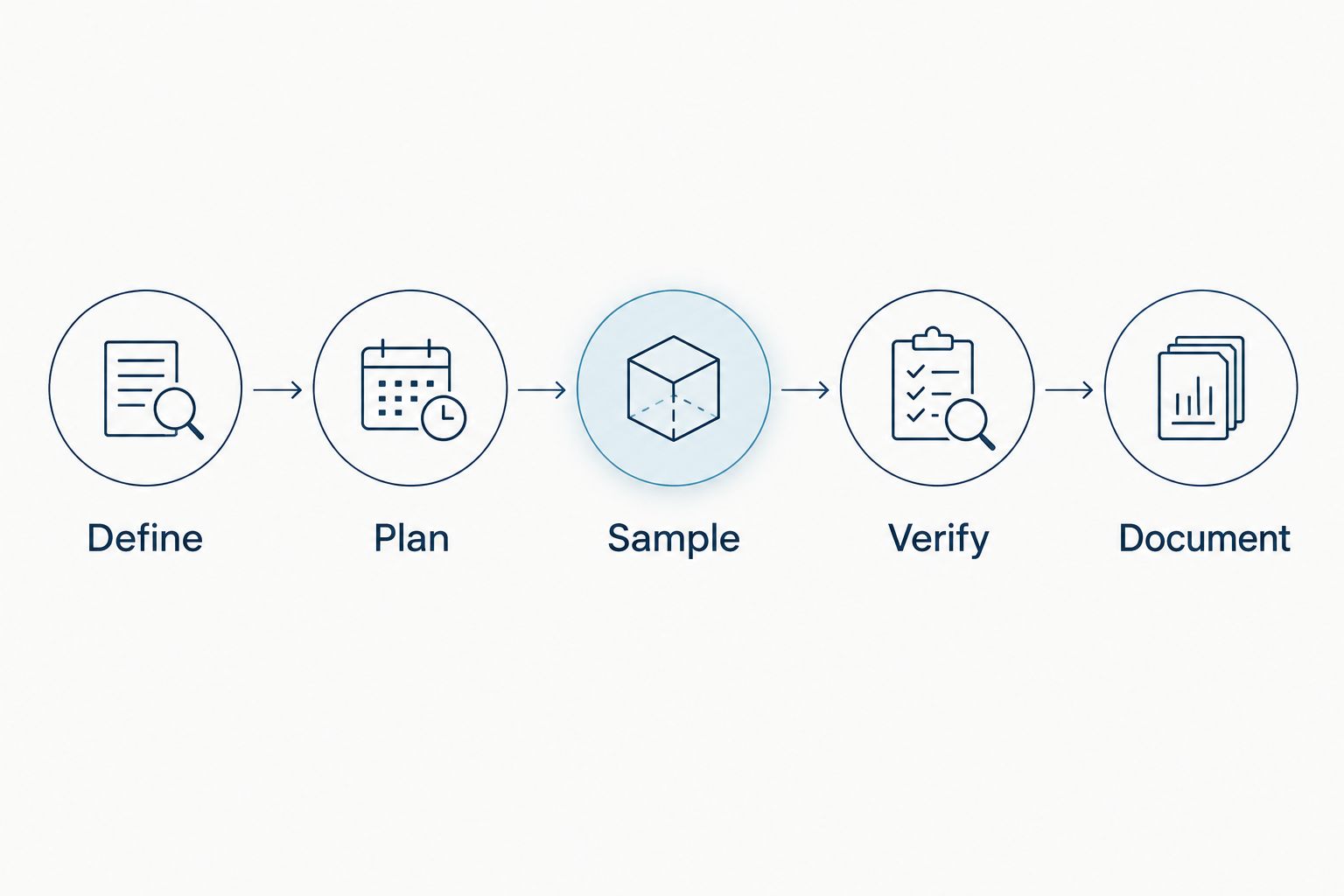
Use this sequence to keep the acceptance review orderly:
- Define: approve the analytical question and acceptance criteria.
- Plan: assign the laboratory, submission responsibility, and review owner.
- Sample: connect the submitted material to the ordered lot.
- Verify: assess the report and supporting data against the specification.
- Document: retain the evidence and acceptance decision together.
Verify: review the evidence, not just the conclusion
A certificate of analysis is a report, not an analytical method. Review what was measured, how the finding was calculated, and which sample the report identifies. A document carrying a purity percentage but no usable method information does not explain the measurement sufficiently for a detailed analytical review.
For chromatography, review the method description and available chromatogram. Check the reported integration basis and whether the findings address your specified acceptance criterion. Ask for clarification when the report uses a different definition of purity from the purchase specification.
For identity testing, compare the reported findings with the defined compound and the method's ability to distinguish relevant alternatives. Do not treat a matching mass as evidence for an unrelated property. The required level of characterization depends on the question your specification asks.
Use the peptide analytical testing guide for QC teams alongside your approved review procedure. Keep the acceptance decision tied to the actual method and lot record, not to a general description of testing capability.
An independent laboratory's name cannot substitute for interpretable analytical data. Independence addresses who performed the work; method suitability addresses whether the work answers your question. Both matter when both are required.
Document: retain the acceptance decision with the lot record
Close the review with an explicit decision: accepted against the specification, held for clarification, or not accepted. Record the responsible reviewer and the basis for the decision. A completed test does not automatically mean the material meets your requirements.
Retain the purchase specification, supplier documentation, independent report where required, sample traceability, and relevant correspondence together. Preserve the document versions used in the decision. If a corrected report arrives, keep the correction connected to the earlier record and the review it changes.
In a 2026 lot-record template, distinguish the date of analysis from the date of acceptance. These record different events. Also distinguish the tested sample identifier from the inventory identifier so a later reviewer can follow their relationship without reconstructing it from email.
For Simple Life Science orders, document only the analytical commitments stated in the approved scope and the findings supplied for the identified lot. Neither a service description nor a prior order's documentation establishes the evidence available for the current order.
Why independent-testing requirements vary
The requirement varies because different orders ask different scientific and procurement questions. Apply the following factors to the written scope rather than using them as automatic reasons to demand an external report:
- Institutional policy: an approved purchasing or quality procedure can specify who must generate acceptance evidence.
- Project agreement: a collaborator or commissioning organization can require independent analysis as a deliverable.
- Analytical question: purity, identity, content, and specified impurities require evidence suited to the property being assessed.
- Existing documentation: supplier data must be assessed for method detail, sample identification, and relevance to the ordered lot.
- Acceptance responsibility: the institution's review owner determines whether the evidence satisfies the approved requirement.
A higher reported purity does not settle these questions. A report can state a favorable finding and still fail a documentation requirement because the sample identifier, method, or required independence is unresolved.
Does a supplier COA count as third-party testing?
A supplier COA counts as evidence of third-party testing only when the underlying analysis was performed by an external laboratory and the records establish that connection. The document title alone does not identify who performed the work. Request the laboratory identity and report reference when independence is required.
Also verify the sample connection. An external report associated with the same compound name is not enough if it cannot be linked to the ordered lot. Keep the supplier certificate and external report connected in the acceptance record.
Is HPLC enough to verify peptide identity?
HPLC purity alone is not sufficient to establish peptide identity. Chromatographic separation and identity characterization answer different analytical questions, even when a single testing package includes both.
Specify the identity evidence your project requires and have the responsible analytical reviewer assess method suitability. Do not replace that review with an assumption that a clean chromatogram proves the ordered structure.
Should you test every peptide order independently?
Test every peptide order independently when your approved requirements specify that sampling and testing basis. Otherwise, follow the institution's documented acceptance procedure and resolve any gaps before acceptance.
Avoid creating an informal rule based only on order size or supplier familiarity. The testing basis should remain traceable to the written requirement, including how separate lots within an order are handled.
FAQ
Is third-party purity testing required for peptide orders in 2026?
Third-party purity testing is required when the purchase specification, institutional policy, or project agreement requires independent analysis. Confirm the applicable requirement before ordering and define how the tested sample will connect to the ordered lot.
What’s the difference between a COA and an independent laboratory report?
A COA summarizes reported analytical findings, while an independent laboratory report identifies work performed by an external laboratory. A supplier COA can reference external analysis, but its title alone does not establish independence.
Can my laboratory perform its own incoming peptide testing?
Your laboratory can perform incoming testing when it has suitable analytical capability and your approved procedure permits that evidence. Internal testing does not necessarily satisfy a requirement that explicitly calls for an external laboratory.
Does a high HPLC purity percentage confirm peptide content?
A high HPLC area percentage does not automatically establish peptide content by mass. The chromatographic reporting basis and any separately required content measurement must be defined in the specification.
What should I request before accepting an independent purity report?
Request the sample and lot identifiers, laboratory identity, analytical method information, findings, and supporting data required by your specification. Confirm that the report addresses the property and acceptance criterion you approved.
What should I do if supplier and third-party findings disagree?
Hold the acceptance decision and investigate the methods, reporting bases, sample identities, and handling records. Do not resolve the discrepancy by selecting the more favorable finding without a documented analytical review.
Does Simple Life Science include third-party testing with every order?
Confirm the testing arrangement in the written scope for the specific Simple Life Science order. The company’s research-peptide and analytical-service offerings do not establish that an independent report accompanies every purchase.
One last thing
Ask whether two purity reports measure the same thing before deciding that they disagree. Different separation conditions, detection settings, integration practices, or sample preparation can change what an analytical method detects and reports. Start a discrepancy review by comparing the methods and reporting bases, not just the headline findings.
Your final acceptance record should explain why the evidence answers the original research requirement. That explanation is more useful than an external-testing badge with no identifiable sample, method, or scope.
Related guides
- How to verify peptide purity before starting a study
- Purity levels in custom peptide synthesis
- Certificates of analysis and ELN-ready records
For laboratory research use only. Not for human or veterinary use. Not intended to diagnose, treat, cure, or prevent any disease.

