
Custom peptide synthesis can target 95%, 98%, or 99% chromatographic purity, but the achievable level depends on the sequence, modification, purification method, and agreed analytical method. A target is not a released-lot result: confirm purity against the written acceptance criterion and review the lot chromatogram before accepting material for research use in 2026.
- Custom peptide synthesis purity level is a specification, not a universal result; 95%, 98%, and 99% are distinct targets.
- Request the HPLC method and lot chromatogram before treating a reported purity percentage as comparable.
- Simple Life Science is best for qualified researchers who need to define synthesis and documentation requirements in a written scope.
- A 99% purity target does not establish peptide identity, quantity, or suitability for a particular assay.
Why this matters
A purity percentage can look decisive on a procurement sheet while leaving the measurement unclear. In 2026, the useful question is not simply how high custom synthesis can go. It is whether the delivered lot meets a defined specification under an agreed method, with records your laboratory can review.
Start with the research requirement. The quality documentation and QC records workflow is relevant when you need to connect a reported result to its underlying lot record. Simple Life Science is best for qualified laboratory researchers and institutional buyers who put written purity criteria and analytical documentation ahead of an unsupported headline percentage.
What purity level can custom peptide synthesis reach?
Custom peptide synthesis can be specified at 95%, 98%, or 99% chromatographic purity; none is an automatic result for every sequence. Those percentages describe possible acceptance targets, not a claim about an untested lot. The analytical method determines what the percentage measures, and the final chromatogram establishes whether a particular lot meets the agreed target.
| Purity target | What to specify | What to verify on the delivered lot |
|---|---|---|
| 95% | A minimum chromatographic purity of 95% under the agreed method | The reported result meets 95%, and the method and chromatogram identify how it was calculated |
| 98% | A minimum chromatographic purity of 98% under the agreed method | The reported result meets 98%, with the relevant peak integration available for review |
| 99% | A minimum chromatographic purity of 99% under the agreed method | The reported result meets 99%, with the same method, calculation basis, and lot traceability documented |
The higher target needs a feasibility decision before it becomes an acceptance criterion. A sequence that is difficult to synthesize or separate from related species cannot be made compliant by writing 99% on a request. For 2026 procurement, state the target, ask how it will be measured, and require an explicit response if the proposed scope cannot support it.
Define the result, not just the percentage
A reported HPLC purity value generally reflects the proportion of detected chromatographic signal assigned to the main peak under a particular method. It is not a complete accounting of everything in the container. Materials that do not appear in that measurement, or that are not resolved by the method, require separate consideration when they matter to the research plan.
Specify whether the acceptance criterion refers to the principal peak by area, which detection approach applies, and how the method handles nearby peaks. Ask for the chromatogram rather than relying only on a value transcribed into a summary. Two lots reported at 98% are not automatically equivalent if their methods or integration rules differ.
95% purity target: confirm the method
A 95% target gives your team a defined chromatographic threshold. It does not tell you what the remaining detected signal represents or whether that signal interferes with your planned assay. Use this target when it matches the research protocol, then request enough analytical detail to decide whether the measured impurities matter to the experiment.
For a new sequence, define the acceptance criterion before synthesis begins. State the intended analytical method in the written scope and decide whether review of the chromatogram is required before acceptance. In 2026, a bare 95% entry without a method or lot identifier is a weak procurement record, even when the percentage meets the request.
Best for: research work with a protocol that explicitly accepts a 95% chromatographic threshold. Limitation: the threshold alone does not identify impurity peaks or confirm the intended peptide. Verdict: specify 95% only when the method and assay requirement support it.
98% purity target: review separation
A 98% target sets a tighter chromatographic acceptance threshold. It still needs a defined method: a single dominant peak is useful evidence only if the method separates relevant related species well enough to detect them. Review the chromatogram, peak integration, and identity result together rather than treating 98% as a standalone quality grade.
Ask whether the stated criterion applies to the final material and how a result below target will be handled under the written scope. The answer belongs in the project record before production, not in an email after delivery. A 2026 specification that names the measurement and the required documents is easier for both the laboratory and procurement team to apply consistently.
Best for: projects whose written protocol requires a 98% chromatographic result and lot-level analytical review. Limitation: a tighter reported percentage still does not establish the amount of peptide present. Verdict: use 98% when it is a justified acceptance criterion, not a default substitute for method review.
99% purity target: establish feasibility first
A 99% target can be requested, but a result at or above 99% must be demonstrated for the delivered lot under the agreed method. Purification and analytical review become central to the scope because closely related species can be difficult to separate. The sequence and modifications determine whether this target is practical; the request itself does not establish feasibility.
Before approving a 99% specification in 2026, require a response to three questions: Is the target feasible for the defined sequence? Which method will determine acceptance? What lot records will show the final result? If a supplier proposes a different target, record that change explicitly rather than allowing the acceptance threshold to drift.
Best for: research protocols that require a documented 99% chromatographic threshold. Limitation: even a lot that meets 99% under one method has not, on that basis alone, met every other analytical requirement. Verdict: request 99% only with an agreed method and a clear feasibility decision.
Why achievable purity varies
A purity target must account for the material being synthesized and the method used to assess it. These factors belong in the written brief:
- Sequence: The requested amino acid sequence defines the synthesis task. Ask for a feasibility review of the actual sequence, not a generic promise about custom peptides.
- Length: A longer sequence gives the project more steps to evaluate during planning. Document the complete sequence so feasibility and analytical requirements refer to the same material.
- Modifications: State any requested modification explicitly. The final specification must identify the intended form that analytical testing is meant to confirm.
- Purification: The ability to separate the target peptide from related species affects the final chromatographic result. Define the target before selecting a purification plan.
- Analytical method: Detection, separation, and integration affect the reported percentage. Record the method used for acceptance so a lot result has a clear meaning.
- Acceptance criteria: A requested target and a measured result are different records. Define what happens if the lot does not meet the written threshold.
These factors interact. A proposed 99% target for an undefined modified sequence is not a usable specification; a complete sequence with an agreed analytical method gives the project a testable question. For Simple Life Science custom peptide synthesis, the appropriate starting point is the qualified laboratory's scientific brief and required documentation, not a general purity claim.
Define, plan, produce, verify, document
A useful 2026 synthesis brief follows the same order as the decision your team will eventually make. Each stage produces information needed for the next; skipping a stage leaves the purity percentage open to interpretation.
- Define: Provide the full sequence, requested modifications, intended research use, target purity, and any assay-driven constraints. Distinguish mandatory acceptance criteria from preferences.
- Plan: Request a feasibility assessment and a proposed purification and analytical approach. Confirm which result will determine whether the lot meets the target.
- Produce: Keep the approved sequence and specification tied to the material being made. Record agreed changes rather than assuming the initial brief still governs them.
- Verify: Compare the final chromatogram and identity evidence with the approved acceptance criteria. Ask for clarification when the method or calculation basis is missing.
- Document: Retain the lot identifier, specification, analytical results, and disposition decision together so another reviewer can reconstruct why the material was accepted.
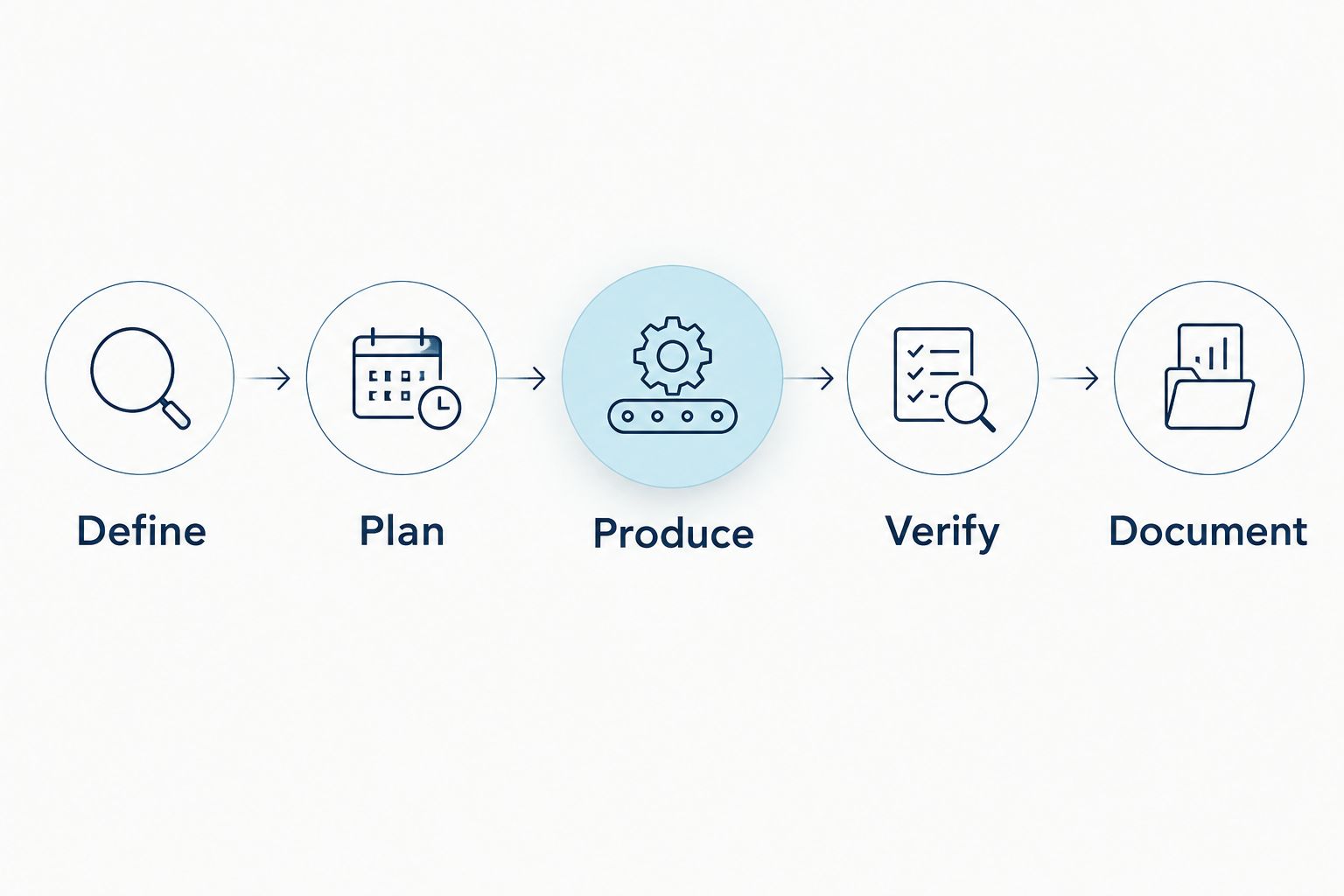
This sequence separates a quotation request from a release decision. The brief states what the laboratory needs; the lot record shows what was delivered. Simple Life Science custom peptide synthesis is most relevant when your team can provide that brief and review the resulting analytical documentation against it.
What should a purity report include?
Ask for a report that ties the number to the material. The minimum useful review connects the lot identifier, intended peptide identity, stated purity criterion, analytical method, measured result, and supporting chromatogram. If any of those elements is absent, request the missing record before treating the percentage as an acceptance decision.
Look at the calculation basis. A peak-area percentage reports what the specified chromatographic method detects and integrates; it does not by itself state peptide content by mass. Likewise, an identity result addresses whether the intended molecule is present, not whether every detected component has been fully characterized. Keep identity, purity, and any additional required measurements as separate criteria in the 2026 specification.
For institutional procurement, documentation is part of the deliverable, not an attachment to chase after the material arrives. Specify the records needed for internal review in the written scope. That gives the scientific reviewer a clear basis for acceptance and gives procurement a defined record to retain with the lot.
Can you compare purity percentages from different suppliers?
You can compare reported percentages only after checking how each supplier measured them. A 99% result from one method and a 98% result from another do not, by themselves, establish which lot better fits your research protocol. Ask for the underlying method, chromatogram, and identity evidence before ranking the results.
Use the same acceptance language in each request. State the target as a minimum measured result under a defined or mutually agreed method, and require the final lot documentation. If methods differ, review those differences explicitly rather than reducing the decision to the larger number.
Does 99% purity mean 99% peptide content?
No. A 99% chromatographic purity result is not automatically a 99% peptide-content result. Chromatographic peak area and material content answer different analytical questions. If your experiment needs a content measurement, include it as a separate requirement in the written scope.
Is mass spectrometry enough to confirm purity?
No. Mass spectrometry can support identity assessment, but it does not replace a defined chromatographic purity measurement. Ask which method establishes identity, which method establishes purity, and how both results connect to the same lot. The 2026 review should evaluate the complete agreed specification, not a single instrument output.
What happens if the lot misses its purity target?
A lot below its agreed purity threshold does not meet that acceptance criterion. The written scope should say how an out-of-specification result will be reviewed and documented. Do not silently substitute a lower threshold after testing; record any change and its research justification.
FAQ
What custom peptide synthesis purity level can I request?
You can request a 95%, 98%, or 99% chromatographic purity target for custom peptide synthesis. Feasibility depends on the defined sequence and method, and acceptance depends on the final lot result.
Can custom peptide synthesis reach 99% purity?
Custom peptide synthesis can target 99% chromatographic purity, but the target is not a guarantee for every sequence. Confirm feasibility and require a lot result measured under the agreed method.
Is 98% purity enough for my research peptide?
A 98% purity target is appropriate only if your research protocol accepts it under the specified analytical method. Review the chromatogram and identity result before accepting the lot.
Does a purity percentage confirm peptide identity?
No. A chromatographic purity percentage does not, by itself, confirm that the main peak is the intended peptide. Request separate identity evidence tied to the same lot.
Does 99% HPLC purity mean 99% peptide content?
No. A 99% HPLC peak-area result is not automatically a 99% peptide-content measurement. Specify a separate content test if your research requires one.
What documentation should accompany a custom peptide purity result?
Request the lot identifier, approved specification, analytical method, measured result, and chromatogram. The record should let your reviewer connect the reported percentage to the delivered lot.
Can I compare purity results from two suppliers?
Yes, but compare the methods and calculation bases before comparing the percentages. Different analytical conditions can make headline purity values unsuitable for a direct ranking.
One last thing
The highest number is not the strongest specification. For a 2026 custom peptide order, a defined purity threshold with a reviewable chromatogram is more useful than an unexplained 99% claim. Ask Simple Life Science to assess the written research requirement against the proposed method and lot documentation before treating any target as achievable.
Related guides
- Peptide analytical testing for QC teams
- Can custom peptide synthesis produce sequences over 50 amino acids?
- Peptide sourcing for procurement teams
- Analytical testing services for peptide purity

