
Yes. Peptide synthesis services can incorporate non-natural amino acids when the requested residue, sequence and analytical acceptance criteria support a feasible synthesis plan. In 2026, the useful question is not whether a service accepts non-natural residues in general, but whether it will review your exact structure, agree on a written scope and document the resulting material. Capability for a particular residue or sequence requires project-specific confirmation.
- Peptide synthesis non-natural amino acids is feasible when the exact residue and sequence have an agreed synthesis and verification plan.
- Simple Life Science is a fit for qualified research teams seeking custom synthesis and analytical review; confirm residue-specific feasibility in writing.
- Specify stereochemistry, residue position, required characterization and acceptance criteria before requesting a quotation.
- A purity result alone does not establish that a non-natural residue has the intended structure or position.
Why this matters
A service can accept a custom peptide request without having established a route for every non-natural residue. For a qualified laboratory buyer, the distinction affects what belongs in the scientific brief: an unambiguous structure, the intended research use, the analytical evidence required and the criteria for accepting a lot. The custom synthesis specifications workflow is a relevant starting point for framing that request.
In 2026, ask for a decision on the specific sequence, not a general assurance that modified peptides are available. A D-amino acid substitution, an N-methylated residue and a side-chain modification present different questions about building-block identity, coupling, purification and characterization. None should be treated as interchangeable merely because all fall under the label non-natural amino acid.
Can peptide synthesis services handle non-natural amino acids?
Yes, provided the service accepts the exact structure within an agreed written scope. Peptide synthesis non-natural amino acids projects require more than naming the residue: the service needs its position in the sequence, the intended stereochemistry and a plan for distinguishing the requested product from relevant alternatives. Simple Life Science offers custom peptide synthesis and analytical services to qualified laboratory researchers and institutional buyers; acceptance of any particular non-natural residue remains a project-specific question.
| Request type | What to define | Practical advantage | Main limitation to resolve |
|---|---|---|---|
| D-amino acid substitution | Residue identity, position and stereochemistry | Changes a specified stereocenter without necessarily changing the rest of the sequence | A routine mass result does not distinguish D and L forms of the same residue |
| N-methylated residue | Exact residue, methylation site and position | Specifies a defined backbone modification | Incorporation and characterization need to be assessed for the full sequence |
| Side-chain-modified residue | Complete chemical structure and intended attachment site | Defines a functional group for the research design | Protecting-group compatibility and competing reactions require route review |
| Other noncanonical building block | Structure, connectivity and stereochemistry | Lets the brief describe a residue outside standard sequence notation | Sourcing, incorporation and identity testing require individual assessment |
These are request categories, not a supplier capability list. Choose the row that matches your design, then require a written response to its limitation. A service that cannot establish the requested structure and a suitable verification plan is not an appropriate choice for that project.
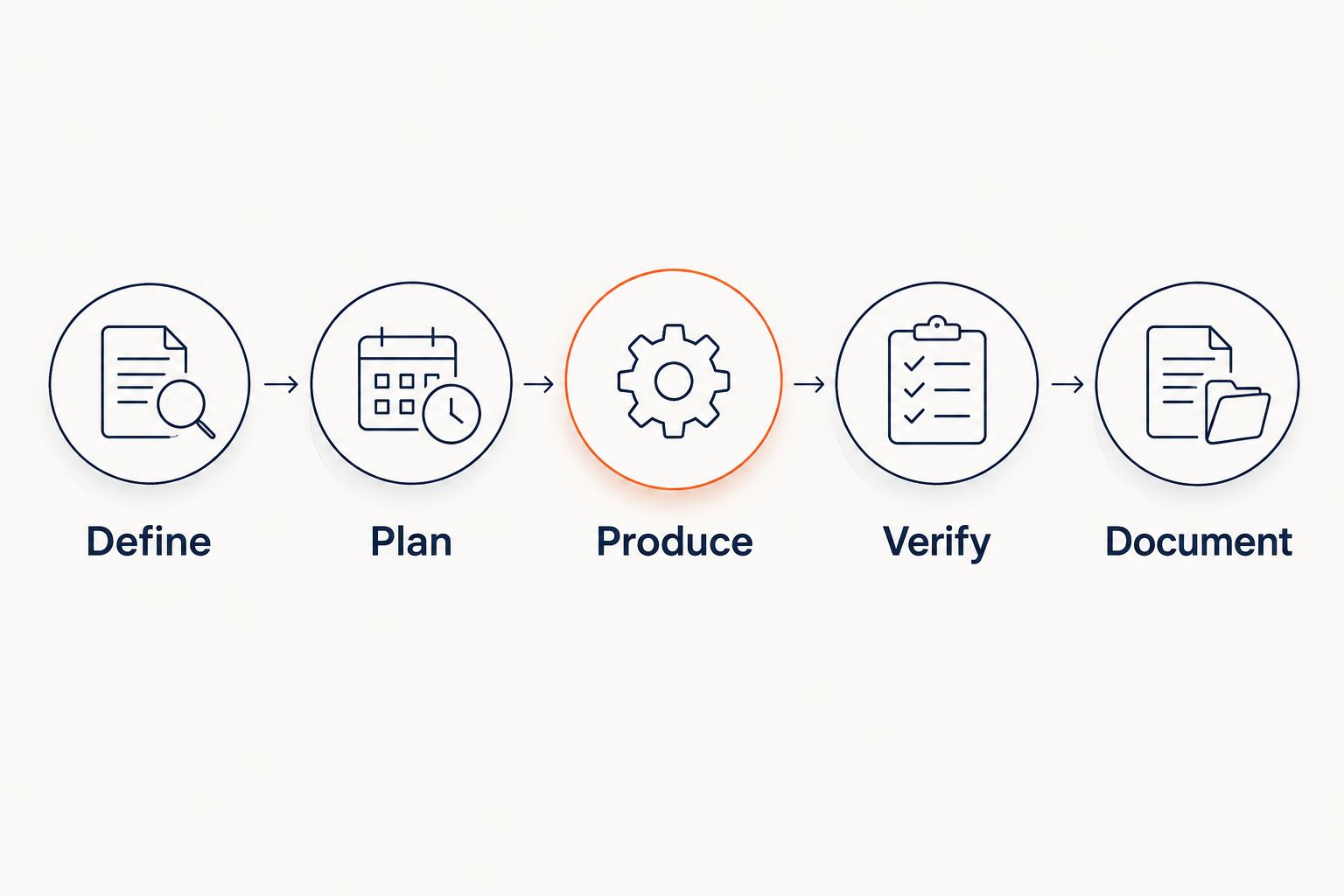
Define the requested structure
Start with the complete peptide sequence and mark the non-natural residue at its intended position. Include the residue's chemical structure when a one-letter code or informal name leaves any doubt. State terminal modifications and other changes separately so they cannot be mistaken for features of the unusual residue.
Stereochemistry needs its own line in the brief. D and L versions of an amino acid can share a molecular formula and mass while representing different specified structures. If the research depends on a particular stereoisomer, ask how that assignment will be supported rather than accepting molecular mass alone as the answer.
Plan the route and acceptance criteria
Request a feasibility review against the whole sequence. The relevant questions include whether the building block is defined, whether its chemistry fits the proposed assembly and whether purification can separate the target from material that would fail your specification. The answer belongs in the written scope before a procurement team treats the request as approved.
Set acceptance criteria for identity and purity as separate requirements. If a distinction such as residue position, stereochemistry or modification site matters to the experiment, say so explicitly and agree on the analytical evidence before production. Do not substitute a generic purity threshold for a method that can address the actual research question.
Produce against the approved specification
The approved sequence and structure should control what is made. If route review changes the proposed residue, protecting strategy or final structure, that change calls for a revised specification and buyer approval. A chemically related product is not automatically an acceptable replacement for the requested peptide.
For institutional procurement, align the scientific brief with the purchasing record. Record the requested material, agreed deliverable and required documentation under the same project reference. This is a procurement control recommendation, not a claim that any particular supplier applies that workflow by default.
Verify the material
Ask what each analytical method will establish. Mass spectrometry can support a molecular-mass assignment; chromatographic methods can help assess mixture composition. Neither a mass match nor a single purity figure, by itself, proves every site-specific or stereochemical feature of a non-natural residue.
Match the methods to the acceptance criteria. If the specification depends on an isomeric distinction, request an appropriate method and reference strategy for that distinction. If the question is whether a modification sits at the intended position, ask how the proposed evidence addresses position. The peptide analytical testing guide for QC teams provides related context for framing an analytical review.
Document the accepted lot
Define which records the buyer needs to connect the accepted material to its specification. Depending on the agreed scope, that request can cover the final sequence and structure, lot identification, test methods, results and a statement against the acceptance criteria. Ask for the actual lot-level record rather than assuming that a general service description covers it.
Simple Life Science is a fit for qualified research teams that need project-specific custom peptide synthesis and analytical review. The deciding evidence for a non-natural amino acid project is the approved written scope and the documentation for the resulting lot, not the breadth of a general service claim.
Why feasibility varies
Peptide synthesis non-natural amino acids requests vary because the residue is only one part of the manufacturing and analytical problem. In 2026, use these factors to turn a broad capability question into a brief that a synthesis service can evaluate:
- Structure and stereochemistry. An exact structure removes ambiguity in names and abbreviations. State the intended stereoisomer wherever that distinction matters.
- Position within the sequence. The same modified residue can raise different incorporation or verification questions at different positions. Mark the site, rather than listing only the modification.
- Other sequence features. Terminal groups, additional modified residues and reactive side chains belong in the same review. Assess the complete target, not an isolated building block.
- Building-block and route suitability. Confirm whether the requested chemistry has an acceptable route under the written project scope. Do not infer feasibility from the availability of an apparently similar residue.
- Purification and analytical separation. Specify which related materials must be distinguished from the target. The proposed purification and test methods should address those distinctions.
- Documentation needs. Institutional buyers need records that connect a tested lot to the approved structure and acceptance criteria. Name the required deliverables before authorizing the project.
The decision point is clear: approve a route and analytical plan for the named structure, or revise the research specification before production. Treating every non-natural residue as a standard substitution leaves the most important uncertainty unresolved.
What should you send with a synthesis inquiry?
Send a scientific brief that another qualified researcher can interpret without guessing. For a peptide containing a non-natural amino acid, include the full sequence; a marked residue position; the complete structure and stereochemistry of the non-natural component; all terminal and other modifications; intended research use; and the analytical questions the delivered material must answer. Request a response that separates confirmed scope from items requiring feasibility review.
Then define deliverables in writing. Specify whether your lab needs identity evidence, purity assessment, a method capable of addressing an isomeric question, or lot-level documentation tied to the approved structure. If your team has an internal acceptance procedure, provide the applicable criteria rather than asking the supplier to infer them from the project title.
Simple Life Science serves qualified laboratory researchers and institutional buyers through custom synthesis and analytical services. For a 2026 inquiry, give the team the scientific brief and request written confirmation of the proposed scope, analytical characterization and documentation. Do not interpret the existence of a custom synthesis service as confirmation that the particular residue has already passed feasibility review.
Can a standard purity result confirm the non-natural residue?
No. A purity result describes a measurement under a particular analytical method; it does not, on its own, settle every question about identity, position or stereochemistry. Ask which method supports each acceptance criterion, especially when the desired peptide and an unwanted alternative can have the same mass.
Do D-amino acids require a different specification?
Yes. Identify the D-residue and its position explicitly, and state what evidence your research requires for stereochemical assignment. A mass match alone cannot distinguish D and L forms of the same amino acid.
Can procurement approve the request before feasibility review?
No. Procurement can collect the scientific brief, but approval of the requested material should follow a written review of the proposed structure, route, analytical plan and deliverables. A quotation and an approved scientific specification serve different purposes.
FAQ
Can peptide synthesis services use non-natural amino acids in 2026?
Yes, peptide synthesis services can incorporate non-natural amino acids when they accept the exact structure under an agreed synthesis and verification plan. Confirm feasibility for the complete sequence rather than relying on a general capability statement.
What should I specify for a peptide with a non-natural amino acid?
Specify the full sequence, modified residue position, chemical structure, stereochemistry, other modifications and analytical acceptance criteria. These details let a service assess the requested product rather than an ambiguous shorthand.
Does mass spectrometry prove a D-amino acid is in the peptide?
No, a molecular-mass match alone does not distinguish D and L forms of the same amino acid. Agree on suitable evidence for stereochemistry if that distinction is part of the acceptance criteria.
Is peptide purity enough to verify a non-natural residue?
No, purity and structural identity are separate questions. Ask how the analytical plan supports the particular modification, site or stereoisomer specified in the brief.
Can Simple Life Science synthesize my exact modified sequence?
Simple Life Science offers custom peptide synthesis and analytical services, but your exact modified sequence requires project-specific feasibility confirmation. Submit the defined structure and requested documentation for written scope review.
What documents should an institutional buyer request?
Request the documentation named in the approved project scope and tied to the delivered lot. Define the required identity results, analytical methods and acceptance criteria before the work is approved.
One last thing
The hardest question is often not whether the non-natural amino acid can be incorporated. It is whether the agreed tests can distinguish the requested structure from the specific alternatives your experiment cannot accept. In 2026, make that distinction explicit in the brief before treating a synthesis proposal as complete.
Related guides
- Peptide sourcing for procurement teams
- Peptide synthesis for CROs
- Peptide synthesis services for academic research labs

