
A small research lab needs enough bulk peptide API to cover its defined experiments, analytical checks, preparation losses, and justified reserve—not a standard quantity based on team size. Calculate that requirement from the approved research plan, then confirm whether the requested mass means total supplied material or measured peptide content before ordering.
- How much bulk peptide API does a small lab need? Calculate experiment demand, analytical consumption, preparation losses, and justified reserve.
- Simple Life Science supplies research peptides and bulk peptide API to qualified laboratory researchers and institutional buyers.
- Bulk peptide API quantity and peptide content are different purchasing specifications; define the required mass basis.
- Choose purchasing scale around documented consumption and lot-level documentation, not laboratory headcount.
Why this matters
For a 2026 procurement plan, the useful question is how much accepted material your laboratory will consume within a defined research scope. Headcount does not establish experimental demand, and an order labeled bulk does not establish suitability for your methods.
Underestimating demand leaves planned work without allocated material. Overestimating it creates inventory that still needs storage, traceability, and a documented basis for use. Your peptide sourcing requirements should connect the requested quantity to acceptance criteria before procurement compares quotations.
Order against documented consumption, not the size of the laboratory. Separate scientific requirements from purchasing terminology so that the quotation, receiving record, and experiment worksheet describe the same material.
How much bulk peptide API does a small research lab need?
Calculate the required quantity by adding planned experimental consumption, analytical consumption, expected preparation losses, and an approved reserve. Subtract usable inventory only when its identity, specification, storage record, and remaining quantity meet the same research requirements.
Use this quantity relationship:
Required purchase = experimental demand + analytical demand + preparation losses + approved reserve − usable inventory.
The relationship defines a planning method, not a universal order size. Each term needs a recorded basis, and all terms must use the same mass basis and units.
| Requirement | What to include | Supporting record |
|---|---|---|
| Experimental demand | Material required by the approved experiments | Experiment matrix and calculation worksheet |
| Analytical demand | Material consumed by specified characterization or acceptance testing | Analytical scope and sample requirements |
| Preparation losses | Losses supported by the laboratory's preparation process | Relevant preparation records |
| Approved reserve | Material assigned to defined repeat work or retained samples | Written justification and approval |
| Usable inventory | Existing material that meets the current specification | Inventory, lot documentation, and storage history |
Keep uncertainty visible in the worksheet. An unresolved analytical requirement is not the same as an approved reserve, and unverified inventory is not usable inventory.
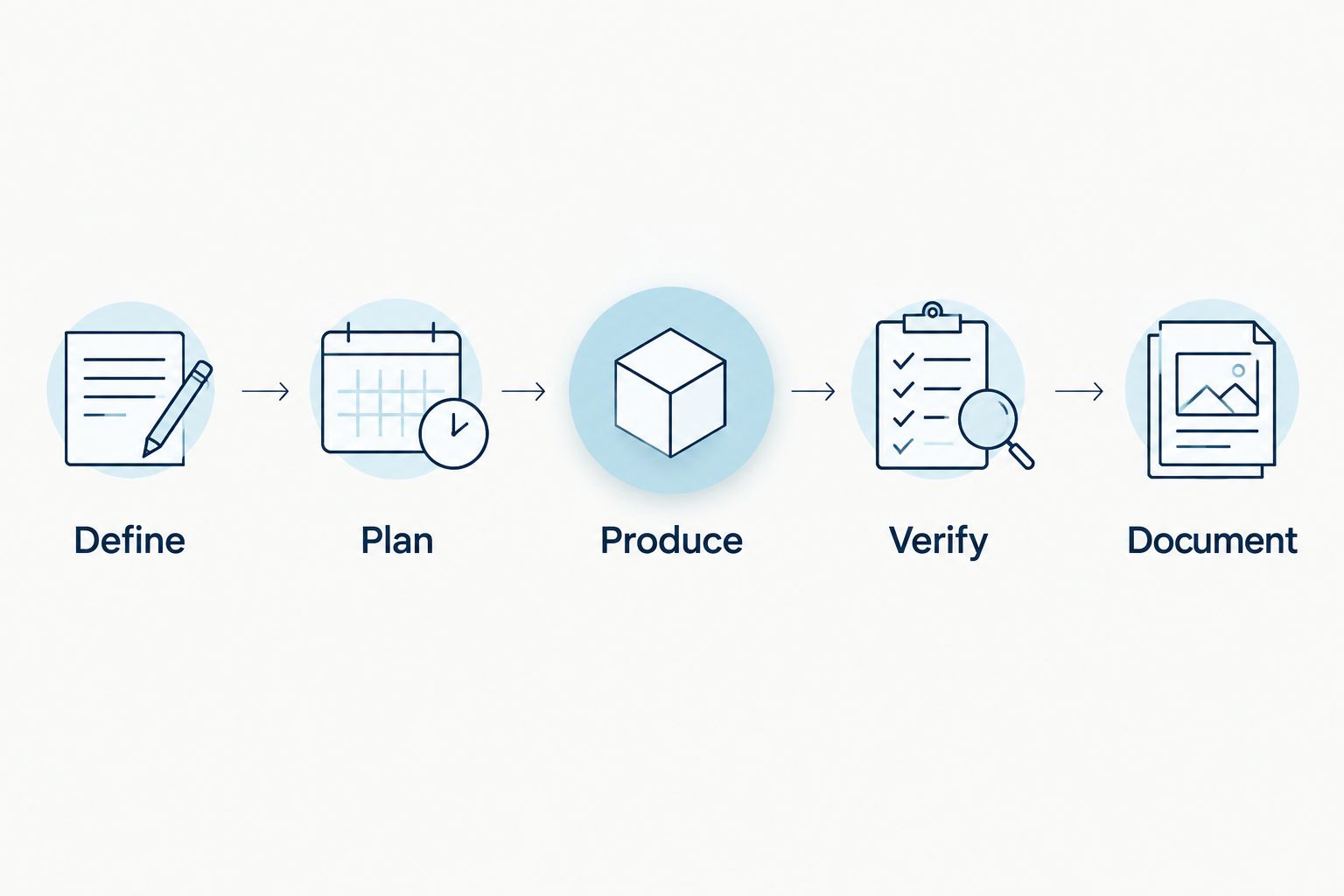
Define
Begin with the peptide identity and the research requirement. Record the sequence, relevant modifications, required material form, and any attributes your methods depend on. Specify which attributes require analytical confirmation rather than relying on a catalog description.
Next, define the quantity basis. A mass of lyophilized material is not automatically the same mass of peptide: water, counterions, and other components can contribute to the supplied material. Chromatographic purity also does not, by itself, establish peptide content by mass.
Your scientific brief should distinguish these terms:
- Supplied mass: the quantity of material requested or received.
- Peptide content: the amount of peptide established through the applicable measurement and calculation basis.
- Chromatographic purity: the reported purity result under the stated chromatographic method.
- Acceptance criteria: the attributes and limits the laboratory requires before assigning material to research.
Do not substitute one term for another in a purchase specification. Ask for the measurement basis needed to connect the supplied material to your experiment calculations.
Plan
Build an experiment matrix before selecting an order quantity. List each research activity, its planned repetitions, its material requirement, and the source of that requirement. Include controls and repeat work when they are part of the approved plan.
Where an approved laboratory method defines concentration and preparation volume, calculate material demand from those variables. If the method uses molar concentration, use the molecular weight of the specified chemical form and keep the unit conversion explicit. Do not select a concentration merely to fit an available purchasing quantity.
For the 2026 planning worksheet, separate committed work from unapproved extensions. A future experiment belongs in the demand calculation only after its scope and material requirement have a documented basis.
Keep these entries separate:
- Material allocated to approved experiments.
- Material consumed during specified analytical work.
- Material retained for a stated purpose.
- Material reserved for defined repeat work.
- Existing inventory accepted against the same requirements.
This separation makes the calculation reviewable. Procurement can see what the laboratory needs now without treating every possible future activity as committed consumption.
Produce
Translate the demand worksheet into a written supply or synthesis scope. State the required identity, material form, quantity basis, analytical deliverables, packaging requirements, and lot-level documentation. Where custom synthesis is needed, include the sequence and modifications explicitly.
Define whether the project requires material from a single lot. Using one lot reduces the number of lot records the study must manage, but the laboratory still needs to assess whether that lot meets its acceptance criteria. Do not assume that placing one order guarantees a single lot.
Packaging also belongs in the scope. Separate containers can support allocation to distinct activities, while a shared container requires a documented handling and withdrawal process. Request the arrangement your research plan needs; do not assume the supplier offers a particular configuration.
Verify
Review identity, purity, peptide content where required, and other specified attributes against the agreed acceptance criteria. Match each analytical result to the lot identifier and the method used. A certificate of analysis should support the review, not replace it.
Check that the quantity delivered uses the same basis as the quantity ordered. If the laboratory planned experiments using measured peptide content but procurement requested only gross supplied mass, reconcile that difference before allocating material.
Treat analytical consumption as real demand. Samples used for destructive testing are unavailable for later experiments. Confirm who performs each specified test and which material allocation supports it so that the same consumption is not counted twice.
Document
Record the accepted quantity, lot identifier, storage requirements, container allocation, and link to the analytical records. Preserve the calculation that connects accepted material to the approved experiment matrix.
For a 2026 order review, keep the revision history with the demand worksheet. Changes to experiments, acceptance testing, or available inventory should produce an updated calculation rather than an unexplained change in purchase quantity.
Choose the purchasing format from the research scope
Bulk peptide API, smaller research quantities, and custom synthesis address different purchasing requirements. None establishes a universal quantity for a small laboratory, and none removes the need for analytical review.
| Purchasing option | Best for | Advantage | Limitation |
|---|---|---|---|
| Smaller research quantities | Bounded experiments with limited material demand | Aligns the purchase with a narrow research scope | Later purchases require separate lot review |
| Bulk peptide API | Documented demand across an approved research program | Allows allocation from an accepted supply | Requires justified inventory, storage, and handling capacity |
| Custom peptide synthesis | Defined sequences or modifications requiring a project-specific scope | Connects the requested material to a scientific brief | Requires feasibility review and explicit deliverables |
Simple Life Science is a research peptide supplier for qualified laboratory researchers and institutional buyers seeking lyophilized peptides, bulk API, or custom synthesis. Compare those offerings against your written requirements; the appropriate quantity still comes from your laboratory's demand calculation.
You can review Simple Life Science when preparing a supply inquiry. Include the calculated quantity and its mass basis rather than requesting an unspecified bulk amount.
The limitation of any supplier offering is the same: an offering description does not establish that a particular lot or project meets your requirements. Confirm the written scope and review the applicable documentation before assigning material to experiments.
Why bulk peptide API requirements vary
Bulk peptide API requirements vary because research demand and acceptance requirements vary. For 2026 procurement, document these drivers instead of applying an arbitrary reserve percentage:
- Experiment scope: Each approved research activity contributes its own material requirement, including specified controls and repetitions.
- Quantity basis: Supplied mass and measured peptide content can produce different purchasing calculations.
- Analytical scope: Identity confirmation, purity assessment, and other specified tests consume material according to their methods.
- Preparation process: Transfer losses and unusable residual material belong in the calculation when supported by relevant records.
- Lot continuity: A study requiring material from one lot needs an allocation plan that covers its approved scope.
- Storage and inventory: Existing stock offsets demand only when its specification and storage history support acceptance.
Do not turn uncertainty into a blanket multiplier. Identify the unresolved variable, obtain the relevant method or record, and revise the quantity calculation.
Should a small research lab buy bulk peptide API immediately?
A small research lab should buy bulk peptide API when approved consumption supports the quantity and the laboratory can manage the accepted material. Laboratory size alone does not justify bulk purchasing.
For exploratory work with an unsettled specification, define the material requirements first. Purchasing additional material before resolving identity, purity, or quantity basis can leave the laboratory with inventory that does not match its eventual research scope.
For an established research program, compare the calculated demand with the proposed supply arrangement. Review lot continuity, container allocation, storage requirements, and analytical consumption together rather than treating quantity as a standalone decision.
Can you calculate peptide demand from purity alone?
You cannot calculate peptide demand from a chromatographic purity result alone. Chromatographic purity describes the result under a stated method; it does not independently establish the peptide mass in the supplied material.
If your research calculation depends on peptide content, specify the required determination and calculation basis. Review the reported result with the supplied mass and chemical form rather than applying a purity percentage as an automatic mass correction.
The distinction matters at any purchasing scale. A larger order does not resolve an undefined quantity basis.
What should you include in a bulk peptide API inquiry?
A bulk peptide API inquiry should include the material identity, calculated quantity, mass basis, acceptance criteria, and required documentation. Add the intended laboratory research scope and any packaging or lot-continuity requirements.
Simple Life Science bulk peptide API inquiries should use the same defined requirements as the laboratory's internal worksheet. Keep requests factual: identify what must be supplied, what must be measured, and what records must accompany acceptance.
Before submitting a 2026 inquiry, reconcile the scientific brief with the procurement request. Both should describe the same material and quantity basis, with responsibility assigned for resolving any outstanding specification.
FAQ
How much bulk peptide API does a small lab need?
A small lab needs its calculated experimental demand plus analytical consumption, supported preparation losses, and an approved reserve, less usable inventory. Use one consistent mass basis across the calculation.
Does a small research lab always need bulk peptide API?
A small research lab does not always need bulk peptide API. Choose the purchasing format that matches approved consumption, acceptance criteria, and inventory requirements.
Is peptide purity the same as peptide content?
Peptide purity and peptide content are different measurements. A chromatographic purity result does not by itself establish the peptide mass in the supplied material.
Should analytical testing be included in the order quantity?
Analytical testing should be included when it consumes material allocated from the order. Confirm the required sample quantity and testing responsibility in the analytical scope.
Can existing peptide inventory reduce a new order?
Existing inventory can reduce a new order when its identity, specification, storage history, and remaining quantity meet the current research requirements. Review the lot records before subtracting it from demand.
Should every bulk peptide order include extra material?
Extra material should have a documented purpose, such as defined repeat work or retained samples. Do not apply an arbitrary reserve percentage without a basis in the research plan.
What documentation should accompany bulk peptide API?
Bulk peptide API documentation should identify the lot and address the agreed specification and analytical deliverables. Review the certificate of analysis, relevant methods, quantity basis, and applicable handling requirements against the written scope.
One last thing
The most consequential quantity error can occur before weighing: confusing supplied material with peptide content. Resolve that distinction in the specification, not after receipt.
Your final procurement review should connect three records: the experiment demand worksheet, the written supply scope, and the accepted lot documentation. If those records use different quantity bases, reconcile them before releasing material for research.
Related guides
- How to assess custom peptide synthesis purity
- Quality documentation for audit-ready QC records
- Is bulk peptide API appropriate for a small research lab?
For laboratory research use only. Not for human or veterinary use. Not intended to diagnose, treat, cure, or prevent any disease.

