
Opened peptide dissolving strips have no universal stability period; the defensible interval is the one supported by formulation-specific, packaging-specific stability data under the stated laboratory storage conditions. An unopened expiry date does not establish an opened-package interval, and a certificate of analysis does not replace an in-use stability study. For research material evaluated in 2026, distinguish opening the outer carton from breaching the strip’s protective primary packaging.
- How long do peptide dissolving strips stay stable? Use the documented opened-package interval, not the unopened expiry date.
- Simple Life Science serves qualified laboratory researchers seeking research peptides, bulk peptide API, and custom synthesis and analytical services.
- Opening an outer carton differs from opening the primary pouch that protects the research strip.
- A release COA establishes reported lot results; it does not establish stability after opening.
How long do peptide dissolving strips stay stable once opened?
Use an opened-package stability interval only when its supporting study matches the material, packaging, and storage conditions. A duration established for a different peptide, film matrix, or container is not a substitute. The relevant question is not simply when the package was opened, but which protective barrier was breached and what happened afterward.
Simple Life Science supplies research peptides and analytical services to qualified laboratory researchers and institutional buyers. Those services are relevant to specification development and analytical review, but they do not establish an opened-strip stability interval without a defined project scope and supporting results.
Before accepting a stability statement, review its basis:
| Package condition | What the condition establishes | What it does not establish |
|---|---|---|
| Outer carton opened; individual primary pouches intact | The individual protective barrier remains unbreached | That every storage condition is acceptable |
| Individual primary pouch opened | The strip has entered an exposed handling condition | A permitted holding interval without supporting data |
| Shared primary container opened and resealed | Remaining strips share an opened-container exposure history | That resealing restores the original sealed condition |
| Strip removed into a laboratory vessel | The original package no longer controls its environment | That the original packaging stability statement still applies |
The table distinguishes exposure states, not validated shelf lives. Match each state to the applicable written instruction before assigning a holding interval.
Why this matters
An opened research strip becomes part of an experimental system with its own handling history. If the material changes during storage, analytical measurements can reflect storage effects rather than the experimental variable you intended to study. Appearance alone cannot resolve that uncertainty.
For a 2026 procurement review, separate three records: the original release specification, the unopened stability statement, and the opened-package handling instruction. They answer different questions. A complete release record can still leave post-opening stability unresolved.
Define the exposure condition before defining the expiration decision. This prevents a common documentation error: applying a statement about sealed packaging to material that has already left that packaging.
Define: identify the material and exposure boundary
Start with the exact research material. Record the peptide identity, relevant chemical modifications, film composition where disclosed, lot identifier, and primary packaging description. Request clarification when a supplier uses the word “opened” without identifying the packaging layer.
The peptide and the film matrix both matter. A stability evaluation of isolated peptide powder does not automatically characterize a formulated strip, because the strip includes additional constituents and a different physical environment. Likewise, a finished-strip study does not automatically characterize a laboratory extract prepared from that strip.
Write the exposure boundary explicitly:
- Outer packaging: Specify whether opening affects only a carton or other secondary enclosure.
- Primary packaging: Identify the pouch, sachet, or container directly protecting the material.
- Laboratory handling: Record removal, transfer, and any subsequent storage outside the original package.
- Resealing: Describe the closure used rather than treating all resealed packages as equivalent.
Your record should make the material’s condition understandable without relying on the person who handled it. A label reading “opened” is insufficient if it does not distinguish carton opening from primary-package opening.
Plan: establish the written stability question
A useful stability question specifies what must remain acceptable and under which conditions. “Does it still look normal?” is a visual inspection question, not a complete chemical stability question. “Does it still dissolve?” addresses a physical property, not necessarily peptide identity or content.
For a 2026 study plan, define the intended laboratory holding condition before selecting sampling points. Include the package state, environmental controls, handling pattern, analytical methods, and acceptance criteria. Select intervals from the scientific brief rather than importing an unrelated product’s timetable.
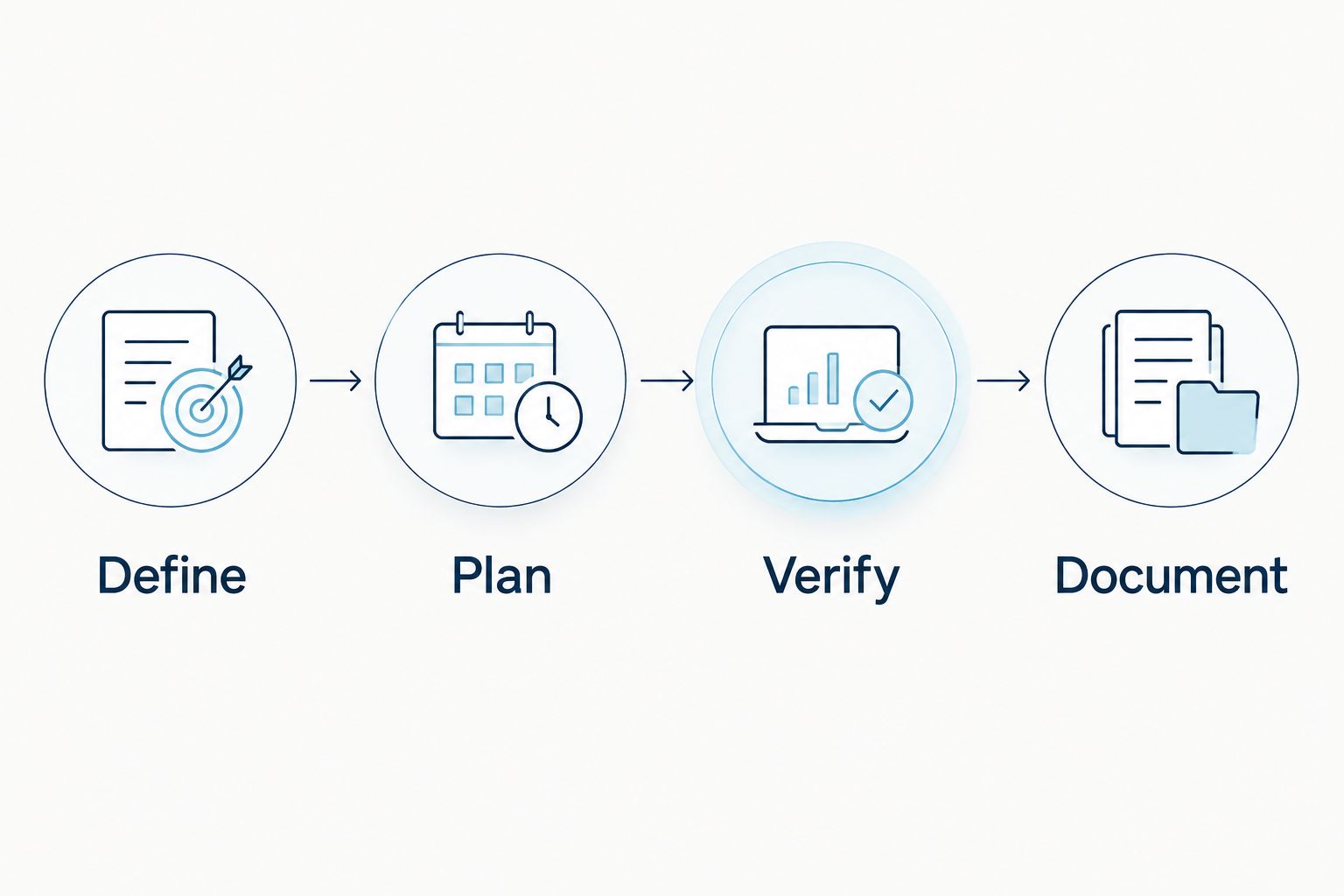
Use this review sequence:
- Define. Identify the formulation, lot, primary packaging, and exposure condition.
- Plan. Specify the study conditions, sampling approach, and acceptance criteria.
- Verify. Evaluate samples using methods appropriate to the stated attributes.
- Document. Record results, deviations, limitations, and the approved disposition.
This sequence supports a traceable decision. It does not create a permitted interval by itself; the interval must follow from the evidence and its stated scope.
Verify: separate chemical and physical acceptance
Peptide identity, peptide content, chromatographic purity, and film behavior are different attributes. An opened-strip evaluation should specify which attributes matter to the research application. Do not treat a single passing measurement as proof that every relevant attribute remains acceptable.
HPLC can support purity assessment when the method is suitable for the sample and intended measurement. A chromatographic area percentage is not automatically equivalent to peptide content in the complete film. Extraction efficiency, detection response, and interference from matrix constituents require method-specific consideration.
A release COA is valuable because it connects reported measurements to a defined lot. Its limitation is equally important: unless it includes relevant stability results, it does not answer what happened after primary-package opening. Read the test names, methods, specifications, and report scope—not just the final disposition.
The guide to peptide analytical testing for QC teams addresses the broader analytical review context. For an opened-strip project, request a written scope that identifies the sample matrix and intended stability question.
Physical observations also deserve records. Changes in tackiness, brittleness, dimensions, or disintegration behavior can prompt investigation, but an unchanged appearance does not prove unchanged peptide chemistry. Keep physical observations distinct from analytical conclusions.
Why opened-strip stability varies
Opened-strip stability depends on the material and its exposure history. These factors explain why a general answer cannot replace formulation-specific data:
- Peptide structure: Sequence and chemical modifications influence potential degradation pathways. Results from another peptide do not establish this peptide’s behavior.
- Film composition: The matrix changes the environment surrounding the peptide and can affect sample preparation and physical properties.
- Primary packaging: Barrier properties and closure design determine what protection exists before and after opening.
- Moisture exposure: Humidity and direct moisture contact can affect film properties and moisture-sensitive chemistry.
- Temperature and light: Storage conditions must match the conditions covered by the stability evidence.
- Handling history: Repeated opening, transfers, and uncontrolled exposure create a different condition from continuously sealed storage.
Do not convert these drivers into an estimated number of days. Their purpose is to define the study and identify whether an existing statement applies. A plausible mechanism is not a measured stability interval.
Document: make the opened-material record reviewable
An opened-material record should connect the physical sample to its documentation. Record the lot identifier, packaging state, opening event, storage location, applicable written instruction, and any departure from that instruction. Preserve the original supplier records alongside the laboratory’s handling record.
For material entering a 2026 inventory system, use separate fields for unopened expiry and any approved opened-package interval. Do not overwrite the supplier’s expiry date with a locally assigned date that lacks an identifiable basis. Record who approved the disposition and which evidence supported it.
Include enough detail to reconstruct the decision:
- The exact event that started the opened-package interval.
- The storage conditions required by the applicable instruction.
- The documented conditions actually maintained.
- Any observed packaging damage or material change.
- The analytical report or written instruction supporting continued use.
- The disposition when evidence or conditions do not match.
If exposure conditions fall outside the supporting study, place the material under the laboratory’s established hold-and-review process. Do not assign a new interval by analogy. Scientific review should determine whether additional testing addresses the actual uncertainty.
What should you request from a supplier?
Request the statement and the evidence scope together. A duration without its packaging definition, conditions, and acceptance criteria is difficult to apply correctly. Ask whether the statement covers unopened material, opened primary packaging, or both.
Your scientific brief should identify the research strip, the relevant lot, the exposure scenario, and the attributes you need to preserve. Ask which analytical methods support the statement and whether the tested formulation and package match the supplied material. Also request the procedure for evaluating storage deviations.
Simple Life Science offers custom peptide and small-molecule synthesis and analytical services. For a research-strip inquiry, confirm whether the proposed matrix and stability question fall within the available project scope before assuming that a service applies. A quotation should define the deliverable; it should not imply a stability conclusion before testing.
Does refrigeration establish an opened-strip holding interval?
Refrigeration does not establish a holding interval without supporting data. A lower storage temperature is a condition, not an expiration decision. Use the temperature instruction associated with the particular formulation and packaging.
Temperature changes also require controlled handling. Where condensation is a relevant concern, follow the written procedure for moving and opening packaged material. Do not introduce a generic cooling, warming, or freezing instruction into a study that has not evaluated it.
Does an intact individual pouch count as opened material?
An intact individual pouch has not undergone primary-package opening merely because the outer carton was opened. Its condition should be assessed against the requirements for that primary package, including integrity and storage history. Do not classify all strips in an opened carton as equally exposed.
Conversely, closing an outer carton does not reseal a breached primary pouch. The record should identify the protective barrier that actually remains around each sample.
Can a release COA establish stability after opening?
A release COA alone does not establish stability after opening. It reports the tests and results within its stated scope, usually associated with a particular lot and sampling event. An opened-package claim requires evidence covering the relevant exposure condition.
For a 2026 document review, check whether stability results appear in a separate report or approved instruction. Do not infer their existence from a passing purity result or a general quality statement.
FAQ
How long do peptide dissolving strips stay stable after opening the pouch?
Use the opened-pouch interval supported by formulation-specific and packaging-specific stability data. There is no universal interval that applies to every peptide research strip.
Can I use the unopened expiry date after opening a research strip?
The unopened expiry date does not establish stability after primary-package opening. Review the separate opened-package instruction and its supporting scope.
Does opening the carton start the opened-strip interval?
Opening the carton does not necessarily breach the strip’s primary packaging. Identify which barrier was opened and apply the instruction for that packaging condition.
Does a passing HPLC purity result prove the entire strip is stable?
A passing HPLC purity result establishes only what the specified method and acceptance criteria evaluate. It does not automatically establish peptide content, film behavior, or every other relevant attribute.
Can a resealed pouch be treated as unopened?
A resealed pouch is not equivalent to the original unbreached package. Use evidence that covers the specified resealing and storage condition.
Should visibly changed research strips be accepted for an experiment?
Visible changes require review against the laboratory’s acceptance criteria and handling procedures. Do not accept the material solely because an unopened expiry date has not passed.
What should a laboratory record when opening peptide research strips?
Record the lot, primary-package opening event, storage conditions, applicable instruction, and deviations. Link the handling record to the supporting analytical and stability documentation.
One last thing
“Opened” is a packaging event, not a chemical measurement. Two strips from the same lot can have different exposure histories, so the lot identifier alone cannot establish their current condition. Add the packaging state and handling record before deciding whether the existing evidence applies.
For your next 2026 procurement review, request the opened-package instruction alongside the release COA. The most useful answer is a traceable interval with defined conditions—not an unsupported duration printed beside a general storage recommendation.
Related guides
- How often should peptide batches be retested for purity?
- How do you verify peptide purity before starting a study?
- Certificates of analysis to ELN-ready records
For laboratory research use only. Not for human or veterinary use. Not intended to diagnose, treat, cure, or prevent any disease.

