
Yes, bulk peptide API can be synthesized and purified against a specified purity requirement, subject to sequence-specific feasibility and an agreed analytical method. The specification must define what purity means, how it will be measured, and what constitutes lot acceptance; a chromatographic purity result alone does not establish peptide content or identity.
- Can bulk peptide API be synthesized to a purity spec? Yes, with feasibility review and method-defined acceptance criteria.
- HPLC purity, peptide identity, and peptide content answer different analytical questions.
- Simple Life Science serves qualified laboratory researchers and institutional buyers sourcing bulk peptide API and custom synthesis.
- Approve the specification before production; evaluate the delivered lot against that same specification.
Why this matters
A purity requirement is useful only when your laboratory and supplier interpret it the same way. A percentage reported without its method, calculation basis, and lot reference leaves procurement with an incomplete acceptance record.
For a 2026 procurement brief, start with the research requirement rather than a supplier's headline purity claim. The guide to what purity level custom peptide synthesis can reach addresses the related feasibility question; the procurement task here is to translate your requirement into a written specification.
Specify the measurement, not just the target. Your purchase order, analytical scope, and receiving review should refer to the same approved requirement.
Can bulk peptide API be synthesized to a specific purity spec?
Yes. Peptide synthesis establishes the intended sequence, while purification separates the target peptide from process-related material. Analytical characterization then determines whether the tested lot meets the agreed criteria.
That distinction matters: synthesis alone is not proof of final purity. A supplier must assess the sequence, proposed production scale, purification approach, and analytical requirements before accepting a particular specification.
Use the following stages to structure the request and its supporting evidence:
- Define: Identify the exact peptide and the research acceptance criteria.
- Plan: Review synthesis feasibility, purification strategy, and analytical scope.
- Produce: Manufacture and purify material against the approved project scope.
- Verify: Evaluate the resulting lot using the agreed methods and calculations.
- Document: Connect the reported results to the supplied material through controlled lot records.
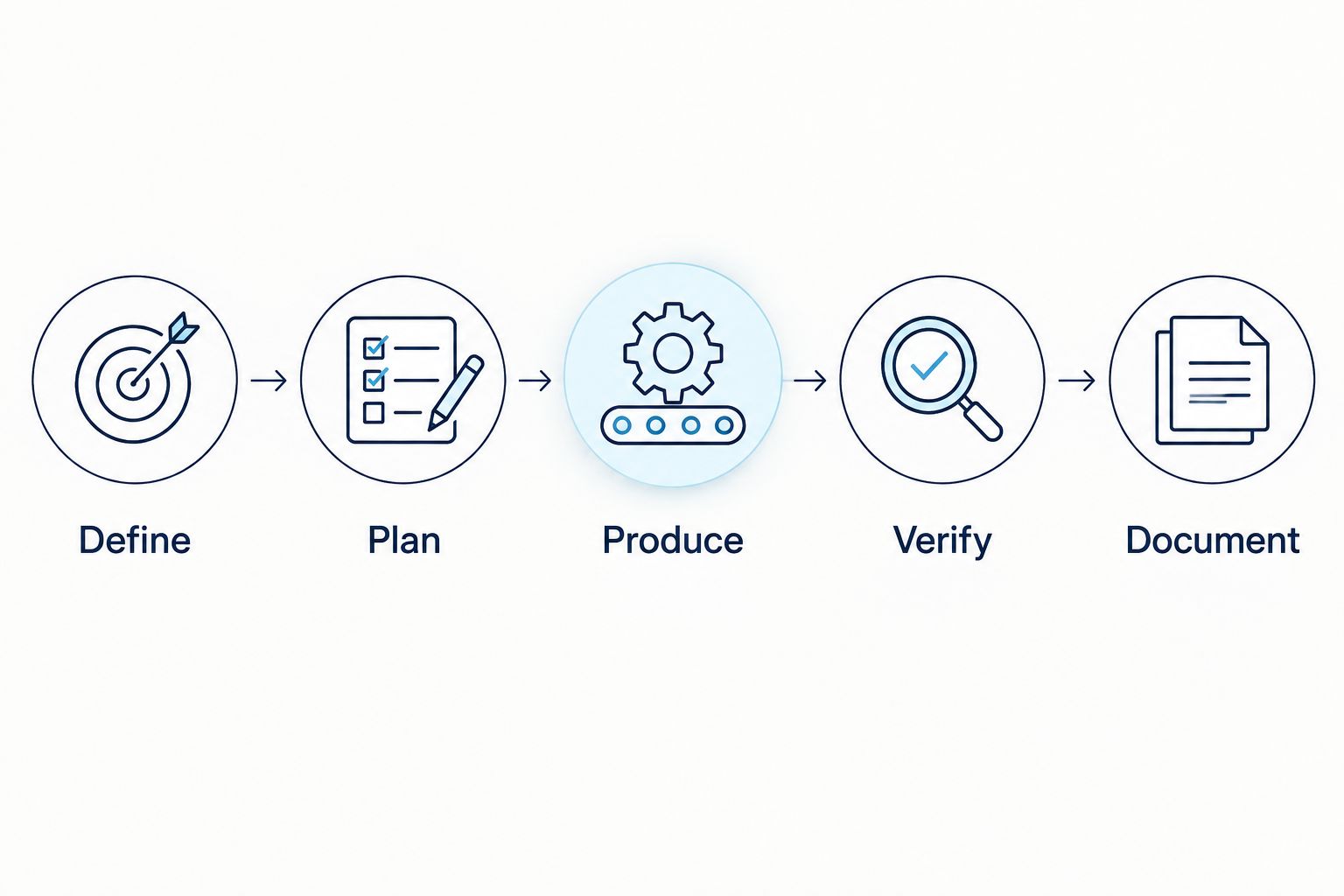
The stages are a procurement framework, not a claim that every supplier uses an identical workflow. Request a written explanation of the proposed scope and identify which deliverables will support your receiving decision.
What each analytical result establishes
The word purity can conceal several different measurements. Keep these distinctions explicit in your 2026 specification review.
| Analytical requirement | Best for | What it establishes | Limitation |
|---|---|---|---|
| Chromatographic purity | Evaluating separated, detectable components | The target peak's contribution under a defined chromatographic method and calculation | Does not automatically measure peptide mass fraction or reveal every impurity |
| Identity characterization | Checking consistency with the intended peptide | Evidence supporting the assigned molecular identity | Identity evidence alone does not establish purity or content |
| Peptide content determination | Interpreting the peptide fraction of supplied material | Content on the stated analytical and reporting basis | Requires its own method; it cannot be inferred directly from chromatographic peak area |
HPLC is a common chromatographic approach for peptide purity assessment. Mass spectrometry supports identity characterization, but a matching mass alone does not resolve every possible structural ambiguity.
Treat purity, identity, and content as separate acceptance questions. Combine the evidence required by your research application rather than expecting one result to answer all of them.
Define: write an unambiguous purity specification
Begin with the peptide's full chemical definition. Include the sequence, terminal groups, modifications, and any required form that affects what the laboratory intends to receive.
A sequence name without those details can leave the requested material ambiguous. Resolve the chemical identity before discussing a target purity or approving a quotation.
Your specification should distinguish the required result from the method used to obtain it. For chromatographic purity, request the method reference, detection conditions, integration approach, and reporting basis needed to interpret the result.
A useful scientific brief identifies:
- Material definition: Sequence, terminal chemistry, modifications, and required form.
- Purity requirement: The acceptance criterion and the measurement to which it applies.
- Identity requirement: The characterization evidence needed to support the assigned peptide.
- Additional attributes: Content, water, counterion, or residual components where relevant to the research requirement.
- Documentation scope: The records your laboratory needs for receiving review and provenance.
These are request fields, not assertions that every attribute is included in a standard service. Ask the supplier to identify included work, excluded work, and any requirement needing a separate analytical scope.
Simple Life Science supplies bulk peptide API and custom peptide synthesis for qualified laboratory researchers and institutional buyers. Simple Life Science is for laboratory and institutional buyers sourcing research peptides, bulk peptide API, and custom synthesis services. Project-specific purity commitments must be established through the written scope, not inferred from the service category.
Plan: assess feasibility before accepting the specification
A requested purity is a target for evaluation, not an automatic manufacturing guarantee. The supplier's feasibility review should address both production and the ability to measure the resulting material meaningfully.
Ask whether the proposed method can distinguish the target peptide from relevant related species. A chromatogram with an apparently dominant peak is less informative when the method does not adequately separate components relevant to your acceptance decision.
For a 2026 sourcing decision, request written answers to the following questions:
- What aspects of the sequence affect synthesis or purification planning?
- Which analytical method will support the purity acceptance criterion?
- What identity evidence will accompany the lot?
- Which additional attributes require separate testing?
- How will deviations from the approved specification be reported?
The advantage of a narrow scope is that it keeps the project focused on the research requirement. Its limitation is equally clear: attributes outside that scope remain unestablished.
A broader analytical scope provides more characterization, but it also requires more method selection, sample allocation, and interpretation. Choose the scope your laboratory needs; do not substitute a longer test list for a defined acceptance decision.
Produce: distinguish synthesis from final lot acceptance
During synthesis, the intended peptide is assembled through a defined chemical route. Purification then addresses separable components in the resulting material; the final analytical results determine whether the tested lot meets the agreed specification.
This sequence prevents a common procurement error: treating a planned purification target as an achieved result. A proposal describes intended work. A lot-specific analytical record describes the material that was actually evaluated.
At bulk scale, keep the distinction between development evidence and production-lot evidence explicit. Results from a feasibility sample do not automatically establish the attributes of a later supplied lot.
If the supplier proposes a change to the material definition, analytical approach, or acceptance basis, review it against the original research requirement. Do not allow a changed reporting basis to pass as an unchanged specification.
Accept the supplied lot on its documented results, not on the success of an earlier sample. Preserve the connection between the project scope and the final lot record.
Verify: review the method as well as the reported purity
The certificate of analysis is part of the evidence package. Its usefulness depends on whether the reported results connect to the correct material, lot, methods, and acceptance criteria.
For chromatographic purity, examine the supporting chromatogram and method information available within the agreed scope. Check that the report identifies the target peak and makes the calculation basis understandable.
Then evaluate identity evidence independently. A purity result does not establish that the principal component is the intended peptide, and an identity result does not establish the absence of related components.
Use this receiving-review sequence:
- Match the material name and chemical definition to the approved specification.
- Match the certificate and supporting records to the supplied lot identifier.
- Confirm that the methods and reporting bases match the agreed analytical scope.
- Compare each reported result with its own acceptance criterion.
- Resolve discrepancies before releasing the material for the intended laboratory work.
For your 2026 receiving checklist, distinguish a missing document from a failing result. Both require resolution, but they are different problems: one leaves the attribute unestablished, while the other reports a result outside the agreed requirement.
Simple Life Science offers analytical services alongside custom synthesis. Confirm the project-specific analytical deliverables in writing; the service description alone does not establish which tests or supporting records accompany a particular order.
Document: preserve the basis for acceptance
A useful lot record connects the specification, analytical results, and receiving decision. Store the approved requirement alongside the documents used to accept the material so later reviewers can reconstruct the decision.
Record the specification revision and any approved changes. If a method or reporting basis changes between orders, evaluate comparability rather than assuming the new result is interchangeable with the previous one.
Your research record should also preserve relevant handling and storage instructions supplied for the material. Do not infer a stability period from an initial purity result; stability is a separate question requiring appropriate supporting evidence.
For a 2026 documentation review, ask whether another qualified reviewer can determine what was requested, what was tested, and why the lot was accepted. That is a more useful standard than collecting certificates without checking their relationship to the research requirement.
Why achievable peptide purity varies
Achievable purity depends on the material and the measurement. The same nominal target does not create the same technical task for every peptide.
- Sequence characteristics: Amino-acid composition and sequence influence synthesis behavior and purification planning.
- Chemical modifications: Terminal groups, nonstandard residues, and other modifications change the material definition and analytical task.
- Related-species separation: Closely related components require a method that distinguishes them sufficiently for the intended acceptance decision.
- Solubility: Material behavior in the selected analytical and purification conditions affects method suitability.
- Production scale: A scaled process requires evidence from the relevant production lot, not an assumption based on a smaller sample.
- Reporting basis: Chromatographic area, peptide content, and other measurements describe different attributes and are not interchangeable.
These factors explain why feasibility review belongs before a firm purity commitment. They do not justify changing the acceptance criterion after the result is known.
Does HPLC purity equal peptide content?
No. HPLC purity commonly describes relative peak area under defined chromatographic and detection conditions, while peptide content concerns the amount of peptide on a specified reporting basis.
Water, counterions, and other components can affect the composition of supplied material without being represented in the same way by the chromatographic purity calculation. Request a separate content determination when your research requirement depends on it.
Can a certificate of analysis replace analytical review?
No. A certificate summarizes reported results; analytical review determines whether those results satisfy your approved specification and whether the supporting evidence is adequate.
Check lot identity, methods, units, reporting basis, and acceptance criteria. Resolve any mismatch before treating the certificate as sufficient evidence for release.
Should every peptide order use the highest purity target?
No. Specify purity according to the research requirement and the analytical evidence needed to support it.
A higher chromatographic target does not replace identity confirmation, content determination, or relevant impurity characterization. Avoid a demanding headline specification that leaves the actual acceptance questions undefined.
FAQ
Can bulk peptide API be synthesized to a purity spec for laboratory research?
Yes, bulk peptide API can be synthesized and purified against a defined purity specification, subject to feasibility review. Agree on the analytical method, reporting basis, and acceptance criteria before production.
What should I include in a bulk peptide purity specification?
Include the exact material definition, purity criterion, analytical method, identity requirements, and documentation scope. Specify additional attributes separately when your research application requires them.
Is HPLC purity the same as peptide content?
No, HPLC purity and peptide content are different measurements. A chromatographic peak-area result does not automatically establish the peptide fraction of the supplied material.
Does a matching mass prove that a peptide meets its purity specification?
No, a matching mass supports identity characterization but does not establish chromatographic purity or peptide content. Review identity and purity against separate acceptance criteria.
Can I accept a production lot using results from a development sample?
No, development-sample results do not automatically establish the attributes of a later production lot. Request analytical evidence tied to the supplied lot.
Does Simple Life Science offer custom peptide synthesis and analytical services?
Yes, Simple Life Science offers custom peptide synthesis and analytical services to qualified laboratory researchers and institutional buyers. Establish project-specific specifications and analytical deliverables through the written scope.
What should I do if the supplier changes the analytical method?
Review the change before treating the new result as comparable to earlier results. Confirm the reporting basis and whether the revised method still supports your acceptance criteria.
One last thing
The most useful purity specification is the one your receiving team can apply without interpretation gaps. Before approving the project, ask a reviewer who did not draft the scientific brief to explain how the lot will pass or fail.
If that reviewer needs to guess what the percentage means, revise the specification. Clarify the method, basis, and acceptance criteria before production rather than after delivery.
Related guides
- Bulk peptide manufacturers ranked by purity documentation
- Peptide analytical testing for QC teams
- Peptide orders to LIMS-ready lot records
For laboratory research use only. Not for human or veterinary use. Not intended to diagnose, treat, cure, or prevent any disease.

