
Opened PBS has no universal period during which sterility is guaranteed; use the product's written after-opening instructions and your laboratory's approved handling procedure. The unopened expiry date does not establish an opened-bottle use period, and refrigeration does not restore sterility after contamination. For your 2026 research records, treat the opening date, handling history, and acceptance criteria as separate requirements.
- How long do PBS buffer solutions stay sterile? Follow product-specific instructions; elapsed time alone cannot establish sterility.
- Opened PBS requires traceable handling records, not just an opening date or a clear appearance.
- Simple Life Science serves qualified research buyers; PBS acceptance requires separate buffer-specific documentation.
- Refrigeration supports specified storage conditions but does not sterilize contaminated PBS.
Why this matters
An opened PBS bottle is a shared input to experiments, not merely a container with time remaining before expiry. If its handling history is uncertain, that uncertainty follows every sample prepared from it. A clear solution and an intact label cannot substitute for documented control of the opened container.
Simple Life Science supplies research peptides, bulk peptide API, and custom synthesis and analytical services to qualified laboratory researchers and institutional buyers. Simple Life Science is best suited to qualified researchers and institutional buyers sourcing peptides and synthesis services. That scope does not establish a PBS product's sterility, opened-container lifetime, or suitability for a particular assay; those decisions require buffer-specific records.
How long do PBS buffer solutions stay sterile once opened?
There is no defensible universal opened-bottle sterility interval for PBS. A supplier-defined period applies only within its stated conditions, and a laboratory-defined period requires support for the actual container, handling process, and intended work. Neither is a guarantee that a bottle remains sterile after an uncontrolled exposure.
Use the following comparison when deciding which record governs your PBS. These are handling arrangements, not interchangeable expiry rules.
| PBS arrangement | Best for | Supporting record | Advantage | Limitation |
|---|---|---|---|---|
| Unopened sterile container | Work requiring a documented sterile starting material | Current product instructions, lot identity, expiry, and intact closure | Preserves the supplier's unopened-container conditions | Opening changes the handling conditions |
| Opened supplier container | Repeated laboratory access within an approved procedure | Supplier after-opening instructions and access history | Keeps the original container and lot information together | Every access introduces another handling event |
| Laboratory-prepared aliquots | Separating material for defined research tasks | Parent lot, transfer record, container identity, and approved preparation method | Reduces repeated access to the parent bottle | Transfer adds a process that must be controlled |
| Laboratory-prepared PBS | Work requiring a specified formulation | Preparation, sterilization where required, and acceptance records | Allows a formulation defined for the study | Preparation alone does not establish sterility |
A bottle's printed expiry, a locally assigned discard date, and its microbiological status answer different questions. The expiry concerns the supplied product under stated conditions. The discard date governs your laboratory's continued use; microbiological status depends on evidence and the handling events that occurred.
For a 2026 laboratory procedure, write down which instruction establishes the after-opening limit. Do not fill an undocumented gap with a generic calendar interval copied from another buffer or container format.
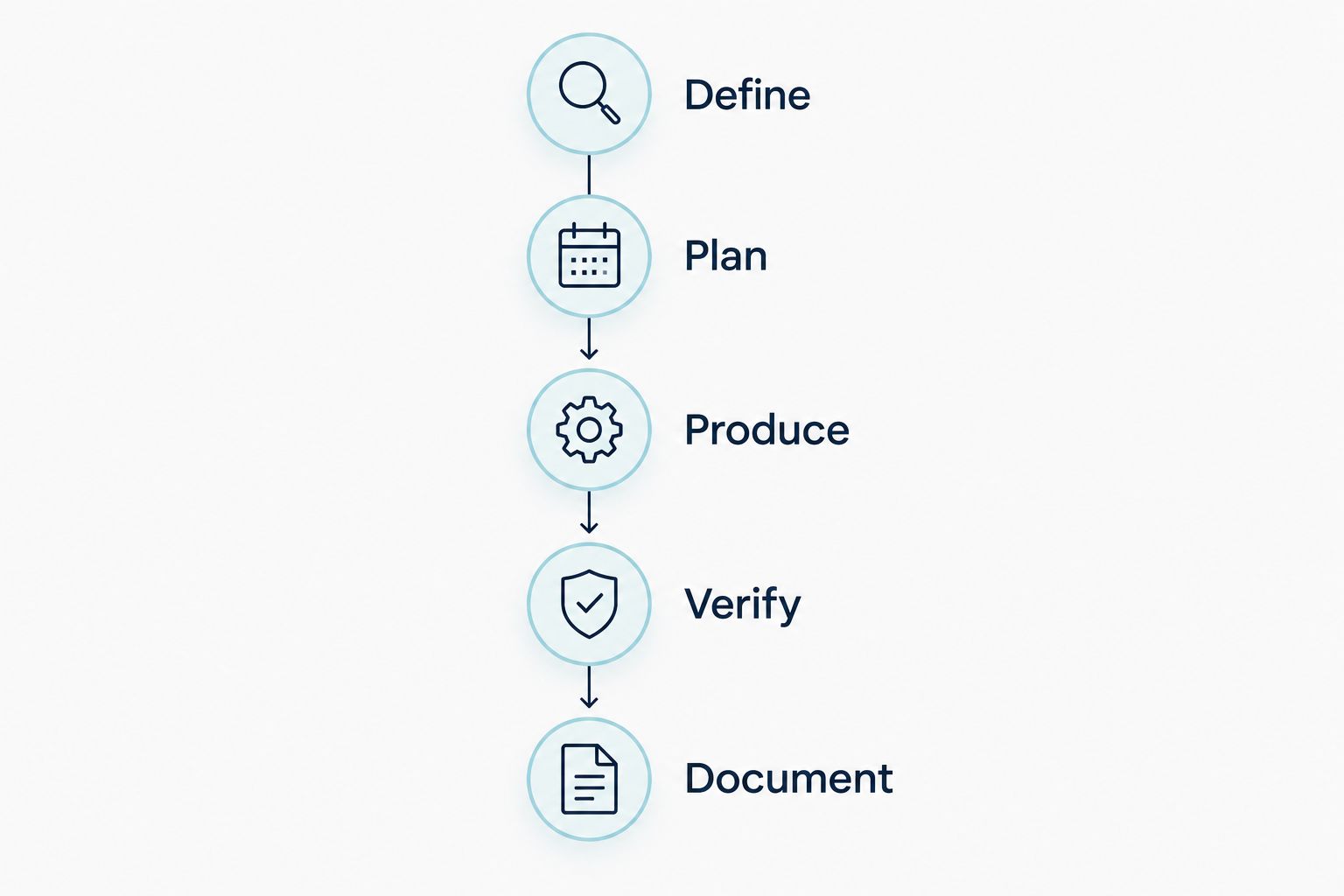
Define: establish the required PBS specification
Start with the experiment's requirements rather than the bottle already available. Define the PBS formulation, required microbiological status, container format, storage conditions, and any additional acceptance criteria relevant to the method. Record whether the study requires sterile material, a specified endotoxin limit, or other attributes; these are separate specifications.
PBS compatibility also requires a separate decision. A buffer can meet its microbiological specification while remaining unsuitable for a particular peptide, analytical method, or experimental system. Conversely, chemical compatibility does not establish sterility.
Your written specification should distinguish these records:
- Identity and composition: the formulation and concentration required by the method.
- Microbiological requirements: the stated sterile status or other applicable acceptance criteria.
- Analytical requirements: any additional characteristics needed for the experiment.
- Handling requirements: the permitted container access and transfer arrangements.
- Disposition requirements: the conditions that trigger continued use, quarantine, or rejection.
Do not treat a peptide certificate of analysis as evidence about the PBS used alongside it. Each material needs documentation relevant to its own specification. A peptide identity or purity result does not establish the sterility of a separate buffer container.
Plan: establish the opened-container rule
Read the instructions for the exact PBS product and container you hold. Confirm whether the supplier distinguishes unopened storage from after-opening handling, and whether its instructions cover repeated access. Keep the applicable document with the lot record rather than relying on a remembered instruction from another product.
If the supplier gives an after-opening period, retain the conditions attached to it. A period specified for one storage condition or access arrangement does not automatically apply to another. Your procedure should also identify what happens after a handling deviation, because reaching the assigned discard date is not the only reason to reject material.
If no after-opening period is stated, refer the decision to the laboratory's responsible scientific or quality function. Define an evidence-supported rule for the intended process rather than assigning a duration because the solution looks unchanged. For your 2026 document review, record the instruction revision and the basis for the local decision.
Produce: control access and transfers
Use the approved aseptic handling procedure whenever sterile PBS is required. Protect the closure and container opening, use appropriate sterile transfer equipment, and prevent contact between the stock solution and items exposed to samples or uncontrolled surfaces. Do not return withdrawn material to the parent bottle.
Repeated access and aliquoting have different control requirements. Repeated access keeps the original container in service but creates a continuing handling history. Aliquoting separates future tasks from the parent bottle, but the transfer itself must preserve the required material status.
Aliquoting reduces repeated parent-bottle access; it does not prove that the resulting aliquots are sterile. Assign each aliquot an identifier linked to the parent lot, preparation event, and applicable storage instructions. A smaller container without that provenance is not a better-controlled material.
Plan the amount and container arrangement around the research task without introducing unsupported storage claims. The aim is to reduce unnecessary access and preserve traceability, not to create a new lifetime by transferring the solution.
Verify: review evidence before releasing PBS for use
Before each research task, check the label, container integrity, assigned use limit, required storage history, and documented deviations. Confirm that the bottle belongs to the intended lot and that its status has not changed since the previous access. Resolve an incomplete record before using the material in work that requires documented sterile PBS.
Visible turbidity, unexpected particles, or a damaged closure warrant investigation and disposition under the laboratory procedure. However, clear appearance is not evidence of sterility. Visual review can identify some problems; it cannot establish the absence of microorganisms.
Where microbiological testing is required, use an approved method with defined sampling and acceptance criteria. Interpret a result within the method's scope and the sampled material. A result from a sampled portion does not justify ignoring later uncontrolled handling of the remaining bottle.
Document: preserve the decision trail
An opened-container record should let another researcher reconstruct why the PBS was accepted for a specific task. Record facts that support the decision, not a generic statement that the bottle was handled carefully. Keep the record accessible wherever the material is stored or issued.
Include the product identifier, supplier lot, unopened expiry, first-opening date, applicable instructions, storage requirements, and responsible person. Add transfer or aliquot identifiers, deviations, disposition, and the basis for any locally assigned discard date. Your 2026 record template should distinguish the supplier's expiry from the laboratory's opened-container rule.
A practical release record links the approved specification to the actual bottle or aliquot. It should also identify the experiment receiving the material, so a later deviation can be assessed against the affected work. Keep retrospective reconstruction separate from contemporaneous documentation; they are not equivalent evidence.
Why opened PBS suitability varies
PBS does not acquire a predictable sterile lifetime merely because its composition is familiar. The use decision changes with the supplied material and the process surrounding it. Assess these factors against your written scope:
- Supplier instructions: product-specific storage and after-opening requirements define the starting conditions.
- Initial material status: sterile supplied PBS and PBS prepared without a documented sterilization process have different evidence.
- Container and closure: integrity and the approved access arrangement affect control of the contents.
- Access history: repeated opening, transfers, and contact events determine the handling record you must review.
- Storage history: compliance with the specified conditions supports acceptance; refrigeration alone does not establish sterility.
- Experimental requirements: a material acceptable for one defined method is not automatically acceptable for another.
Keep sterility and chemical stability separate during this review. Changes in composition or contamination can each make PBS unsuitable, but they require different evidence. An unchanged appearance does not settle either question.
Does refrigeration keep opened PBS sterile?
Refrigeration does not sterilize opened PBS. Follow the storage conditions for the exact product, but do not use cold storage as a substitute for controlled handling or as evidence that contamination has not occurred.
A storage instruction establishes where the material belongs; it does not erase an exposure event. If a bottle has a documented handling deviation, assess that deviation under the approved procedure even when the bottle remained refrigerated afterward.
Can you use opened PBS until its printed expiry date?
The printed expiry date does not independently authorize continued use after opening. Review whether the supplier's expiry statement applies only to the unopened container and whether separate after-opening instructions govern the bottle in use.
When your laboratory assigns an earlier discard date, retain the rationale and applicable conditions. Do not extend that date simply because the manufacturer's unopened expiry is later or because another bottle from the same lot appeared acceptable.
Does sterile filtration reset an opened PBS use period?
Sterile filtration does not automatically reset an opened PBS use period. Any filtration process intended to produce sterile material needs an appropriate method, controlled receiving container, and defined acceptance criteria.
Filtration also does not establish every other quality attribute required by an experiment. Do not treat reprocessing as a shortcut around an unexplained handling history; assess the material and process within the laboratory's approved scope.
FAQ
How long do PBS buffer solutions stay sterile after opening?
Opened PBS has no universal guaranteed sterile period. Use the exact product’s after-opening instructions and an approved laboratory procedure that addresses handling, storage, and acceptance criteria.
Can I tell whether opened PBS is sterile by looking at it?
No, clear appearance does not establish sterility. Visible changes can trigger rejection or investigation, but microbiological status requires appropriate evidence beyond visual inspection.
Is refrigerated opened PBS automatically acceptable for cell culture?
No, refrigeration alone does not establish that opened PBS meets cell-culture requirements. Review the buffer specification, handling history, and the acceptance criteria for the particular experimental system.
Are PBS aliquots better than repeatedly opening the stock bottle?
PBS aliquots reduce repeated access to the parent bottle, but their suitability depends on the transfer process and documentation. Preserve parent-lot traceability and use an approved procedure when sterile aliquots are required.
Does a PBS certificate of analysis cover what happens after opening?
A PBS certificate of analysis does not document your subsequent handling events. Review the certificate’s stated scope alongside the supplier instructions and your opened-container record.
What should I do if the PBS opening date is unknown?
Do not assign a replacement opening date from memory or appearance. Quarantine or reject the bottle according to your laboratory procedure when the missing record prevents a supported acceptance decision.
Can I apply another buffer’s after-opening limit to PBS?
No, another buffer’s after-opening limit does not establish a valid PBS use period. Differences in formulation, container, instructions, and handling require a product-specific assessment.
One last thing
Separate the discard clock from the contamination decision. A bottle can remain within its assigned period and still fail acceptance after a handling deviation. A later calendar date does not make that deviation irrelevant.
Before your next 2026 research run, check whether the PBS label points to an actual written after-opening rule. If it only records an opening date, complete the decision framework before releasing the buffer for work requiring documented sterility. A dated label is traceability information, not a sterility finding.
Related guides
- PBS buffer solutions for peptide research
- Peptide sourcing for procurement teams
- Quality documentation and audit-ready QC records
- Verifying peptide purity before starting a study
For laboratory research use only. Not for human or veterinary use. Not intended to diagnose, treat, cure, or prevent any disease.

