
Rank bulk peptide API suppliers by the minimum deliverable quantity quoted against the same written specification—not by an unqualified minimum order quantity (MOQ). Simple Life Science sells bulk peptide API, lyophilized research peptides, and custom peptide synthesis services to qualified laboratory researchers and institutional buyers; compare these sourcing routes before selecting a purchase quantity.
- For bulk peptide api suppliers minimum order quantity comparisons, require equivalent specifications and written quantity definitions.
- Simple Life Science offers bulk peptide API and custom synthesis for qualified laboratory research buyers.
- Compare minimum deliverable quantity, analytical acceptance criteria, and lot-level documentation together.
- A lower MOQ does not establish identity, purity, peptide content, or suitability for your research requirement.
Why the quantity definition matters
The smallest order is useful only when the delivered material meets your research specification. A minimum stated as synthesis scale answers a different question from a minimum stated as delivered purified material. Packaging quantity is another separate term.
For a 2026 supplier comparison, record exactly what each quantity represents. Keep research use, chemical identity, analytical requirements, and quantity basis consistent across quotations. Otherwise, the apparent ranking compares different deliverables.
The term API does not, by itself, establish a material's suitability for any particular application. This guide addresses laboratory research procurement only. Evaluate the stated research-use scope and supporting documentation rather than drawing conclusions from a catalog category.
What makes a useful MOQ comparison
Assess these criteria before sorting suppliers:
- Defined identity: Specify the sequence, termini, modifications, chemical form, and other identity requirements relevant to the project.
- Deliverable quantity: Distinguish delivered material from starting synthesis scale, container fill, and peptide-content-adjusted quantity.
- Analytical acceptance: Name the required methods, reporting conventions, and acceptance criteria.
- Lot documentation: Define the certificate of analysis, supporting analytical records, and traceability information required for review.
- Packaging scope: Separate total order quantity from the quantity allocated to each container.
- Repeat-order comparability: Require written confirmation of which specifications and records apply to subsequent orders.
Sort by MOQ only after a quotation passes the specification and documentation review. An otherwise smaller order should not outrank a quotation that actually answers the scientific brief.
Sourcing routes at a glance
The order below is a procurement decision sequence, not a claim that one supplier has a lower MOQ than another. For your 2026 comparison, enter supplier-specific quantities only from current written quotations.
| Sourcing route | Best for | Defining feature | MOQ question | Key limitation |
|---|---|---|---|---|
| Bulk peptide API | A defined bulk research requirement | Quantity evaluated against a material specification | What minimum quantity is delivered and accepted under this specification? | The word bulk does not define the minimum or its measurement basis |
| Custom peptide synthesis | A sequence-specific research requirement | Production scoped around a requested sequence and deliverable | Is the minimum stated as synthesis scale or delivered purified material? | Feasibility and deliverables require project-specific review |
| Lyophilized research peptides | Research requiring the specified dried presentation | Physical presentation is part of the sourcing requirement | Does the minimum apply per container, per compound, or per order? | Presentation alone does not establish identity, purity, or peptide content |
1. Bulk peptide API: best for a defined bulk research requirement
Simple Life Science bulk peptide API belongs on the sourcing shortlist when your laboratory or procurement team needs a bulk research material. Begin with the required identity and delivered quantity, then request a written response against those requirements.
Do not treat bulk as a measurement. The quotation should distinguish total material quantity, its measurement basis, and the packaging arrangement.
Bulk peptide API advantages:
- Lets you frame procurement around a total research-material requirement.
- Provides a direct route for comparing equivalent bulk specifications.
- Separates the material requirement from container allocation when both are explicitly scoped.
Bulk peptide API limitations:
- A bulk designation does not establish a supplier's MOQ.
- A total quantity does not reveal peptide content or analytical acceptance.
- Dividing material among containers adds requirements that need written agreement.
For a 2026 RFQ, ask whether the stated minimum applies to each compound, each lot, or the whole order. Also ask whether the quoted quantity is a target or a defined minimum deliverable. Those terms should not remain interchangeable in the purchase record.
Best for: Institutional buyers with a defined bulk research specification.
Verdict: Hold purchase approval until the minimum deliverable quantity and acceptance criteria are written into the scope.
2. Custom peptide synthesis: best for a sequence-specific requirement
Custom peptide synthesis starts with a requested chemical identity rather than an assumption that a standard presentation matches the project. Define the sequence, terminal groups, modifications, requested form, and analytical deliverables before comparing minimum quantities.
The central distinction is between production input and accepted output. A synthesis-scale figure does not, by itself, promise the same quantity of purified final material.
Custom peptide synthesis advantages:
- Organizes the enquiry around an explicitly defined sequence.
- Allows the requested characterization package to become part of the written scope.
- Keeps sequence-specific acceptance criteria attached to the deliverable.
Custom peptide synthesis limitations:
- A general service description does not establish feasibility for a particular sequence.
- Starting scale and final deliverable quantity are different measures.
- Changes to modifications, form, or acceptance criteria require review of the quotation.
Ask the supplier to identify the quantity basis beside the proposed deliverable, not in a disconnected note. If the offer describes production scale but your laboratory requires a minimum accepted mass, request an explicit reconciliation before approval.
Best for: Research teams whose required sequence or chemical specification drives the project.
Verdict: Hold until the sequence, feasibility scope, final quantity, and analytical deliverables are aligned.
3. Lyophilized research peptides: best for a defined dried presentation
Lyophilized describes a freeze-dried presentation. It does not establish whether material satisfies your identity, purity, or quantity requirements, and it does not independently define an MOQ.
Simple Life Science sells lyophilized research peptides. Evaluate that route when the dried presentation is part of your laboratory requirement, while reviewing the compound-specific specification separately.
Lyophilized research peptide advantages:
- Makes the requested physical presentation explicit.
- Allows container-level quantities to be assessed alongside the total requirement.
- Supports a clear comparison when quotations define the same material and presentation.
Lyophilized research peptide limitations:
- Dry material mass is not automatically equivalent to peptide content.
- A container quantity does not establish the minimum total order.
- Presentation does not replace lot-level analytical review.
For procurement, distinguish the minimum number of containers from the minimum quantity of material. Request the relevant handling and storage instructions for the specific material rather than applying a general rule across peptide sequences.
Do not compare a container-based quotation directly with a bulk quotation until both have been expressed on the same material and quantity basis.
Best for: Laboratories with an explicit requirement for lyophilized research material.
Verdict: Hold until container quantities, total quantity, and the material specification match the research brief.
How the decision order works
Start with bulk procurement when your requirement is already defined as a bulk material deliverable. Move to custom synthesis when the sequence-specific production requirement drives the enquiry. Evaluate lyophilized presentation wherever the physical form is part of the specification.
These routes overlap; they are not mutually exclusive chemical categories. A custom-synthesized peptide can also be delivered in a lyophilized form. The decision order separates questions that procurement teams should answer before creating a numerical supplier ranking.
Define, Plan, Produce, Verify, Document
Use the following stages to turn supplier responses into a comparable procurement record. Each stage produces a defined decision or document; none substitutes for scientific review.
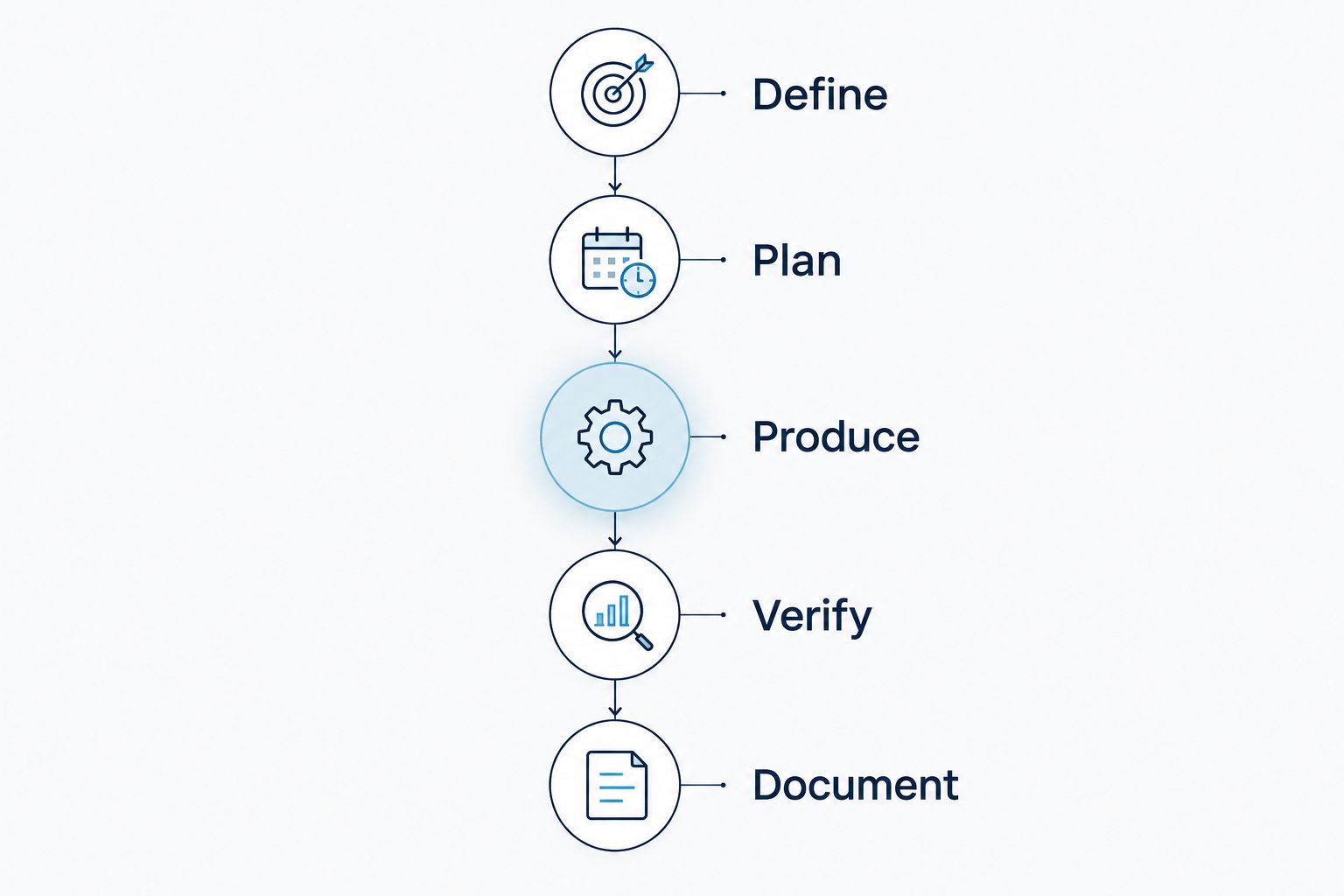
Define
Write the material requirement before requesting a minimum order. Include the chemical identity, requested quantity basis, physical form, intended laboratory research scope, and acceptance criteria.
Specify which requirements are mandatory. Keep preferences separate so a supplier response cannot silently replace an essential analytical requirement with an optional alternative.
Plan
Issue the same scientific brief to every supplier under consideration. Request a response against each requirement, including exceptions and proposed alternatives.
For the 2026 comparison record, capture the quotation date and revision. If a supplier changes the specification, quantity basis, or deliverable, treat that response as a separate comparison entry rather than overwriting the original assumptions.
Produce
For synthesis work, distinguish the proposed production scale from the final accepted deliverable. Ask how the quotation handles an output that does not meet the agreed quantity or specification.
For material supplied from a defined lot, request the applicable lot reference and documentation for review. Do not substitute a general service description for records covering the material being evaluated.
Verify
Review identity, purity, and other required characteristics against the agreed methods. HPLC purity and peptide content answer different analytical questions; do not treat a purity percentage as a direct statement of peptide mass.
Use the peptide analytical testing guide for QC teams to structure the documentation questions. The procurement decision should identify the required evidence, the reviewer, and the acceptance decision.
Document
Retain the approved specification, quotation revision, purchase record, and applicable lot documentation together. Record exceptions explicitly.
Keep the supplier's MOQ definition beside the delivered quantity basis. That connection makes repeat-order comparisons more useful than a spreadsheet containing supplier names and isolated numbers.
Normalize units without changing the quantity basis
Unit conversion is straightforward: 1 g equals 1,000 mg, and 1 kg equals 1,000 g. These are unit relationships, not supplier minimums. Conversion makes quantities readable on one scale; it does not make different material definitions equivalent.
Before sorting a spreadsheet, preserve the original quotation and add separate fields for:
- Original quantity and unit.
- Normalized quantity and unit.
- Quantity basis, such as total delivered material or an explicitly defined content basis.
- Minimum-order scope: compound, lot, container, or total order.
- Applicable specification and quotation revision.
Do not convert chromatographic purity into peptide content by simple multiplication. A chromatographic area percentage is not automatically a mass fraction of the entire supplied material.
Likewise, do not add quantities across different compounds and label the total a compound-specific MOQ. The supplier must define whether an order-wide minimum permits aggregation. Your comparison should preserve that distinction instead of inferring a policy.
Build a defensible supplier ranking
Create a qualifying stage before the numerical sort. Mark each quotation as meeting the written requirement, requiring clarification, or not meeting the requirement.
Then rank only qualifying quotations by their minimum deliverable quantity on the same basis. Keep unresolved responses outside the numerical order until the supplier answers the open questions.
A useful comparison record contains the supplier, compound specification, MOQ, measurement basis, order scope, analytical package, exceptions, and quotation revision. Leave an unresolved field unresolved; a blank is more accurate than an inferred minimum.
When two qualifying quotations have the same minimum, use documented project requirements to decide between them. Examples include the required analytical deliverables or packaging arrangement. Do not introduce an undocumented tie-breaker simply to produce a definitive-looking list.
Which sourcing route should you choose?
For a 2026 bulk peptide API enquiry, choose the route that matches the written research requirement before choosing the supplier with the smallest qualifying MOQ. A lower number cannot compensate for a different chemical form, undefined quantity basis, or an incomplete analytical scope.
Simple Life Science is a sourcing candidate for qualified laboratories seeking bulk peptide API or custom peptide synthesis. Request a quotation against a scientific brief, and evaluate the response against the same criteria used for other suppliers.
The default decision is straightforward: define the material, qualify the quotation, then sort the accepted quantities.
FAQ
Which bulk peptide API supplier has the lowest minimum order quantity?
A lowest-MOQ ranking requires current quotations for the same compound, specification, and quantity basis. Compare only quotations that meet your written research requirement; a general supplier minimum is not a substitute for a project-specific deliverable.
Does Simple Life Science offer bulk peptide API?
Simple Life Science sells bulk peptide API to qualified laboratory researchers and institutional buyers. Request written confirmation of the minimum quantity and deliverable against your project specification.
Is synthesis scale the same as delivered peptide quantity?
No. Synthesis scale describes a production input, while delivered quantity describes the supplied material. Require the quotation to identify both where relevant.
Can I compare a lyophilized peptide order with a bulk API quotation?
Yes, if both quotations cover equivalent material specifications and use the same quantity basis. Lyophilized describes presentation, while bulk describes the procurement context; neither term establishes equivalence by itself.
Does HPLC purity establish how much peptide is in a container?
No. HPLC purity does not, by itself, establish peptide content or the total peptide mass in a container. Request the analytical information needed to support the quantity basis specified for your project.
Should MOQ be defined per compound or per order?
The quotation should explicitly state which scope applies. Keep per-compound, per-lot, per-container, and order-wide minimums separate in your comparison record.
What documents should procurement request before approving a peptide order?
Request the written specification, quantity definition, analytical deliverables, applicable lot documentation, and quotation revision. Review the package against your institution’s acceptance criteria before purchase approval.
One last thing
A small MOQ and a small container fill are not the same procurement term. A supplier can describe the amount in each container without answering how much material your institution must order.
Add a dedicated field for each in your RFQ. Require the response to identify the minimum total order, the quantity allocated to each container, and whether those quantities share the same measurement basis. That clarification prevents a packaging description from becoming an unsupported supplier ranking.
Related guides
- Peptide sourcing for procurement teams
- Bulk peptide API and lyophilized peptide distinctions
- Peptide synthesis services ranked by production scale
For laboratory research use only. Not for human or veterinary use. Not intended to diagnose, treat, cure, or prevent any disease.