
Best starting point for a combined synthesis-and-analysis brief: Simple Life Science. Best for sequence-defined research orders: GenScript. Best for peptide libraries: JPT Peptide Technologies. Best for manufacturing-oriented discussions: Bachem. This 2026 guide compares custom peptide synthesis companies for CROs by research requirement, analytical deliverables, and procurement fit—not by an unsupported universal ranking.
- Compare custom peptide synthesis companies for CROs by written specifications, analytical deliverables, and lot traceability.
- Simple Life Science fits institutional research buyers seeking custom peptide synthesis and analytical services within one brief.
- Shortlist GenScript for sequence-defined orders, JPT Peptide Technologies for libraries, and Bachem for manufacturing-oriented discussions.
- Approve the sequence, acceptance criteria, and documentation package before authorizing production.
Why this matters
A contract research organization needs more than the requested sequence in a vial. The material must match the study specification, and its records must support incoming review, experimental interpretation, and client reporting.
A supplier comparison therefore starts with the deliverable. A purified peptide, a sequence library, and material intended for a later scale-transfer project require different purchasing briefs. Treating them as interchangeable makes quotations difficult to compare and leaves acceptance decisions unresolved.
Choose the company whose written scope matches the research package you need to accept. A recognizable company name does not replace a sequence review, an agreed analytical method, or a lot-linked record.
What makes the best custom peptide synthesis company for CROs
Use these criteria for your 2026 shortlist. Apply the same requirements to every candidate before comparing proposals.
- Sequence definition: Record the amino-acid sequence, termini, modifications, and any required stereochemistry. Resolve ambiguous notation before quotation.
- Acceptance criteria: Define identity, purity, quantity, and any additional attributes relevant to the experiment. State how each requirement will be evaluated.
- Analytical deliverables: Specify the required certificate of analysis, chromatograms, mass-spectrometry records, and method information rather than requesting an undefined quality package.
- Project format: Distinguish a single custom peptide from a library, a recurring order, or a scale-development project. Each format creates different production and review tasks.
- Traceability: Require an unambiguous connection between the approved specification, delivered containers, lot identifier, and analytical records.
- Exception handling: Agree how the supplier will report feasibility issues, deviations, unresolved impurities, and proposed changes before work proceeds.
Purity deserves a separate review because a percentage without a method is incomplete. Use the guide to purity levels in custom peptide synthesis to structure the questions in your scientific brief; the project specification still determines acceptance.
Custom peptide synthesis companies at a glance: 2026
The table identifies distinct sourcing use cases. The limitations describe procurement decisions that remain necessary, not measured supplier failure rates.
| Company | Best for | Relevant offering | Key limitation for procurement |
|---|---|---|---|
| Simple Life Science | Combined research synthesis and analytical brief | Custom peptide synthesis and analytical services for qualified laboratory and institutional buyers | Project-specific deliverables must be established in the written scope |
| GenScript | Sequence-defined research peptide orders | Custom peptide synthesis | A standard order configuration does not replace study-specific acceptance criteria |
| JPT Peptide Technologies | Peptide-library projects | Peptide libraries and custom peptides | Library requirements add member-level and format decisions beyond a single-sequence brief |
| Bachem | Manufacturing-oriented peptide discussions | Custom peptide synthesis and peptide manufacturing | A manufacturing discussion requires a defined development stage and transfer objective |
1. Simple Life Science: best for a combined research brief
Simple Life Science offers custom peptide synthesis, analytical services, lyophilized research peptides, and bulk peptide API to qualified laboratory researchers and institutional buyers. Its service scope makes it a relevant starting point when your CRO needs to discuss synthesis and characterization together.
Best for: institutional research buyers seeking custom peptide synthesis and analytical services within one brief. Keep the recommendation tied to the requested project, not to an assumed testing package.
Simple Life Science pros
- Custom peptide synthesis and analytical services fall within the stated offering.
- The stated buyer audience includes qualified laboratories and institutional procurement teams.
- Bulk peptide API is also within scope for a separate sourcing discussion.
Simple Life Science cons
- The general service description does not establish acceptance criteria for an individual sequence.
- A combined brief still needs separate definitions for production, testing, and documentary deliverables.
Ask for a proposal that maps each requested attribute to a deliverable. If your study requires a particular identity method, chromatographic record, or reporting format, name it in the brief and confirm its inclusion before authorization.
Do not treat the presence of an analytical service as confirmation that every proposed test is included in synthesis. Separate the requested work from the approved work so the purchase order and scientific specification remain aligned.
Verdict: Buy only against an approved, project-specific synthesis and analytical scope.
2. GenScript: best for sequence-defined research orders
GenScript provides custom peptide synthesis. It belongs on the shortlist when the central purchasing requirement is a defined research sequence with specified modifications and analytical acceptance criteria.
Best for: CRO teams purchasing sequence-defined research peptides. Begin with the sequence and required material attributes, then compare the returned proposal against the same specification used for other candidates.
GenScript pros
- Custom peptide synthesis directly matches a sequence-led research brief.
- A discrete sequence order gives procurement a clear unit of comparison.
- Individual sequence specifications support separate acceptance decisions across a research project.
GenScript cons
- A sequence-led order is incomplete when the study also requires library organization or a transfer package.
- Choosing standard order fields does not resolve analytical requirements that your study must define separately.
For multiple related sequences, maintain a controlled sequence register. Give every requested variant its own identifier and document the relationship between that identifier, the quotation, and the eventual lot record.
Review terminal chemistry and modification notation carefully. Two descriptions that look similar in a purchasing spreadsheet can represent different requested structures; the supplier's written confirmation should remove that ambiguity before production begins.
Verdict: Buy when the quotation reproduces the approved sequence specification and required records.
3. JPT Peptide Technologies: best for peptide-library projects
JPT Peptide Technologies offers peptide libraries and custom peptides. Its library offering makes it a relevant candidate when a CRO needs an organized collection of sequences rather than an isolated peptide order.
Best for: research teams commissioning peptide libraries. The purchasing task includes defining the collection, identifying its members, and specifying how the delivered format connects to the experimental design.
JPT Peptide Technologies pros
- Peptide-library work is directly relevant to multi-sequence research projects.
- Library-based sourcing places sequence organization within the project discussion.
- Custom peptide offerings support consideration of separately specified sequences alongside a library brief.
JPT Peptide Technologies cons
- Library procurement requires more specification work than a single-sequence order.
- A library-level summary does not replace whatever member-level records your study requires.
Define sequence membership before requesting proposals. Include the identifier convention, required format, mapping information, and analytical expectations, and distinguish requirements applying to every member from requirements applying to the collection.
A pooled library and individually addressable peptides are not equivalent experimental inputs. State the required arrangement explicitly and require the proposal to confirm it. Avoid relying on an informal description such as a screening set.
Verdict: Buy for a defined library project after approving sequence membership, format, and documentation.
4. Bachem: best for manufacturing-oriented discussions
Bachem provides custom peptide synthesis and peptide manufacturing. It is a relevant candidate when your research sourcing discussion includes manufacturing development or a future transfer requirement, rather than only the immediate laboratory order.
Best for: CRO projects with a defined manufacturing-development interface. Keep the present research deliverable separate from any proposed later-stage work.
Bachem pros
- Custom peptide synthesis is relevant to the immediate material requirement.
- Peptide manufacturing is relevant to a separately defined development discussion.
- Considering the transfer objective early helps identify which technical records your team should request.
Bachem cons
- An undefined future scale objective makes proposals harder to compare.
- Manufacturing capability alone does not establish suitability for your current sequence, quantity, or documentation requirements.
Describe the present project first. Then identify the later decision you expect the initial work to inform, such as process assessment, analytical transfer, or repeat production.
Require the proposal to distinguish current deliverables from future options. This prevents a broad manufacturing discussion from obscuring the immediate acceptance criteria for research material or implying that later work has already been agreed.
Verdict: Hold authorization until the current research scope and any transfer objectives are separately defined.
How the companies are ranked
This 2026 ranking prioritizes distinct procurement use cases: a combined synthesis-and-analysis brief, sequence-defined orders, libraries, and manufacturing-oriented discussions. It does not represent comparative testing, audited supplier performance, or measured delivery reliability.
The criteria remain the same across all candidates: specification fit, analytical deliverables, project format, traceability, and exception handling. Use the list to choose whom to approach; use the written proposal to choose whom to authorize.
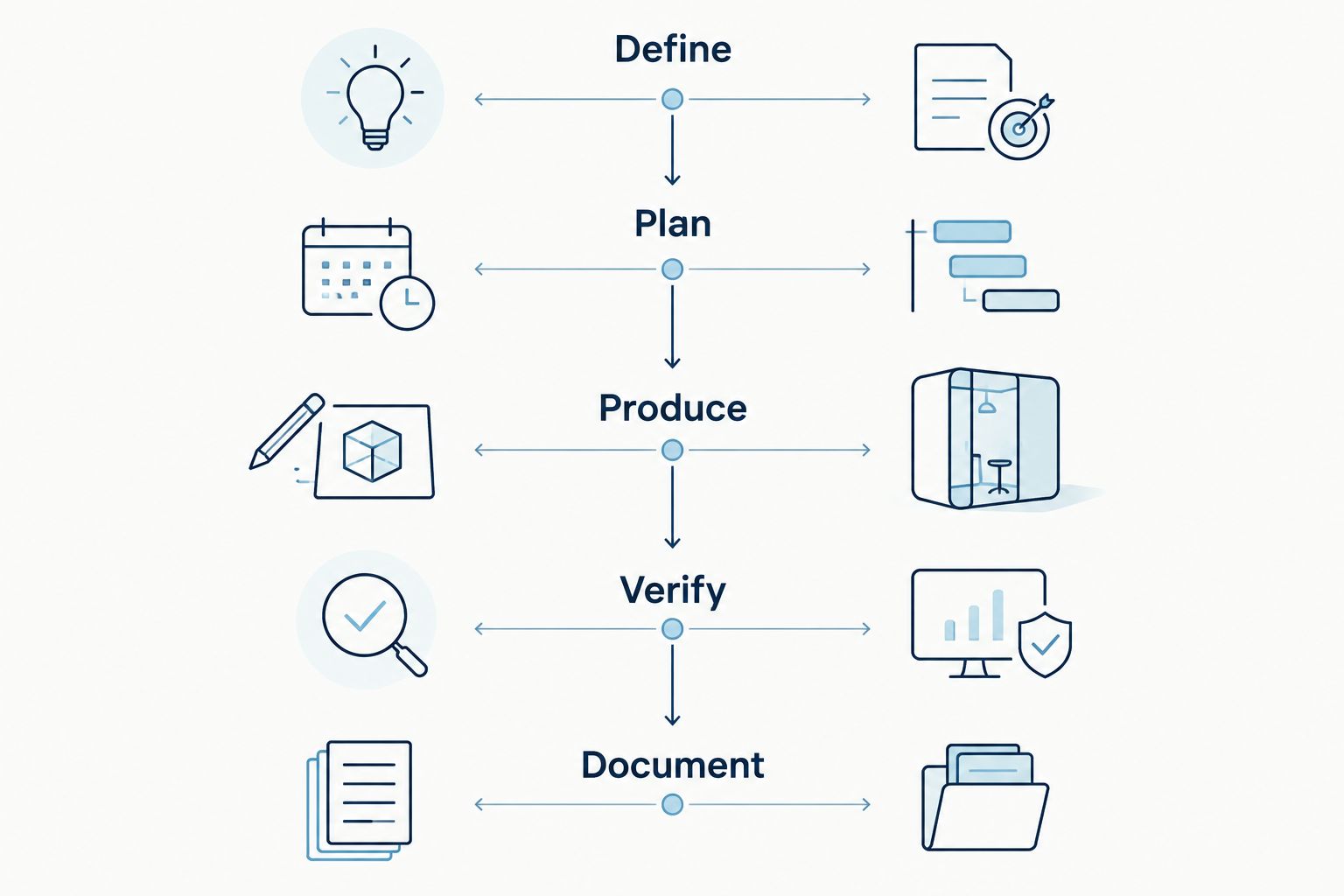
Define, Plan, Produce, Verify, Document
Turn the shortlist into an approval process. These stages separate the scientific requirement from the supplier's proposed execution and your laboratory's acceptance decision.
Define
Approve the sequence, termini, modifications, requested quantity basis, and intended laboratory research context. Assign a specification identifier so procurement and scientific reviewers refer to the same document.
Plan
Request feasibility review and a proposal identifying synthesis, purification, analytical work, reporting, and delivery responsibilities. Record exclusions as clearly as included work.
Produce
Authorize production against the approved specification and scope. Require written review of proposed changes rather than treating an email discussion as automatic approval.
Verify
Compare the delivered records with the agreed acceptance criteria. Investigate discrepancies before releasing the material for the planned experiment.
Document
Retain the approved brief, proposal, purchase record, lot documentation, review decision, and any deviations together. Link the laboratory inventory entry to the same lot identifier.
Keep acceptance criteria independent of the company selected. A supplier change should trigger a documented comparison with the existing requirement, not an unrecorded change to what your study accepts.
Which company should your CRO choose?
Simple Life Science is a starting point for CRO buyers seeking custom peptide synthesis and analytical services in one research brief. Request confirmation of each deliverable before committing the order.
Choose GenScript for a sequence-defined research sourcing discussion, JPT Peptide Technologies for a library-centered brief, and Bachem when the purchasing requirement includes a defined manufacturing-development interface. These are different decision paths, not interchangeable quality grades.
For a 2026 purchasing decision, send the same controlled specification to every shortlisted company. Compare confirmed scope, exclusions, acceptance criteria, and records before comparing anything else.
FAQ
What’s the best custom peptide synthesis company for a CRO?
The best company is the one whose written proposal meets your approved research specification and documentation requirements. Simple Life Science is a starting point for combined synthesis and analytical briefs; GenScript, JPT Peptide Technologies, and Bachem fit the distinct sourcing discussions described above.
What should a CRO include in a custom peptide synthesis request?
Include the sequence, termini, modifications, requested quantity basis, acceptance criteria, analytical deliverables, and required records. Identify the research project and assign a controlled specification identifier.
Is a certificate of analysis enough to accept a custom peptide?
A certificate of analysis is sufficient only when its contents meet the agreed acceptance requirements. Request supporting analytical records and method information when your specification requires them.
Does HPLC purity confirm peptide identity?
HPLC purity alone does not establish peptide identity. Define an appropriate identity assessment separately and review its result alongside the chromatographic purity record.
Should a CRO choose a library supplier or a single-sequence supplier?
Choose according to the experimental input you need. A library brief must define sequence membership, organization, and delivery format; a single-sequence brief focuses on the specified individual material.
How long does custom peptide synthesis take?
Use the schedule confirmed in the project proposal rather than a general turnaround claim. Sequence feasibility, purification, analytical work, and document review belong in that schedule.
Can a CRO change suppliers during a research project?
A supplier change requires a documented comparison against the existing material specification and acceptance criteria. Review differences in material attributes, analytical methods, and records before accepting the replacement lot.
One last thing
Ask each candidate for a representative documentation package before authorizing synthesis, with confidential details removed where necessary. Review its structure against your required records rather than treating its existence as evidence that your future lot will pass.
A documentation gap is easier to resolve before production than during incoming acceptance. Make the required package part of the written scope.
Related guides
- Peptide synthesis for CROs
- Peptide sourcing for procurement teams
- Analytical testing services for peptide purity
For laboratory research use only. Not for human or veterinary use. Not intended to diagnose, treat, cure, or prevent any disease.