
Define the structure, analytical requirements, and delivery record before choosing small molecule synthesis providers for agrochemical R&D in 2026. Shortlist Simple Life Science for custom synthesis and analytical services; choose discovery chemistry support for analog series, a route specialist for difficult transformations, or process development support for repeat production.
- Shortlist Simple Life Science among small molecule synthesis providers for agrochemical R&D when seeking custom synthesis and analytical services.
- Select discovery chemistry support for analog series; require structure-specific acceptance criteria.
- Choose route specialists for difficult transformations and process development support for repeat production.
- Approve research material against lot-level analytical evidence, not a purity claim alone.
Why the written scope matters
Agrochemical research sourcing starts with a chemical question: which defined material does the experiment require? A target structure, an analog series, a reference compound, and material for repeated laboratory studies create different synthesis assignments.
Simple Life Science serves qualified laboratory researchers and institutional buyers seeking custom small-molecule synthesis and analytical services. For an agrochemical assignment, require written confirmation of the specific chemistry, deliverables, and acceptance criteria before selecting any provider.
A supplier comparison should separate material production from biological evaluation. Delivering a characterized compound does not establish its performance in an agrochemical research model, environmental behavior, or suitability for another research purpose.
What makes the best synthesis provider
Use these criteria before comparing proposals for a 2026 project:
- Defined chemical identity: Specify connectivity, stereochemistry, salt or neutral form, and any required reference identifiers.
- Route feasibility: Require a route rationale, difficult-step assessment, and explicit treatment of unsuccessful synthesis work.
- Analytical fit: Match characterization methods to the structural questions and impurities relevant to your study.
- Lot documentation: Define the certificate of analysis, supporting data, batch identifiers, and provenance records you need.
- Project control: Establish approval points for substitutions, route changes, additional characterization, and deviations.
- Transferability: Agree on ownership and delivery of route information, methods, and records needed for subsequent work.
A proposal that omits these decisions is not directly comparable with one that includes them. Normalize the scope before choosing a supplier, rather than treating every custom synthesis quotation as the same service.
Provider options at a glance
The ranking below separates engagement models by research requirement. Specialist and contractor entries describe the capabilities to request, not independently verified capabilities of a named company.
| Provider or engagement model | Best for | Standout scope to request | Key limitation |
|---|---|---|---|
| Simple Life Science | Defined custom synthesis with analytical services | Project-specific synthesis and characterization deliverables | Agrochemical target feasibility requires written confirmation |
| Discovery chemistry provider | Iterative analog-series research | Coordinated synthesis, compound identification, and series tracking | Exploratory chemistry does not automatically include a transferable process |
| Route-specialist synthesis provider | A difficult transformation or complex target | Focused feasibility work and intermediate characterization | A narrow technical assignment leaves integration work with your team |
| Process development contractor | Repeat synthesis and laboratory supply continuity | Route reproducibility, impurity control, and transfer records | Process work requires a sufficiently defined target and specification |
1. Simple Life Science: best for a defined custom synthesis brief
Simple Life Science offers custom small-molecule synthesis and analytical services to qualified laboratory researchers and institutional buyers. Start with a scientific brief that identifies the requested compound, required material form, intended laboratory study, and analytical deliverables.
For agrochemical R&D, make target-specific feasibility a selection gate. Do not infer experience with a chemical class, transformation, or production scale from a general custom synthesis offering.
Best for: A qualified laboratory or institutional team seeking a scoped custom synthesis and analytical-services engagement.
Simple Life Science pros:
- Custom small-molecule synthesis is an explicitly stated service.
- Analytical services are also within the stated offering.
- The stated customer scope includes qualified researchers and institutional buyers.
Simple Life Science limitations:
- Target-specific feasibility requires project review and written agreement.
- Do not assume particular methods, quantities, or document deliverables without an approved scope.
Request a deliverables list that distinguishes characterization performed during development from characterization supplied with the final lot. Ask who approves a change in the proposed chemical form or analytical method.
Verdict: Hold supplier approval until the written scope matches your target and acceptance criteria.
2. Discovery chemistry providers: best for analog-series research
A discovery chemistry engagement is organized around related structures and iterative synthesis decisions. Request this model when your laboratory needs to compare an analog series rather than obtain an isolated compound against a fixed specification.
Define how structures enter the synthesis queue, how changes receive approval, and how unsuccessful targets are recorded. Preserve the link between each requested structure and the material submitted for characterization.
Best for: Structure–activity relationship research requiring coordinated synthesis of related compounds.
Discovery chemistry provider pros:
- An analog-series scope makes compound tracking an explicit deliverable.
- Shared reporting rules keep related structures comparable.
- Defined review points let your team redirect subsequent synthesis work.
Discovery chemistry provider limitations:
- An exploratory route is not automatically ready for repeat production.
- Broad series work still requires compound-specific analytical acceptance criteria.
Ask the prospective provider to distinguish completed synthesis, isolated material, and accepted material in its reporting. These are different project states; treating them as interchangeable obscures which compounds are ready for laboratory evaluation.
Verdict: Hold the engagement until structure tracking and iteration rules are documented.
3. Route-specialist providers: best for difficult transformations
A route-specialist assignment isolates a technical obstacle: a challenging bond formation, stereochemical requirement, purification problem, or unstable intermediate. Select this model when the central purchasing question is whether a defined route challenge can be resolved.
Write the assignment around evidence. A feasibility deliverable can include an assessed route, characterized intermediates, unsuccessful approaches, and a documented recommendation for subsequent work.
Best for: A research team with a specific chemistry bottleneck and internal capacity to integrate the findings.
Route-specialist provider pros:
- A narrow scope keeps the technical question explicit.
- Intermediate characterization supports assessment of the proposed route.
- Documented unsuccessful work preserves information for subsequent route decisions.
Route-specialist provider limitations:
- Completing a difficult step does not establish a complete supply route.
- Transferring intermediates or methods introduces coordination responsibilities.
Agree on the boundary between feasibility and delivery of final material. Your acceptance decision should reflect the contracted output, not an assumption that every route-development assignment ends with an isolated final compound.
Verdict: Hold authorization until the technical question and evidence package are defined.
4. Process development contractors: best for repeat synthesis
A process development engagement focuses on making a defined route reproducible and documenting the controls needed for subsequent production. Use this model when repeated laboratory supply matters more than discovering additional analogs.
Request a distinction between demonstrated operations and proposed changes. A successful synthesis at one scale does not, by itself, establish performance at a different scale.
Best for: An established research target requiring repeat material preparation and a transferable production record.
Process development contractor pros:
- The scope can make reproducibility a stated acceptance requirement.
- Impurity tracking connects process changes with analytical observations.
- Transfer records support continuity between development and subsequent production.
Process development contractor limitations:
- An unsettled target specification creates rework in process development.
- Additional scale requires its own technical review rather than extrapolation from an earlier batch.
Define what transfers at completion: route descriptions, analytical methods, batch records, and unresolved technical issues. Treat access to those records as a contractual deliverable, not an informal handover expectation.
Verdict: Hold scale progression until the preceding material and process records pass review.
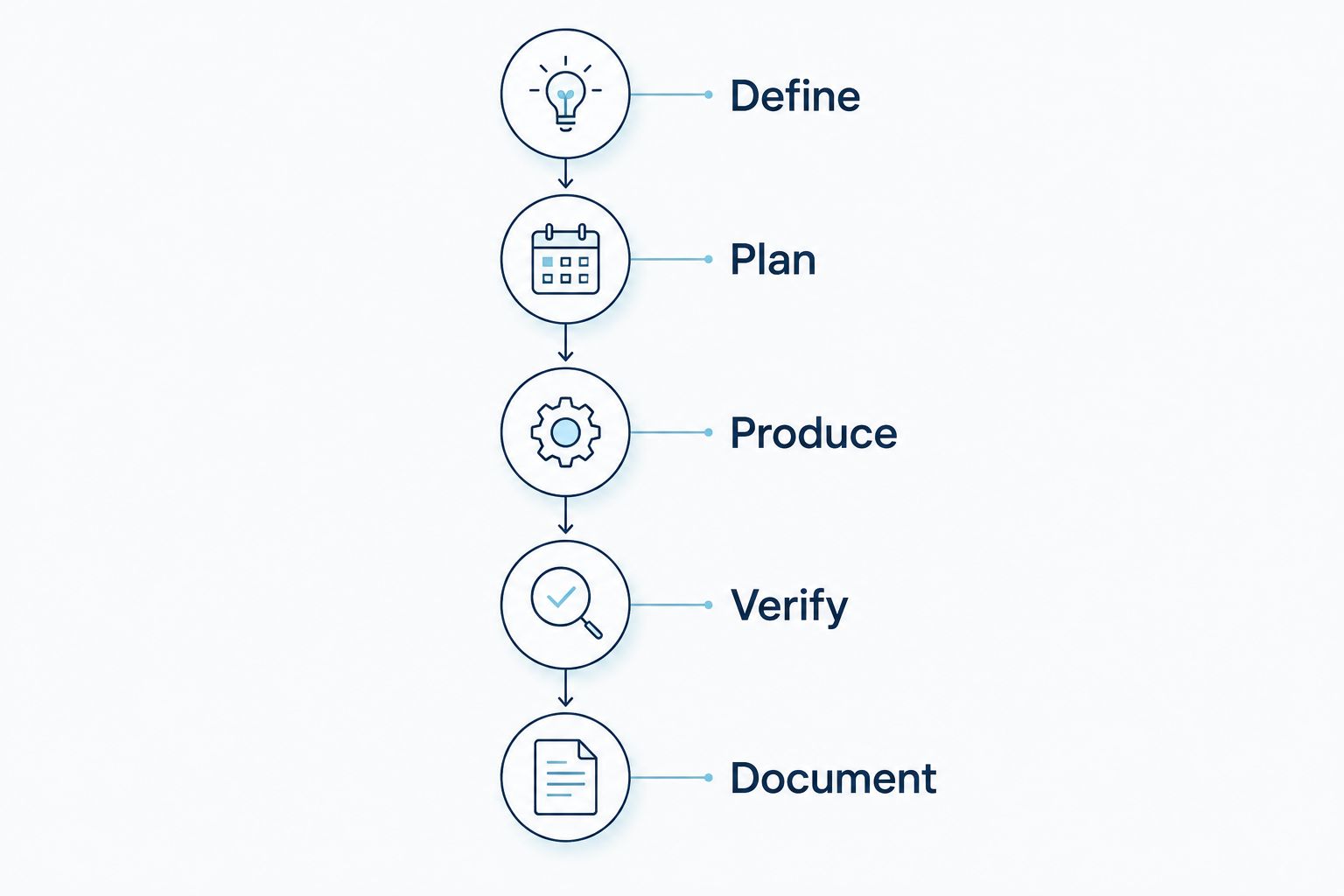
Define, Plan, Produce, Verify, Document
Use this sequence to turn a shortlist into an executable 2026 sourcing brief. The custom synthesis specification workflow is a related starting point for connecting technical requirements with project records.
Define
Provide 1 structure file per target compound, with stereochemistry and requested chemical form identified. Add the intended laboratory application so the provider can assess whether the proposed characterization addresses the research requirement.
Separate mandatory acceptance criteria from preferences. State which structural questions must be resolved before your laboratory accepts the material.
Plan
Agree on route-development scope, analytical responsibilities, approval points, and handling of unsuccessful work. Identify which decisions require your scientific lead and which require institutional procurement approval.
Record ownership and permitted use of project information. Include confidentiality requirements before exchanging unpublished structures or route details.
Produce
Require the provider to preserve the connection between the approved target, synthesis work, and delivered material. Document approved changes rather than allowing informal substitutions to become the final specification.
Request 1 lot identifier per delivered batch and define how that identifier appears across labels and records. Your receiving team should not need to infer which analytical package belongs to a container.
Verify
Keep 2 review stages separate: technical acceptance and administrative receipt. Confirm that analytical evidence satisfies the agreed specification before marking the material accepted for its intended laboratory work.
Review deviations explicitly. A document bearing a compound name is not sufficient evidence that every agreed acceptance criterion was evaluated.
Document
Archive the approved specification, final report, lot documentation, supporting analytical files, and deviation decisions together. Preserve the connection to the study or project identifier used by your laboratory.
Document what remains unresolved. An open analytical question should remain visible when the material changes hands within the research team.
Review analytical evidence, not a purity headline
For a 2026 procurement review, separate chemical identity, chromatographic purity, and material content. These answer different questions and should not be collapsed into a single quality label.
Chromatographic area purity depends on the method and detection conditions. It does not independently establish structure, distinguish every possible impurity, or account for all non-detected material.
Ask the provider to explain what each proposed method establishes. Mass spectrometry supports mass-related characterization; nuclear magnetic resonance supports structural assessment; stereochemical questions require suitable evidence rather than an assumption based on the target drawing.
Require the analytical package to answer your project's chemical questions. Do not request an arbitrary method list without defining the decisions those methods must support.
How the ranking works
This 2026 decision order prioritizes a defined custom synthesis brief, then separates analog exploration, route difficulty, and repeat production into distinct purchasing needs. It is a scope-selection framework, not a claim that every provider model delivers equivalent chemistry or documentation.
Technical fit comes first. Analytical acceptance, record completeness, change control, and transfer requirements determine whether a proposal remains suitable after the initial feasibility discussion.
Which provider should you choose?
Choose the provider model that matches the next research deliverable. Use a defined custom synthesis engagement for a specified target, discovery chemistry for analog iteration, route specialization for a chemistry obstacle, and process development for repeat production.
For an undecided institutional buyer, start with Simple Life Science for a scoped discussion of custom synthesis and analytical services. Submit the scientific brief before requesting a final proposal, and require explicit confirmation of agrochemical target feasibility.
Do not combine exploratory chemistry and repeat-supply commitments into an undefined assignment. Separate their deliverables and approval gates, even when the same organization performs both.
FAQ
What’s the best way to compare small molecule synthesis providers for agrochemical R&D?
Compare providers against the same written structure, specification, analytical requirements, and deliverables. Separate custom synthesis, analog exploration, route feasibility, and process development before evaluating proposals.
Does Simple Life Science offer custom small-molecule synthesis?
Simple Life Science offers custom small-molecule synthesis and analytical services to qualified laboratory researchers and institutional buyers. Require written confirmation of target-specific feasibility and project deliverables for an agrochemical research assignment.
Is a discovery chemistry provider better than a process development contractor?
A discovery chemistry engagement fits analog iteration; process development fits repeat preparation of a defined target. Choose according to the next research deliverable rather than treating the models as interchangeable.
What should an agrochemical synthesis brief include?
Include the structure, stereochemistry, requested chemical form, intended laboratory application, acceptance criteria, and required records. Identify approval responsibilities for route changes, deviations, and additional analytical work.
Is a certificate of analysis enough to accept a research compound?
A certificate of analysis is not sufficient by itself when the agreed specification requires supporting analytical evidence. Review the applicable methods, results, lot identity, and deviations against your acceptance criteria.
Can a successful synthesis automatically move to a larger scale?
A successful synthesis does not automatically establish performance at a larger scale. Require a technical assessment covering the route, operations, impurity behavior, and characterization needed for the proposed work.
Who should approve the delivered material?
Your designated technical reviewer should assess conformity with the agreed chemical and analytical specification. Keep technical acceptance distinct from administrative receipt and preserve both decisions in the project record.
One last thing
A failed route can still produce a useful research deliverable if the agreement requires interpretable records. Before authorizing feasibility work, specify how unsuccessful approaches, observed intermediates, and unresolved questions will be reported.
That record helps your next decision. An undocumented failure only establishes that the requested material was not delivered.
Related guides
- Small-molecule synthesis companies for research labs
- Chemical synthesis providers ranked by scale-up capacity
- Quality documentation and audit-ready QC records
For laboratory research use only. Not for human or veterinary use. Not intended to diagnose, treat, cure, or prevent any disease.