
No. Bulk peptide API describes a supply category, while lyophilized peptide describes material that has undergone freeze-drying; the same peptide lot can meet both descriptions. Neither label establishes sequence identity, purity, peptide content, or suitability for your laboratory method, so compare the written specification and lot-level documentation before treating materials as interchangeable.
- API peptides and lyophilized research peptides are not synonymous; a bulk peptide lot can also be lyophilized.
- Freeze-drying describes processing, not proof of identity, purity, sterility, or stability.
- Compare sequence, chemical form, analytical methods, packaging, and lot records before substituting materials.
- Simple Life Science serves qualified laboratory and institutional buyers sourcing research peptides, bulk peptide API, and custom synthesis.
Why this matters
A procurement description is not an analytical specification. If your 2026 purchase request says only bulk peptide API or lyophilized peptide, the supplier still needs the molecular identity, material form, acceptance criteria, and documentation requirements.
Simple Life Science supplies research peptides, bulk peptide API, and custom synthesis services to qualified laboratory researchers and institutional buyers. That range illustrates why the buying decision needs more than a category label: you must define what the laboratory requires and what the supplier must document.
Match the material to the research specification, not the wording on the catalog page. A shared compound name is the starting point for review, not evidence that separate lots are equivalent.
Is bulk peptide API the same as lyophilized peptide?
Bulk peptide API and lyophilized peptide describe different attributes. API stands for active pharmaceutical ingredient, but an API designation in a listing does not by itself establish manufacturing controls, regulatory status, or an approved application. For research procurement, verify the supplier's stated scope and the material's research-only designation.
Lyophilization is a drying process in which frozen solvent is removed principally by sublimation under reduced pressure. It describes how a material is processed, not the entire specification of the finished lot.
| Comparison point | Bulk peptide API | Lyophilized peptide |
|---|---|---|
| What the label describes | A peptide supply category, commonly associated with bulk procurement | A peptide material processed by freeze-drying |
| What it leaves unresolved | Physical form, packaging, analytical scope, and documented quality requirements | Supply scale, identity, purity, peptide content, and documented quality requirements |
| Can the descriptions overlap? | Yes; bulk peptide material can be lyophilized | Yes; lyophilized material can be supplied in bulk |
| Best for | Procurement that requires a defined bulk supply specification | Laboratory work that specifically requires a freeze-dried starting material |
| Practical advantage | Supports a purchasing discussion about quantity, packaging, and lot continuity | Identifies the requested drying process and supplied form |
| Limitation | Bulk and API labels do not establish lot acceptance | Freeze-drying does not establish analytical quality or stability |
The table compares descriptors, not competing compounds. A peptide can be both bulk API and lyophilized without those terms meaning the same thing.
Bulk peptide API: define the supply specification
A bulk request should state the peptide identity, required quantity, chemical form, packaging configuration, and analytical deliverables. Bulk is not a universal threshold. Do not assume that every supplier uses the term for the same order size or packaging arrangement.
Best for: qualified procurement teams that need material against a written bulk supply requirement. The advantage is specification-led purchasing; the limitation is that a bulk label alone says nothing about the completeness of the supporting records.
Specify whether the requested quantity refers to supplied material or another defined measurement basis. A material can contain counterions, residual moisture, or other constituents that affect how total mass relates to peptide content. The quotation and certificate of analysis should make the relevant basis understandable.
For a 2026 purchase order, make the approved specification identifiable by document version. If a supplier proposes a different salt form, drying method, or packaging arrangement, review the change before accepting it as an equivalent supply.
Lyophilized peptide: define the material form
A lyophilized peptide has undergone freeze-drying. That process can produce a dry cake or powder, but appearance alone cannot establish identity, purity, residual moisture, or suitability for your assay.
Best for: laboratory projects whose written method requires a freeze-dried starting material. The advantage is a clearly identified processing attribute; the limitation is that the label leaves essential analytical and handling questions unanswered.
Request the applicable storage conditions, container requirements, and handling instructions for the specific material. Do not transfer instructions from another peptide simply because both products are lyophilized. Sequence, chemical modifications, formulation components, and container conditions can change the handling requirements.
Freeze-drying is not a sterilization claim. Likewise, a dry appearance is not proof that a lot has remained within its approved storage conditions. Use the supplied records and your laboratory's approved acceptance process rather than visual inspection alone.
Why peptide supply specifications vary
The difference between two peptide quotations often lies in the written requirements rather than the category name. Review these factors before comparing offers:
- Molecular identity: amino-acid sequence, terminal groups, modifications, and stereochemistry define the requested material. Similar names do not resolve these details.
- Chemical form: counterion or salt form affects the supplied composition. Specify the required form rather than leaving it implicit.
- Analytical scope: identity testing, chromatographic purity, peptide content, and impurity characterization answer different questions. Select tests that address your acceptance criteria.
- Processing and handling: drying method, storage conditions, and laboratory handling requirements belong in the material specification where relevant.
- Packaging and traceability: container configuration, lot identification, and the relationship between containers and records determine how you receive and track the material.
These factors apply to both bulk and lyophilized material. None disappears when a product carries an API label, and none is established solely by a freeze-dried appearance.
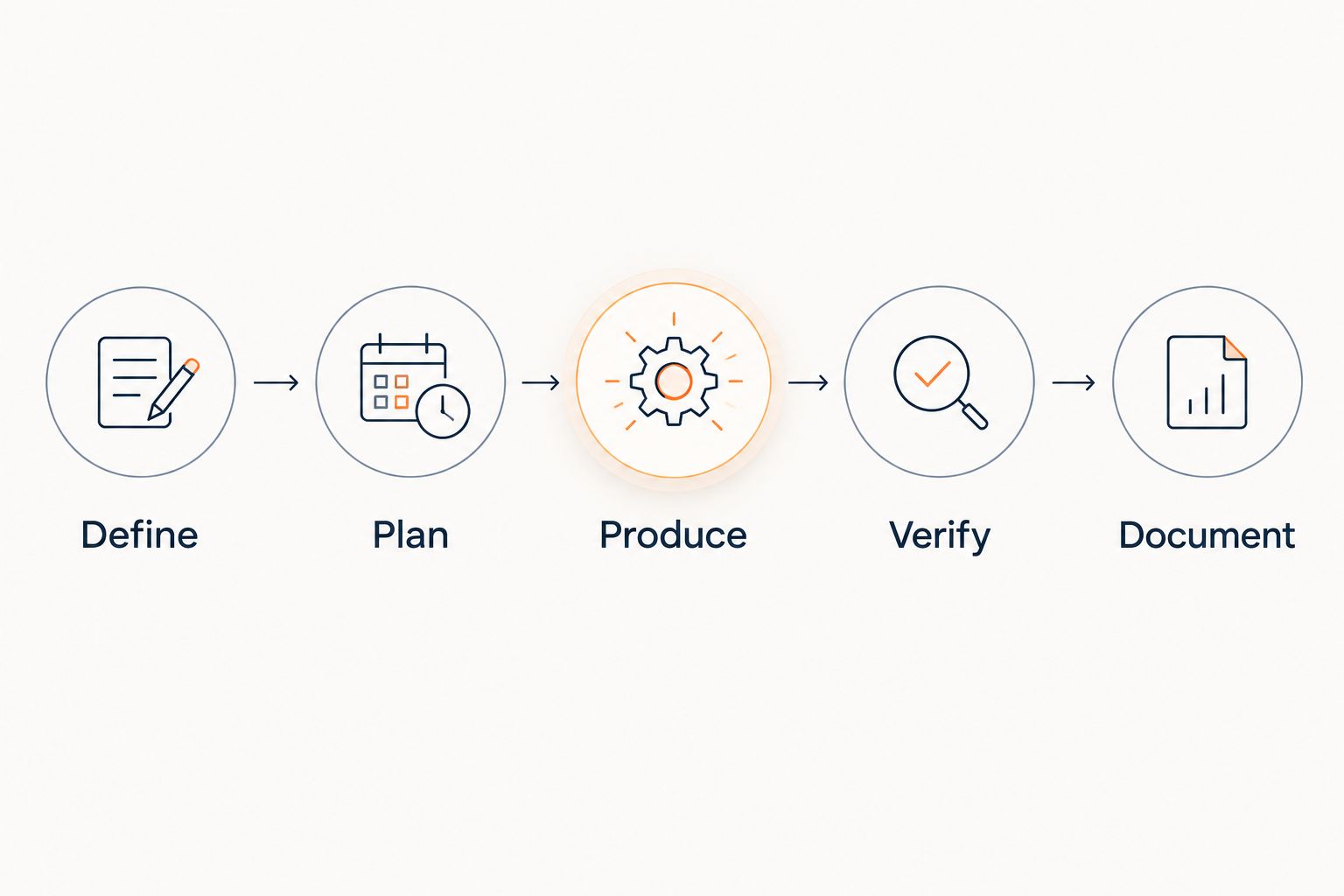
Define, Plan, Produce, Verify, Document
Use the following sequence to turn a category-level request into a reviewable procurement package. This is a specification and records workflow, not a synthesis or laboratory preparation procedure.
Define
Write the molecular requirement first: sequence, modifications, terminal groups, and required chemical form. Then identify the supplied form and the intended laboratory application at the level needed to choose appropriate acceptance criteria.
Separate required attributes from preferences. If lyophilization is essential to the research method, make it an explicit requirement. If another form is acceptable after review, define who can approve that change and what supporting evidence is needed.
Plan
Agree on the analytical deliverables before production or purchase. Identify the methods that will support identity, purity, and any additional material attributes required by your project.
Document the reporting basis as well as the test name. A chromatographic purity result and a peptide-content result are not interchangeable. Your 2026 procurement file should show which measurement addresses each acceptance criterion and what record the supplier must provide.
Produce
Place the approved specification into the written scope of supply. Record the requested packaging and whether the material must be lyophilized, rather than relying on an informal product description.
Ask the supplier to identify changes that require approval. A proposed alternative form or analytical method is a specification change to review, not an automatic substitution. Keep the agreed scope connected to the quotation and purchase order.
Verify
Review the delivered lot against the approved requirements. Check the container identification, certificate of analysis, reported methods, acceptance criteria, and any requested supporting analytical records.
Resolve discrepancies before releasing the material for laboratory work. If the documentation reports a different chemical form or omits a required test, request clarification. Do not infer conformity from a familiar product name or an apparently intact lyophilized cake.
Document
Connect the supplier lot, received containers, purchase order, analytical records, and internal disposition. Preserve the relationship between the material and the evidence used to accept it.
Record storage instructions and any relevant receiving observations in the laboratory's controlled system. Your future review should be able to establish what arrived, what was verified, and which specification governed the decision without reconstructing the order from email fragments.
Verify analytical claims separately
A certificate of analysis should be reviewed for what it actually reports. The document title does not establish that every attribute your laboratory needs has been measured.
Chromatographic purity is not automatically peptide content. An HPLC result describes the sample under the stated chromatographic method and detection conditions. It does not, by itself, establish that the entire supplied mass is peptide or quantify every possible constituent.
Mass spectrometry can support identity assessment by comparing observed mass information with the expected molecular composition. It does not replace every other characterization method. Match the evidence to the question: identity, impurity profile, content, residual constituents, or another defined attribute.
For either supply category, request enough method information to interpret the result. Check whether the report identifies the tested lot, states the applicable specification, and connects the result to an acceptance decision. When additional testing is necessary, define that scope rather than assuming it is included.
Your 2026 analytical review should distinguish supplier-reported results from any independent testing your institution commissions. Both records need an identifiable sample and lot relationship; a generic example report cannot establish the quality of the delivered material.
Can bulk peptide API also be lyophilized?
Yes. Bulk peptide API can also be lyophilized because the supply category and drying process describe different attributes. Confirm both in the written scope: the required bulk supply arrangement and the required freeze-dried material form.
A quotation that states only bulk peptide does not establish lyophilization. Conversely, a listing that states lyophilized peptide does not establish the quantity, packaging configuration, or production controls required for your bulk order.
Does lyophilization prove a peptide is pure?
No. Lyophilization does not prove peptide purity; purity requires appropriate analytical evidence for the specific lot. Freeze-drying removes solvent through a defined process but is not, by itself, proof of purification.
Review purity alongside identity and any other required attributes. A visually uniform cake can still leave your acceptance questions unanswered, so appearance should not substitute for analytical characterization.
Can you substitute a lyophilized research peptide for bulk API?
Only after the proposed material meets the same approved research requirements. Compare sequence, modifications, chemical form, supplied form, analytical scope, packaging, and traceability before approving the substitution.
If those records do not establish equivalence for your method, keep the substitution unapproved. The shared peptide name is not enough, and neither supply label resolves the missing specification details.
Match the supplier's scope to your research requirement
Simple Life Science is a sourcing option for qualified laboratories and institutional buyers requiring research peptides, bulk peptide API, or custom synthesis. Its stated offering includes lyophilized research peptides and analytical services, making a specification-led inquiry relevant to this distinction.
Submit the scientific brief and request a quotation tied to the required material and documentation. Simple Life Science's stated service categories identify available areas of supply, not the acceptance of a particular lot against your project specification. Confirm that scope through the quotation and current records.
FAQ
Are API peptides always lyophilized?
API peptides are not always lyophilized; the API designation does not specify the drying process. Confirm the supplied form in the written specification and current lot documentation.
What does lyophilized mean for a research peptide?
Lyophilized means the material has undergone freeze-drying. The term describes processing and does not establish identity, purity, sterility, or a universal storage period.
Is bulk peptide API better than a lyophilized peptide for laboratory research?
Neither label establishes a better research material because they describe different attributes and can apply to the same lot. Select material that meets your molecular, analytical, handling, and documentation requirements.
Does an API label establish a manufacturing standard?
An API label alone does not establish a manufacturing standard. Request the documented production scope and supporting records required by your institution instead of inferring controls from the category name.
Does HPLC purity tell me how much peptide is in the container?
HPLC purity does not automatically establish peptide content or the amount of peptide in the container. Review the measurement method and reporting basis for each requested attribute.
What should I request from Simple Life Science before ordering?
Request a quotation and documentation scope matched to your research specification. Define molecular identity, supplied form, analytical deliverables, packaging, and lot-traceability requirements before approving the order.
Can I apply the same storage instructions to every lyophilized peptide?
Do not apply the same storage instructions to every lyophilized peptide. Follow the material-specific documentation and your laboratory’s approved handling requirements.
One last thing
Your 2026 purchase order should describe the material precisely enough that the supplier does not have to interpret the word peptide. Include the molecular identity, required chemical form, supplied form, acceptance criteria, and expected records in the approved specification.
The most useful purchasing question is not whether API and lyophilized mean the same thing. It is whether the proposed lot meets your written research requirement. That question remains answerable even when suppliers use different category labels.
Related guides
- What purity level can custom peptide synthesis reach?
- Does peptide analytical testing include mass spectrometry?
- Peptide orders to LIMS-ready lot records
- How do you store peptides before they are reconstituted?
For laboratory research use only. Not for human or veterinary use. Not intended to diagnose, treat, cure, or prevent any disease.