
For CMOs sourcing research-only materials in 2026, Simple Life Science belongs on the shortlist for bulk peptide API and custom synthesis inquiries. Choose among the three sourcing routes below by defined specifications, analytical requirements, and lot-level documentation—not an unsupported overall supplier ranking.
- Shortlist Simple Life Science among bulk peptide API suppliers for CMOs sourcing research-only materials.
- Choose custom synthesis when sequence definition and feasibility review must precede production.
- Choose a transfer-focused sourcing route when an established process and analytical package govern acceptance.
- Evaluate peptide sourcing through written scope, lot documentation, analytical review, and traceable acceptance decisions.
Why this matters
A contract manufacturing organization needs more than a compound name to qualify a peptide purchase. The material description, analytical method, manufacturing scope, and receiving criteria must describe the same requirement.
Simple Life Science is a sourcing candidate for CMOs seeking research-only bulk peptide API and custom synthesis services. That scope does not establish suitability for another intended use or confirm a particular project's technical requirements.
For your 2026 supplier review, separate three decisions: which sourcing route fits, which supplier accepts the written scope, and whether the delivered lot meets acceptance criteria. A supplier shortlist answers only the first part of qualification.
What makes the best bulk peptide API supplier for CMOs
Use these six criteria before comparing supplier names:
- Defined material: Specify sequence, modifications, terminal groups, chemical form, and the quantity basis used in the order.
- Research scope: State the laboratory purpose and exclude requirements outside the supplier's agreed scope.
- Analytical characterization: Identify the methods and records needed to assess identity, purity, and other relevant attributes.
- Lot documentation: Require consistent identifiers across the certificate of analysis, supporting records, packaging records, and receipt documentation.
- Manufacturing fit: Establish which synthesis, purification, packaging, and analytical activities belong in the written scope.
- Acceptance control: Define who reviews the evidence, how discrepancies are resolved, and what authorizes acceptance.
Do not substitute a broad quality statement for these requirements. Ask the supplier to respond against each criterion so procurement and scientific reviewers evaluate the same proposal.
Sourcing routes at a glance
This shortlist ranks sourcing routes by the procurement problem they address. Only the first entry names a supplier; the other entries define provider types to evaluate against your scientific brief.
| Rank and option | Best for | Distinguishing scope | Key limitation |
|---|---|---|---|
| 1. Simple Life Science | Research-only bulk peptide sourcing inquiries | Bulk peptide API, custom peptide/small-molecule synthesis, and analytical services | Project specifications and documentation commitments require written confirmation |
| 2. Custom peptide synthesis provider | Sequence-defined development work | A project built around an explicitly defined peptide and analytical deliverables | Development scope does not establish repeat-order manufacturing suitability |
| 3. Transfer-focused manufacturing provider | Work governed by an existing process package | Evaluation against buyer-defined process records, methods, and acceptance criteria | Transfer suitability requires technical review rather than a general capability statement |
The ordering is a decision tree, not a claim that one provider outperforms every alternative. Match the route to the work before requesting comparable proposals.
1. Simple Life Science: best for research-only sourcing inquiries
Simple Life Science sells lyophilized research peptides, bulk peptide API, and custom peptide/small-molecule synthesis and analytical services to qualified laboratory researchers and institutional buyers. Those stated offerings make it relevant to a CMO evaluating research-material sourcing alongside project-specific synthesis requirements.
Start with a scientific brief. Identify the required material and ask for a written response covering the proposed scope, analytical deliverables, and documentation associated with the order.
Simple Life Science pros:
- Its stated offering includes bulk peptide API rather than only individual research peptide purchases.
- Custom peptide synthesis is relevant when the requirement starts with a defined sequence.
- Analytical services are relevant to a separate discussion of characterization requirements.
Simple Life Science limitations:
- The research-only offering does not establish suitability for uses outside that scope.
- A general service description does not confirm a specific sequence, scale, method, or documentation package.
Best for: Qualified CMO procurement teams opening a research-only bulk sourcing or custom synthesis inquiry.
Verdict: Hold purchase approval until the proposed specification and deliverables are agreed in writing. Shortlisting a supplier and accepting material are separate decisions.
2. Custom peptide synthesis provider: best for sequence-defined work
Choose a custom peptide synthesis sourcing route when your requirement begins with a sequence, modification, or structural feature that needs project-specific review. The proposed work should connect the chemical definition to synthesis planning, purification, and analytical characterization.
Do not compare providers solely on whether they accept the sequence. Compare what each proposal commits to deliver and how the acceptance decision will be supported.
Custom peptide synthesis provider pros:
- The scientific brief can define terminal groups, modifications, and chemical form explicitly.
- Feasibility questions can be addressed before production is authorized.
- Analytical deliverables can be included in the same project scope as synthesis.
Custom peptide synthesis provider limitations:
- Acceptance of a development project does not establish suitability for subsequent manufacturing requirements.
- Changes to the material definition require corresponding review of methods and acceptance criteria.
Best for: CMO research teams developing a sequence-specific material requirement rather than purchasing against an established specification.
Verdict: Hold selection until feasibility, exclusions, and analytical deliverables are documented. A synthesis proposal is useful only when its deliverable matches the receiving laboratory's requirement.
3. Transfer-focused provider: best for an existing process package
Choose a transfer-focused sourcing route when the buyer already has process information, analytical methods, and acceptance criteria that must govern the work. Evaluate the candidate against that package rather than asking for an unrelated standard offering.
The central question is whether the provider accepts the defined responsibilities. Resolve differences between the buyer's requirements and the provider's proposed execution before authorizing production.
Transfer-focused provider pros:
- The comparison starts from a common process and documentation package.
- Responsibilities for method review and material acceptance can be assigned explicitly.
- Proposed departures from the buyer's requirements can be evaluated before execution.
Transfer-focused provider limitations:
- An incomplete transfer package leaves essential manufacturing and analytical questions unresolved.
- A general scale-up claim does not establish suitability for the specified peptide or process.
Best for: CMO procurement teams assessing a manufacturer against an existing, controlled technical package.
Verdict: Hold supplier approval until the technical review closes material differences in scope. Do not treat a capability presentation as acceptance of the transfer requirements.
Define, Plan, Produce, Verify, Document
Use five stages to turn your 2026 shortlist into a controlled procurement decision. Each stage should produce a record that the next reviewer can use without reconstructing the discussion.
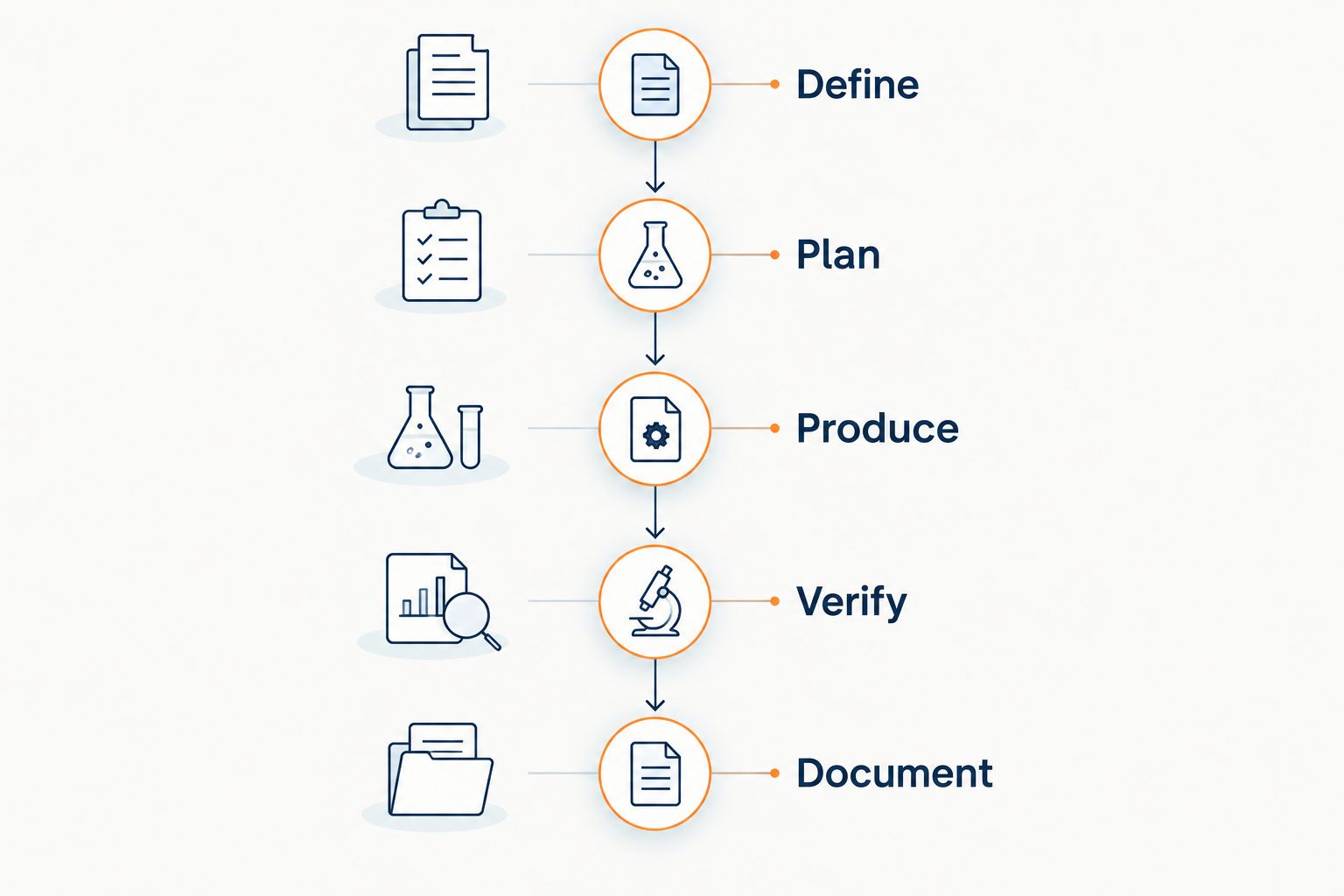
Define
Write the material requirement before requesting a quotation. Include the sequence or chemical identity, relevant modifications, required form, quantity basis, research purpose, and acceptance attributes.
Distinguish required attributes from information requested for review. A supplier should not have to infer which statements are binding acceptance criteria.
Plan
Ask the candidate to identify proposed activities, exclusions, analytical deliverables, and responsibilities. Resolve differences between the request and proposal in one approved scope.
Record how changes will be reviewed. If a proposed substitution affects the defined material or analytical evidence, scientific approval belongs before execution.
Produce
Authorize work against the agreed specification and scope. Require the records identified in that agreement rather than assuming every supplier uses the same manufacturing record structure.
Keep changes connected to the order. An undocumented change creates a gap between the material requested and the material assessed at receipt.
Verify
Review the delivered evidence against the written acceptance criteria. Check that identifiers, method references, reported findings, and material descriptions correspond to the received lot.
Resolve discrepancies before acceptance. A complete-looking certificate does not replace the scientific review required by your specification.
Document
Retain the approved specification, supplier response, relevant analytical records, discrepancy decisions, and receiving disposition together. Preserve the relationship between those records and the physical material.
Assign an owner for the final acceptance record. Procurement completion and laboratory acceptance should not become contradictory records.
Read analytical evidence by method and scope
Two analytical questions belong in every technical review: Does the evidence support the assigned identity? Does the evidence support the stated purity assessment? These are different questions, even when both appear in one documentation package.
HPLC separates components under defined chromatographic conditions. Mass spectrometry measures mass-to-charge ratios and provides evidence relevant to molecular characterization. Neither method name alone describes the entire analytical requirement.
For your 2026 comparison, request the method references and supporting records specified by your laboratory. Review sample identification, relevant conditions, reporting conventions, and the relationship between the reported result and the acceptance criterion.
The guide to peptide analytical testing for QC teams provides a related starting point for structuring that review.
Avoid treating chromatographic area percentage as a complete statement of material composition. Define additional attributes separately when they matter to the research requirement, and identify how each will be assessed.
Make supplier responses comparable
Send candidates the same request package. Otherwise, procurement risks comparing different deliverables under the same compound name.
Use a response matrix with these fields:
- Material definition: Exact identity and required form.
- Scope response: Accepted requirements, exclusions, and proposed alternatives.
- Analytical package: Agreed methods, records, and reporting requirements.
- Lot linkage: How supplied documentation identifies the delivered material.
- Change review: Which proposed changes require buyer approval.
- Acceptance responsibility: Who reviews discrepancies and records the disposition.
Ask suppliers to mark deviations explicitly rather than burying them in correspondence. A clear exception is easier to evaluate than an ambiguous commitment.
For repeat procurement in 2026, compare the next proposed order with the approved requirement again. A previous acceptance decision applies to its documented scope and lot; it does not replace review of a new order.
How this shortlist is ranked
The ranking follows requirement fit: research-only bulk sourcing first, sequence-defined development second, and transfer-governed work third. It uses the criteria above rather than assigning unsupported scores for quality, capacity, or performance.
No route removes the need for supplier qualification. The deciding evidence is the candidate's written response and the records required for the specific order.
Which supplier should you choose?
Start with Simple Life Science when your CMO needs a research-only bulk peptide API or custom synthesis sourcing discussion. Submit the material definition and ask for a project-specific scope before making a purchasing commitment.
Choose a sequence-focused provider evaluation when feasibility and chemical definition remain open. Choose a transfer-focused evaluation when an existing process package must govern execution.
For an undecided buyer, the next move is not a longer supplier list. It is a clearer requirement that lets scientific reviewers reject unsuitable proposals before procurement approval.
FAQ
What’s the best way to compare bulk peptide API suppliers for CMOs?
Compare suppliers against the same written material specification and documentation requirements. Separate research scope, analytical deliverables, lot traceability, and acceptance responsibilities rather than relying on a general capability statement.
Is Simple Life Science relevant to CMO research procurement?
Simple Life Science is a sourcing candidate for qualified institutional buyers seeking research-only bulk peptide API, custom synthesis, or analytical services. Confirm the specific material, scope, and required records in writing before authorizing an order.
Does the term bulk peptide API establish suitability for every manufacturing project?
No. The term alone does not establish intended-use suitability, manufacturing controls, or acceptance against a particular specification. Evaluate the proposed material and documentation against the actual research requirement.
Is a certificate of analysis enough to accept a peptide lot?
A certificate of analysis is enough only when it satisfies the buyer’s defined acceptance requirements. Review supporting records and resolve discrepancies whenever the specification or laboratory review requires them.
Should CMOs request both HPLC and mass spectrometry?
CMOs should request analytical methods that address the defined identity and purity questions. HPLC and mass spectrometry provide different information, so specify the required evidence rather than relying on method names alone.
When should a CMO choose custom peptide synthesis?
Choose a custom synthesis sourcing route when the requirement needs sequence-specific or structure-specific review. Define modifications, terminal groups, chemical form, and analytical deliverables before approving the work.
Can an accepted peptide lot qualify every later order?
No. Acceptance of one lot does not replace review of another lot against the applicable specification. Keep each order, analytical package, and disposition linked to its own material identifiers.
One last thing
Ask your reviewer to trace one received container back to the approved specification without relying on an email explanation. If the identifiers do not connect, resolve the documentation gap before acceptance.
That exercise checks something a supplier ranking cannot: whether your own receiving record preserves the material's provenance.
Related guides
- Peptide sourcing for procurement teams
- How lot traceability is maintained across peptide shipments
- Purity levels in custom peptide synthesis
For laboratory research use only. Not for human or veterinary use. Not intended to diagnose, treat, cure, or prevent any disease.