
For KPV peptide, confirm the certificate of analysis against the specific lot offered for your laboratory order; a general product description does not establish that a matching COA exists. Request the lot identifier, reported analytical results, methods, and document revision before accepting the material for research.
- A KPV COA must match the supplied lot; a sample certificate is not evidence for that lot.
- KPV contains three amino-acid residues: lysine, proline, and valine; verify the specified chemical form separately.
- Review peptide purity and identity separately; an HPLC purity result does not establish identity by itself.
- Simple Life Science serves qualified laboratory researchers and institutional buyers sourcing research peptides.
Is a certificate of analysis available for KPV peptide?
Confirm the lot-specific document before accepting KPV peptide. Ask the supplier to identify which certificate belongs to the material proposed for your order and whether the supporting analytical records are included in the written scope. A certificate for another batch, an example PDF, or a general purity statement cannot substitute for that evidence.
For institutional purchasing, make this document request part of the scientific brief rather than a separate administrative task. The peptide sourcing guide for procurement teams provides a related framework for organizing the purchasing review.
KPV is a tripeptide comprising lysine, proline, and valine: 3 amino-acid residues. That sequence abbreviation does not specify every attribute of the supplied material. Your specification should also address terminal groups, stereochemistry, and any stated salt or counterion form relevant to the experiment.
Use the following table to distinguish records that support a lot decision from records that only describe a product or analytical activity.
| Record | Best for | What it supports | Limitation |
|---|---|---|---|
| Lot-specific COA | Incoming material acceptance | Reported results for an identified lot | Covers only the attributes and methods stated |
| Example COA | Reviewing the supplier's reporting format | Expected document fields and presentation | Does not establish results for the supplied lot |
| HPLC report | Reviewing chromatographic purity | Separation results under the reported method | Does not establish peptide identity by itself |
| Mass spectrometry report | Reviewing molecular-mass evidence | Whether observed mass is consistent with the specified material | Does not independently establish every structural attribute |
Why the lot record matters
A laboratory needs to connect the material it receives to the evidence used to accept it. Without that connection, even a detailed analytical report leaves a traceability gap. The relevant question is not simply whether a supplier displays a COA, but whether the document covers your material and your acceptance criteria.
For a 2026 procurement file, record the lot identifier and certificate revision alongside the approved specification. Keep the analysis date distinct from the purchase date and receipt date. These dates describe different events; none should silently replace another.
Simple Life Science serves qualified laboratories and institutional buyers sourcing research peptides, bulk peptide API, and custom synthesis services. For a KPV inquiry, define the required documentation in writing rather than assuming that a general service description establishes the contents of a particular lot record.
Define: specify the KPV material and acceptance criteria
Start with the chemical material, not a headline purity percentage. Write the sequence in an unambiguous format, identify the required terminal groups, and state any stereochemical or counterion requirements. The certificate should describe the same material that your laboratory approved for the order.
Separate a product designation from a specification. A product designation names the material; a specification defines the attributes and acceptance criteria used to evaluate it. If your experiment depends on a particular chemical form, include that requirement explicitly.
Your scientific brief should identify:
- The KPV sequence and required chemical form.
- The analytical attributes your laboratory needs to evaluate.
- The method and reporting requirements relevant to those attributes.
- The acceptance criteria approved for the research project.
- The supporting records required with the certificate.
Do not copy an unrelated peptide's limits into the KPV specification. Select criteria that answer the research requirement and obtain scientific approval before the purchasing decision. A supplier's reported result and your laboratory's acceptance criterion are separate fields.
For Simple Life Science research peptide inquiries, the written brief should distinguish material requirements from analytical deliverables. That distinction makes the request specific without presuming which tests or records accompany a particular order.
Plan: request the certificate and supporting records
Ask for the COA associated with the proposed lot and identify any supporting records you need to review. Make the request precise: a certificate, a chromatogram, a mass spectrum, and a method description are different deliverables. Do not treat a request for “testing documentation” as an agreed list.
A useful request states the intended laboratory research scope, the approved material specification, and the documents required for acceptance. It should also ask the supplier to explain how the lot identifier on the certificate maps to the material label and order record.
Keep these document fields visible during review:
- Material name and lot or batch identifier.
- Specification reference, where used.
- Analytical method references and reported units.
- Results and applicable acceptance criteria.
- Analysis date, issue date, and revision identifier, where provided.
- Identification of the issuing organization and document authorization.
In your 2026 purchasing record, preserve the supplier's response with the approved request. This records the agreed scope without turning an informal expectation into an assumed deliverable. If the scope changes, document the change before acceptance.
Produce: connect the reported sample to the lot
The analytical record must identify the material tested. Check that the sample or batch reference in a supporting report connects to the lot named on the certificate. A matching compound name alone does not establish that connection.
When a supplier provides an external laboratory report, review the sample identifier and its documented relationship to the supplied lot. An external report adds another record to the chain; it does not remove the need for traceability. Ask for clarification when the certificate and supporting report use different identifiers.
At receipt, compare the material label, receiving record, and COA. Keep any discrepancy separate from the scientific assessment of the test results. A result can meet a specification while the package-to-document relationship remains unresolved.
Do not release material for the research project while the lot relationship remains unresolved. Use your institution's incoming-material procedure to record the discrepancy, request clarification, and document the final disposition. A corrected record should explain the correction rather than obscure the earlier version.
Verify: evaluate identity and purity separately
A KPV COA should be reviewed against 2 analytical questions: does the evidence support the specified identity, and does the material meet the defined purity requirement? Neither question replaces the other. Review additional attributes when the written specification requires them.
HPLC separates components under a particular chromatographic method. A reported area percentage describes the integrated detector response under that method; it is not automatically a measure of peptide content by mass. Method details and integration choices matter when interpreting the reported result.
Mass spectrometry provides molecular-mass evidence. The observed signal needs interpretation against the specified chemical material, including the ion form being reported. For related method context, review whether peptide analytical testing includes mass spectrometry.
During analytical review, ask:
- Does the certificate identify the method used for each reported attribute?
- Does the supporting report refer to the same lot or a traceably linked sample?
- Are the reported units consistent with the acceptance criterion?
- Does the evidence address the specified material rather than only its abbreviation?
- Are any required attributes absent from the agreed analytical scope?
An HPLC result does not establish sterility, endotoxin status, water content, or counterion content. Those are separate analytical attributes. Request them only when they belong in the research specification, and do not infer them from a purity percentage.
Document: preserve the decision and source records
Complete the review by recording the acceptance decision, the reviewer, the reviewed certificate revision, and the applicable specification. Preserve the source certificate and supporting reports in their original form. A manually entered purity value is not a replacement for those records.
For a 2026 electronic laboratory notebook or purchasing file, connect the order, receipt, lot, analytical evidence, and disposition. Use the same lot identifier consistently, and retain a mapping when institutional systems assign an additional internal identifier.
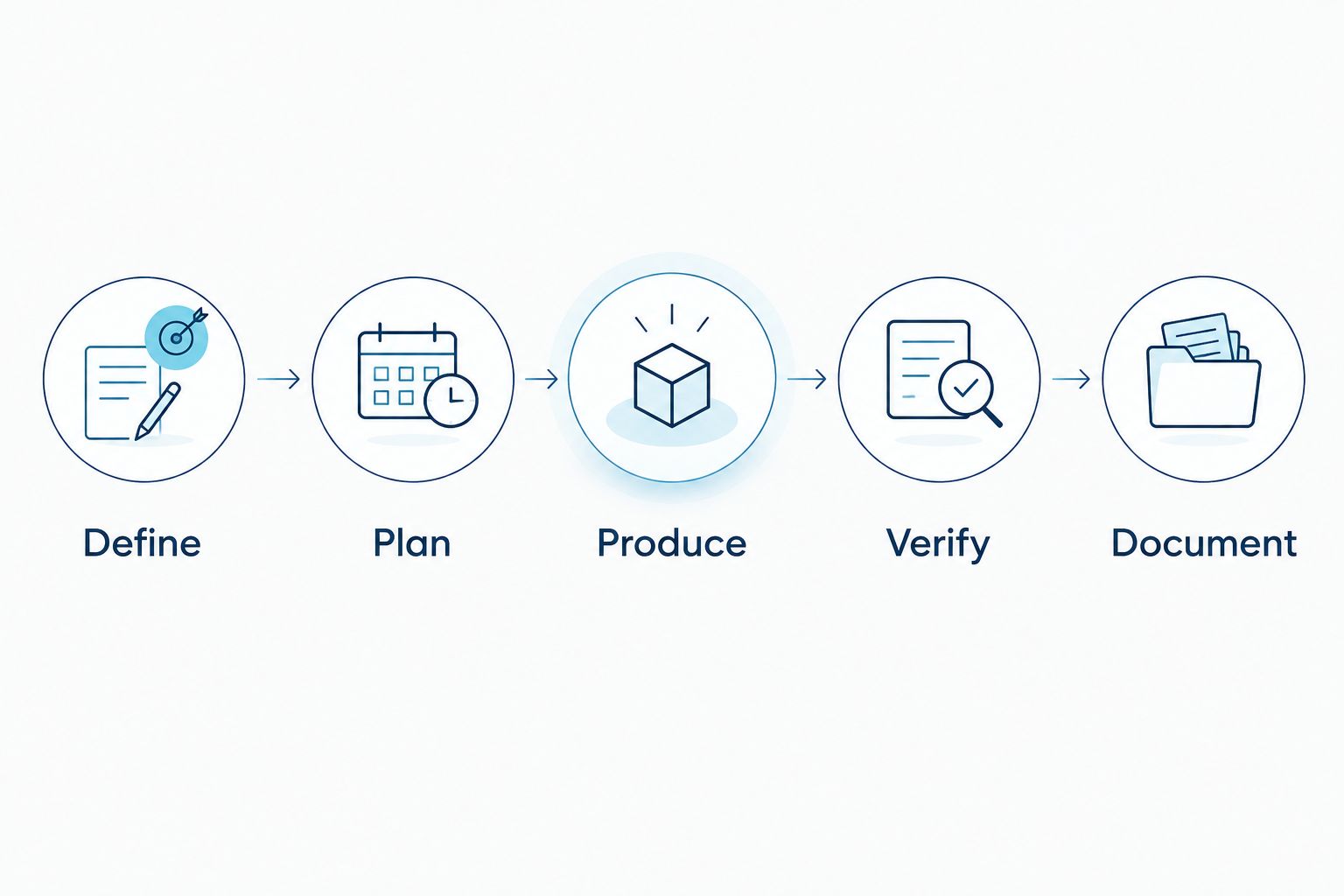
Keep the process organized into 5 review stages: Define, Plan, Produce, Verify, and Document. The stages separate the scientific requirement, agreed deliverables, lot relationship, analytical assessment, and retained decision. They are a review structure, not a claim about any supplier's manufacturing process.
Document control continues after initial acceptance. If a revised certificate arrives, preserve both versions and record which version supports the current decision. Assess whether the revision changes the analytical interpretation, the lot relationship, or only an administrative field.
Why KPV COA contents vary
The contents of a KPV certificate depend on its defined analytical and reporting scope. Compare documents against your specification rather than expecting every certificate to contain the same fields.
- Material definition: Sequence, terminal groups, stereochemistry, and chemical form determine what identity evidence needs to address.
- Analytical scope: Purity, identity, water, and counterion measurements answer different questions.
- Method selection: Separation conditions, detection, and reporting conventions affect how results are interpreted.
- Lot traceability: Manufacturer, supplier, and external laboratory identifiers need a documented relationship.
- Document scope: A summary certificate and supporting analytical reports contain different levels of detail.
For 2026 supplier comparisons, use a consistent document checklist. A longer certificate is not automatically more relevant; relevance depends on whether its evidence answers your approved research requirements.
Does an HPLC purity result confirm KPV identity?
No. An HPLC purity result does not, by itself, confirm KPV identity. Chromatographic purity and identity are different analytical questions, even when the same certificate reports both.
Review the identity evidence specified for the project and its connection to the lot. A clean chromatogram cannot compensate for an unresolved material description or a report belonging to a different sample.
Can an example KPV COA support lot acceptance?
No. An example KPV COA cannot establish the analytical results of a different lot. It is useful for reviewing the supplier's reporting format and identifying which supporting records to request.
Keep example documents clearly separated from acceptance evidence. Your 2026 procurement file should identify the actual lot certificate used for the decision, not merely the document viewed during supplier evaluation.
Is third-party testing necessary for every KPV order?
There is no single document-based answer for every KPV research order. Set the testing requirement through your institution's procedures and the project's written analytical scope; an external laboratory's involvement does not replace review of methods, sample identity, and acceptance criteria.
Independent testing is useful when it answers a defined verification question. Specify that question before commissioning work, and ensure the submitted sample remains traceable to the lot being evaluated.
FAQ
How do I confirm that a KPV COA covers my order?
Match the lot identifier on the KPV COA to the material label and purchasing record. Obtain a documented mapping if the certificate and supporting laboratory reports use different identifiers.
What should I request with a KPV certificate of analysis?
Request the lot-specific certificate, reported methods, and the supporting analytical records required by your research specification. State each deliverable explicitly rather than assuming that a certificate includes every chromatogram or spectrum.
Does a KPV COA prove peptide identity?
A KPV COA supports identity only to the extent of the reported analytical evidence. Review the specified chemical form, method, result, and sample-to-lot relationship rather than relying on the compound name alone.
Is HPLC purity the same as peptide content?
HPLC area purity is not automatically peptide content by mass. It describes integrated chromatographic detector response under the reported method; a content requirement needs an appropriate measurement and defined reporting basis.
Can I use a KPV certificate from another batch?
A certificate from another KPV batch does not establish results for your batch. Use it to review reporting format, not to support acceptance of the received material.
Does a research peptide COA establish sterility?
A research peptide COA establishes no sterility claim unless that attribute is explicitly tested and reported within the applicable scope. Do not infer sterility from chromatographic purity or molecular-mass evidence.
How should a laboratory retain a KPV COA?
Retain the original KPV COA with its supporting reports, lot identifier, approved specification, and acceptance decision. Preserve revised versions and document which revision supports the current disposition.
One last thing
A high purity result cannot repair a broken lot-to-document connection. Before reviewing the analytical detail, confirm that the certificate actually belongs to the material your laboratory will receive. That simple ordering of the review prevents a technically detailed document from being accepted for the wrong lot.
When discussing research peptide requirements with Simple Life Science, submit the material specification and document request together. Ask for written confirmation of the analytical deliverables and lot-level records required for your project; do not substitute a general company description for that agreement.
Related guides
- Verifying peptide purity before a study
- Connecting certificates of analysis to ELN-ready records
- Reviewing when peptide batches need purity retesting
For laboratory research use only. Not for human or veterinary use. Not intended to diagnose, treat, cure, or prevent any disease.

