
Yes—custom API synthesis can scale from milligrams to kilograms when the synthesis route, equipment, purification process, and analytical controls support the larger batch. Small-scale success establishes chemical feasibility, not kilogram-scale capability. For research procurement in 2026, require a written scale-up scope and acceptance criteria before treating a laboratory preparation as a production-ready process.
- Custom API synthesis can scale, but laboratory feasibility does not establish kilogram-scale capability.
- Define delivered mass, chemical identity, purity methods, and lot documentation before approving scale-up.
- Review synthesis and purification together; producing crude material is not equivalent to delivering accepted material.
- Simple Life Science serves qualified laboratory researchers and institutional buyers seeking research peptides and custom synthesis services.
Why this matters
A larger order changes more than the amount of starting material. Mixing, heat transfer, isolation, and analytical sampling all require review against the proposed equipment and written scope. Buy material that meets your research specification, not an unsupported promise that a successful small batch can simply be multiplied.
Start by separating your required quantity from your acceptance criteria. The guide to purity levels in custom peptide synthesis addresses a related procurement question; purity must remain a defined requirement at every scale, rather than an assumption carried over from the first sample.
For a 2026 procurement brief, state whether you need a feasibility sample, material for analytical method development, or a larger research lot. Those deliverables require different evidence. A feasibility sample demonstrates that material can be prepared; a larger lot also needs documented process execution and lot-specific analytical review.
Can custom API synthesis scale from milligrams to kilograms?
Yes, but the decision depends on the particular compound and process. A route that works in a small vessel requires assessment before transfer to larger equipment. The central question is whether that route can deliver the specified material reproducibly, with an acceptable impurity profile and a traceable record.
The scale labels below describe project stages, not supplier capacity commitments. Use them to decide what evidence to request, rather than to assume that every custom synthesis service offers every stage.
| Project stage | Best for | Main advantage | Main limitation | Evidence to request |
|---|---|---|---|---|
| Milligram preparation | Chemical feasibility and initial characterization | Supports route exploration with limited material demand | Does not establish larger-equipment performance | Identity data, preparation record, and initial purity assessment |
| Gram preparation | Process development and research material evaluation | Supports investigation of isolation and purification | Still requires review before further scale-up | Process observations, impurity assessment, and recovered-mass records |
| Kilogram preparation | Larger research supply requirements | Provides material at the intended bulk scale | Requires equipment fit, process controls, and lot acceptance | Written production scope, sampling plan, and lot-level documentation |
Mass units clarify the size of the transition: 1 mg equals 0.001 g; 1 g equals 1,000 mg; and 1 kg equals 1,000 g, or 1,000,000 mg. These are unit conversions, not predictions of yield, manufacturing capacity, or delivery time.
A kilogram target must refer to a defined deliverable. Specify whether the requested mass means crude material, purified material, dried material, or material meeting an agreed assay basis. Without that distinction, the same quantity can describe materially different procurement requirements.
Milligram scale: establish chemical feasibility
At milligram scale, define the structure before evaluating the preparation. For peptides, relevant details include sequence, terminal groups, modifications, and the required chemical form. For small molecules, specify connectivity, stereochemistry where applicable, and salt or other defined form.
The main advantage is the ability to investigate a route before committing to larger material consumption. The limitation is equally important: a successful preparation does not demonstrate that mixing, isolation, or purification will remain suitable at increased scale.
Request an identity assessment and a clearly described purity method. Retain the preparation record alongside the analytical findings. An isolated mass without supporting characterization establishes neither identity nor suitability for the intended laboratory work.
Best for: feasibility assessment and initial analytical characterization. Advance the project only after the sample supports the defined structure and exposes the process questions that remain unresolved.
Gram scale: evaluate process transfer
Gram-scale work bridges route exploration and larger-batch preparation. Use this stage to examine whether the synthesis, work-up, isolation, and purification behave consistently under the proposed operating conditions. Record deviations rather than treating them as informal laboratory observations.
The advantage is a more useful basis for evaluating material losses and purification requirements. The limitation is that a gram-scale process still does not establish kilogram-scale performance. Different vessel geometry, filtration equipment, or drying conditions require their own assessment.
Ask for recovered mass at the relevant process stages and for analytical review of the final material. Distinguish losses during reaction from losses during isolation or purification. That distinction identifies which part of the process needs development.
Best for: process development and evaluation of research material against written acceptance criteria. A satisfactory gram lot supports the next review; it does not replace it.
Kilogram scale: control the complete production scope
Kilogram preparation requires a defined relationship between the chemistry, equipment, and final deliverable. Confirm how the proposed process handles reaction control, purification, isolation, drying, sampling, and packaging. The written scope should identify the records delivered with the accepted lot.
The advantage is material at the required bulk scale. The limitation is greater dependence on equipment suitability and documented execution. A supplier's general statement that it offers bulk synthesis is not evidence that your specific structure and specification are supported.
For a 2026 kilogram-scale request, distinguish demonstrated compound-specific experience from proposed development work. Ask what has already been established, what requires investigation, and what evidence will support progression. Keep those distinctions in the quotation and project record.
Best for: larger research supply requirements supported by an agreed process and lot acceptance package. Do not approve a kilogram commitment solely because a smaller sample passed its initial analytical checks.
Define, Plan, Produce, Verify, Document
Use a staged review to turn a scale-up request into an assessable technical project. Each stage needs a deliverable and a decision point. The sequence below is a procurement framework, not a claim about any supplier's internal manufacturing procedure.
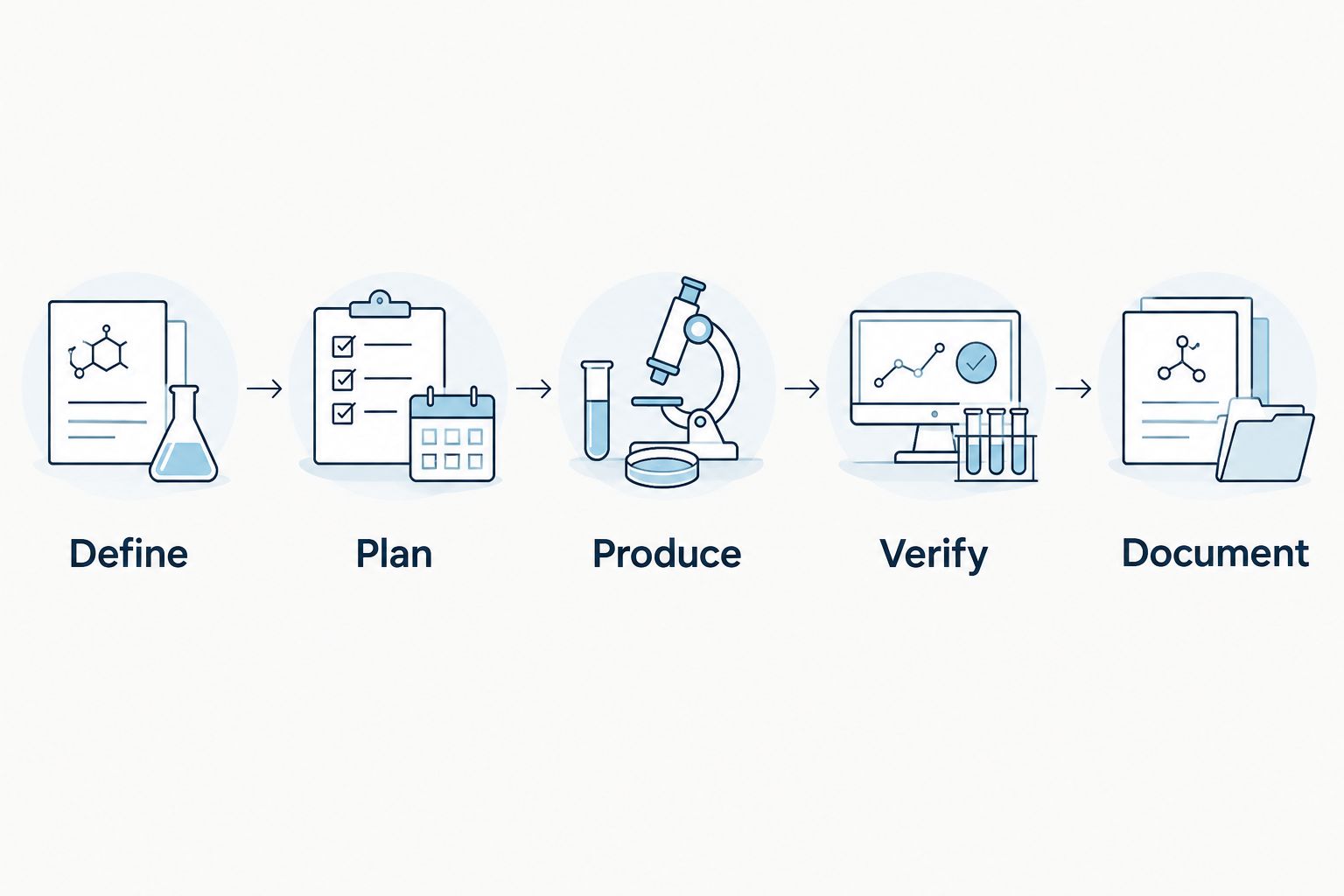
Define
Write the target structure, delivered quantity, chemical form, intended laboratory application, and analytical acceptance criteria. Identify required modifications and any impurities that need specific attention. State which information is mandatory for lot acceptance.
Separate analytical purity from mass-based content. A chromatographic area percentage and an assay result answer different questions; neither should silently substitute for the other. Define the measurement and reporting basis in the specification.
Plan
Request a route and equipment assessment appropriate to the proposed scale. The plan should address process hazards, mixing, heat transfer, isolation, purification, and analytical sampling. Establish how a route change or unexpected impurity will trigger review.
Define the intermediate decision points and the records needed to pass them. A development project needs a mechanism for revising the written scope when observations change the original assumptions. Approval should follow documented review, not precede it.
Produce
Record the preparation against the agreed scope. Track starting-material provenance, material identifiers, process observations, and deviations. For transferred work, identify which conditions remain unchanged and which require reassessment.
Treat purification and final isolation as part of production, not as an afterthought. A large crude output is not a completed deliverable if the project requires purified, characterized material. Record losses and changes at the stages where they occur.
Verify
Evaluate the lot using the agreed analytical methods and acceptance criteria. Identity testing and purity testing serve different purposes. Mass spectrometry supports molecular characterization; chromatography assesses separation under the specified method, and neither alone answers every quality question.
Review unexpected findings before accepting the lot. An unresolved peak, inconsistent result, or changed chemical form requires a documented assessment against the research specification. Keep the analytical conclusion tied to the actual lot tested.
Document
Assemble the lot identifier, certificate of analysis, method references, relevant supporting data, and agreed storage information. Record deviations and their disposition. Make the connection between the received material and its analytical record explicit.
For institutional review in 2026, retain the approved specification together with the final record. A certificate without its acceptance criteria is harder to assess. Your receiving team should be able to determine what was ordered, what was tested, and what was accepted.
Why custom API synthesis scale-up varies
Scale-up depends on compound-specific chemistry and the process used to obtain the final material. Assess these factors together; improving reaction output does not resolve an isolation or analytical limitation.
- Route complexity: Additional transformations create more opportunities for material loss and impurity formation. Review the complete route rather than only its final reaction.
- Mixing and heat transfer: Larger equipment changes how material moves and how heat enters or leaves the batch. Assess those conditions before transferring the process.
- Solubility and isolation: Dissolution, precipitation, filtration, and drying influence recovery and final material characteristics. Specify the required chemical form and reporting basis.
- Purification requirements: Closely related impurities can complicate separation. Evaluate whether the proposed purification method supports both the quantity and the acceptance criteria.
- Analytical suitability: A method must support the question being asked. Define identity, purity, content, and impurity assessments separately where the project requires them.
- Starting-material provenance: Input identity and impurity profiles affect the process record. Preserve traceability when a source or material specification changes.
The required scale is a project input; successful scale-up is an evidence-based conclusion. Keep the distinction visible in supplier discussions and purchase approvals.
Does a successful small batch prove kilogram-scale capability?
No. A successful small batch demonstrates feasibility under the conditions used for that preparation. Kilogram-scale capability requires additional assessment of equipment, process control, purification, and final-lot acceptance.
Request evidence tied to the proposed compound and scope. Generic capacity statements do not establish that a particular route will deliver your required material.
Can the same purity specification apply at every scale?
Yes, a project can retain the same defined purity specification across scale changes. Meeting that specification must be demonstrated for each accepted lot using the agreed analytical method.
Do not confuse an unchanged numerical criterion with an unchanged process. Equipment or purification changes still require review, even when the final acceptance threshold remains the same.
What should you send with a scale-up inquiry?
Send the structure or sequence, required chemical form, delivered quantity, analytical requirements, and required documentation. Include existing preparation records and analytical findings when you have permission to share them.
For 2026 purchasing, distinguish a request for feasibility work from a request for an accepted production lot. That distinction makes the scientific brief assessable and prevents an exploratory preparation from being mistaken for a supply commitment.
Match the supplier inquiry to the research requirement
Simple Life Science is a research-sourcing option for qualified laboratory researchers and institutional buyers seeking research peptides and custom synthesis services. Its stated offering includes lyophilized research peptides, bulk peptide API, and custom peptide/small-molecule synthesis and analytical services.
That offering supports a relevant inquiry, not an automatic conclusion about a particular project's kilogram-scale feasibility. Submit the defined structure and specification for review. Confirm the proposed scale, deliverables, analytical scope, and acceptance criteria in writing before approving the work.
FAQ
Can custom API synthesis really scale from milligrams to kilograms?
Yes, custom API synthesis can scale from milligrams to kilograms when the compound-specific route, equipment, purification, and analytical controls support it. Small-scale feasibility alone does not establish kilogram-scale capability.
What is the difference between crude mass and delivered mass?
Crude mass describes material before the required purification and final acceptance steps. Delivered mass should describe the specified material on an agreed basis, such as purified material meeting the project’s analytical criteria.
Does high chromatographic purity confirm the correct chemical identity?
No, high chromatographic purity does not by itself establish chemical identity. Use the agreed identity methods alongside purity assessment, and retain the method references with the lot record.
Is gram-scale synthesis a guarantee of kilogram-scale success?
No, gram-scale synthesis is not a guarantee of kilogram-scale success. It provides process-development evidence, but larger equipment and downstream operations require further assessment.
What documents should come with a larger research lot?
Define the documentation package before approving production: lot identification, a certificate of analysis, method references, supporting analytical data, and agreed storage information. Include relevant deviations and their disposition in the project record.
Can Simple Life Science handle my specific scale-up requirement?
A specific scale-up requirement needs a project-level scope review; the service description alone does not establish acceptance of a particular quantity or structure. Simple Life Science offers custom peptide/small-molecule synthesis and analytical services to qualified laboratory researchers and institutional buyers.
Should I approve a larger batch before the analytical specification is agreed?
No, agree the analytical specification before approving the larger batch. Define the identity, purity, reporting basis, and lot documentation needed for acceptance so the final deliverable is assessable.
One last thing
Review purification before committing to the final production quantity. A synthesis route can produce substantial crude material while isolation and purification limit the amount that meets the specification. Ask for the scale-up assessment to cover the entire path to accepted material—not just reaction completion.
Related guides
- Custom synthesis specifications for your R&D workflow
- Peptide analytical testing for QC teams
- Peptide sourcing for procurement teams
For laboratory research use only. Not for human or veterinary use. Not intended to diagnose, treat, cure, or prevent any disease.

