
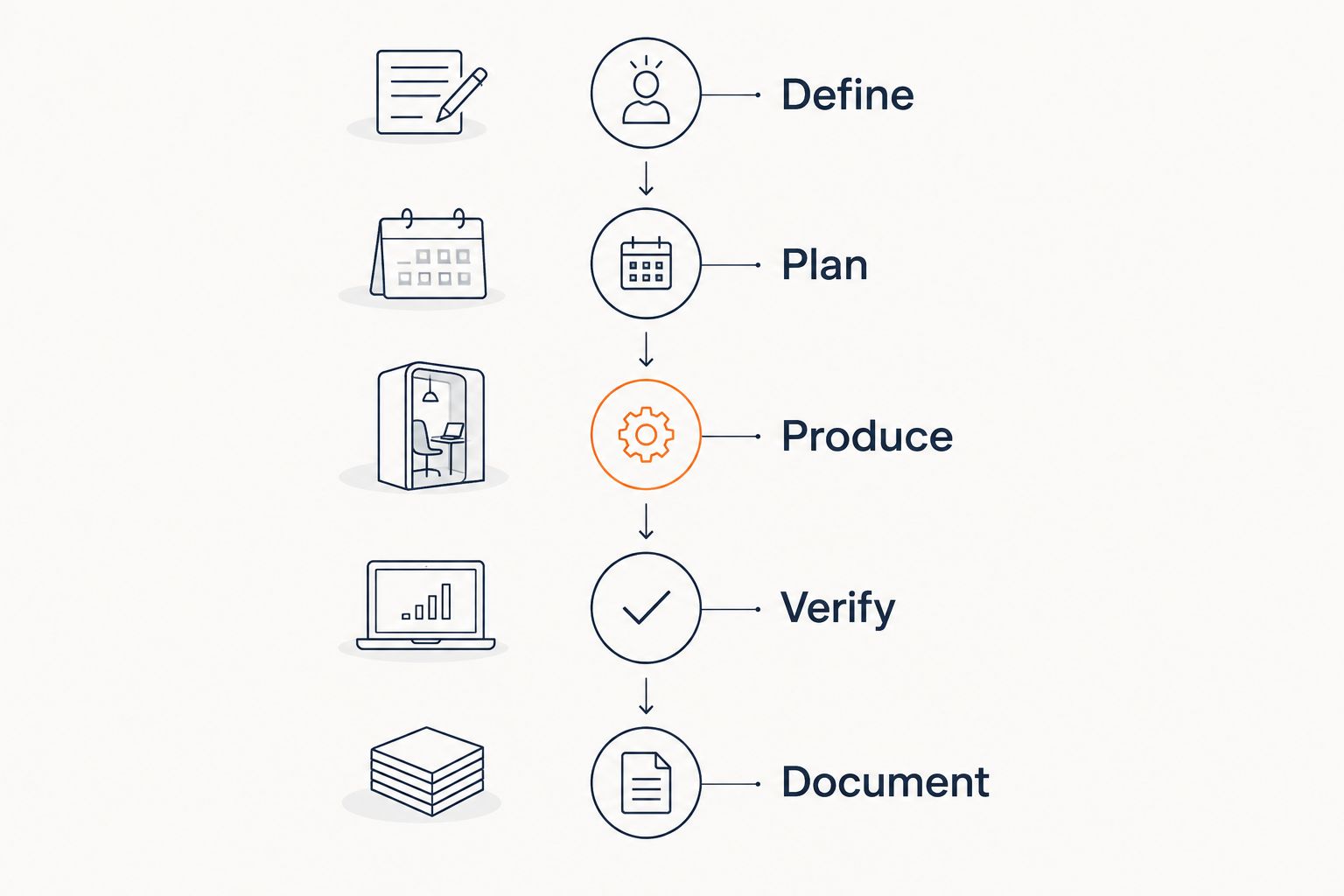
Routing a custom peptide synthesis request through sequence design, feasibility review, synthesis, purification, and analytical release by email and spreadsheet loses specification detail at every handoff. A defined project workflow — one that carries the written scope from Scientific Brief through procurement, production, and verification into your lab's own record system — keeps acceptance criteria, lot numbers, and Certificates of Analysis traceable instead of buried in a thread. This is the custom peptide synthesis project management workflow that qualified laboratory and institutional buyers use to move a request from Define to Document without re-keying data at each stage.
- A custom peptide synthesis project management workflow moves a request through five stages: Define, Plan, Produce, Verify, Document.
- Simple Life Science ties each Scientific Brief to a written scope with fixed acceptance criteria before quoting starts.
- Amend the written scope before synthesis begins — changes made mid-Produce restart the Verify stage.
- The same workflow shortens for recurring bulk API reorders, skipping feasibility review when the specification is already validated.
- Lot records land in your ELN or LIMS as documentation, not as a manual re-entry task.
Why this matters
A custom synthesis order that skips a documented workflow tends to fail at the point where a specification detail — a purity threshold, an analytical method, a delivery format — gets restated verbally instead of written down. That gap shows up later as a Certificate of Analysis that doesn't match what the requesting scientist expected, and a project that stalls while the mismatch gets resolved.
Procurement teams managing multiple concurrent synthesis requests feel this most. The peptide sourcing for procurement teams process depends on the same discipline this workflow enforces: a written scope fixed before a purchase order is cut, not negotiated after synthesis is underway. In 2026, labs running multiple simultaneous custom synthesis projects need this control point more than they need faster turnaround.
Before you start
- A completed Scientific Brief — target sequence, required purity specification, quantity, analytical method, and delivery format defined in writing.
- Procurement authorization — a purchase order number, or a punchout catalog connection if your institution routes orders that way.
- A destination for lot records — ELN or LIMS credentials for the system your research team will query later.
The gotcha: acceptance criteria — purity threshold, mass confirmation method, endotoxin limit if relevant to the application — must be fixed before a quotation is generated. Criteria added after synthesis starts require a written scope amendment, and that amendment restarts the Verify stage. Fix this at Define, not at Verify.
Define the Scientific Brief
The Scientific Brief is the single document every downstream stage references. Incomplete fields here are the most common cause of a stalled feasibility review.
- Enter the Target Sequence field with the exact sequence and any modification (acetylation, amidation, cyclization) written out in full — not abbreviated shorthand your synthesis partner has to interpret.
- Set the Purity Specification field as a numeric threshold (for example, greater than or equal to 95% by HPLC), not a qualitative description like "high purity."
- Specify the Analytical Method field — HPLC, LC-MS, or both — since a reportable purity value changes depending on which method generates it.
- Complete Quantity Required and Delivery Format (lyophilized powder, specific vial size, custom packaging) so the Produce stage has a fixed target.
Expected result: a written scope document with acceptance criteria fixed before a quotation goes out, not negotiated afterward.
Route the Request Through Procurement
Once the Scientific Brief is complete, the request has to clear procurement before synthesis starts.
- If your institution routes laboratory purchases through a punchout catalog, connect Simple Life Science to your punchout catalog before submitting the brief so the order lands with the right cost center automatically.
- If your institution issues a direct purchase order instead, attach the PO number to the Scientific Brief submission.
- Confirm the authorized quantity on the PO matches the Quantity Required field from the brief — mismatches here are the second most common cause of delayed feasibility review.
Expected result: the Scientific Brief and its procurement authorization are matched before the Plan stage opens, so synthesis isn't blocked mid-project waiting on a corrected PO.
Track Synthesis and Verification Stages
This is where the written scope becomes a physical lot.
- Feasibility Review — synthesis chemistry confirms the sequence and modification are producible at the specified purity and scale before Produce begins.
- Produce — synthesis and purification run against the written scope, not against a verbal restatement of it.
- Verify — analytical characterization (HPLC, mass spectrometry, or both, matching the method fixed at Define) tests the lot against the acceptance criteria set in the Scientific Brief.
- A Certificate of Analysis is issued per lot, reporting the result against the exact criteria the brief specified — not a generic purity claim.
Expected result: the Certificate of Analysis matches the acceptance criteria defined at the start of the project. Any exception is flagged before the lot is released, not after it ships.
Land Lot Records in Your ELN or LIMS
A Certificate of Analysis that lives only in an email inbox isn't queryable by the rest of the research team.
- Request the lot-level documentation package at the time of shipment — this is the same package described in the certificates of analysis to ELN-ready records workflow.
- Map the fields your ELN or LIMS expects — lot number, synthesis date, purity result, storage condition — against the fields the documentation package provides.
- Confirm the record is accessible to every researcher who will reference that lot, not just the person who placed the order.
Expected result: the lot record is queryable inside your ELN or LIMS without manual re-entry, and it stays attached to every future reference to that lot.
Track a Bulk API Reorder Instead of a New Synthesis
The workflow shortens for a recurring bulk peptide API order against a specification that's already been validated. Skip Feasibility Review — the sequence and purity threshold are already proven — and route the request straight to Produce and Verify against the prior written scope.
The difference that matters here is provenance: a reorder should inherit the documentation trail of the original lot, not start a fresh one. The peptide orders to freezer-ready lot traceability workflow covers how a repeat order carries forward storage condition and chain-of-custody records instead of generating a disconnected new file. Reorders that skip this step lose the link between the new lot and the original validated specification — verify the link before accepting the shipment, not after.
“Acceptance criteria defined before quoting is the single control point that prevents a stalled Verify stage.”
Submit a scientific brief
Request a quotation scoped to a defined specification and acceptance criteria.
Troubleshooting
- Quotation is taking longer than expected. Check the Scientific Brief for a missing acceptance criteria field — an incomplete purity or analytical method field is the most common cause of a stalled feasibility review.
- The Certificate of Analysis reports a different purity value than expected. Confirm the analytical method on the CoA matches what the written scope specified. HPLC and LC-MS report different values for the same lot, and a mismatch here is a method discrepancy, not a synthesis defect.
- The lot record isn't appearing in your LIMS. Confirm field mapping was completed when the documentation package was first requested, then re-request the package rather than re-entering the data manually.
- A punchout catalog connection fails at submission. Verify the catalog connection was completed correctly before the Scientific Brief is submitted — a broken connection routes the order to the wrong cost center instead of rejecting it outright.
- A reorder's specification appears to have drifted from the original lot. Request a side-by-side comparison against the original Certificate of Analysis before accepting the new lot into inventory.
Customize your workflow
The five-stage structure holds for a single custom synthesis order and for a recurring bulk API contract, but the documentation depth should scale with who's downstream. A university lab tracking one sequence for a single study needs less than an institutional buyer running the same specification across multiple sites. Review the peptide sourcing for procurement teams process again once your first project clears Document — the second and third orders move faster once the punchout connection and ELN mapping are already in place from the first one.
Heading into 2026, the labs getting the most out of this workflow are the ones that write the acceptance criteria into the Scientific Brief in numeric terms the first time, not the ones with the fastest synthesis turnaround.
FAQ
What is a custom peptide synthesis project management workflow?
It’s a defined sequence of stages — Define, Plan, Produce, Verify, Document — that carries a written scope and acceptance criteria from initial request through to a lot record in your ELN or LIMS. It replaces email-based tracking with a document trail every stage can reference.
What has to be in a Scientific Brief before requesting a quote?
A complete brief includes the target sequence, any modification, a numeric purity specification, the analytical method (HPLC, LC-MS, or both), required quantity, and delivery format. Missing acceptance criteria fields are the most common cause of a delayed feasibility review.
Can acceptance criteria be changed after synthesis starts?
Yes, but it requires a written scope amendment and restarts the Verify stage for that lot. Fixing criteria at the Define stage avoids this delay entirely.
How does a bulk API reorder differ from a new custom synthesis project?
A reorder against a previously validated specification skips Feasibility Review and routes straight to Produce and Verify, inheriting the documentation trail of the original lot instead of starting a new one.
Why does a Certificate of Analysis sometimes report a different purity value than expected?
Purity values differ by analytical method — HPLC and LC-MS report different numbers for the same lot. Confirm the CoA method matches the method specified in the written scope before treating a discrepancy as a synthesis issue.
How do lot records get into an ELN or LIMS without manual entry?
The documentation package requested at shipment maps directly to standard ELN and LIMS fields — lot number, synthesis date, purity result, storage condition — so the record loads without re-keying.
Does a punchout catalog connection change how the Scientific Brief is submitted?
No — the brief is submitted the same way. The punchout connection routes the resulting purchase order to the correct cost center automatically instead of requiring a manually entered PO number.
What causes a custom synthesis project to stall between stages?
Most stalls trace back to an incomplete Scientific Brief, a mismatched purchase order quantity, or acceptance criteria added after synthesis has already started. All three are avoidable at the Define stage.
One last thing
The acceptance criteria written into the Scientific Brief become the exact specification tested at Verify — vague language at Define costs more project time in 2026 than any step in the synthesis chemistry itself. A numeric purity threshold and a named analytical method, fixed before the quote goes out, is the cheapest control point in the entire custom peptide synthesis project management workflow.
Related guides
- Peptide orders to freezer-ready lot traceability workflow
- Best custom peptide synthesis companies for biotech startups

