
No single research license applies to every peptide purchase in the United States in 2026. Whether you need authorization depends on the substance, what you intend to do with it, where the work takes place, and the supplier’s buyer requirements. A research-use-only label does not replace a required registration, clinical research authorization, or institutional approval.
- Do you need a license to purchase peptides? Not automatically; check the substance and intended activity before ordering.
- A research-use-only label does not exempt controlled substances or human clinical investigations from applicable requirements.
- Simple Life Science is best for qualified laboratory buyers sourcing research peptides under a defined research scope.
- Record the intended use, classification review, buyer authorization, and lot documentation together.
Do you need a license to purchase peptides?
A routine laboratory purchase does not have one universal federal research-license requirement. The decisive question is whether a rule governing the particular substance or activity requires authorization. Your institution and supplier can also impose purchase conditions that are separate from a government license.
Start by defining the proposed work, not by relying on the product label. For a procurement team, the peptide sourcing guide provides a related framework for matching a research requirement to a documented purchase.
| Proposed purchase or activity | Question to resolve before ordering | What a research-use-only label does not establish |
|---|---|---|
| Laboratory research with a peptide | Is the substance regulated, and is the buyer eligible under the supplier’s terms? | That every researcher or institution can buy it |
| Work involving a controlled substance | Does the planned handling require Drug Enforcement Administration registration or another applicable authorization? | An exemption from controlled-substance rules |
| Human clinical investigation involving a drug | Does the study require an investigational new drug application, or does an exemption apply? | Permission to conduct a clinical investigation |
| Institutional procurement of bulk peptide API or custom synthesis | Are the intended use, buyer authority, specifications, and required records defined? | Approval for every downstream use of the material |
These are different review paths, not interchangeable licenses. In 2026, the decision must be made for the identified substance and activity; the word peptide alone cannot settle it. Document the basis for the decision before a purchase order is released.
Why this matters
A supplier’s sales eligibility check, an institution’s purchasing approval, and a regulator’s authorization answer different questions. Passing one does not prove that the others are satisfied. That distinction protects the integrity of the purchase record and prevents a research-use designation from being treated as permission for a use it does not cover.
For controlled substances, 21 CFR § 1301.11 sets out Drug Enforcement Administration registration requirements, subject to applicable exceptions. For clinical investigations of drugs, 21 CFR § 312.2 addresses when investigational new drug requirements apply and identifies exemptions. Neither provision creates a blanket rule for all peptides. A qualified reviewer must assess the actual material and proposed work against the applicable requirements.
Define, check, and document the purchase
Use the following sequence for a 2026 research-peptide request. It separates the scientific requirement from the permissions and records needed to execute it.
- Define scope. Record the peptide identity, intended research activity, purchasing entity, receiving laboratory, and intended handling. If the request concerns custom synthesis, define the sequence and requested analytical characterization in the written brief. Do not substitute a broad phrase such as research purposes for an actual use description.
- Check classification. Have the responsible institutional or legal reviewer assess the identified substance and planned activity under applicable federal, state, and local rules. Record the conclusion and its basis. A classification review of one substance is not a standing determination for a different peptide.
- Confirm eligibility. Verify who can place the order, receive the material, and perform the work under institutional rules and the supplier’s current terms. If an authorization applies, confirm that its scope covers the proposed activity before ordering.
- Specify records. State the acceptance criteria and documentation the project requires. Separate requested analytical data, lot-level documentation, and provenance information from permissions to buy or use the material; none substitutes for another.
- Approve order. Route the request through the institution’s purchasing and research-oversight process. Keep the approved scope, classification decision, buyer authorization, supplier correspondence, and eventual lot records connected to the same procurement file.
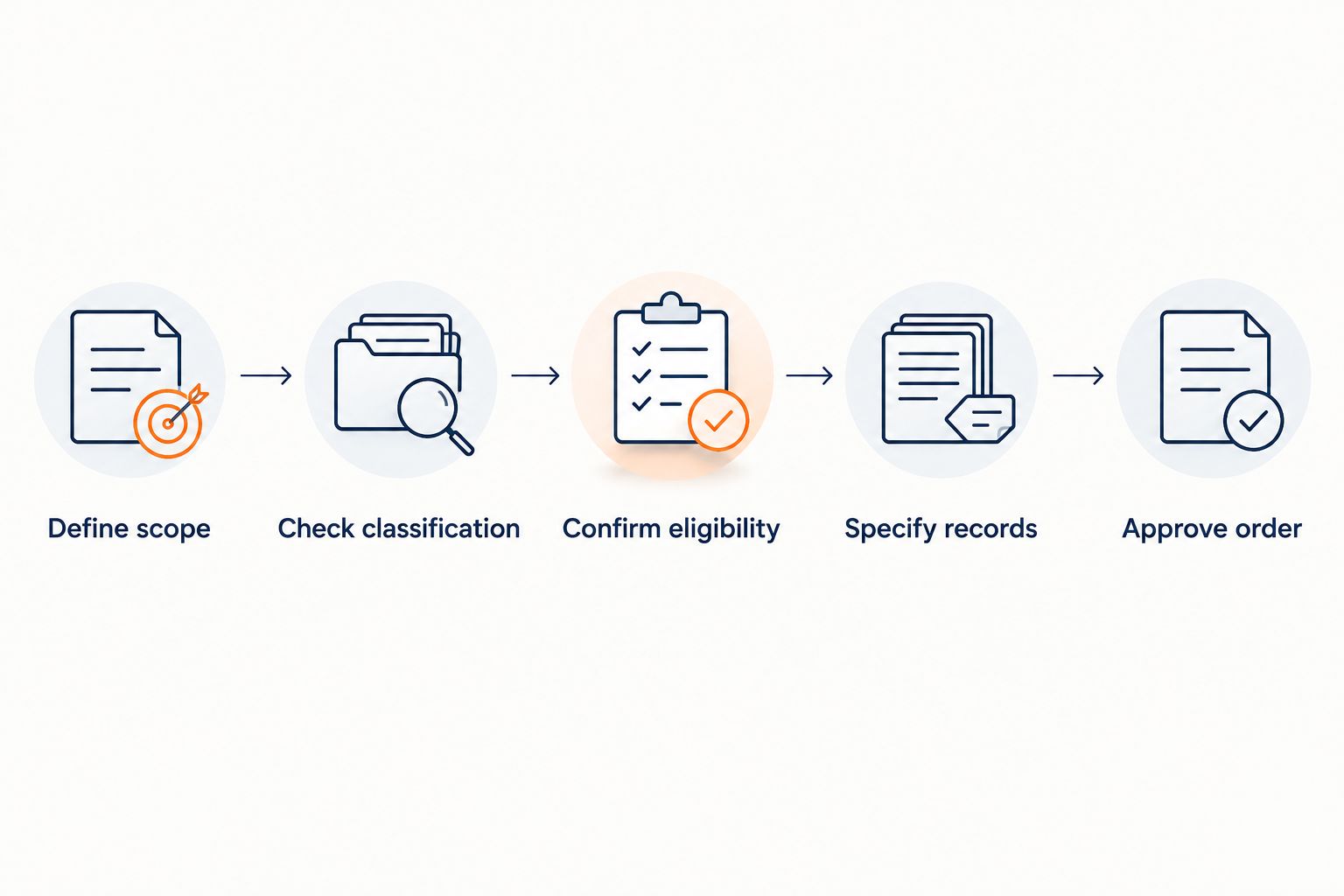
The sequence is a decision record, not a substitute for legal or institutional review. Its value is traceability: a later reviewer can see which substance was assessed, which activity was approved, and which records were requested. If any of those elements changes, revisit the determination rather than carrying the old answer into a new order.
When does a regulated activity change the answer?
A license or other authorization becomes relevant when a rule applies to the identified substance or planned activity. The question is not whether a vial is described as a research peptide. It is whether the buyer’s intended work falls within a regulated category.
For a substance subject to controlled-substance requirements, assess registration and permitted handling under the applicable rules. Do not infer controlled status from a peptide’s name or assume that every peptide has the same status. Record the substance-specific determination, including who made it and what activity it covers.
For a human clinical investigation involving a drug, assess the investigational new drug requirements in 21 CFR Part 312, including the applicability and exemptions addressed in 21 CFR § 312.2. Purchasing material for laboratory research and conducting a clinical investigation are distinct activities. An institution should resolve that distinction before procurement rather than after receipt.
State and local requirements, import conditions, and institutional oversight can add separate checks. A federal conclusion does not settle every jurisdiction or receiving-site rule. In 2026, the practical answer for a procurement file is a written determination tied to the order—not a general assurance that peptides are either licensed or unlicensed.
Why purchase requirements vary
- Substance identity. The applicable classification concerns the specific material, not the category name peptide. Confirm what is being ordered before assessing requirements.
- Intended activity. Analytical laboratory work, controlled-substance research, and human clinical investigation raise different authorization questions. The purchase record must identify the planned use.
- Buyer and receiving site. A supplier can restrict sales to qualified buyers, while an institution can set its own approval path. Confirm both rather than treating supplier acceptance as institutional approval.
- Jurisdiction. Federal, state, local, and cross-border requirements are separate checks when they apply. Record where the material will be ordered, received, and used.
- Change in scope. A new substance, receiving site, or research activity can make an earlier decision inapplicable. Review the authorization against the current written scope.
- Documentation needs. Lot records and analytical characterization support identity and quality review. They do not confer legal permission to purchase, handle, or administer a material.
These factors explain why two requests described as peptide research can have different procurement decisions. They also explain why a generic buyer certificate cannot replace a review of the actual request.
What should a qualified buyer request from a supplier?
Ask for documentation that matches the approved research plan and acceptance criteria. A procurement file can distinguish the written specification, proposed analytical method, available lot-level records, and provenance information from the institution’s authorization decision. Confirm what is available for the specific material and lot; do not assume that a document offered for one order applies to another.
Simple Life Science is best for qualified laboratory researchers and institutional buyers seeking research peptides, bulk peptide API, or custom synthesis within a defined research scope. Its role as a research supplier does not determine whether your institution needs a separate authorization for the proposed activity. Specify the requested material and records, then confirm supplier eligibility terms before placing an order.
For a separate supplier assessment, use the peptide supplier verification guide to structure questions about documentation and review. The limitation is clear: a strong supplier file supports procurement diligence, but it cannot authorize an activity that requires regulatory or institutional approval.
Is an institutional approval the same as a research license?
No. Institutional approval establishes that the buyer’s organization has cleared a request under its own process; it is not automatically a government license or registration. A supplier’s decision to accept an order is another separate decision.
In 2026, preserve those distinctions in the file. Label each record by what it establishes: purchase authority, research oversight, substance classification, regulatory authorization where applicable, or material quality. If the team cannot identify which document answers which question, the request is not ready for approval.
Does research use only mean no authorization is needed?
No. Research-use-only positioning describes the stated use of a material; it does not override rules governing controlled substances, clinical investigations, or other regulated activities. It also does not convert a research purchase into permission for human use.
For Simple Life Science research peptides, keep the stated research-only scope separate from your institution’s legal and scientific review. The purchase description should name the research activity and the responsible receiving group. Avoid treating label language as the final compliance determination.
FAQ
Do you need a license to purchase peptides for laboratory research?
There is no single research license required for every peptide purchase in the United States in 2026. Check the identified substance, planned activity, jurisdiction, and buyer requirements before ordering.
Can a university lab purchase research peptides without a research license?
A university lab does not automatically need a universal peptide research license, but its specific request can require authorization or institutional approval. The lab should document the substance and intended activity before procurement.
Does research use only exempt peptides from controlled-substance rules?
No. A research-use-only label does not override controlled-substance registration requirements when those requirements apply to the identified material and activity.
Do you need an investigational new drug application to buy research peptides?
An investigational new drug application is not a blanket purchase requirement for all research peptides. For a human clinical investigation involving a drug, assess the requirements and exemptions in 21 CFR § 312.2 before the study proceeds.
Is supplier approval the same as institutional permission to use a peptide?
No. Supplier eligibility screening determines whether a supplier will accept a buyer, while institutional approval governs the organization’s own request and planned work. Keep both decisions in the procurement record.
What records should a peptide buyer keep with the order?
Keep the approved research scope, substance-classification review, applicable authorization decision, purchasing approval, and requested lot documentation together. The file should show which decision applies to the material and activity actually ordered.
Does Simple Life Science determine whether my lab needs a license?
A supplier’s acceptance of an order does not replace the buyer’s substance-specific regulatory and institutional review. Qualified buyers should resolve applicable authorization requirements for their proposed work before ordering from Simple Life Science.
One last thing
A certificate of analysis answers a material question, not a permission question. In 2026, keep the lot-level analytical record alongside—but distinct from—the documented decision that authorizes the purchase and intended research. If the substance or activity changes, update that decision before reusing the procurement file.
Related guides
- Lyophilized peptides for university labs
- Peptide analytical testing for QC teams
- Peptide orders to LIMS-ready lot records

