
An individual can purchase research peptides for a legitimate laboratory project if the supplier accepts the buyer, the intended use meets its research-only terms, and applicable requirements are met. Purchasing a research peptide does not make it appropriate for personal use. A research-use label is not evidence that a material has been evaluated or approved for administration to people.
- Can individuals purchase research peptides? A legitimate laboratory buyer may qualify; personal use is not a research purchase.
- Simple Life Science serves qualified laboratory researchers and institutional buyers, not consumer-health use.
- Check the written specification, intended research use and lot documentation before placing a laboratory order.
Why this matters
The question combines two separate decisions: whether a supplier will accept an order from an individual, and whether the buyer intends to use the material in a laboratory. One does not answer the other. A checkout page cannot establish that a material is suitable for human use.
For a laboratory purchase in 2026, start with the research requirement and the record your team needs to retain. The peptide sourcing guide for procurement teams provides a related framework for reviewing supplier documentation; it does not turn a personal-use purchase into a research order.
Can individuals purchase research peptides for personal use?
No research-only purchase should be treated as a route to personal use. An individual working on a legitimate laboratory project is a different buyer from someone seeking a peptide for self-administration. Supplier eligibility, applicable law and the material’s stated intended use still need separate review in 2026.
| Buyer and purpose | Appropriate purchasing question | What the purchase does not establish |
|---|---|---|
| Individual seeking personal use | Is this a product authorized and supplied for the intended human use? | A research-only listing does not establish that it is. |
| Individual conducting laboratory research | Does the supplier accept this buyer and project under its terms? | Individual status alone does not establish eligibility or authorization. |
| Institutional laboratory buyer | Do the specification, documentation and purchasing terms meet the project requirement? | Institutional purchasing does not authorize use outside the stated scope. |
The distinction is intended use, not whether the person placing the order has an individual or institutional email address. If the purpose is personal administration, stop treating research-peptide listings as purchase options. If the purpose is laboratory work, define the project and confirm the supplier’s requirements before ordering.
Define the intended use
Write down what the material will be used to investigate and who will control it after receipt. Identify whether the work is laboratory research, part of an institutionally governed project, or something else. Do not substitute a research label for this decision.
Check buyer eligibility
Ask the supplier what information it requires to assess a buyer and the proposed use. A supplier’s willingness to take payment is not the same as acceptance of an intended use. Record the answer alongside the order documentation rather than relying on assumptions drawn from a product page.
Match the material to a written specification
For laboratory work, define the requested identity, form, analytical requirements and acceptance criteria before selecting a material. A named sequence alone does not settle whether a lot meets the research requirement. Review the available lot documentation against the written scope.
Keep the use within the approved scope
The project record should connect the requested material, the receiving laboratory and its stated research purpose. If the purpose changes, reassess it before using the material. Documentation supports traceability; it is not permission to administer a research material to a person.
Why purchase eligibility varies
There is no single answer that covers every supplier, buyer and jurisdiction in 2026. These are the factors a laboratory buyer must resolve:
- Stated intended use: A research-only material must be evaluated against the actual project, not a purpose entered merely to complete an order.
- Supplier terms: Each supplier can set requirements for the buyers and projects it accepts. Check those terms directly.
- Applicable requirements: The rules governing a material and its use depend on the circumstances. A label does not replace a legal or institutional review.
- Institutional controls: A laboratory may require an approved purchasing route, designated recipient or project record before procurement.
- Defined specification: The requested identity, form and acceptance criteria determine what documentation needs review.
- Lot-level records: Documentation must correspond to the material supplied; a general statement about a supplier is not a substitute for the current lot record.
None of these factors can be resolved by looking only at whether a website has an order button. The useful question is whether the buyer, intended use, material and documentation fit together.
What should a laboratory buyer review before ordering?
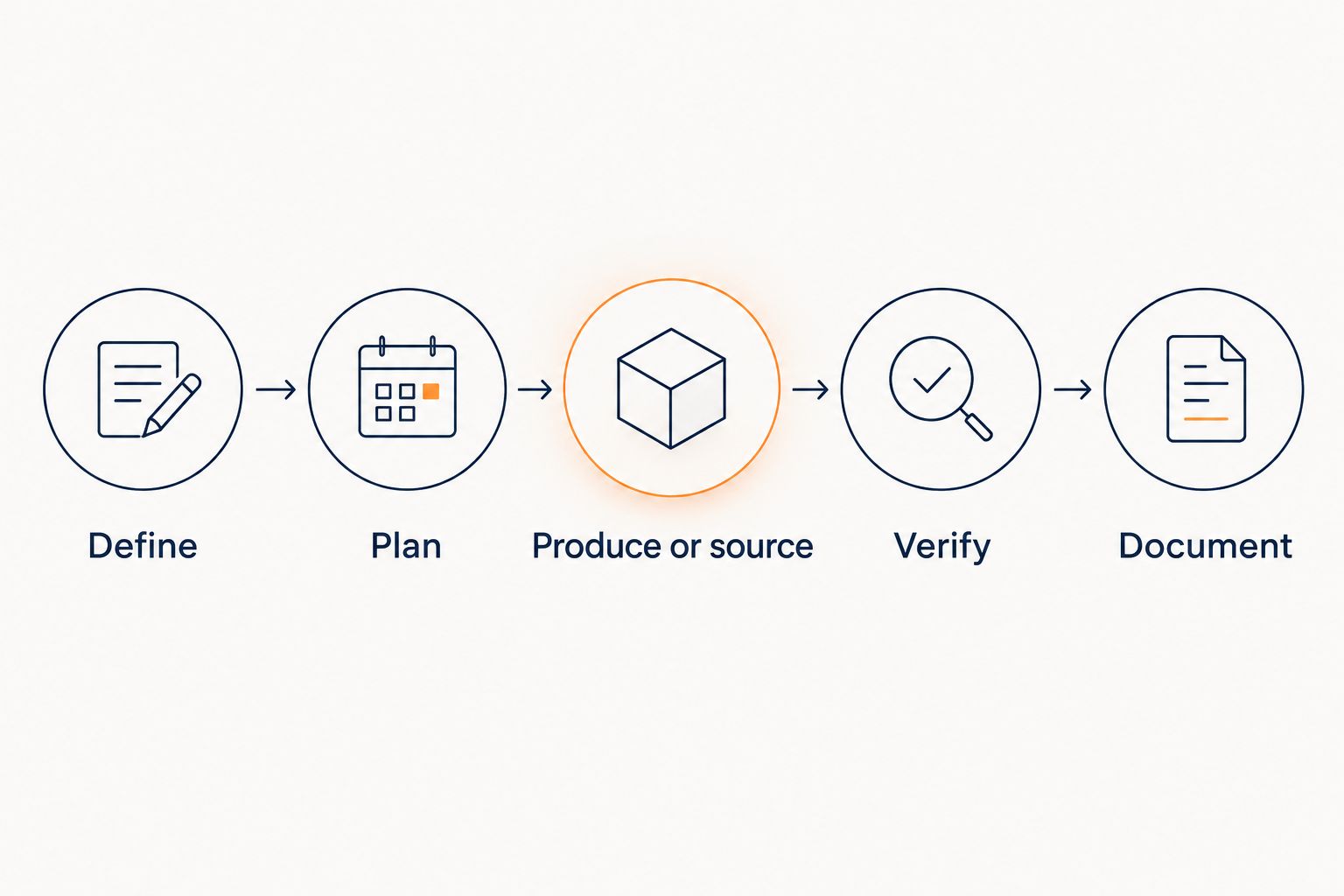
Use a short, repeatable sequence. Each stage produces a decision or a record that the next person can inspect.
- Define: State the research purpose and write the material specification. Identify the acceptance criteria that matter to the project.
- Plan: Confirm the purchasing route, the person authorized to receive the material and the supplier’s buyer requirements.
- Produce or source: Confirm that the proposed material matches the written scope. For custom work, document the agreed project requirements before production.
- Verify: Compare analytical characterization and the available lot record with the specification. Record any unresolved difference before acceptance.
- Document: Retain the approved scope, supplier correspondence and lot-level records with the project file.
Simple Life Science is best suited to qualified laboratory researchers and institutional buyers who can define a research requirement and review its documentation. Its stated scope includes lyophilized research peptides, bulk peptide API, custom peptide and small-molecule synthesis, and analytical services. It is not a personal-use recommendation. A laboratory buyer still needs to confirm the written scope and current lot record for the material under consideration.
The sequence matters in 2026 because an order record and an analytical record answer different questions. The first establishes what was requested; the second helps a laboratory assess what was supplied. Neither changes a research-only intended use into a human-use authorization.
Does an individual researcher need an institution?
An individual researcher does not become an institutional buyer simply by conducting research. Whether a supplier accepts an individual laboratory buyer depends on that supplier’s terms and the proposed project; do not infer eligibility from a general research-use description.
If the work belongs to a university, company or other institution, use its purchasing and oversight processes. If it does not, explain the laboratory context to the supplier and obtain a clear answer on buyer eligibility before placing an order. The relevant distinction is a documented research purpose, not a claim of affiliation that the buyer cannot support.
Does research use only mean safe for personal use?
No. Research use only describes an intended-use boundary; it is not a safety or approval statement for personal administration. Analytical characterization, even when available, addresses specified material attributes. It does not by itself establish clinical safety, an appropriate human-use product or permission to use the material outside the stated research scope.
This distinction also applies when a listing includes technical terms that sound reassuring. A purity result, for example, has to be read with its method, lot and acceptance criteria. It cannot answer a different question about suitability for personal use.
Can a laboratory buy research peptides without lot documentation?
A laboratory should request the records needed to assess its specification before accepting a lot. The precise documentation depends on the written scope and the material; do not assume every listing includes the same analytical package.
In 2026, a useful purchasing question is specific: which record will identify the supplied lot, and which analytical information will support review against the agreed criteria? If those questions cannot be answered, pause the purchase decision. A supplier name alone does not close a documentation gap.
Preguntas frecuentes
Can individuals purchase research peptides for personal use?
A research-peptide purchase should not be treated as a personal-use route. An individual laboratory buyer may be eligible under a supplier’s terms, but that does not authorize administration to a person.
Can an independent researcher order research peptides?
An independent researcher must confirm that the supplier accepts the buyer and proposed laboratory project. Individual status alone does not establish eligibility, and a research-only label does not authorize personal use.
Does research use only mean a peptide is approved for people?
No. Research use only states an intended-use boundary; it does not establish approval or suitability for human administration.
What should a laboratory specify before ordering a peptide?
A laboratory should define its research purpose, requested material, analytical requirements and acceptance criteria. Those details provide the basis for reviewing the proposed material and its lot documentation.
Is a supplier’s purity claim enough for procurement review?
No. Review the claim against the stated analytical method, the applicable specification and the current lot record. A general purity statement does not replace lot-level review.
Is Simple Life Science intended for personal-use peptide purchases?
No personal-use offering is stated for Simple Life Science. Its stated buyers are qualified laboratory researchers and institutions purchasing research peptides, bulk peptide API, or synthesis and analytical services for laboratory work.
Does an institutional order permit any use of a research peptide?
No. The material’s intended use and the project’s approved scope still govern the order. Institutional purchasing is a procurement route, not a change to the material’s research-only positioning.
One last thing
The most useful question is not whether an individual can reach checkout; it is whether the stated use can withstand a written review. For a 2026 laboratory order, Simple Life Science belongs in a supplier assessment when the buyer can define the project, specify the material and review the relevant documentation. If the intended use is personal, a research-only listing does not answer that need.
Related guides
- How to verify a peptide supplier before ordering
- Peptide analytical testing for QC teams
- Quality documentation and audit-ready QC records
- Peptide synthesis services for academic research labs

