
Yes, research peptides can be disposed of safely after a study when your laboratory identifies the complete waste composition, assigns the correct waste stream, and follows its approved collection and disposal procedure. For a 2026 study closeout, retain the lot record, review the safety data sheet, and obtain your environmental health and safety team's acceptance criteria before releasing material for disposal. A research-use-only label, high purity, or an expired storage period does not establish that a peptide belongs in the drain or ordinary trash.
- How to dispose of research peptides depends on the complete waste composition and your laboratory’s approved waste classification.
- Simple Life Science research peptides are supplied for qualified laboratory researchers and institutional buyers, not consumer use.
- A certificate of analysis documents analytical findings; it does not authorize a disposal route.
- Keep unidentified waste separate and request environmental health and safety review before combining or discarding it.
Can research peptides be disposed of safely after a study?
Yes. Safe disposal requires a documented waste determination, compatible containment, and an approved receiving route. Start with what is actually in the container—not just the peptide name on the original vial.
Simple Life Science supplies research peptides, bulk peptide API, and custom synthesis services to qualified laboratory researchers and institutional buyers. The laboratory generating the waste must determine how its remaining material, solvents, assay residues, and contaminated supplies enter the institution's waste system.
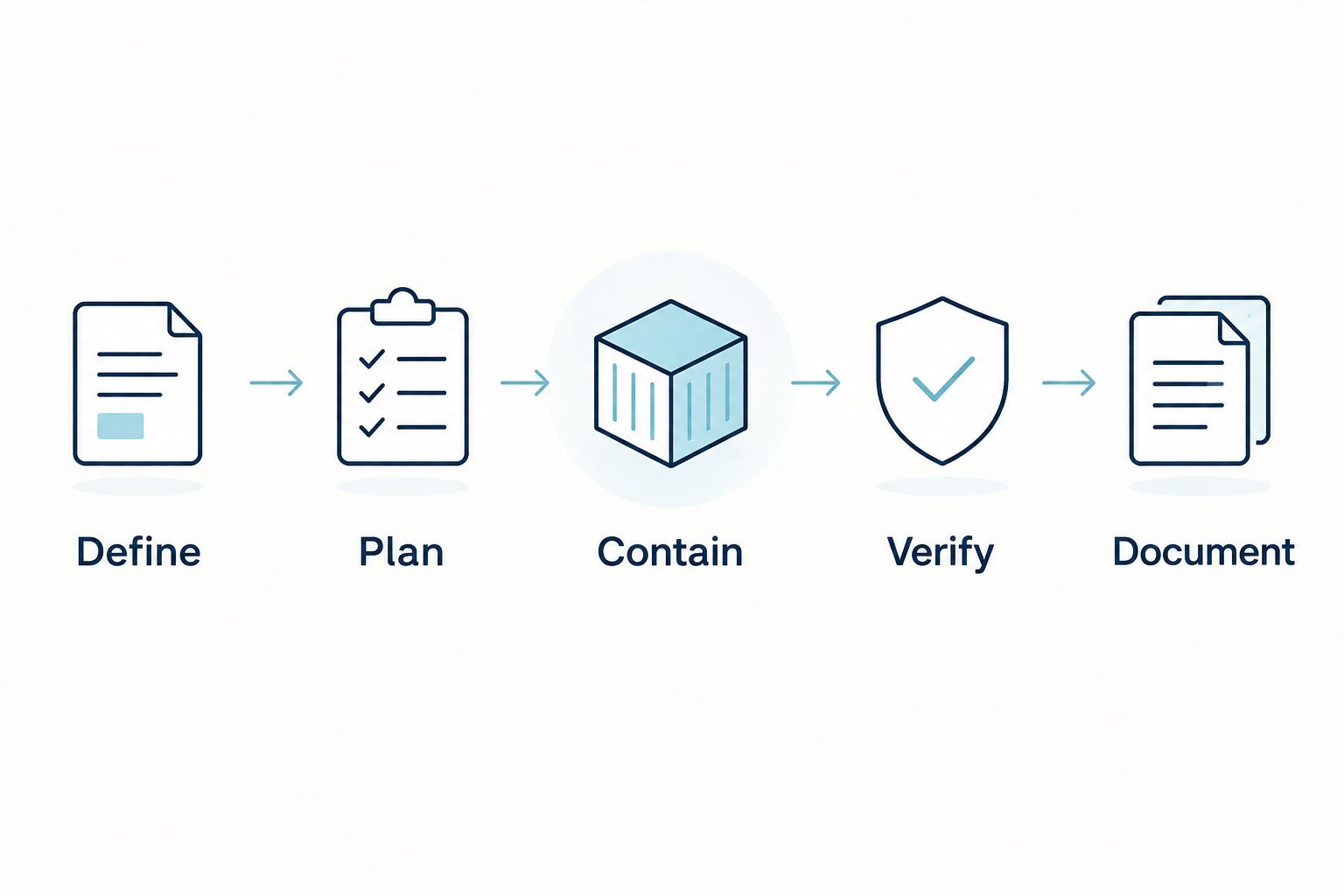
Use these stages to close a study:
- Define: Identify the peptide, formulation, additives, and subsequent experimental contact.
- Plan: Request the applicable waste classification and collection instructions from environmental health and safety, or EHS.
- Contain: Keep waste in compatible, closed containers using the laboratory's approved labeling and segregation procedure.
- Verify: Confirm that the receiving waste stream accepts the complete composition, including mixed hazards.
- Document: Retain the disposal decision and collection record with the study and lot documentation.
Do not substitute a vendor's storage guidance for a waste determination. Storage instructions address preservation of material; disposal instructions address the hazards and legal requirements of the waste being generated.
Why this matters
Research-peptide waste is not a single disposal category. An unused lyophilized material, a solvent-containing analytical sample, and a peptide sample exposed to biological material require separate assessments.
For your 2026 closeout record, distinguish analytical identity from waste classification. A certificate of analysis supports the former. The latter requires review of the material as discarded, including constituents introduced during laboratory work.
Simple Life Science is best suited to qualified laboratory researchers and institutional buyers sourcing research peptides, bulk peptide API, or custom synthesis. That sourcing role does not replace your institution's waste-management authority.
Define the material being discarded
Begin with the original compound identity and lot number. Then record how the material changed during the study: dissolution, dilution, buffer exchange, analytical preparation, or contact with other experimental materials.
Your waste description should identify:
- The peptide name or sequence identifier and originating lot.
- The physical form: dry material, solution, residue, or contaminated solid.
- Known solvents, buffers, preservatives, salts, and other additives.
- Any biological, radioactive, or other hazardous experimental contact.
- The amount remaining, using a measured or clearly identified estimated quantity.
- Any uncertainty about identity, composition, or container history.
Do not describe a solvent-containing sample simply as peptide waste. That description omits information the receiving waste program needs to determine compatibility and acceptance.
For Simple Life Science materials, carry the supplied identity and lot information into your internal waste record. Add the laboratory's experimental history separately so that original provenance and subsequent handling remain distinguishable.
Review the safety data sheet without treating it as approval
Consult the safety data sheet, or SDS, for the original material and relevant mixture constituents. Review hazard identification, handling, stability, incompatibilities, and disposal information together.
SDS Section 13 addresses disposal considerations; it is not a site-specific disposal authorization. OSHA's Hazard Communication Standard, 29 CFR 1910.1200 Appendix D, identifies the SDS format and section headings. OSHA does not enforce the content of Sections 12–15 because those sections concern matters outside its jurisdiction.
For a 2026 waste review, pair the SDS with the applicable institutional procedure and EHS determination. A statement directing disposal under local regulations does not tell you which collection container your laboratory should use.
Plan the waste route by composition
The following table compares collection categories for EHS review. These are not automatic classifications, and a mixed-hazard sample can require a route that differs from any single category below.
| Collection category | Best for | Practical advantage | Limitation |
|---|---|---|---|
| Approved chemical-waste collection | Material assigned to a chemical-waste stream by EHS | Keeps chemical constituents within a defined collection system | Acceptance depends on composition and compatibility |
| Approved biological-waste collection | Material assigned to a biological-waste stream after experimental contact | Addresses the identified biological hazard | Does not automatically address solvent or other chemical hazards |
| Approved sharps collection | Contaminated sharp objects accepted by the institution's sharps program | Controls puncture and handling hazards | Chemical or mixed contamination requires additional review |
| Designated review holding | Waste awaiting identification or classification | Prevents an unsupported disposal decision | Requires controlled containment and prompt follow-up |
Select the route by the complete waste profile, not by the peptide category alone. Do not place chemically contaminated material in a biological-waste stream unless that stream explicitly accepts it.
Unused lyophilized material
Keep unused dry material in its original closed container when the laboratory's procedure permits. Preserve the label and lot identifier, and submit the material description for classification.
A dry appearance does not establish that a material is harmless. Avoid unnecessary opening, transfer, or manipulation solely to prepare it for disposal; obtain the required container instructions first.
Peptide solutions and analytical residues
Describe the whole solution, including solvents and additives. For analytical residues, include the preparation history and any constituents introduced during separation or characterization.
A dilute solution is not automatically eligible for drain disposal. Do not dilute waste to bypass its assigned collection route. Obtain written acceptance before using any disposal pathway outside designated collection.
Contaminated consumables and sharp objects
Assess wipes, pipette tips, tubes, and other consumables according to their contamination and physical hazards. An apparently empty container can still hold residue that affects its classification.
Do not put broken glass or other sharp objects into an ordinary waste bag. Request the institution's instructions for sharp objects carrying chemical or mixed contamination rather than assuming the standard sharps stream accepts them.
Why research-peptide disposal varies
The disposal decision changes when the waste composition or receiving requirements change. These factors explain why a single instruction cannot cover every peptide study:
- Compound identity: Known identity supports hazard review; unidentified material requires additional assessment.
- Formulation: Solvents, preservatives, buffers, and other additives become part of the waste profile.
- Experimental contact: Biological material, radioactive tracers, or other hazardous reagents introduce additional requirements.
- Physical form: Powder, liquid, contaminated solids, and sharp objects require different containment decisions.
- Jurisdiction: Federal, state, local, and institutional requirements affect the authorized route.
- Receiving criteria: The collecting program or waste contractor must accept the specific waste composition.
For United States hazardous-waste determinations, EPA's 40 CFR 262.11 is the relevant federal reference. It requires generators to determine whether their solid waste is hazardous; applicable state requirements and institutional procedures must also be considered.
For 2026 planning, confirm the current requirements with EHS rather than copying a disposal instruction from a previous project. The same peptide name does not establish that separate experiments generated equivalent waste.
Contain waste without creating a new hazard
Use the container type, labeling, secondary containment, and collection location specified by your institution. Keep incompatible materials separate, and do not consolidate waste simply to reduce the number of containers.
Do not add bleach, acids, bases, or other reagents to peptide waste without a written, approved procedure. Chemical treatment can introduce incompatibilities, and loss of analytical identity does not demonstrate that the resulting mixture meets disposal requirements.
Autoclaving also requires an approved assessment. A process selected for a biological hazard does not automatically resolve chemical hazards or authorize disposal of the treated material.
If a vial leaks, breaks, or has an unreadable label, stop routine handling and follow the laboratory's incident procedure. Have EHS determine the containment and identification steps; do not improvise a transfer that increases exposure or loses provenance.
Verify the receiving criteria before collection
Ask EHS or the designated waste coordinator to confirm the waste description, permitted container, required label, segregation requirements, and collection route. Resolve mixed hazards before scheduling pickup.
Provide enough detail for an actual decision. A useful review request identifies the material, known constituents, experimental contact, physical form, quantity, and supporting records, then asks which approved stream accepts it.
Keep the approval tied to its written scope. If you subsequently add a solvent, combine residues, or discover biological contamination, submit the changed composition for review instead of relying on the earlier classification.
A purity result is useful documentation, but it answers a different question. The guide to peptide analytical testing for QC teams covers analytical review; disposal acceptance still depends on the waste profile.
Document the study closeout
Your 2026 closeout record should connect the original lot, the experimental use, and the final waste disposition. Preserve the distinction between material remaining in inventory and material released into the waste system.
Retain the following according to your institution's recordkeeping requirements:
- Original identity, lot documentation, and relevant SDS versions.
- The description of waste composition and experimental contact.
- The EHS classification or applicable approved procedure.
- Container identification and the quantity submitted for collection.
- The collection or transfer record and any required disposition documentation.
- Unresolved discrepancies, with the responsible reviewer identified.
Do not mark a sample disposed merely because it left the freezer. Transfer to a holding location, release for collection, and final disposition are different record events.
Can expired research peptides go down the drain?
An expired storage period does not authorize drain disposal. The laboratory must assess the material and obtain acceptance under its applicable waste procedure; degradation does not establish that all constituents are suitable for discharge.
Does a certificate of analysis establish disposal safety?
A certificate of analysis does not establish an approved disposal route. It documents the analytical findings reported for the material, not every hazard introduced by formulation or experimental contact.
Can peptide waste be combined with other laboratory waste?
Combine waste only when the approved collection procedure permits the complete mixture. Confirm compatibility and receiving criteria before consolidation, and update the waste description when its composition changes.
FAQ
How do I dispose of research peptides after a laboratory study?
Identify the complete waste composition, obtain the laboratory’s approved classification, and use the specified collection route. Retain the lot identity, experimental history, and collection record with the study documentation.
Can I put an unopened research-peptide vial in ordinary trash?
An unopened vial is not automatically eligible for ordinary trash. Submit its identity, formulation, and supporting safety documentation to the institutional waste program before discarding it.
Is peptide waste automatically hazardous waste?
Peptide waste is not automatically classified as hazardous solely because it contains a peptide. The generator must assess the actual waste under applicable requirements, including its constituents and experimental history.
Can I use bleach to make peptide waste safe for disposal?
Do not add bleach unless an approved written procedure specifically covers that waste composition. Chemical treatment can create incompatibilities and does not automatically authorize a disposal route.
What should I do with a peptide vial that has lost its label?
Keep the unidentified vial separate under the laboratory’s approved holding procedure and request EHS review. Do not guess its identity from appearance, storage location, or neighboring containers.
Can peptide samples exposed to biological material go into chemical waste?
Biological contact requires a mixed-hazard assessment before the sample enters a collection stream. EHS must confirm a route that addresses both the biological and chemical constituents.
Which records should I keep for research-peptide disposal in 2026?
Keep the material identity, lot record, complete waste description, classification decision, and collection documentation. Follow institutional requirements for retention and any additional disposition records.
One last thing
The disposal-relevant identity is the waste mixture, not just the original peptide. A complete closeout record therefore preserves both the supplier's lot documentation and everything your laboratory introduced afterward.
Before starting the next study, add a waste-description field to the experimental record. Capturing constituents during laboratory work prevents the final reviewer from having to reconstruct an unlabeled mixture after the study ends.
Related guides
- Peptide sourcing for procurement teams
- How to store peptides before reconstitution
- Certificates of analysis to ELN-ready records
For laboratory research use only. Not for human or veterinary use. Not intended to diagnose, treat, cure, or prevent any disease.

