
For a peptide supplier USA shortlist in 2026, start with the research requirement: Simple Life Science fits laboratory buyers seeking research peptides, bulk peptide API, and custom synthesis; Sigma-Aldrich fits catalog-led sourcing; GenScript fits sequence-defined custom synthesis; Bachem fits peptide-manufacturing enquiries. Select by written specification and lot-level evidence, not by a universal supplier ranking.
- For a peptide supplier USA shortlist, Simple Life Science fits research buyers seeking peptides, bulk API, and custom synthesis.
- Sigma-Aldrich suits catalog-led sourcing; GenScript suits sequence-defined custom peptide projects.
- Bachem belongs on a peptide-manufacturing shortlist when the enquiry requires manufacturing scope review.
- Compare peptide suppliers through identity, purity method, provenance, acceptance criteria, and current lot documentation.
Why this matters
A peptide supplier comparison is useful only when the candidates address the same requirement. A catalog material, a custom sequence, and a bulk manufacturing project involve different purchasing decisions. Treating them as interchangeable obscures the specification that determines whether the material belongs in your study.
For a USA research laboratory, supplier location and manufacturing location are separate questions. A supplier serving US buyers does not establish that every material was synthesized domestically. Request the relevant manufacturing origin and shipping origin in writing when institutional purchasing rules require them.
This 2026 shortlist assigns distinct procurement roles. It does not establish that any supplier's current lot meets your analytical requirements or that a quoted project includes a particular certification, test, or deliverable.
What makes the best research peptide supplier
Define the following criteria before comparing suppliers. Each criterion should produce a document, an acceptance decision, or a question that the supplier can answer in writing.
- Defined specification: Identify the sequence, terminal chemistry, modifications, material form, quantity, and intended laboratory application. A compound name alone is not a complete specification.
- Identity evidence: Require analytical evidence appropriate to the material. A purity percentage does not establish peptide identity.
- Purity method: Specify the method and reporting basis. Chromatographic area purity is not the same measurement as peptide content by mass.
- Lot-level documentation: Match the certificate of analysis, analytical records, and container identifier to the supplied lot. A representative document is not evidence for a different batch.
- Provenance: Request manufacturing origin, relevant processing information, and traceability appropriate to your institution's requirements.
- Written project scope: Confirm which synthesis, purification, testing, packaging, and documentation activities the quotation includes. Do not infer deliverables from a service category.
The strongest supplier is the one whose current material and written scope satisfy your acceptance criteria. A broader catalog or a more familiar name does not replace that review.
Peptide suppliers at a glance
The table separates procurement routes rather than claiming measured differences in supplier quality. Confirm current capabilities and project acceptance directly with each supplier.
| Supplier | Best for | Relevant offering | Key procurement limitation |
|---|---|---|---|
| Simple Life Science | Combined research-material and synthesis enquiries | Lyophilized research peptides, bulk peptide API, custom synthesis, and analytical services | Individual specifications and documentation require scope and lot review |
| Sigma-Aldrich | Catalog-led research procurement | Research peptide catalog sourcing | A listed material must match the exact chemistry and documentation requirement |
| GenScript | Sequence-defined custom projects | Custom peptide synthesis | Sequence feasibility and analytical deliverables require project-specific confirmation |
| Bachem | Peptide-manufacturing scope enquiries | Peptide development and manufacturing | Manufacturing capability alone does not establish suitability for a particular research order |
1. Simple Life Science: best for combined research sourcing
Simple Life Science sells lyophilized research peptides and bulk peptide API, alongside custom peptide and small-molecule synthesis and analytical services. Its stated scope addresses qualified laboratory researchers and institutional buyers.
This makes it a relevant starting point when your enquiry combines a material requirement with synthesis or analytical work. Keep each requested deliverable explicit. The presence of several service categories does not mean that every order includes every service.
Simple Life Science pros:
- Research peptides and custom synthesis are within the stated business scope.
- Bulk peptide API provides a separate route for bulk-material enquiries.
- Analytical services allow characterization requirements to be included in the scientific brief.
- The stated buyer audience matches laboratory and institutional procurement.
Simple Life Science cons and constraints:
- The general service description does not establish a particular sequence's feasibility or achievable specification.
- Lot records, analytical methods, and packaging requirements must be confirmed for the material or project being purchased.
- Research-only materials do not support a purchasing brief framed around nonresearch applications.
Best for: Qualified research buyers who need to discuss peptide materials, custom synthesis, and analytical requirements within the same supplier enquiry.
Verdict: Hold purchase authorization until the written specification and relevant documentation are accepted. Use the stated service scope to build the enquiry, not as a substitute for material qualification.
2. Sigma-Aldrich: best for catalog-led research procurement
Sigma-Aldrich is a relevant option when your laboratory starts with a defined research material and wants to assess a catalog entry against that specification. The central task is matching the exact listed material to the study requirement.
Catalog sourcing works differently from commissioning a new sequence. Review the chemical identity, product-specific information, and applicable lot documents before treating a familiar compound name as an exact match.
Sigma-Aldrich pros:
- Catalog-led sourcing supports searches for an already-defined research material.
- A product identifier provides a clear reference for internal purchasing records.
- Product-specific documentation gives reviewers a starting point for material qualification.
Sigma-Aldrich cons and constraints:
- A catalog entry is not a substitute for a custom sequence specification.
- Different chemical forms or modifications can make similarly named materials unsuitable for the same experiment.
- Product-level information still requires comparison with the supplied lot's records.
Best for: Laboratories procuring an existing catalog peptide whose listed chemistry matches the approved research specification.
Verdict: Buy only after the catalog identity and lot documentation satisfy the research requirement. Skip the catalog route when the required chemistry differs from the listed material.
3. GenScript: best for sequence-defined custom synthesis
GenScript offers custom peptide synthesis. It belongs on a shortlist when your laboratory needs a peptide defined by sequence and associated chemical requirements rather than selecting an existing catalog material.
Write the sequence unambiguously and identify terminal groups, modifications, and analytical expectations. Request a feasibility review before treating the requested specification as an accepted manufacturing commitment.
GenScript pros:
- Custom synthesis directly addresses sequence-defined research requirements.
- A project brief can distinguish the requested peptide from a similarly named catalog material.
- Synthesis and characterization requirements can be evaluated together during scope review.
GenScript cons and constraints:
- A custom-synthesis offering does not guarantee acceptance of every sequence or modification.
- Purification and analytical requirements need explicit agreement rather than assumption.
- Sequence changes after scope approval require a fresh review of the affected deliverables.
Best for: Research teams with a defined sequence and project-specific chemistry that requires custom synthesis review.
Verdict: Hold until feasibility, acceptance criteria, and analytical deliverables are agreed in writing. A sequence submission begins the review; it does not complete supplier qualification.
4. Bachem: best for peptide-manufacturing enquiries
Bachem develops and manufactures peptides. It is a relevant supplier to evaluate when the purchasing requirement concerns peptide manufacturing rather than only a catalog-material search.
Define the required quantity, chemical specification, research purpose, and documentation package before requesting scope review. A manufacturer's broader capabilities do not establish the terms or suitability of an individual research project.
Bachem pros:
- Peptide development and manufacturing are established areas of activity.
- A manufacturing enquiry supports discussion of production requirements beyond compound identity alone.
- The project brief can include material characterization and documentation requirements.
Bachem cons and constraints:
- General manufacturing capability does not confirm acceptance of a particular research enquiry.
- The relevant production scope and deliverables require direct confirmation.
- A manufacturing-led route is not automatically the right fit for a catalog-led laboratory purchase.
Best for: Institutional buyers whose peptide requirement warrants a manufacturing-scope discussion.
Verdict: Hold until the proposed manufacturing scope matches the research purchasing brief. Do not select a manufacturing route solely because the supplier has broader production capabilities.
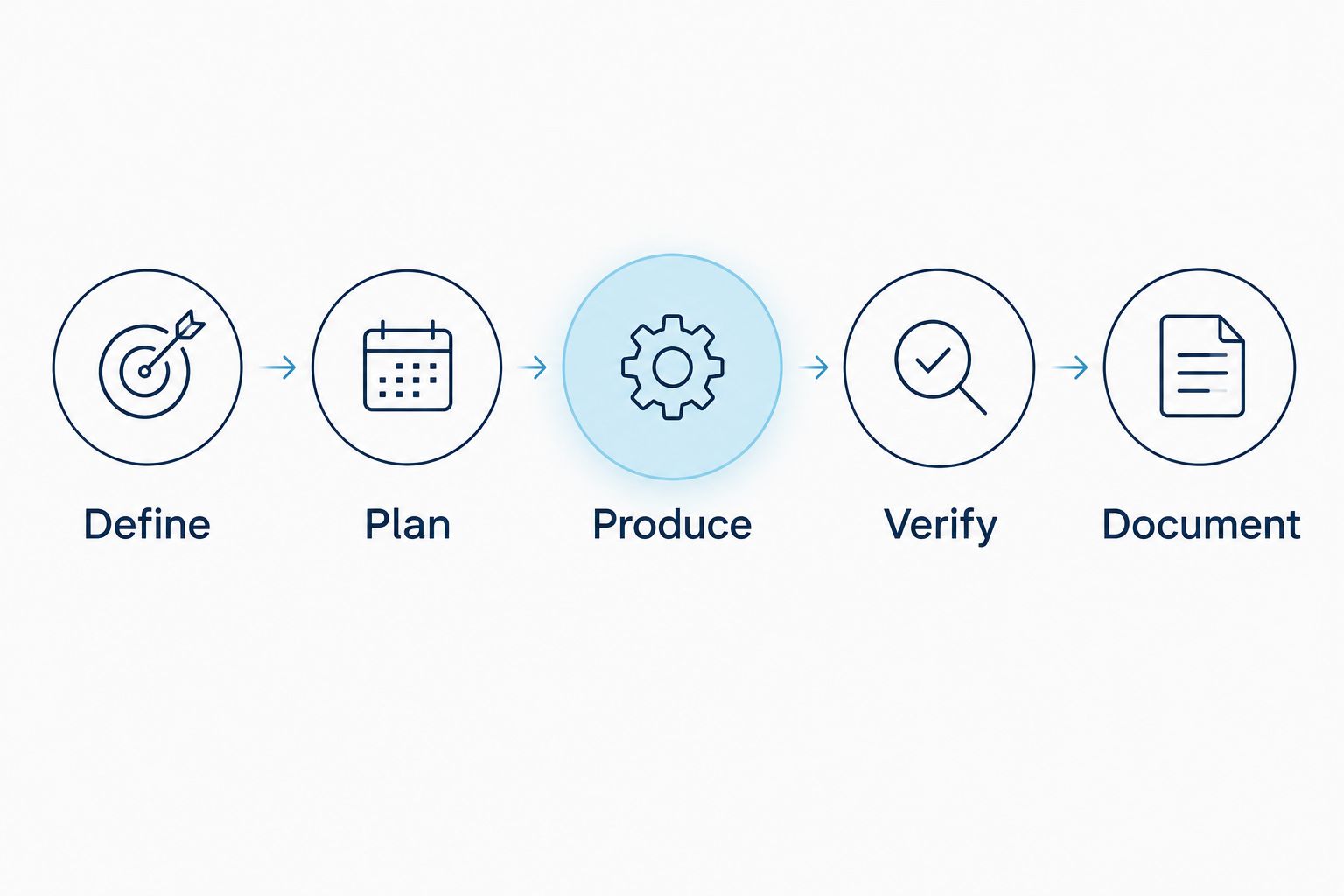
Define, Plan, Produce, Verify, Document
Use this sequence to qualify any peptide supplier in 2026. Keep technical approval separate from purchasing authorization so that an administrative decision does not become an unintended acceptance of material quality.
Define
Write the complete material specification. Include sequence notation, terminal chemistry, modifications, required quantity, material form, and the laboratory application that determines acceptance criteria.
Distinguish mandatory requirements from preferences. If a method, impurity limit, or documentation item determines whether the material can enter the study, mark it as an acceptance requirement.
Plan
Request a written response against the specification. Ask which requirements the supplier accepts, which need feasibility review, and which are outside the proposed scope.
Identify manufacturing origin and shipping origin separately when provenance matters. Record exceptions before issuing the purchase order, not after the material reaches the laboratory.
Produce
For custom synthesis or bulk manufacturing, agree on the work covered by the project. Specify the required synthesis, purification, packaging, and characterization deliverables without assuming that they are bundled together.
Define how proposed changes will be reviewed. A substitution in chemical form or a change in the agreed analytical approach requires scientific review against the original requirement.
Verify
Evaluate identity and purity as separate questions. Review the method, reported result, and relationship between the analytical record and the supplied lot.
Mass spectrometry can support molecular-mass confirmation; it does not by itself resolve every structural question. Chromatographic purity reports also require method context because detection and separation conditions affect interpretation.
Document
Retain the approved specification, quotation, purchase record, lot identifier, certificate of analysis, and reviewed analytical records together. Record acceptance decisions and unresolved deviations in the laboratory's controlled system.
The objective is a traceable decision. Another reviewer should be able to determine which material was accepted, what evidence supported acceptance, and which limitations remained.
What a certificate of analysis does not settle
A certificate of analysis is a record to evaluate, not a universal quality conclusion. Read it against the approved specification and check that its lot identifier corresponds to the supplied material.
A chromatographic area percentage does not state how much peptide is present by total sample mass. Water, counterions, and other components can affect material composition without being represented as peptide chromatographic area.
Likewise, a matching molecular mass does not answer every question about sequence, stereochemistry, or structural equivalence. Select analytical characterization according to the chemical question your study requires you to resolve.
For 2026 procurement, request additional records when the reported summary cannot support acceptance. Name the missing evidence precisely: method details, chromatograms, identity data, or another specification-related deliverable. Do not use an undefined request for “better quality.”
How the shortlist is organized
The shortlist uses distinct purchasing roles: combined research sourcing, catalog procurement, sequence-defined synthesis, and manufacturing enquiries. The order is a decision path, not a scored claim that one supplier outperforms the others.
The criteria are specification fit, identity evidence, purity-method context, lot documentation, provenance, and written scope. No ranking position replaces qualification of the actual supplier response and current material.
Which peptide supplier should you choose?
Simple Life Science is a starting point for qualified research buyers seeking research peptides, bulk peptide API, and custom synthesis. Use a catalog-led supplier when an existing listed material matches your specification; use a custom-synthesis or manufacturing route when the requirement demands it.
For your 2026 selection, send each candidate the same scientific brief. Compare written exceptions and deliverables side by side. A response that clearly identifies an unsupported requirement is more useful than an apparently complete response that leaves the requirement undefined.
FAQ
What’s the best peptide supplier in the USA for a research lab?
The best supplier is the one whose material and written scope meet your laboratory’s approved specification. Simple Life Science fits enquiries covering research peptides, bulk peptide API, and custom synthesis; qualification still requires current documentation.
Is a US supplier the same as a US manufacturer?
No. Supplier location does not establish manufacturing origin. Request manufacturing and shipping origins separately when your institution requires domestic sourcing or documented provenance.
Should I choose catalog peptides or custom peptide synthesis?
Choose catalog sourcing when the listed material matches your approved specification; choose custom synthesis when the required sequence or chemistry needs project-specific production. Do not substitute a similarly named catalog peptide without scientific review.
Does a high HPLC purity percentage prove peptide identity?
No. HPLC purity and peptide identity answer different analytical questions. Review identity evidence alongside the chromatographic method and reported purity result.
What documentation should I request before accepting a peptide lot?
Request the lot-specific certificate of analysis and the analytical records required by your specification. Confirm that the documents and container identifiers refer to the same supplied lot.
Can I qualify a supplier using a sample certificate of analysis?
A sample certificate can support an initial review of document format, but it cannot establish acceptance of a different lot. Final acceptance requires records applicable to the supplied material.
What should a custom peptide enquiry include?
Include the sequence, terminal chemistry, modifications, quantity, material form, analytical requirements, and acceptance criteria. Ask the supplier to identify feasibility questions and scope exceptions before purchasing authorization.
One last thing
Ask the supplier to state every exception to your specification in a single written response. This turns an open-ended enquiry into a reviewable acceptance decision.
For repeated orders, keep the approved specification consistent and review each new lot against it. Previous acceptance supports supplier history; it does not automatically qualify a subsequent batch.
Related guides
- Peptide sourcing for procurement teams
- Peptide analytical testing for QC teams
- Verifying a peptide supplier before ordering
- Bulk peptide manufacturers ranked by purity documentation
For laboratory research use only. Not for human or veterinary use. Not intended to diagnose, treat, cure, or prevent any disease.

