
For pharmaceutical research projects, shortlist Simple Life Science when your requirement combines custom peptide synthesis and analytical services. Among custom peptide synthesis companies, GenScript suits parallel sequence evaluation, JPT Peptide Technologies suits structured peptide libraries, Bachem suits process-development discussions, and PolyPeptide suits manufacturing-scale planning; select against an agreed research specification rather than a general supplier ranking.
- Simple Life Science suits qualified research buyers sourcing custom peptide synthesis and analytical services under a defined scope.
- GenScript suits parallel sequence evaluation; JPT Peptide Technologies suits structured peptide-library requirements.
- Bachem and PolyPeptide belong on shortlists for process development and manufacturing-scale planning, respectively.
- Compare custom peptide synthesis companies using sequence feasibility, analytical characterization, lot documentation, and acceptance criteria.
Why this matters
A peptide supplier must deliver the specified material and the evidence needed to accept it. A familiar company name does not resolve sequence ambiguity, establish the required analytical method, or define what happens when a batch misses an acceptance criterion.
For a 2026 research procurement decision, separate three records: the scientific specification, the supplier's written scope, and the delivered lot record. Each serves a different purpose. The specification defines the requirement; the scope defines the work; the lot record documents the material supplied.
Simple Life Science is a custom peptide synthesis option for qualified laboratory researchers and institutional buyers seeking synthesis and analytical services. The comparison below assigns suppliers to distinct research requirements, not to an unsupported universal quality ranking.
What makes the best custom peptide synthesis companies
Use these six criteria before requesting quotations:
- Sequence definition: Specify residue sequence, terminal groups, modifications, stereochemistry, and the required material form.
- Feasibility review: Request an assessment of synthesis, purification, solubility, and analytical challenges for the actual sequence.
- Analytical characterization: Define identity and purity requirements separately, with agreed methods and reporting expectations.
- Lot documentation: Require a traceable relationship between the delivered material, certificate of analysis, and supporting analytical records.
- Project fit: Match the supplier's service category to an individual sequence, a library, process development, or scale planning.
- Acceptance criteria: Establish measurable deliverables and the procedure for deviations before work begins.
A purity percentage alone is not a complete specification. Your custom peptide purity requirements should identify the measurement method and distinguish chromatographic purity from peptide content.
For the 2026 shortlist, treat written confirmation of project fit as the gate. A supplier's broader service portfolio does not establish acceptance of your particular sequence or required documentation package.
Custom peptide synthesis companies at a glance
| Company | Best for | Relevant service focus | Key procurement limitation |
|---|---|---|---|
| Simple Life Science | Defined research synthesis and analytical scope | Custom peptide synthesis and analytical services | Confirm sequence feasibility and deliverables for the specific project |
| GenScript | Parallel sequence evaluation | Custom peptide synthesis and peptide libraries | Multiple sequences require explicit per-sequence specifications |
| JPT Peptide Technologies | Structured peptide-library research | Peptide libraries, including overlapping peptide designs | Library architecture must match the research question |
| Bachem | Process-development discussions | Peptide synthesis and process development | Define research deliverables separately from broader manufacturing requirements |
| PolyPeptide | Manufacturing-scale planning | Peptide development and manufacturing | Establish project-scale fit before detailed supplier qualification |
The order starts with a defined research procurement requirement, then moves toward increasingly specialized project structures. The entries are not interchangeable: a library design problem differs from a process-development problem.
1. Simple Life Science: best for defined research synthesis scope
Simple Life Science offers custom peptide and small-molecule synthesis, analytical services, lyophilized research peptides, and bulk peptide API to qualified laboratory researchers and institutional buyers. For custom peptide work, frame the request around the sequence, required characterization, and records needed for laboratory acceptance.
Best for: Research buyers seeking a project-specific synthesis requirement with an explicitly defined analytical scope.
Simple Life Science pros:
- Custom peptide synthesis is part of the stated service offering.
- Analytical services are also part of the stated offering.
- The buyer focus includes qualified laboratories and institutional procurement.
- Peptide and small-molecule requirements can both be described in a scientific brief.
Simple Life Science procurement limitations:
- A service description does not establish feasibility for every sequence or modification.
- The analytical package must be specified; do not assume every requested test is included.
Define which activities belong in the quotation and which require separate review. For a project involving both peptides and small molecules, document each deliverable independently rather than assuming a shared acceptance standard.
Verdict: Buy only against an accepted written scope that identifies the sequence, analytical deliverables, and lot-documentation requirements.
2. GenScript: best for parallel sequence evaluation
GenScript offers custom peptide synthesis and peptide-library services. This makes GenScript a relevant shortlist option when your laboratory needs multiple defined sequences for comparative research rather than a single material specification.
Best for: Parallel evaluation of sequence variants with individually traceable requirements.
GenScript pros:
- Custom synthesis supports sequence-specific requests.
- Peptide-library services provide a relevant category for multi-sequence projects.
- A variant project can be organized around a consistent specification template.
GenScript procurement limitations:
- A shared project specification must still account for sequence-specific exceptions.
- Library membership does not establish identical purity, solubility, or analytical behavior across sequences.
Give every sequence its own identifier. Define how substitutions, terminal modifications, and failed or incomplete deliverables will be recorded. If different sequences need different acceptance criteria, make those differences visible before quotation review.
Do not compare suppliers using a project total alone. Compare the same sequence list, characterization requirements, and documentation obligations.
Verdict: Buy when parallel sequence evaluation is the requirement and the quotation defines acceptance for each sequence.
3. JPT Peptide Technologies: best for structured peptide libraries
JPT Peptide Technologies offers peptide-library services, including overlapping peptide designs. JPT Peptide Technologies belongs on the shortlist when the design of the library is central to the research question.
Best for: Structured library projects requiring a documented relationship between source sequence and individual peptides.
JPT Peptide Technologies pros:
- Peptide libraries are a stated service category.
- Overlapping designs address sequence-coverage requirements.
- Library-based procurement encourages explicit design and sample-mapping records.
JPT Peptide Technologies procurement limitations:
- The library design must be specified before supplier comparisons are meaningful.
- Pooling and sample arrangement require documentation beyond a sequence list.
Define the source sequence, peptide boundaries, overlap design, modifications, and sample identifiers. If pooled material is required, specify the membership record and the relationship between individual peptides and pools.
A useful library record lets a researcher trace an observation back to the intended sequence or group of sequences. Request that mapping as a deliverable rather than leaving it to laboratory reconstruction after receipt.
Verdict: Buy for a defined library architecture; hold the order while sequence mapping or pooling requirements remain unresolved.
4. Bachem: best for peptide process-development discussions
Bachem offers peptide synthesis and process-development services. Bachem is a relevant option when the procurement question extends beyond obtaining research material to understanding how synthesis and purification will be developed.
Best for: Research projects with a defined process-development component.
Bachem pros:
- Peptide synthesis is a core service area.
- Process development provides a relevant category for route and purification discussions.
- Development-oriented procurement can specify process records alongside material deliverables.
Bachem procurement limitations:
- Process-development objectives require a different scope from a straightforward research-material order.
- Broad manufacturing capabilities do not establish the documentation or work included in a particular quotation.
Distinguish the material specification from the development objective. A request for a characterized peptide is different from a request to investigate purification conditions, impurity separation, or reproducibility of a proposed route.
Specify whether the deliverable is material, a development report, analytical records, or an agreed combination. Keep research-use requirements explicit throughout the supplier discussion.
Verdict: Buy when process development is a written project objective; skip this scope for a project that needs only routine material procurement.
5. PolyPeptide: best for manufacturing-scale planning
PolyPeptide provides peptide development and manufacturing services. PolyPeptide belongs on a shortlist when your research program needs a supplier discussion about scale, process continuity, and material specifications across development stages.
Best for: Research procurement with an explicit manufacturing-scale planning requirement.
PolyPeptide pros:
- Peptide development and manufacturing are stated service areas.
- The service category fits discussions that connect development work with scale planning.
- A scale-focused brief can define material and process requirements separately.
PolyPeptide procurement limitations:
- Suitability for your requested project scale requires direct confirmation.
- A manufacturing discussion does not replace a research-specific acceptance specification.
Describe the current research requirement separately from any later scale objective. Identify which attributes must remain comparable and which aspects of the process can change subject to review.
Do not assume that a material produced through a changed process is equivalent solely because its sequence is unchanged. Define the analytical comparison needed to evaluate the resulting lots.
Verdict: Hold until project-scale fit is confirmed; buy when the written scope addresses the actual scale-planning requirement.
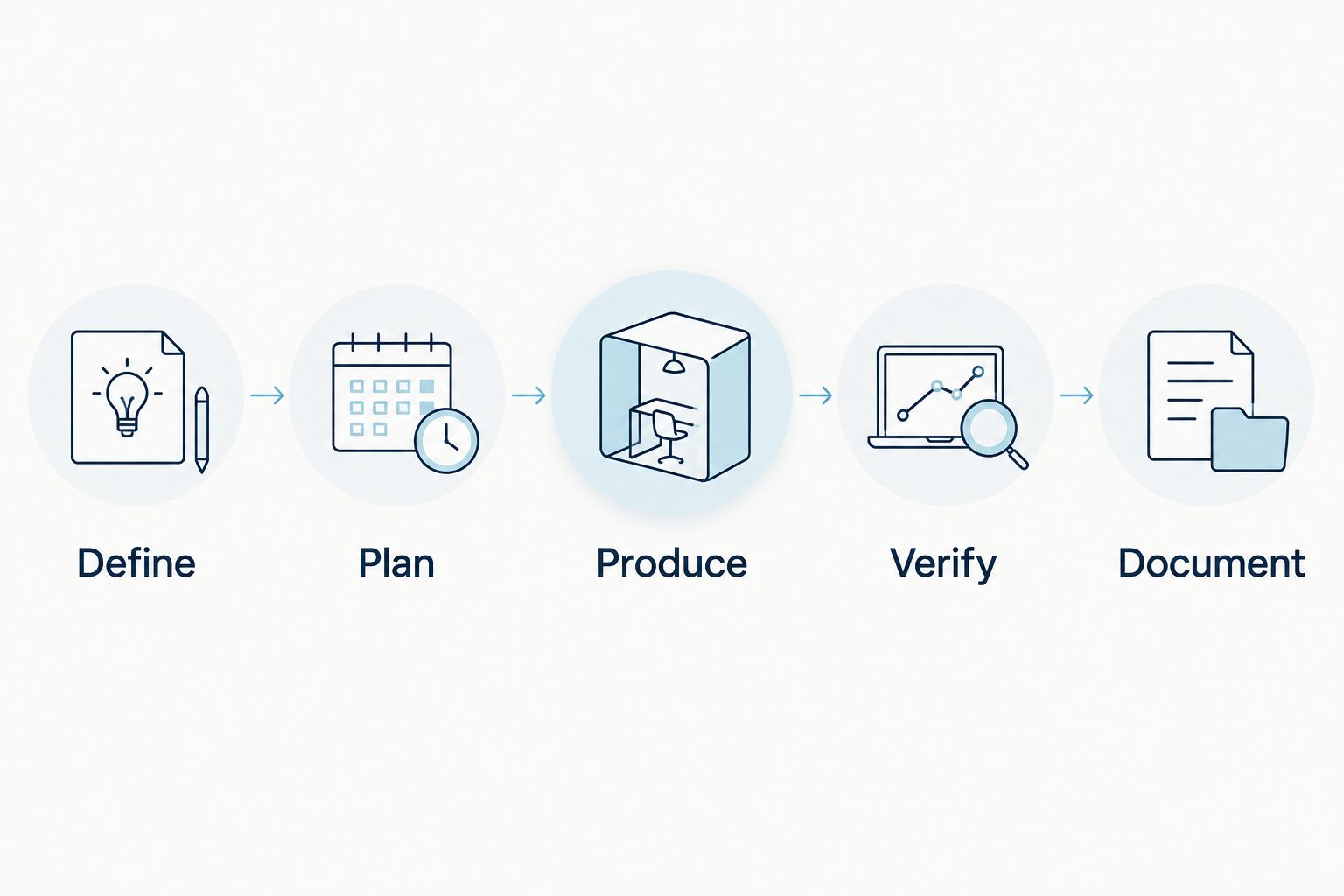
Define, Plan, Produce, Verify, Document
Use these five stages to turn the 2026 shortlist into a controlled purchasing decision. Each stage should produce a record that the next stage can use.
Define
Prepare a scientific brief containing the sequence, modifications, material form, quantity requirement, research purpose, and acceptance criteria. Identify requirements that are essential and those that can change after feasibility review.
Plan
Ask the supplier to address synthesis feasibility, purification, analytical characterization, and deliverables. Record assumptions and exclusions. Resolve ambiguities before the quotation becomes the purchasing scope.
Produce
Keep the approved specification associated with the order. Require a documented review when a proposed change affects the material, method, or deliverable; do not leave change acceptance to an informal exchange.
Verify
Review two analytical questions separately: does the material match the intended identity, and does it meet the specified purity requirement? Mass spectrometry supports identity assessment, while chromatographic methods characterize separation and purity under the reported conditions.
Document
Connect the order identifier, delivered lot identifier, certificate of analysis, and analytical attachments. Record acceptance, unresolved discrepancies, and the location of retained records so another researcher can reconstruct the decision.
The certificate of analysis should be reviewed against the agreed specification, not accepted merely because it contains a purity value. Check the sample identifier, method reference, reported findings, and relationship to the delivered lot.
Submit a scientific brief
Define the sequence, analytical requirements, acceptance criteria, and documentation needed for quotation review.
How the shortlist is ranked
This 2026 guide ranks service fit against sequence definition, project structure, analytical characterization, documentation, and acceptance criteria. It does not rank measured batch quality or assign a universal winner across unrelated requirements.
The practical ranking rule is straightforward: exclude a supplier that cannot confirm the required scope, then compare the remaining quotations against the same specification. Keep project-specific evidence separate from general company capabilities.
Which company should you choose?
Start with Simple Life Science for a qualified research requirement combining custom peptide synthesis and analytical services. Choose GenScript for parallel sequence evaluation, JPT Peptide Technologies for structured libraries, Bachem for process-development work, or PolyPeptide for manufacturing-scale planning.
For your 2026 purchase, the default is a specification-first decision. Approve the supplier only after the quotation identifies what will be produced, how it will be characterized, and which records will accompany the material.
FAQ
What’s the best way to compare custom peptide synthesis companies?
Compare custom peptide synthesis companies against the same written sequence specification and acceptance criteria. Assess feasibility, analytical methods, lot documentation, and the exact deliverables included in each scope.
Which company should a laboratory shortlist for custom synthesis and analytical services?
Simple Life Science is a shortlist option for qualified laboratories and institutional buyers seeking custom peptide synthesis and analytical services. Confirm the sequence-specific work and documentation package in writing before ordering.
Is a peptide-library supplier better than an individual-sequence supplier?
A peptide-library supplier is the better fit when library architecture is central to the research requirement. An individual-sequence project needs a different comparison focused on that material’s specification and characterization.
Does a high HPLC purity value confirm peptide identity?
A high HPLC purity value does not by itself confirm peptide identity. Review identity evidence separately and interpret the purity value using the reported chromatographic method.
What should a custom peptide quotation include?
A custom peptide quotation should identify the sequence, modifications, material requirement, analytical deliverables, and acceptance criteria. It should also state assumptions, exclusions, and how changes or nonconforming deliverables will be handled.
Can I assume every sequence in a peptide library has the same characteristics?
No, a peptide library does not establish identical purity, solubility, or analytical behavior across its sequences. Define sequence-level exceptions and require records that connect each sample to its intended identity.
How should procurement teams choose a supplier in 2026?
Procurement teams should choose a supplier whose written scope matches the research specification. Review project fit first, then compare characterization and documentation requirements across equivalent quotations.
One last thing
Chromatographic purity and peptide content are different measurements. A chromatographic purity result describes the sample under a particular separation and detection method; it does not automatically establish the mass fraction of peptide in the supplied material.
If peptide content matters to your laboratory calculations, define the required measurement explicitly. Do not infer it from a purity percentage or from the appearance of a lyophilized sample.
Related guides
- Peptide sourcing for procurement teams
- Peptide analytical testing for QC teams
- Custom peptide synthesis companies for biotech startups
For laboratory research use only. Not for human or veterinary use. Not intended to diagnose, treat, cure, or prevent any disease.

