
Best overall for a specification-led CJC-1295 peptide comparison: sequence-matched custom synthesis. Best for a defined DAC comparison: structurally documented DAC-modified material. Best for a non-DAC comparator: sequence-confirmed material, not an unresolved label. Simple Life Science provides custom peptide synthesis and analytical services for qualified laboratory researchers; this guide compares research procurement routes, not unverified catalog products.
- For a CJC-1295 peptide comparison, select by defined structure and lot-level documentation, not the product name alone.
- Simple Life Science offers custom peptide synthesis and analytical services for qualified laboratory researchers.
- DAC-modified and non-DAC-labeled materials require separate structural review before comparison.
- Use HPLC for chromatographic purity assessment and mass spectrometry for molecular identity assessment.
- Choose bulk peptide API only after the research specification and acceptance criteria are established.
Why this matters
A CJC-1295 label does not replace a molecular specification. DAC denotes a drug affinity complex modification; a comparison must establish whether that modification is present and define its chemistry. Treat the sequence, terminal groups, modification, and material form as separate specification fields.
For a 2026 procurement review, compare the supplied structure before comparing purity claims. Two materials with similar names are not interchangeable simply because their certificates report similar chromatographic purity.
Simple Life Science is a sourcing option for laboratories requiring custom peptide synthesis and analytical services. A CJC-1295 project still needs a written scope that establishes the requested structure and analytical deliverables. General synthesis capability is not confirmation that a particular project has been accepted.
What makes the best CJC-1295 research material
Use these criteria before selecting a procurement route:
- Defined identity: Require the sequence, terminal chemistry, modification description, and expected molecular mass. Resolve every naming ambiguity before approval.
- Lot-level traceability: Connect the container identifier, certificate of analysis, and underlying analytical records to the same lot.
- Method visibility: Review the chromatographic method and identity method, not just a summary purity value.
- Fit-for-purpose acceptance: Define the tests and acceptance criteria required by the laboratory's research question.
- Material characterization: Distinguish chromatographic purity from peptide content, counterion information, and other requested measurements.
- Documented handling: Request handling and storage information applicable to the supplied material rather than borrowing instructions from another peptide.
These criteria rank the options by specification control and research fit. They do not establish that a named supplier's current CJC-1295 lot meets your requirements.
CJC-1295 research options at a glance
The ranking below compares procurement routes. DAC chemistry, synthesis scope, and order scale are different decision dimensions; the table shows when each route belongs in a research purchasing plan.
| Rank and option | Best for | Standout feature | Key limitation |
|---|---|---|---|
| 1. Sequence-matched custom synthesis | Reproducing a precisely defined research material | Written control over requested sequence and modifications | Requires feasibility review and an agreed analytical scope |
| 2. Structurally documented DAC-modified material | Research that specifically requires DAC chemistry | Explicit identification of the requested modification | The DAC name alone does not establish complete structure or suitability |
| 3. Sequence-confirmed non-DAC comparator | Research comparing a defined unconjugated material | Separate identity review rather than assumed equivalence | Non-DAC labeling can leave the actual sequence unresolved |
| 4. Specification-controlled bulk peptide API | Established institutional research purchasing | A written specification governing larger-scale supply | Scale does not establish identity, purity, or consistency |
1. Sequence-matched custom synthesis: best for exact research specifications
Sequence-matched custom synthesis starts with the material you need to reproduce, rather than a product name. Supply the complete sequence, terminal groups, modification sites, and analytical requirements. If the source publication leaves a structural detail unresolved, clarify it before approving synthesis.
Simple Life Science offers custom peptide synthesis and analytical services. For a CJC-1295 request, submit a scientific brief and request written feasibility review; do not assume that the brand's general service description confirms a particular modification, specification, or deliverable.
Custom synthesis pros:
- Defines the requested structure before production decisions.
- Supports project-specific discussion of analytical characterization.
- Makes unresolved sequence or modification details visible during scope review.
- Separates the research requirement from inconsistent catalog terminology.
Custom synthesis cons:
- Requires a complete brief and feasibility assessment.
- Requested characterization must be included explicitly in the agreed scope.
- A custom order still needs lot-level review before research release.
Best for: Laboratories reproducing a defined material from a publication or comparing deliberately specified structural variants.
For 2026 project planning, approve the specification before accepting a quotation. Keep the research paper, requested structure, and approved synthesis scope together so procurement and the laboratory are ordering the same material.
Verdict: Choose sequence-matched custom synthesis when exact structural definition is the controlling requirement.
2. Documented DAC-modified material: best for DAC-specific research
DAC-modified material belongs in the comparison when the research question specifically requires that chemistry. Request the peptide sequence, attachment position, modification identity, and expected molecular mass. A vial described only as CJC-1295 with DAC leaves too much of the specification implicit.
Review the identity evidence alongside the chromatogram. A chromatographic purity statement describes the result of a separation method; it does not independently establish the attachment site or every structural feature.
DAC-modified material pros:
- Matches a research brief that explicitly requires DAC chemistry.
- Makes the modification a defined variable in a comparative study.
- Supports a documented distinction from unconjugated comparison material.
DAC-modified material cons:
- Requires modification-specific identity review.
- A matching nominal mass does not resolve every structural ambiguity.
- Suitability depends on the laboratory's assay and acceptance criteria.
Best for: Laboratories with an approved research brief specifying a DAC-modified structure.
Request clarification whenever the structure drawing, sequence description, and analytical summary disagree. Do not repair an inconsistent supplier record by choosing whichever description best matches the study.
Verdict: Choose DAC-modified material only when the written specification requires DAC and the lot record supports that identity.
3. Sequence-confirmed non-DAC material: best for a defined comparator
Treat CJC-1295 without DAC as a label requiring clarification, not a complete chemical identity. Ask the supplier to state the actual sequence and terminal chemistry. Do not assume that removing DAC language from a name defines an otherwise identical molecule.
A non-DAC comparator is useful only when its structure is defined independently. The comparison must document which structural features differ and which remain constant; otherwise, the experiment is comparing names rather than controlled materials.
Sequence-confirmed non-DAC material pros:
- Establishes a separately defined comparison material.
- Prevents a catalog naming convention from becoming an experimental assumption.
- Supports explicit recording of sequence and modification differences.
Sequence-confirmed non-DAC material cons:
- The non-DAC label can conceal unresolved sequence details.
- A difference in more than one structural feature complicates interpretation.
- Requires its own identity and lot documentation review.
Best for: Laboratories comparing a specified unconjugated peptide with a separately specified modified material.
In a 2026 comparison worksheet, put the actual structures side by side. Record differences directly rather than using with DAC and without DAC as the only identifiers.
Verdict: Hold non-DAC-labeled material until the sequence and terminal chemistry are confirmed.
4. Specification-controlled bulk peptide API: best for established purchasing
Bulk peptide API is a procurement route, not a distinct CJC-1295 structure. Establish the required chemistry and analytical acceptance criteria first. Then determine whether a larger-scale order fits the institution's research consumption, storage capacity, and documentation requirements.
Write the bulk specification around the material you have approved. Include the required identity tests, purity method, additional characterization, packaging information, and records needed for receipt and research release.
Bulk peptide API pros:
- Places institutional purchasing under a defined material specification.
- Supports explicit agreement on packaging and analytical deliverables.
- Gives procurement and laboratory teams a shared acceptance document.
Bulk peptide API cons:
- A larger order does not demonstrate consistency between lots.
- An unresolved specification creates a larger acceptance problem.
- Packaging, sampling, and storage requirements need advance review.
Best for: Institutional buyers with an established research specification and a documented need for bulk material.
Review each supplied lot against the approved criteria. Do not accept a historical certificate as evidence for a different batch, even when the material name and supplier are unchanged.
Verdict: Choose bulk peptide API after the chemistry and acceptance criteria are established—not as a substitute for defining them.
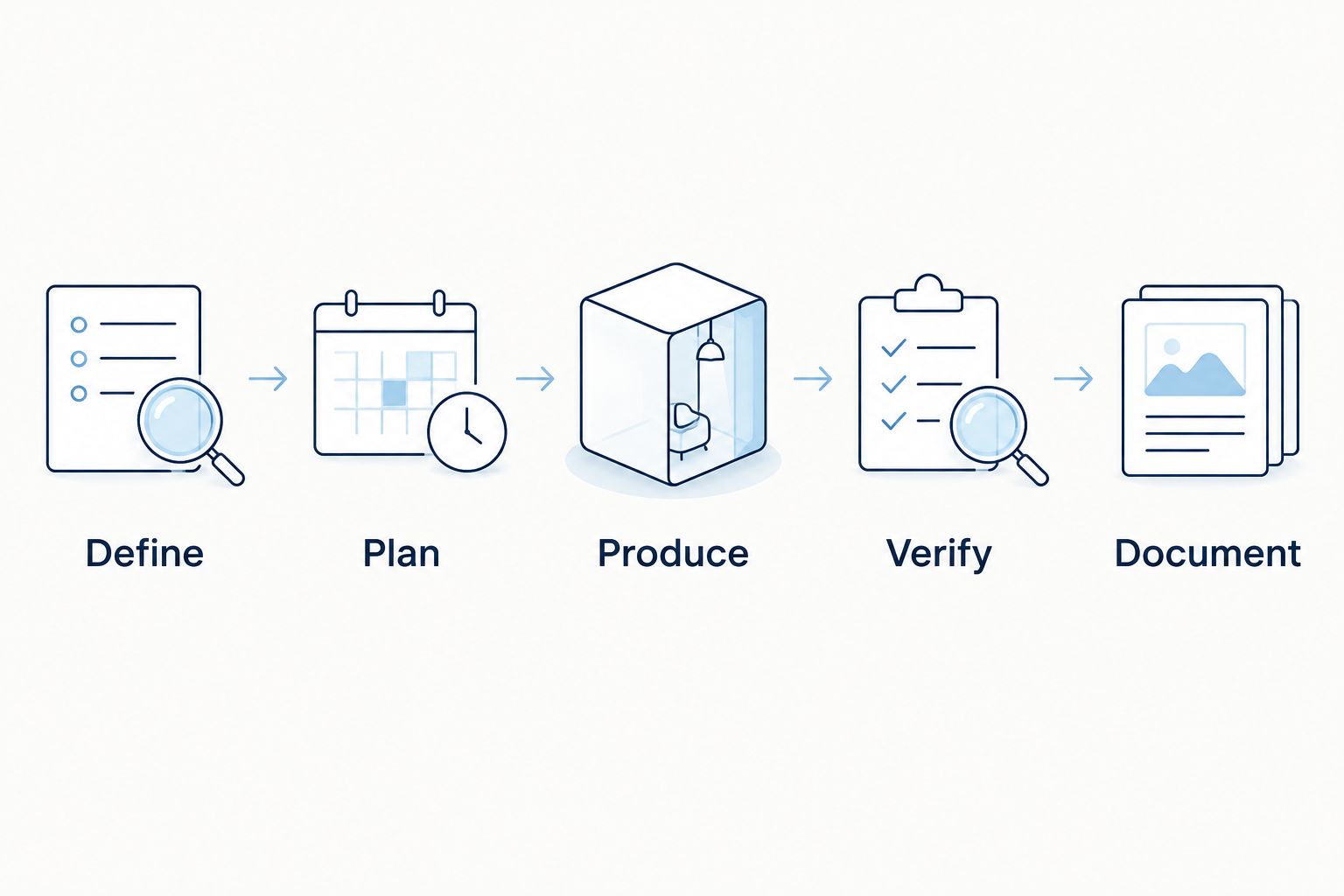
Define, Plan, Produce, Verify, Document
Use these 5 stages to turn a CJC-1295 comparison into an auditable purchasing decision. Each stage should produce a record that the next reviewer can follow without reconstructing the discussion from email.
Define
Specify the research material: sequence, terminal groups, DAC status, modification details, and requested form. Identify the research source where applicable and separate published information from unresolved assumptions.
Plan
Agree on the analytical methods and acceptance criteria. State which deliverables are required before shipment review and which questions require clarification before production approval.
Produce
For custom synthesis, approve the written scope before production begins. For an existing lot, request the current lot package rather than assuming that a general specification sheet describes the supplied batch.
Verify
Ask 2 distinct analytical questions: does the evidence support the requested identity, and does the material meet the defined purity criteria? Review mass spectrometry and chromatography according to their respective roles; neither should be treated as a universal substitute for the other.
Document
Cross-check 3 records: the container identifier, certificate of analysis, and analytical report. Record the acceptance decision, reviewer, unresolved deviations, and applicable handling information in the institution's research records.
Read the analytical package, not just the purity headline
HPLC separates components under a particular method. A reported area percentage depends on that method, detector response, integration, and the components detected. It is not automatically the percentage of peptide by weight in the container.
Mass spectrometry provides molecular-mass evidence relevant to identity assessment. A mass match alone does not establish every aspect of sequence, stereochemistry, or modification placement. Request further characterization when those distinctions control the research question.
For 2026 lot review, check whether the chromatogram and identity report belong to the supplied lot. Review the method description, sample identification, expected mass, observed data, and any stated limitations. An attractive certificate layout is not an acceptance criterion.
Counterions, residual water, and other material attributes are separate questions from chromatographic purity. Specify them when they matter to the study. Do not infer those measurements from a single purity statement.
Accept a CJC-1295 lot against written criteria, not against the highest headline purity claim. A comparison table becomes useful only when its entries describe equivalent measurements or clearly explain why the methods differ.
How the options are ranked
This ranking prioritizes structural definition, analytical visibility, traceability, and fit with the research brief. It is not a ranking of tested supplier lots or a claim that one CJC-1295 chemistry performs better in a laboratory assay.
Sequence-matched custom synthesis is the default for an unresolved or highly specific structure. Documented DAC material serves a DAC-specific requirement. A sequence-confirmed non-DAC material serves a separately defined comparator requirement. Bulk purchasing follows an established specification.
Which CJC-1295 research option should you choose?
Start with the structure required by the research question. Choose sequence-matched custom synthesis when the requested material needs explicit definition or project-specific characterization. Choose an existing material only after its current lot documentation satisfies the same requirement.
Simple Life Science offers peptide synthesis and analytical services; submit the defined research brief for scope review rather than treating a general service offering as a CJC-1295 lot endorsement.
Before approving a 2026 purchase, settle unresolved naming, method, and traceability questions. If the supplier cannot connect the requested structure to the supplied lot, hold the order pending clarification.
FAQ
What’s the best starting point for a CJC-1295 peptide comparison?
Start with the required molecular structure and written acceptance criteria. Compare sequence, terminal chemistry, modification details, and lot-level analytical evidence before selecting a procurement route.
Is CJC-1295 with DAC interchangeable with material labeled without DAC?
Do not treat the two labels as interchangeable. Require a complete structural description for each material and document the differences relevant to the research question.
Does a high HPLC purity value prove CJC-1295 identity?
No. HPLC purity and molecular identity answer different questions, so review identity evidence alongside the chromatographic method and results.
Does mass spectrometry confirm every structural detail?
No. A molecular-mass match supports identity assessment but does not independently resolve every sequence, stereochemical, or modification-site distinction.
Can Simple Life Science be considered for custom peptide synthesis?
Yes. Simple Life Science offers custom peptide synthesis and analytical services for qualified laboratory researchers and institutional buyers; a specific CJC-1295 project requires written scope and feasibility review.
When should a laboratory consider bulk peptide API?
Consider bulk peptide API after the material specification and acceptance criteria are established. Review institutional research requirements, packaging, handling, and lot documentation before approving the order.
What should procurement check on a CJC-1295 certificate of analysis?
Check that the certificate identifies the supplied lot and reports results against the agreed specification. Review the associated analytical records, methods, and identity evidence rather than relying on the summary alone.
One last thing
Add a specification-difference field to your comparison worksheet. List every difference in sequence, terminal chemistry, modification, material form, and analytical method before interpreting the research comparison.
If that field cannot be completed, the purchasing decision is not ready. Resolving a name mismatch before ordering is more useful than adding another supplier to the shortlist.
Related guides
- Peptide sourcing for procurement teams
- Peptide analytical testing for QC teams
- Matching a custom peptide sequence to a study
- Retesting peptide batches for purity
For laboratory research use only. Not for human or veterinary use. Not intended to diagnose, treat, cure, or prevent any disease.

