
Bacteriostatic water can usually be reused after opening for up to 28 days after first puncture, unless the manufacturer specifies a different period. In 2026, the controlling requirements remain the product label, the laboratory’s written procedure, and documented aseptic handling at every withdrawal.
- Bacteriostatic water can be reused after opening, typically for up to 28 days after first puncture.
- The manufacturer’s label overrides the general 28-day guidance when it specifies a different in-use period.
- A 0.9% benzyl alcohol preservative supports repeated entry but does not correct contamination or poor handling.
- Record the first-puncture date, each withdrawal, storage conditions, and final disposition in the 2026 lot record.
Why this matters
Opening the vial starts an in-use period that is separate from the unopened expiration date. The preservative supports repeated entry, but every puncture introduces a new handling event that must remain inside the approved method.
This distinction also affects the material prepared with the water. A reconstituted research material follows its own stability specification, which can be more restrictive than the water vial’s in-use period. The reconstituted-peptide stability guide explains that separate control point.
For qualified laboratories, the defensible question is not simply whether liquid remains in the vial. The question is whether the vial still meets its label instructions, written in-use period, storage requirements, closure-integrity expectations, and documentation criteria in 2026.
Can bacteriostatic water be reused after opening?
Yes. Bacteriostatic water supplied in a multiple-dose container is designed to permit repeated withdrawals because it contains an antimicrobial preservative. The common formulation contains 0.9% benzyl alcohol, but the exact formulation and instructions must be confirmed from the current label.
CDC injection-safety guidance for multiple-dose vials uses 28 days after first puncture as the default discard point unless the manufacturer states another date. A laboratory can define a shorter period through its approved procedure, risk assessment, or study requirements. It should not extend the period beyond the manufacturer’s instructions based only on the solution’s appearance.
| Control point | Bacteriostatic water | Sterile water without preservative |
|---|---|---|
| Antimicrobial preservative | Commonly 0.9% benzyl alcohol | None |
| Repeated withdrawal | Permitted when the label identifies a multiple-dose container | Not supported for a single-dose container |
| General in-use reference | Up to 28 days after first puncture unless otherwise specified | Discard unused contents after initial entry |
| Primary authority | Current manufacturer label and approved procedure | Current manufacturer label and single-dose designation |
| Visual inspection | Required before each withdrawal | Required before initial use |
The following stages convert that general answer into a controlled laboratory process.
- Define. Review the vial label, package instructions, approved protocol, and applicable institutional requirements before opening the container. Record the shortest controlling in-use period rather than selecting the most convenient one.
- Plan. Assign the vial to a defined project, work area, or controlled inventory location. Establish who can access it, where it will be stored, and how withdrawals will be recorded during 2026.
- Produce. Use a new sterile transfer device for every entry and follow the laboratory’s approved aseptic procedure. Do not return unused withdrawn material to the source vial.
- Verify. Check the solution, container, stopper, label, and storage history before each withdrawal. Visible particles, discoloration, closure damage, or an unexplained storage excursion requires documented assessment and usually disposal.
- Document. Record the first-puncture date, calculated discard date, operator, amount withdrawn, related material lot, and final disposition. A reconstitution logging workflow can define how those records move into the laboratory’s existing system.

Bacteriostatic water: 28 days after first puncture
The standard reference period is 28 days from the date the stopper is first penetrated, not 28 days from receipt, shipment, or removal from secondary packaging. If first puncture occurs on the day the vial arrives, those dates happen to match; otherwise they do not.
The manufacturer can specify a shorter or longer period supported by the approved product information. That instruction takes precedence over the general 28-day rule. Institutional procedures can also impose a shorter period when the work requires tighter contamination controls or when the vial will be handled across several operators or locations.
The unopened expiration date does not replace the in-use limit. A vial can remain inside its printed expiration date while exceeding its allowed period after first puncture. The earlier applicable date controls disposal.
A clear label should therefore show at least the first-puncture date and calculated discard date. The electronic record should preserve the operator, source lot, and related preparation identifiers needed to reconstruct use during a 2026 review.
Sterile water without preservative: 1 use after opening
Sterile water without an antimicrobial preservative is not interchangeable with bacteriostatic water for repeat entry. If the container is designated for single-dose use, unused contents are discarded after the initial entry according to the label and institutional procedure.
Transferring single-dose sterile water into another container does not convert it into a multiple-dose material. The absence of preservative remains unchanged, while the transfer adds another handling step and another possible contamination route.
The distinction must be captured in procurement and inventory records. Product name alone is not enough; staff should verify the dosage-form designation, preservative statement, container type, lot, and current instructions before treating any vial as reusable.
Why the allowable reuse period varies
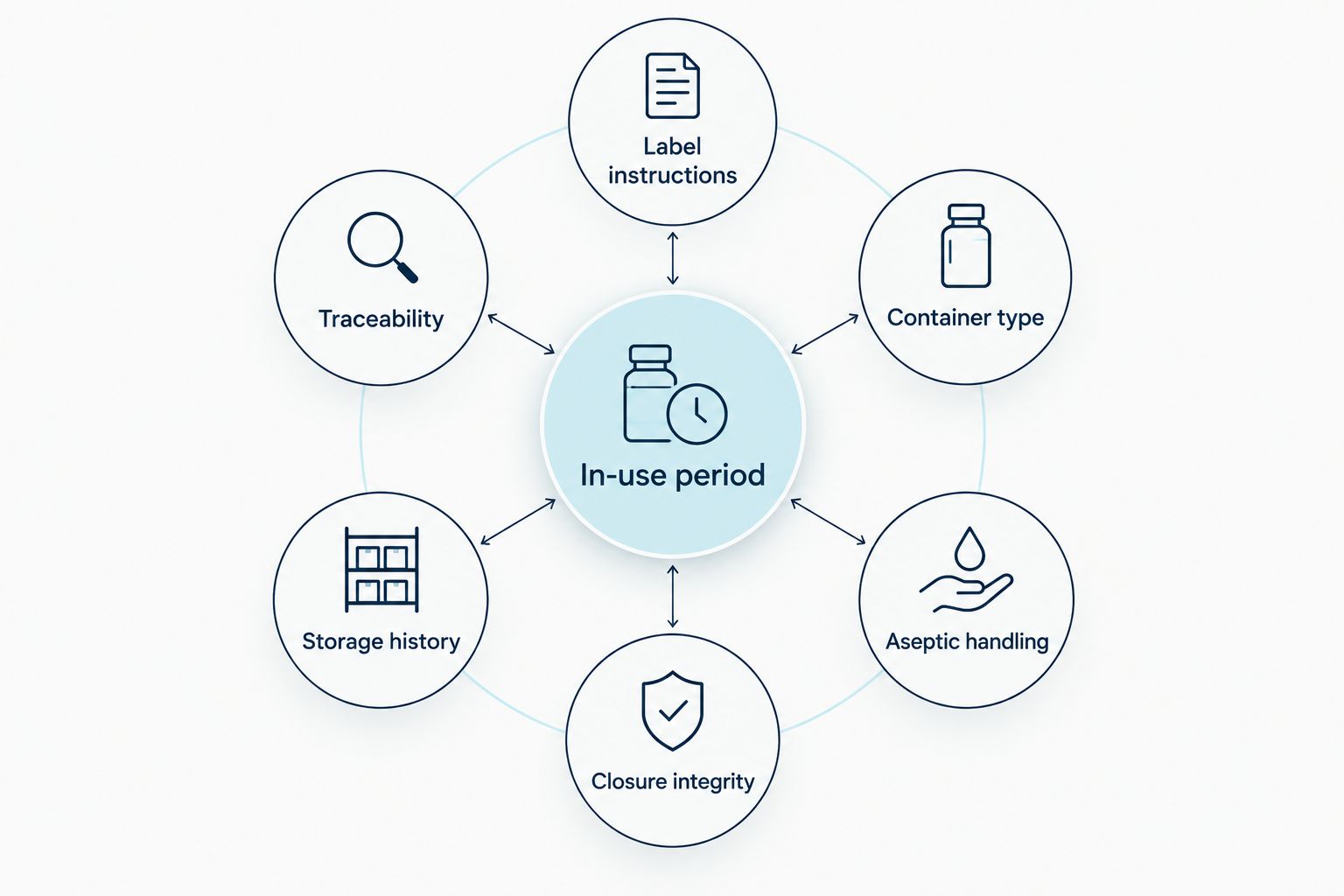
The 28-day reference is conditional. These factors determine whether the full period remains defensible for a specific vial:
- Manufacturer instructions. A product-specific in-use statement overrides the general multiple-dose-vial reference. The current label is the first document to review.
- Container designation. A multiple-dose designation supports repeated withdrawals. A single-dose designation does not, even when unused liquid remains.
- Aseptic handling. The preservative reduces microbial growth risk; it does not sterilize a contaminated needle, stopper, work surface, or transfer device.
- Closure integrity. Stopper coring, tearing, leakage, or other visible damage can invalidate continued use before the calendar limit is reached.
- Storage history. The vial must remain within the storage conditions printed on its label. Refrigeration should not be assumed when the manufacturer specifies controlled room temperature, and room-temperature storage should not be assumed when the label requires refrigeration.
- Environmental control. The approved work area, cleaning procedure, operator qualification, and material flow all affect contamination control.
- Traceability. An unknown first-puncture date, missing withdrawal entry, or unexplained storage excursion prevents the laboratory from demonstrating continued conformance.
- Prepared-material specification. The stability period for a reconstituted peptide or other research material is separate and can end before the source water’s in-use period.
When should an opened vial be discarded early?
Discard or quarantine the vial before its calculated date when its status can no longer be verified. Continued use is not justified by a clear appearance alone because microbial contamination is not always visible.
Early-disposition triggers include:
- The first-puncture date or calculated discard date is missing.
- The stopper, seal, or container is visibly damaged.
- Particles, discoloration, cloudiness, or leakage are observed.
- A nonsterile or previously used transfer device entered the vial.
- Withdrawn material was returned to the source container.
- Storage conditions departed from the label and no approved assessment supports continued use.
- The vial was moved between work areas without a traceable custody record.
- The product label, lot identity, or preservative statement cannot be confirmed.
- The manufacturer’s in-use period has ended.
- The laboratory’s approved procedure requires an earlier disposition point.
Do not extend use by relabeling the vial, transferring the remaining solution, or starting a new 28-day count. The original first entry remains the event that opened the container’s in-use period.
What should the 2026 reuse record contain?
A complete record connects the water vial to every preparation made from it. At minimum, the record should identify the product, manufacturer, source lot, expiration date, first-puncture date, calculated discard date, storage requirement, operator, withdrawal event, related research-material lot, and disposition.
Corrections should preserve the original entry, the reason for the change, the person making it, and the date. Undocumented replacement of an incorrect date weakens provenance and prevents reconstruction of the sequence.
Where several researchers share one vial, a central log is stronger than individual notebook entries. The central record gives procurement, laboratory operations, and QC one source for deciding whether the vial remained inside its written scope throughout 2026.
How much bacteriostatic water should be withdrawn?
The withdrawal amount depends on the approved research method, source-material quantity, target concentration, and analytical plan. There is no universal volume that applies to every peptide vial or study.
Define the calculation before opening either container, then independently verify the units and transcription. The per-vial water calculation guide addresses that planning step without changing the source vial’s reuse requirements.
This article does not provide dosing, administration, or clinical-use instructions. Bacteriostatic water, research peptides, and related materials must be handled according to their legal status, label, institutional controls, and approved research protocol.
Can the same vial support several research preparations?
Yes, when the label permits multiple-dose use and every preparation remains inside the written procedure. Each withdrawal should use a new sterile transfer device, and the log should connect the water lot with the corresponding research-material lot.
Cross-project use demands stronger traceability. If an investigation later identifies a handling deviation, the laboratory must be able to identify every affected preparation without relying on memory or an unstructured note.
Simple Life Science is best suited to qualified laboratory teams that need research peptides supported by defined specifications, analytical review, and lot-level documentation. This fit matters when reconstitution records must connect to procurement, material receipt, controlled storage, and downstream analysis.
Simple Life Science research-peptide documentation should be reviewed against the laboratory’s own acceptance criteria before work begins. The laboratory remains responsible for approving its method, storage plan, in-use period, and deviation process.
Is visual clarity enough to approve continued reuse?
No. A clear, colorless solution can still have an incomplete history, an expired in-use period, closure damage, or contamination that is not visible without testing.
Visual examination is one verification step, not the full acceptance decision. Approval also requires the label, dates, storage record, handling record, and container status to remain acceptable under the written 2026 procedure.
FAQ
Can bacteriostatic water be reused after opening?
Yes, bacteriostatic water can usually be reused for up to 28 days after first puncture unless the manufacturer specifies a different period. Every withdrawal must remain inside the label instructions and the laboratory’s written aseptic procedure.
Does bacteriostatic water expire immediately after opening?
No, it does not normally expire immediately when supplied as a multiple-dose product. Opening starts the documented in-use period, which is commonly 28 days unless the label states otherwise.
Does opened bacteriostatic water need refrigeration?
Store opened bacteriostatic water exactly as its current manufacturer label directs. Do not assume refrigeration or room-temperature storage because requirements vary by product.
Is bacteriostatic water the same as sterile water?
No, common bacteriostatic water formulations contain 0.9% benzyl alcohol, while sterile water without preservative does not. That distinction determines whether repeated withdrawal is supported by the container designation.
Can bacteriostatic water be used after 28 days?
Do not use the general 28-day rule to extend a vial beyond its documented in-use period. Continued use requires explicit support from the manufacturer’s instructions and the laboratory’s approved procedure.
What if the first-puncture date was not recorded?
An opened vial with an unknown first-puncture date should be quarantined or discarded under the laboratory’s deviation procedure. The remaining in-use period cannot be calculated from an undocumented date.
Can one bacteriostatic water vial be used for several research peptide vials?
Yes, if the product is designated for multiple-dose use and every withdrawal follows the approved method. The record should connect the water lot and withdrawal event to each research-peptide lot.
Does benzyl alcohol prevent all contamination?
No, 0.9% benzyl alcohol supports bacteriostatic control but does not sterilize a contaminated vial. A known aseptic breach requires documented disposition rather than continued use based on appearance.
One last thing
The most important date is not the unopened expiration date. Once the stopper is first penetrated, the controlling date becomes the earliest of the manufacturer’s in-use limit, the laboratory’s approved limit, the prepared material’s applicable stability limit, or a documented event that invalidates continued use.
Simple Life Science peptide sourcing is documentation-led, but supplier records do not replace local controls. Define the method, verify the current documents, record every entry, and close the vial record with a final disposition in 2026.
Related guides
- How long reconstituted peptides can stay refrigerated
- Quality documentation to audit-ready QC records

