
Reconstituted peptide in bacteriostatic water typically remains stable for 2 to 4 weeks when stored refrigerated at 2-8°C, a range referenced consistently across peptide-stability and compounding literature in 2026. The number researchers miss: bacteriostatic water itself is commonly labeled for use within 28 days of first puncture, because the benzyl alcohol preservative that keeps the diluent bacteriostatic runs on its own degradation clock — independent of how stable the peptide sequence is.
- Reconstituted peptide in bacteriostatic water lasts 2 to 4 weeks refrigerated at 2-8°C in most documented cases.
- Bacteriostatic water is generally rated for use within 28 days of first puncture regardless of peptide stability.
- Room-temperature exposure cuts the usable window to 24 to 48 hours for most research peptide sequences.
- Freeze-thaw cycling, not time alone, is the leading cause of early degradation in stored aliquots.
- Lot-level documentation of reconstitution date and storage condition is the only way to defend a stability claim later.
Why this matters
A peptide sequence and its diluent age on two separate clocks, and only one of them gets tracked in most lab notebooks. Sequences prone to oxidation or deamidation (methionine, cysteine, or asparagine-containing chains) can shift potency well inside a 28-day window if storage temperature drifts even briefly.
Without a recorded reconstitution date tied to a lot number, a research team has no defensible basis for the stability assumptions built into a study design. That gap is where most inter-lab reproducibility questions start — not in the synthesis, but in the handling record after the vial is opened.
The question of reconstituting peptides with tap water comes up for the same reason: researchers underestimate how much the diluent itself controls the stability outcome, not just the peptide.
How long does reconstituted peptide last in bacteriostatic water?
The answer depends on three variables tracked separately: storage temperature, time since first puncture of the bacteriostatic water vial, and freeze-thaw cycle count on the reconstituted aliquot.
| Storage condition | Typical stability window | Documentation checkpoint |
|---|---|---|
| Refrigerated, 2-8°C | 2 to 4 weeks | Log reconstitution date on the vial and in the LIMS record |
| Room temperature | 24 to 48 hours | Flag for immediate use or discard same day |
| Frozen aliquots, -20°C or below | Extended, sequence-dependent | Record every freeze-thaw cycle against the lot |
The refrigerated window is the one most research protocols default to in 2026, and it is also the one most often extended past its documented limit without a corresponding note in the record.
Refrigerated storage (2-8°C): 2 to 4 weeks
This is the standard handling condition cited across peptide-stability references for reconstituted research material. Most peptide sequences hold measurable potency through this window when the vial stays sealed between uses and is not exposed to repeated temperature swings.
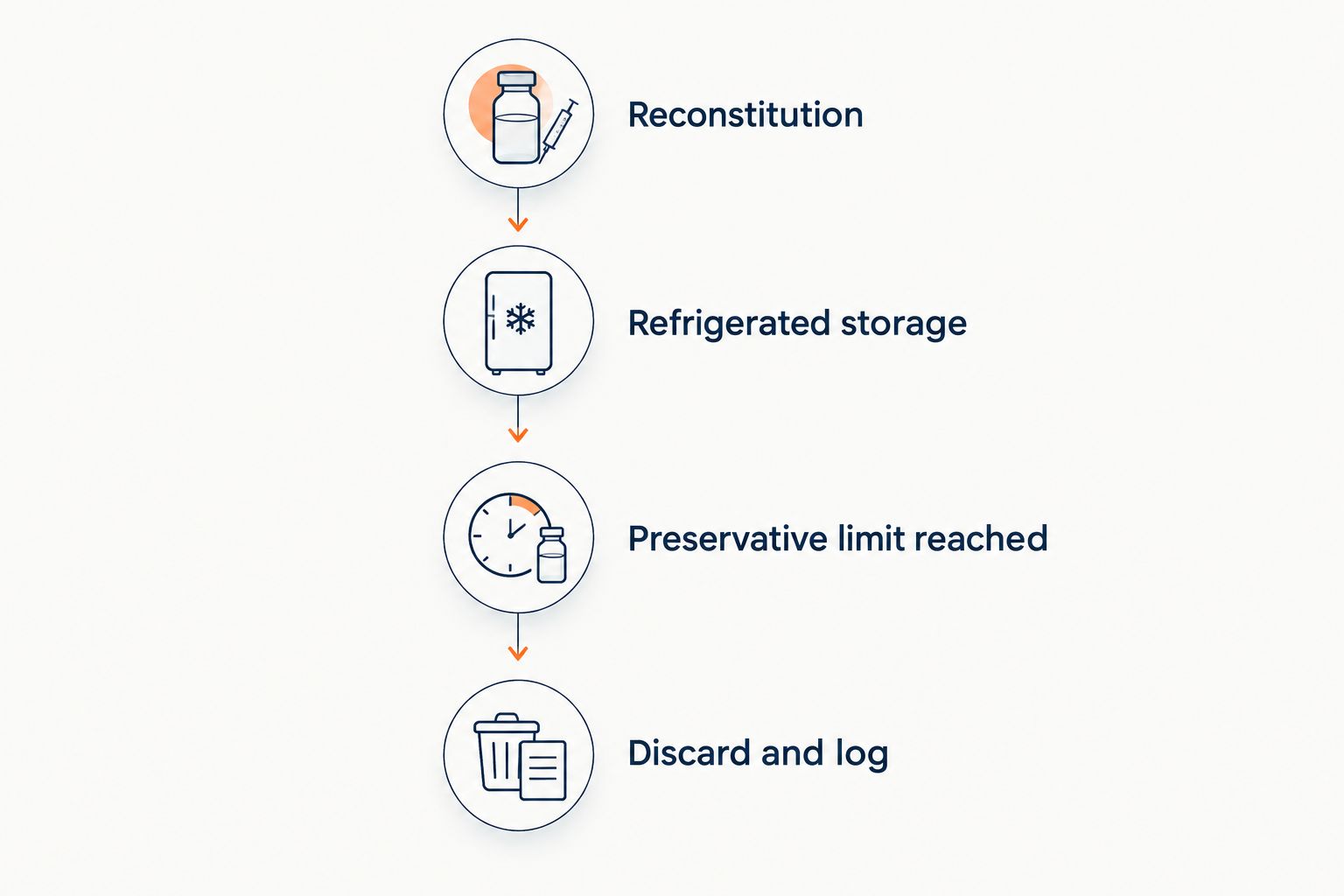
The limiting factor is rarely the peptide alone — it is the bacteriostatic water's own 28-day use limit from first puncture, tied to benzyl alcohol preservative depletion. A peptide reconstituted on day 20 of an opened bacteriostatic water vial inherits whatever is left of that clock, not a fresh 28 days.
Verdict: refrigerated storage at 2-8°C is the documented baseline for research use — track both the reconstitution date and the bacteriostatic water's first-puncture date separately.
Room temperature exposure: 24 to 48 hours
Leaving reconstituted peptide at room temperature compresses the usable window sharply. Twenty-four to 48 hours is the commonly cited ceiling before degradation risk becomes significant enough that most labs discard the aliquot rather than continue using it.
Heat accelerates hydrolysis and oxidation in peptide bonds, and repeated exposure — pulling a vial out for use, then returning it to the refrigerator — adds up faster than a single continuous room-temperature period would.
Verdict: treat any room-temperature exposure as a countdown, not a pause — log the exposure window in the same record as the reconstitution date.
Frozen aliquots: extended stability with tradeoffs
Aliquoting a reconstituted peptide solution and freezing single-use portions at -20°C or below extends the practical stability window well past the refrigerated range, but the tradeoff is freeze-thaw damage, not time.
Each freeze-thaw cycle stresses the peptide structure independently of elapsed days. A protocol that repeatedly freezes and thaws the same vial can degrade faster than one held continuously refrigerated for the same period.
Verdict: single-use frozen aliquots outperform repeated freeze-thaw cycling on the same vial — plan aliquot volume around one use per thaw.
Why stability varies
- Sequence composition — peptides containing methionine, cysteine, or tryptophan oxidize faster than sequences without these residues.
- Concentration — more dilute reconstitutions are generally more sensitive to handling stress than concentrated ones.
- Freeze-thaw cycling — each cycle on the same aliquot adds cumulative structural stress independent of total elapsed time.
- Preservative depletion — bacteriostatic water's benzyl alcohol content declines from the moment the vial is first punctured, not from the moment of reconstitution.
- Light exposure — some sequences are light-sensitive and require amber vials or foil wrap during storage.
- Container material and closure integrity — repeated needle punctures through the same septum increase contamination risk over the storage period.
A reconstitution record that only tracks a single "prepared on" date misses most of these variables. Lot-level documentation that ties reconstitution date, bacteriostatic water first-puncture date, and freeze-thaw count to the same record is the only way to reconstruct what happened to a given aliquot weeks later.
Review documentation before you reconstitute
Check lot records and analytical review before opening a vial.
Related questions
How can you tell if a lyophilized peptide has degraded?
Degradation in a lyophilized peptide is usually flagged through analytical review — a shift in HPLC retention time, unexpected peaks, or a mass spectrometry result outside the original certificate of analysis. Visual cues like clumping or discoloration are secondary indicators at best; a full walkthrough of what to check is in how you can tell if a lyophilized peptide has degraded.
How do you store peptides before they are reconstituted?
Lyophilized peptide is stored frozen or refrigerated, protected from light and moisture, and left sealed until the moment of reconstitution. The pre-reconstitution storage protocol has more tolerance than the post-reconstitution window, but the same documentation discipline applies — see how peptides are stored before reconstitution for the full breakdown.
Does the quality of bacteriostatic water affect stability?
Yes — bacteriostatic water quality and preservative concentration directly set the ceiling on how long a reconstituted peptide solution stays usable, since the diluent's own 28-day use limit runs regardless of peptide sequence stability.
FAQ
How long does reconstituted peptide last in bacteriostatic water?
Reconstituted peptide typically lasts 2 to 4 weeks in bacteriostatic water when refrigerated at 2-8°C. The bacteriostatic water’s own 28-day use limit from first puncture often becomes the actual limiting factor, not the peptide sequence itself.
Can reconstituted peptide be left at room temperature overnight?
Room temperature exposure should be limited to 24 to 48 hours based on commonly documented stability ranges. Extended room-temperature storage increases oxidation and hydrolysis risk well before the refrigerated window would expire.
Does freezing reconstituted peptide extend its stability?
Freezing single-use aliquots at -20°C or below extends the practical stability window compared to continuous refrigeration. Repeated freeze-thaw cycling on the same vial, however, can degrade the peptide faster than time alone would.
Is bacteriostatic water reusable after 28 days?
Bacteriostatic water is generally labeled for use within 28 days of first puncture because the benzyl alcohol preservative concentration declines over that period. Using it beyond that window removes the documented basis for its bacteriostatic function.
What causes reconstituted peptide to degrade faster than expected?
Oxidation-prone residues, temperature excursions, and repeated freeze-thaw cycles are the leading documented causes of accelerated degradation. Sequences with methionine or cysteine residues are typically more sensitive than those without.
Should reconstitution dates be logged separately from bacteriostatic water puncture dates?
Yes — logging both dates separately is the only way to reconstruct the actual stability status of an aliquot. A single "prepared on" date obscures which clock — peptide or diluent — is closer to expiring.
One last thing
The detail most protocols skip: the bacteriostatic water's 28-day clock starts at first puncture, not at the moment a given peptide vial is reconstituted from it. A vial of bacteriostatic water opened on day 1 and used to reconstitute a peptide on day 20 leaves that peptide with roughly 8 days of documented diluent integrity left — regardless of how stable the peptide sequence itself would otherwise be through 2026's commonly cited 2-to-4-week refrigerated range. Tracking the diluent's puncture date on its own line in the lot record closes that gap.
Related guides
- How long can reconstituted peptides stay refrigerated
- Automatically log reconstitution when bacteriostatic water ships
- Best bacteriostatic water for peptide reconstitution

