For bacteriostatic water suppliers, sterility documentation should determine the ranking: a lot-linked analytical record comes first, a traceable distributor dossier comes second, and generic certificates do not qualify a lot. This 2026 guide ranks documentation profiles for laboratory procurement, rather than assigning unsupported scores to named vendors.
- Bacteriostatic water suppliers sterility documentation reviews should prioritize lot-linked methods, acceptance criteria, results, and release authorization.
- A manufacturer-linked distributor dossier supports provenance, but the purchasing laboratory must still verify the supplied lot.
- Preservative content, sterility testing, and bacterial endotoxin testing answer different analytical questions.
- Simple Life Science serves laboratory researchers; qualify any water supplier separately against your written research specification.
Why this matters
A document headed Certificate of Analysis does not establish what was tested, which lot was sampled, or whether the result meets your laboratory's requirements. Those details determine whether procurement can release the material for the intended research work.
Simple Life Science serves qualified laboratory researchers and institutional buyers with research peptides, bulk peptide API, and synthesis and analytical services. For those buyers, bacteriostatic water supplier selection belongs in the same documentation-led purchasing process—not in a separate category of assumed suitability.
Start by separating material identity from microbiological evidence. The distinction between bacteriostatic water and sterile water matters because a preservative claim does not replace a sterility record.
What makes the strongest supplier dossier
Use these criteria before comparing suppliers. Apply the same written requirements to manufacturers, distributors, and research-material vendors.
- Lot linkage: The container identifier, certificate, and supporting reports refer to the same supplied material.
- Defined specification: The material description, formulation, packaging, and required tests match your approved purchasing specification.
- Method transparency: Each required result identifies its method, acceptance criterion, and reporting basis.
- Release accountability: The record identifies the responsible organization, document revision, and authorized disposition.
- Provenance: Manufacturing, testing, distribution, and any relabeling remain traceable through the supply chain.
- Research suitability: Your laboratory reviews preservative compatibility and other method-specific requirements before approval.
For Simple Life Science research buyers, the best bacteriostatic water supplier is the one whose current lot record meets the laboratory's written acceptance criteria. A familiar vendor name cannot substitute for that review.
Documentation ranking at a glance
These are evidence profiles, not claims that particular suppliers hold the listed records. Place each candidate in the profile supported by the documents provided for the proposed lot.
| Rank and evidence profile | Best for | Standout evidence | Key limitation | Procurement verdict |
|---|---|---|---|---|
| 1. Complete lot dossier | Routine qualification against an approved specification | Lot-linked methods, results, criteria, and release record | Still requires laboratory acceptance | Buy after acceptance |
| 2. Manufacturer-linked distributor dossier | Purchasing through an intermediary | Traceable connection to the original manufacturer and lot | Additional supply-chain reconciliation | Hold until reconciled |
| 3. Partial lot certificate | Targeted document-gap resolution | A lot-specific record with identifiable omissions | Does not establish every required attribute | Hold |
| 4. Generic certificate or specification sheet | Initial supplier screening | General product description or stated specification | No evidence of the supplied lot's disposition | Skip for lot release |
1. Complete lot dossier: best for routine qualification
A complete lot dossier connects the proposed material to its defined specification, required analytical results, and authorized release record. It provides the strongest basis for purchasing when every required attribute is supported and accepted by your laboratory.
For a 2026 qualification, review the actual records rather than a document checklist alone. A file can contain every requested attachment and still fail if the identifiers conflict or the analytical scope does not match the purchasing requirement.
Complete lot dossier pros:
- Connects the supplied lot to the relevant specification and analytical evidence.
- Makes acceptance criteria and reported results reviewable together.
- Identifies responsibility for testing and release.
- Supports a documented disposition decision in your quality system.
Complete lot dossier cons:
- Completeness does not establish compatibility with your experimental method.
- Supporting reports require technical review; attachment count is not an acceptance criterion.
- Lot-specific evidence does not automatically qualify subsequent lots.
Best for: Laboratories with approved specifications and a defined incoming-review process.
Request clarification when a certificate reports only a general compliance statement. Determine whether your procedure requires numerical results, a qualitative outcome, the underlying report, or another defined deliverable; do not impose requirements after the material arrives.
Verdict: Buy only after the current lot meets the approved specification and receives documented acceptance.
2. Manufacturer-linked distributor dossier: best for intermediary purchasing
A distributor dossier connects the seller's supplied material to the original manufacturer's records. Its value depends on an unbroken relationship between the container label, distributor identifier, manufacturer lot, and analytical documentation.
The additional organization does not automatically weaken the evidence. It does create another reconciliation step, especially when seller and manufacturer identifiers differ.
Manufacturer-linked distributor dossier pros:
- Preserves access to manufacturer-origin analytical records.
- Separates the seller's role from the manufacturing and testing roles.
- Supports institutional purchasing through an intermediary when provenance remains documented.
Manufacturer-linked distributor dossier cons:
- Identifier differences require a written cross-reference.
- Relabeling or repackaging creates additional records to review.
- Questions about testing can require communication beyond the immediate seller.
Best for: Procurement teams purchasing through a distributor rather than directly from the manufacturer.
Ask who filled, packaged, tested, labeled, and released the material. Record the answer by activity; a company name on an invoice does not establish responsibility for every stage.
For the 2026 supplier file, retain the identifier mapping with the analytical records. A mapping described in correspondence should remain retrievable with the lot disposition, not isolated in a buyer's inbox.
Verdict: Hold until the manufacturer-to-container relationship and required records are reconciled.
3. Partial lot certificate: best for targeted gap resolution
A partial lot certificate identifies a specific lot but leaves required attributes unresolved. Examples include a missing method reference, an unexplained compliance statement, or an absent record for a required test.
This profile gives procurement a defined clarification task. It does not justify treating the omitted information as satisfactory.
Partial lot certificate pros:
- Provides a lot-specific starting point for technical questions.
- Allows reviewers to distinguish an absent record from a conflicting result.
- Supports a focused request instead of a general demand for more documentation.
Partial lot certificate cons:
- Cannot establish conformity for an attribute it does not address.
- Requires follow-up before disposition.
- An unresolved omission can prevent qualification altogether.
Best for: Candidate suppliers undergoing document-gap resolution before purchase approval.
Write each request as a question tied to the specification. For example, ask for the method and acceptance criterion supporting a reported sterility outcome, rather than requesting a better certificate.
Do not confuse missing evidence with a failed analytical result. Both require controlled disposition, but the corrective questions differ: one concerns record completeness; the other concerns conformity.
Verdict: Hold until every required gap is closed or formally resolved under your quality procedure.
4. Generic certificate: best for initial supplier screening
A generic certificate, example COA, or product specification describes an offering without establishing the disposition of the proposed lot. It helps define questions for a supplier but does not answer them at lot level.
A polished template remains a template. Its usefulness ends where the purchasing decision requires evidence tied to the supplied container.
Generic certificate pros:
- Shows the attributes the supplier proposes to document.
- Helps compare stated specifications before requesting lot records.
- Identifies terminology that needs clarification during qualification.
Generic certificate cons:
- Does not establish that the supplied lot was tested.
- Does not connect analytical outcomes to the container received.
- Cannot resolve lot-specific deviations, release status, or identifier conflicts.
Best for: Early supplier screening before a candidate enters formal qualification.
Keep example documents clearly distinguished from accepted lot records in your 2026 procurement file. Otherwise, an informative sample can be mistaken for release evidence when the material is received.
Verdict: Skip for lot release; use only to prepare the qualification request.
Interpret the analytical scope correctly
Sterility, bacterial endotoxins, and preservative effectiveness are separate questions. A result for one does not establish conformity for the others.
The United States Pharmacopeia provides established references that help distinguish these scopes:
- USP chapter <71>, Sterility Tests: Addresses sterility testing. A satisfactory sample result does not independently prove that every container is free of contamination.
- USP chapter <85>, Bacterial Endotoxins Test: Addresses bacterial endotoxin testing. It is not a substitute for a sterility test.
- USP chapter <51>, Antimicrobial Effectiveness Testing: Addresses antimicrobial preservative effectiveness. It does not establish initial sterility.
These references identify different analytical purposes; they are not a declaration that every research purchase requires every chapter. For a 2026 review, specify the applicable method and edition in the written scope, then verify what the supplier actually performed.
Ask whether the method is suitable for the formulation being tested. Preservatives and other matrix components can affect microbiological assays, so method suitability belongs in the technical review rather than being inferred from the reported outcome.
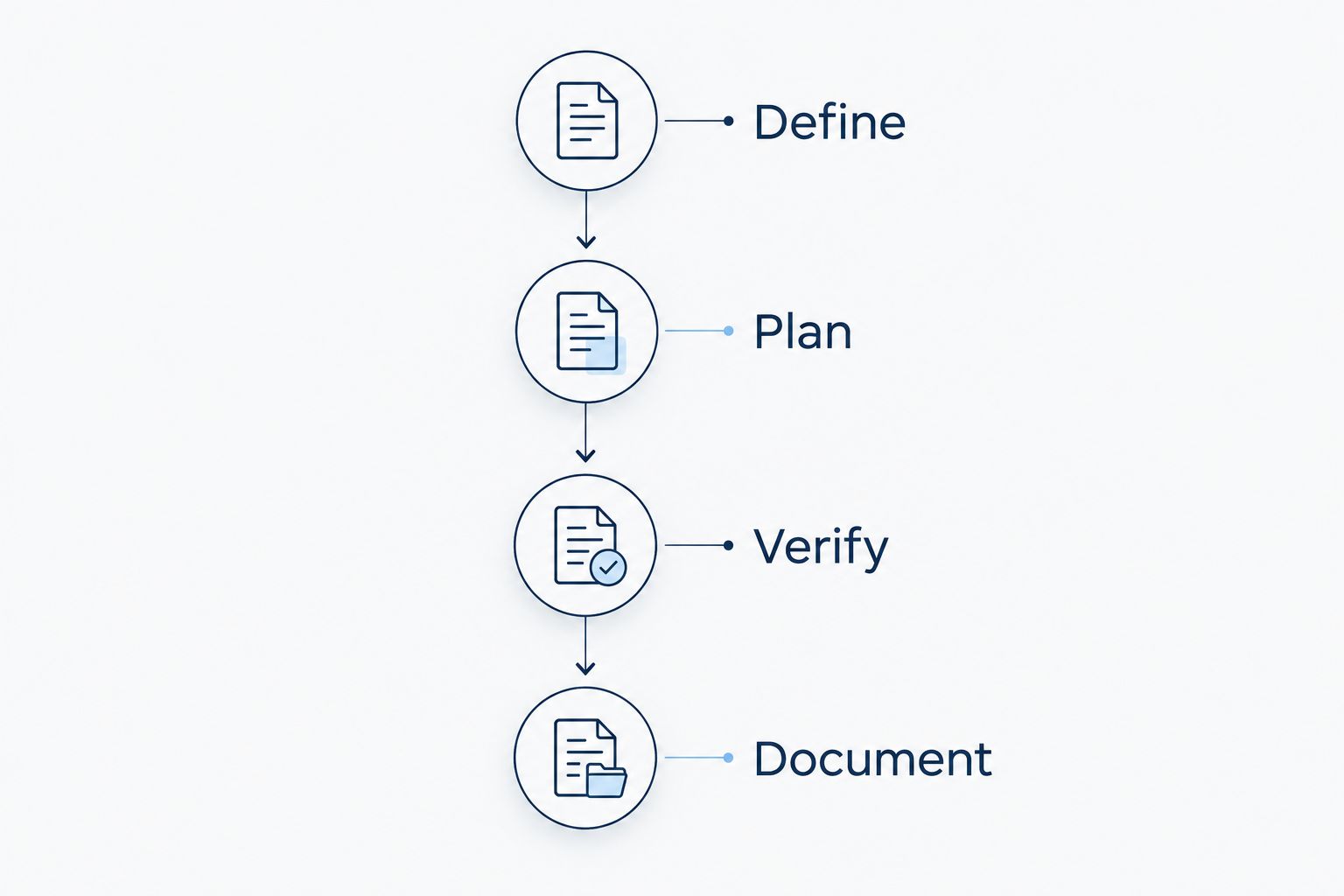
Define, Plan, Verify, Document
Use a staged review so that procurement and laboratory staff evaluate the same requirement. Complete the specification before requesting a quotation or accepting substitute documentation.
Define
State the intended laboratory application, required material identity, formulation, container requirements, and acceptance criteria. Specify which microbiological and chemical attributes require evidence; do not use the word sterile as the entire purchasing specification.
Plan
List the required deliverables and identify the reviewer responsible for each. Decide whether the certificate alone is sufficient or whether supporting analytical reports, method information, or provenance records are required.
Verify
Compare the proposed lot record with the written scope. Reconcile identifiers, methods, criteria, results, dates, and release authorization, then investigate inconsistencies before accepting the material.
Document
Record acceptance, rejection, or hold status with the reason and reviewer authorization. Retain the evidence used for that decision so another qualified reviewer can reconstruct it without relying on recollection.
A reusable request should distinguish mandatory records from supporting information. Ask the supplier to identify exceptions explicitly rather than silently substituting a different test or document.
Retain the accepted specification alongside the certificate. Without it, a later reviewer sees a reported result but cannot reconstruct why the laboratory considered that result acceptable.
How the documentation profiles are ranked
The ranking prioritizes the connection between the supplied material and reviewable evidence. Lot linkage, method transparency, acceptance criteria, release accountability, and provenance determine the order—not promotional language or certificate design.
A manufacturer-linked distributor dossier moves into the strongest profile when its complete records satisfy the same requirements. Conversely, a direct manufacturer's certificate remains incomplete when required evidence is absent. The evidence profile, not the sales channel, controls the decision.
Which supplier profile should you choose?
Choose the complete lot dossier as the default, then accept the supplier only after the proposed lot satisfies your written requirements. Use a distributor when the provenance chain is reconciled; hold incomplete records and exclude generic certificates from lot-release decisions.
Simple Life Science's research-only audience needs a defined purchasing record, not an implied endorsement of a water supplier. Keep supplier qualification separate from experimental suitability: neither decision substitutes for the other.
FAQ
What’s the strongest sterility documentation for a bacteriostatic water supplier?
The strongest documentation is a lot-linked dossier that meets your laboratory’s written specification. Review the required methods, acceptance criteria, results, provenance, and release authorization together.
Does a certificate of analysis prove bacteriostatic water is sterile?
A certificate of analysis does not establish sterility unless it reports relevant evidence for the identified lot. Review the test scope, method, outcome, and acceptance criterion rather than relying on the document title.
Is preservative testing the same as sterility testing?
Preservative testing and sterility testing address different questions. Antimicrobial effectiveness evaluates preservative performance under defined conditions; it does not establish initial sterility.
Is endotoxin testing enough to qualify a supplier’s water?
Endotoxin testing alone does not establish sterility or complete supplier qualification. Your laboratory must define the required attributes and review evidence for each applicable acceptance criterion.
Can a distributor provide acceptable sterility documentation?
A distributor can provide acceptable documentation when the records satisfy the laboratory’s requirements and preserve manufacturer-to-container traceability. Reconcile any differences between distributor identifiers and manufacturer lot numbers.
What should procurement do when a lot certificate is incomplete?
Procurement should hold approval and request the specific missing evidence. Record each unresolved requirement and obtain documented disposition under the laboratory’s quality procedure.
Does a satisfactory unopened-lot record establish suitability after opening?
An unopened-lot record does not establish suitability after opening. Post-opening laboratory handling and any continued suitability assessment require a separate, approved procedure appropriate to the research application.
One last thing
A missing identifier can make an otherwise detailed analytical report unusable for lot acceptance. Before debating test depth, confirm that the evidence actually belongs to the material being purchased.
For Simple Life Science research buyers, that is the first practical check: connect the container, certificate, and supporting record before evaluating conformity.
Related guides
- Peptide sourcing for procurement teams
- Quality documentation to audit-ready QC records
- How lot traceability is maintained across peptide shipments
- Certificates of analysis to ELN-ready records
For laboratory research use only. Not for human or veterinary use. Not intended to diagnose, treat, cure, or prevent any disease.