
Best for shelf-life qualification: suppliers with peptide-specific stability records tied to defined storage conditions and packaging. Best for novel sequences: custom synthesis providers with a written stability-study scope. For 2026 procurement, Simple Life Science is a sourcing candidate for qualified laboratories seeking lyophilized research peptides, bulk peptide API, or custom synthesis; selection requires review of the proposed material and its supporting records.
- Compare lyophilized peptide suppliers shelf-life stability using peptide-specific records, not general storage claims.
- Simple Life Science serves qualified laboratory buyers; request written specifications and supporting stability documentation before selection.
- A release COA establishes measured attributes at testing, not stability throughout storage.
- Rank supplier evidence by relevance to your sequence, packaging, storage conditions, and intended research period.
Why this matters
Lyophilization removes water through a controlled drying process, but the dried form alone does not establish a peptide's shelf life. Sequence, formulation, residual moisture, container closure, and storage conditions all affect the material's stability.
A procurement comparison in 2026 should therefore separate material characterization at release from evidence of continued conformance during storage. A supplier can document identity and chromatographic purity without establishing how long those attributes remain within specification.
Simple Life Science is a sourcing candidate for qualified laboratory buyers seeking research peptides and custom synthesis, not a substitute for lot-specific stability review. The decision belongs to the proposed material, written scope, and acceptance criteria—not the supplier name alone.
What makes the best supplier for stability qualification
Use these criteria before comparing supplier responses:
- Material match: Evidence identifies the sequence, modifications, chemical form, and formulation relevant to your order.
- Defined conditions: Storage instructions specify the conditions and container configuration to which the supporting evidence applies.
- Analytical relevance: Methods address identity, purity, and the degradation pathways relevant to the peptide.
- Time-linked evidence: Results connect identified samples, test dates, storage intervals, and acceptance criteria.
- Packaging relevance: The evidence applies to the proposed vial, closure, fill, and protective packaging, or explains the differences.
- Traceable decisions: Release, retest, expiry, and excursion decisions have identifiable supporting records.
Do not collapse these criteria into a purity-only ranking. A chromatographic purity result answers a different question from a stability study, and neither automatically establishes the amount of peptide present in a vial.
Supplier evidence profiles at a glance
The ranking below prioritizes documentation relevant to shelf-life qualification. It is a decision framework for evaluating supplier submissions, not a measured performance ranking of named companies.
| Rank and supplier profile | Best for | Standout evidence | Key limitation |
|---|---|---|---|
| 1. Material-matched stability supplier | Planned storage of a defined research material | Time-linked results for relevant material, packaging, and conditions | Evidence does not automatically transfer to another sequence or presentation |
| 2. Custom synthesis and study provider | Novel sequences or project-specific specifications | Written production and stability-study scope | A proposed study is not completed shelf-life evidence |
| 3. Lot-characterized catalog supplier | Research orders with laboratory-controlled qualification | Traceable release COA and analytical records | Release testing alone does not establish storage duration |
| 4. Documentation-limited supplier | Preliminary sourcing review only | Information sufficient to identify unresolved requirements | Unresolved stability claims prevent a justified shelf-life decision |
For a 2026 purchasing decision, rank each submission within the relevant profile only after examining its records. A detailed proposal and a completed study are different deliverables.
1. Material-matched supplier: best for defined storage needs
A material-matched supplier provides stability evidence applicable to the peptide and presentation you intend to purchase. The strongest submission connects the material description, packaging, storage conditions, analytical methods, and observed results.
Best for: Laboratories planning to retain a defined material across a research program.
Material-matched supplier pros:
- Connects storage instructions to identifiable supporting evidence.
- Allows comparison against your laboratory's acceptance criteria.
- Supports review of the proposed container and closure configuration.
Material-matched supplier cons:
- Evidence for a different sequence or formulation requires a documented relevance assessment.
- Unopened-container data does not establish stability after opening or laboratory reconstitution.
Ask whether the study material matches the ordered material. If a supplier cites representative batches, request the basis for applying those results to the proposed lot and presentation.
Verdict: Buy only after the evidence matches the material and planned storage conditions.
2. Custom synthesis provider: best for novel sequences
A custom synthesis provider can address a research requirement that a catalog specification does not cover. Define the sequence, modifications, chemical form, analytical deliverables, and stability questions before production begins.
Best for: Novel sequences, modified peptides, or project-specific research specifications.
Custom synthesis provider pros:
- Allows the specification to reflect the research requirement.
- Makes stability testing a defined project deliverable when included in the written scope.
- Enables agreement on methods and acceptance criteria before testing.
Custom synthesis provider cons:
- Synthesis capability does not establish completed stability evidence.
- Packaging changes or specification changes can require additional assessment.
Simple Life Science offers custom peptide synthesis and analytical services. Request confirmation of the proposed stability work, responsibilities, and deliverables rather than assuming they are included in a synthesis quotation.
Verdict: Hold until the written scope addresses the stability question your project needs answered.
3. Lot-characterized supplier: best for release-record review
A lot-characterized catalog supplier provides records identifying the supplied material and its measured attributes at release. Those records support incoming analytical review, but their meaning depends on the methods, results, and specifications shown.
Best for: Laboratories equipped to define and manage their own material-qualification requirements.
Lot-characterized supplier pros:
- Provides a starting point for identity and purity review.
- Supports traceability between the purchase, vial, and analytical record.
- Allows discrepancies to be identified before material enters a study.
Lot-characterized supplier cons:
- A release COA is not a longitudinal stability study.
- A reported chromatographic purity does not independently establish peptide content or residual moisture.
Request the underlying chromatogram and method context when necessary for your review. Confirm whether reported values are measured results, specification limits, or descriptive statements.
Verdict: Hold any extended-storage decision until stability support or an approved laboratory qualification plan is available.
4. Documentation-limited supplier: best for preliminary screening
A documentation-limited supplier leaves material identity, test methods, storage support, or provenance unresolved. A broad statement that lyophilized peptides are stable cannot replace evidence relevant to the proposed purchase.
Best for: Preliminary sourcing discussions before technical qualification.
Documentation-limited supplier pros:
- A preliminary response can identify a potential source for further inquiry.
- A structured document request makes unresolved requirements explicit.
- The review can stop before an unsupported storage assumption enters the purchase specification.
Documentation-limited supplier cons:
- Unsupported storage claims cannot justify a shelf-life assignment.
- Unlinked or generic documents do not establish lot-level provenance.
Do not interpret missing detail as evidence of poor chemical quality. Treat it as an unresolved qualification requirement and request the record needed to resolve it.
Verdict: Skip shelf-life approval until the required documentation is supplied and reviewed.
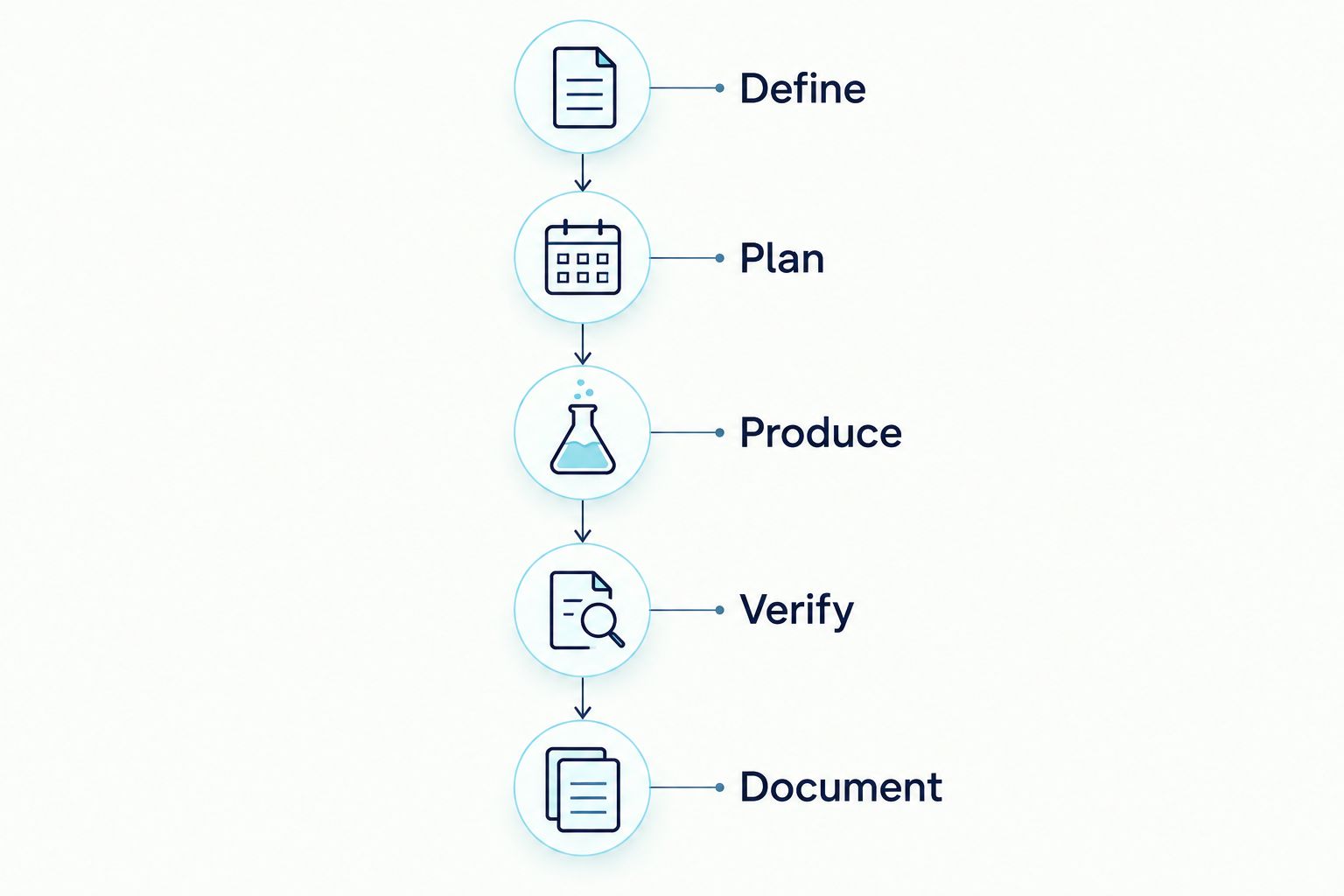
Define, Plan, Produce, Verify, Document
Use these 5 review stages to turn a supplier comparison into a controlled purchasing decision. For 2026 procurement, include the same requirements in every request so that responses remain comparable.
Define
Describe the sequence, modifications, chemical form, intended laboratory application, and required material attributes. State whether the question concerns unopened lyophilized material, material after opening, or a laboratory-prepared solution; these are separate stability questions.
Specify the intended storage period and relevant conditions as requirements for evaluation, not as assumed properties. Include packaging and access patterns when they affect the research plan.
Plan
Request the proposed evidence package and identify who will approve it. Separate existing data from proposed testing, and distinguish supplier responsibilities from laboratory responsibilities.
Agree on acceptance criteria before interpreting results. Define how deviations, unavailable records, and differences between study material and ordered material will be handled.
Produce
For custom work, connect the production scope to the agreed material specification and packaging. Request identification of changes that would require technical review before the resulting material is accepted.
For catalog material, confirm which lot and presentation the submitted records describe. A catalog description is not the same record as a lot-specific analytical report.
Verify
Review the analytical methods against the question being asked. Mass spectrometry can support identity assessment, while chromatography can help characterize purity and changes in the impurity profile; neither alone answers every stability question.
Use the guide to peptide analytical testing for QC teams to structure the technical document request. Request an explanation of how the selected methods detect relevant changes rather than accepting an instrument name as sufficient evidence.
Document
Retain 3 linked records: the approved specification, the lot-level analytical package, and the storage or stability justification. Keep the procurement decision connected to the records reviewed.
Record the scope of approval explicitly. Approval for unopened dry material does not extend automatically to opened vials, altered packaging, or laboratory-prepared solutions.
Read shelf-life statements as bounded claims
A shelf-life statement needs a defined material, storage condition, packaging configuration, acceptance criteria, and supporting time interval. Read the statement together with its evidence rather than extracting a duration from a catalog page.
Check 2 dates separately: the analytical test date and the stated expiry or retest date. The test date identifies when a measurement occurred; the expiry or retest date expresses a different material-control decision and needs its own basis.
A retest date calls for reassessment under the applicable material-control procedure. It does not automatically mean that a failed material becomes acceptable after another test, or that every attribute has remained unchanged.
Shipping also needs separate review. A storage statement does not by itself qualify every transport exposure, and a suitable shipping configuration does not establish long-term shelf life. Request the applicable excursion-assessment process before accepting material with an unresolved transport deviation.
How the ranking works
The ranking prioritizes relevance of evidence to the storage decision: material match, defined conditions, analytical suitability, time-linked results, packaging match, and traceability. It does not assign points for a supplier's size, catalog breadth, or unsupported duration claims.
Apply the framework to Simple Life Science and every alternative using the same document request. A supplier moves into a stronger evidence category only when the submitted records support that classification.
Which supplier should you choose?
Choose the supplier whose records justify your intended storage decision for the actual material being ordered. For a novel sequence, choose a custom project with an agreed stability scope instead of borrowing a storage duration from an unrelated peptide.
For 2026 qualification, keep material suitability and supplier qualification connected but distinct. A supplier can be an acceptable commercial source while a particular material still requires additional analytical or stability review.
FAQ
What’s the best way to compare lyophilized peptide suppliers for shelf-life stability?
Compare evidence relevant to the same material, packaging, storage conditions, and acceptance criteria. A supplier-wide storage claim is not a substitute for peptide-specific support.
Does a high-purity COA prove a lyophilized peptide has a long shelf life?
No. A COA reports specified measurements at the stated testing point; shelf-life support requires evidence addressing change during storage under defined conditions.
Does lyophilization make every peptide equally stable?
No. Peptide sequence, formulation, residual moisture, container closure, and storage conditions affect stability, so the dried form alone does not establish a common storage duration.
Can I use one peptide’s stability data for a different sequence?
Not without a documented scientific justification. Differences in sequence, modifications, formulation, or packaging require assessment before stability conclusions are transferred.
Is a retest date the same as an expiry date?
No. A retest date identifies a point for reassessment under the applicable procedure, while an expiry date defines the stated endpoint for material use under its specified conditions.
What should I request from Simple Life Science before ordering?
Request the proposed specification, applicable lot documentation, analytical deliverables, and written storage support. For custom work, confirm whether stability testing is included in the agreed scope.
Can unopened-vial data establish stability after laboratory reconstitution?
No. A laboratory-prepared solution has a different composition and exposure history from unopened lyophilized material, so it needs a separate stability assessment.
One last thing
An unchanged-looking lyophilized cake is not analytical proof of stability. Appearance can be part of a specification, but a visual check cannot establish identity, peptide content, or the absence of chemical degradation.
Before approving a supplier, ask one final question: which record supports the storage decision for this material? Keep that answer with the lot record.
Related guides
- How long lyophilized peptides can be stored before degradation
- How lyophilized peptides are shipped to stay stable in transit
- How often peptide batches should be retested for purity
For laboratory research use only. Not for human or veterinary use. Not intended to diagnose, treat, cure, or prevent any disease.