
Simple Life Science wrote this comparison. We sell custom peptide synthesis and analytical services, so we are one of the companies listed. Below is how we compared, what each company publishes about itself, and when another company may fit your CRO better than we do.
Facts about other companies come only from their own public web pages, checked Nov 21, 2026. We did not test their peptides, and we make no claims about their purity or reliability. Prices and terms change, so confirm them with each company before you order.
Four companies come up most often when a CRO looks for custom peptide synthesis: Simple Life Science, GenScript, JPT Peptide Technologies and Bachem. They suit different jobs. GenScript is the only one of the other three that publishes a turnaround time. JPT focuses on peptide libraries and pools. Bachem offers non-GMP research batches up to 100 g and has GMP plants. Simple Life Science handles synthesis and analytics in one written scope for US research buyers, with a usual 8 to 12 week lead time.
- Need a peptide in days, not weeks: GenScript publishes regular service from 10 business days and TurboTIDE from 5 business days for short sequences.
- Need a large library, pools or many micro-scale peptides: JPT Peptide Technologies.
- Need a path from research batches to GMP manufacturing: Bachem (or GenScript, which lists RUO to cGMP).
- Need one US research supplier to scope synthesis and analytics together, with a written spec before work starts: Simple Life Science.
- Whoever you pick, send the same written spec to every company and compare the scope, the analytics included and the records you get back.
How we compared
We looked at what each company publishes on its own site about the things a CRO buyer checks first: published price or how pricing works, turnaround, scale, purity range, the analytics included by default, documents shipped with the order, and GMP options. We wrote down only what each page says. Where a company does not publish something, the table says so. We did not order from competitors, and the order of the sections is not a ranking.
Your study spec still decides which supplier is right. Use the checks below for every candidate:
- Sequence definition: sequence, termini, modifications and any stereochemistry, with ambiguous notation resolved before the quote.
- Acceptance criteria: identity, purity, quantity and how each will be measured.
- Analytical deliverables: COA, chromatograms, mass spectra and method details, named rather than assumed.
- Project format: single peptide, library, repeat order or scale-up work.
- Traceability: a clear link from the approved spec to the lot number, the vials and the analytical records.
- Exceptions: how feasibility problems, deviations and proposed changes get reported before work goes on.
A purity percentage without a method is incomplete. Our guide to purity levels in custom peptide synthesis covers the questions to ask.
The four companies side by side (checked Nov 21, 2026)
| Simple Life Science (us) | GenScript | JPT Peptide Technologies | Bachem | |
|---|---|---|---|---|
| Published price | Quoted per project; no price list | Online quote or order request; no flat price shown on the service page | Project-specific quote | Quote by contact form; its form says HPLC purity and MS identity are included in the quoted price |
| Published turnaround | Usually 8 to 12 weeks for custom peptides, with status updates | Regular service from 10 business days; TurboTIDE from 5 business days (4 to 15 aa) or 7 (16 to 25 aa), guaranteed with delay credit | Not stated on the page; set in the quote | Not stated on the page; set in the quote |
| Scale | Milligram to multigram for custom work; bulk API from 100 g | Milligram to kilogram | Micro-scale screening amounts to mid and large scale | Non-GMP 5 mg to 100 g; GMP projects also offered |
| Purity range | Set per project in the written scope | Crude to 98% or higher | Specified by the customer | 80% to 97% for non-GMP synthesis |
| Standard analytics | RP-HPLC and mass spectrometry; other tests by written scope | RP-HPLC purification and analysis; extra options such as TFA exchange, peptide content and endotoxin | LC-MS, MALDI-MS or HPLC, with analytical data sheet and raw data for each order | HPLC and MALDI-MS release testing; extra tests such as net peptide content and counter-ion content |
| Documents | COA with every order; HPLC and MS summary; written project spec | COA and QC data (confirm the package in your quote) | Analytical data sheet plus raw data, double-checked and archived | Analytical Data Sheet; TSE/BSE certificates on request |
| GMP option | No. Research use only | Yes, lists RUO to cGMP | Lists clinical peptides and pools | Yes. Says its GMP sites are inspected by FDA, EMA and Swissmedic |
| Where made / based | US company in Delray Beach, Florida | Not checked for this page | Berlin, Germany | Not checked for this page |
Sources, checked Nov 21, 2026: Simple Life Science custom synthesis terms; GenScript peptide synthesis service; JPT custom peptide synthesis; Bachem custom peptide synthesis services.
Simple Life Science (that is us)
We offer custom peptide synthesis, peptide libraries, analytical characterization and bulk peptide API to business research customers. Our published terms say custom peptide lead time is usually 8 to 12 weeks, pricing and minimums are quoted per project, and every order ships with a Certificate of Analysis.
Where it fits: a US research buyer who wants synthesis and analytics scoped together, with the spec, methods, acceptance criteria, timeline and price agreed in writing before work starts.
Strengths
- Synthesis and analytics sit in one written scope, so the tests you need are named before the order.
- RP-HPLC and mass spectrometry summary plus COA come with the material.
- For catalog materials we publish lot-by-lot purity data and a COA lookup.
- US-based company, so no import step for US labs.
Limits
- Our usual 8 to 12 week lead time is slower than the turnaround GenScript publishes.
- No published price list, so you need a quote to compare cost.
- No GMP manufacturing. We sell for laboratory research use only.
- We do not publish standard net-30 or purchase-order terms; ask during the quote review.
Choose it if: you want one US supplier to own both synthesis and the analytical package, and your timeline allows several weeks.
GenScript
GenScript’s peptide synthesis page (checked Nov 21, 2026) lists regular service from 10 business days, sequences under 200 amino acids, purity from crude to 98% or higher, milligram to kilogram quantities and 300+ modifications. Its TurboTIDE service lists 5 business days for 4 to 15-mers and 7 for 16 to 25-mers at 95% or higher purity, with a credit of 10% of the delayed item’s value per business day, up to 50%.
Where it fits: sequence-defined research orders where speed and a standard order form matter most.
Strengths
- Published, guaranteed turnaround options.
- Wide purity and quantity range, from crude to 98% or higher and mg to kg.
- Lists add-on services such as TFA exchange, peptide content analysis and endotoxin control.
- Lists a route from research use to cGMP.
Limits
- No flat price on the service page; you still need a quote.
- TurboTIDE is limited to short, non-complex sequences, per its own note.
- A standard order form does not replace your study’s acceptance criteria; confirm which QC data comes with your order.
Choose it if: you need a defined peptide quickly and your spec fits a standard order.
JPT Peptide Technologies
JPT’s custom peptide synthesis page (checked Nov 21, 2026) says peptides are made in Berlin, Germany, from micro-scale screening amounts to mid and large scale. Standard QC is LC-MS, MALDI-MS or HPLC, and each order comes with an analytical data sheet and the raw data. It lists an ISO 9001:2015 quality system and SPOT synthesis for making hundreds of micro-scale peptides in parallel.
Where it fits: peptide libraries, pools and other multi-sequence projects.
Strengths
- Libraries, pools and high-throughput micro-scale synthesis are core offerings.
- Raw analytical data is sent with each order, per its page.
- Wide list of modifications, including isotope labels, macrocycles and unusual amino acids.
- Lists clinical peptides and pools for later-stage needs.
Limits
- No published price or turnaround; both come in the quote.
- Made in Germany, so US buyers should plan for international shipping and import paperwork.
- A library order needs more spec work up front: membership, format and plate layout.
Choose it if: your project is a library or pool, or you need many small peptides in parallel.
Bachem
Bachem’s custom peptide synthesis page (checked Nov 21, 2026) lists non-GMP synthesis from 5 mg to 100 g at 80% to 97% purity, HPLC and MALDI-MS release testing, an Analytical Data Sheet, and aliquoting from 0.5 mg per vial. It also says it runs GMP and non-GMP projects and that its GMP sites are inspected by the FDA, EMA and Swissmedic. Its quote form says HPLC purity and MS identity are included in the quoted price.
Where it fits: research batches that may later move into GMP manufacturing.
Strengths
- Same company can support research batches and GMP manufacturing.
- Clear published non-GMP scale and purity range.
- Long list of chemical modifications, from stapling to chelators.
- Precise aliquoting from 0.5 mg per vial.
Limits
- No published price or turnaround.
- Its listed non-GMP purity range tops out at 97%; ask if your spec needs more.
- A manufacturing discussion works best once your development stage and transfer goal are defined.
Choose it if: you expect your research peptide to need a GMP route later and want one partner for both.
Who should choose someone other than us
We would rather you pick the right supplier than the wrong one. Based on what each company publishes, checked Nov 21, 2026:
- You need the peptide in under 8 weeks. GenScript publishes regular service from 10 business days and TurboTIDE from 5. Our usual lead time is 8 to 12 weeks.
- You need GMP material, or a planned path to it. Bachem and GenScript both list GMP options. We do not make GMP material.
- You need a large library, pools or hundreds of micro-scale peptides. JPT is built around that kind of work.
- You want to compare prices without asking for a quote. None of the four publishes a flat custom-synthesis price list on the pages we checked, so you will need quotes from each, including us.
- Your institution needs standard net-30 or purchase-order terms set in advance. We do not publish those terms. Ask each supplier during the quote.
- You are outside the US and want a supplier in Europe. JPT makes its peptides in Berlin.
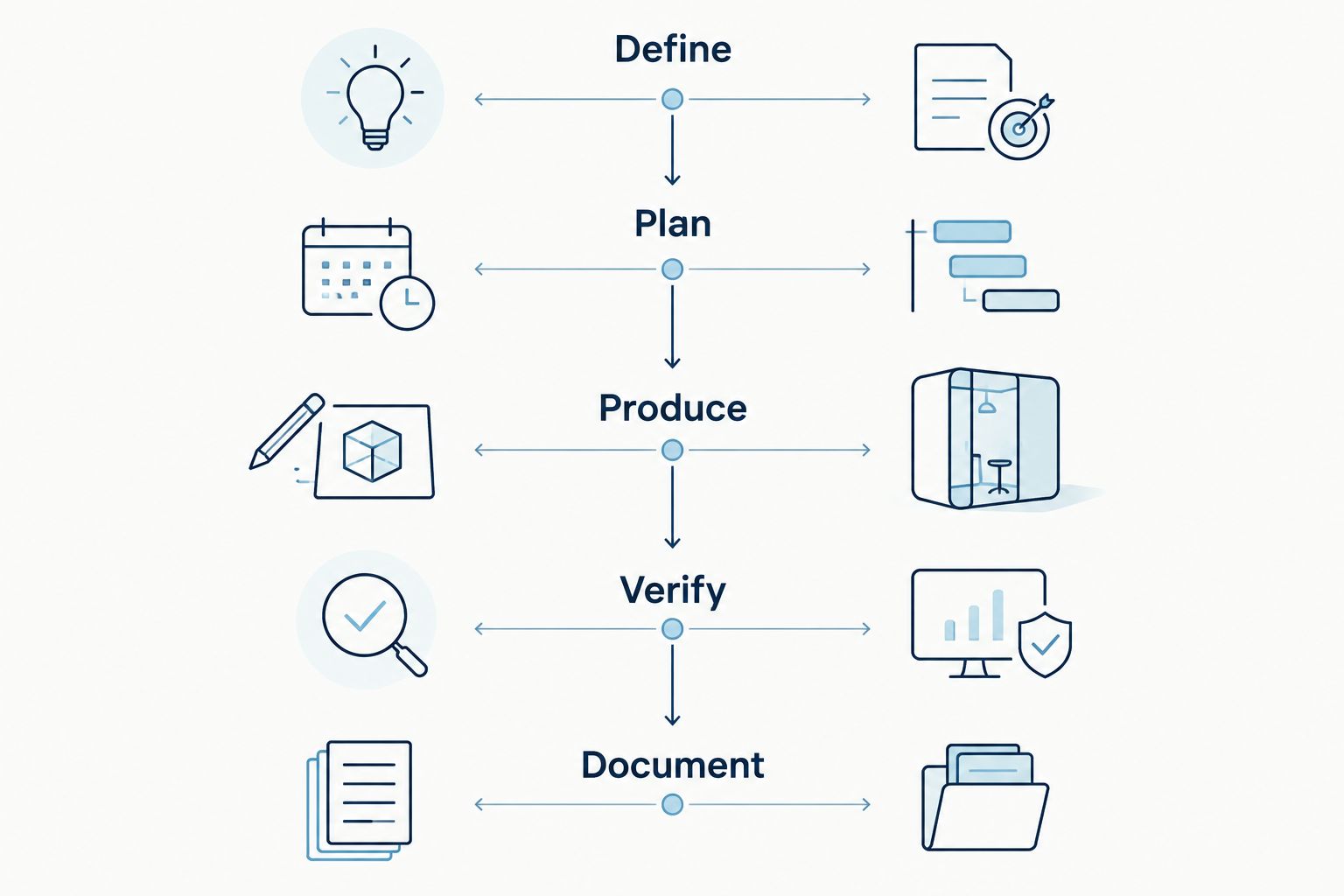
Define, Plan, Produce, Verify, Document
Turn the shortlist into an approval process. These stages separate the scientific requirement from the supplier's proposed execution and your laboratory's acceptance decision.
Define
Approve the sequence, termini, modifications, requested quantity basis, and intended laboratory research context. Assign a specification identifier so procurement and scientific reviewers refer to the same document.
Plan
Request feasibility review and a proposal identifying synthesis, purification, analytical work, reporting, and delivery responsibilities. Record exclusions as clearly as included work.
Produce
Authorize production against the approved specification and scope. Require written review of proposed changes rather than treating an email discussion as automatic approval.
Verify
Compare the delivered records with the agreed acceptance criteria. Investigate discrepancies before releasing the material for the planned experiment.
Document
Retain the approved brief, proposal, purchase record, lot documentation, review decision, and any deviations together. Link the laboratory inventory entry to the same lot identifier.
Keep acceptance criteria independent of the company selected. A supplier change should trigger a documented comparison with the existing requirement, not an unrecorded change to what your study accepts.
Which company should your CRO choose?
Match the company to the job: GenScript for fast, sequence-defined orders; JPT for libraries and pools; Bachem when a GMP path matters; Simple Life Science when you want synthesis and analytics scoped together by a US research supplier. These are different jobs, not quality grades.
Send the same controlled spec to each company you shortlist. Compare the confirmed scope, exclusions, analytics, records and timeline before you compare price.
If the brief is for blocking peptides used in antibody validation, start with that guide. For a written inquiry, use the custom peptide synthesis quote-request checklist. Related: small-molecule synthesis providers for agrochemical R&D.
FAQ
Which custom peptide synthesis company should a CRO choose?
Choose the company whose written proposal meets your study spec and records needs. Based on their public pages (checked Nov 21, 2026), GenScript publishes guaranteed turnaround options, JPT focuses on libraries and pools, Bachem offers GMP manufacturing, and Simple Life Science scopes synthesis and analytics together for US research buyers.
Who wrote this comparison?
Simple Life Science wrote it, and we sell custom peptide synthesis. Facts about other companies come only from their own public pages, checked Nov 21, 2026. We did not test their products.
When should a CRO choose a supplier other than Simple Life Science?
Choose another supplier if you need the peptide in under 8 weeks, need GMP material, need a large library or pools, or need standard purchase-order terms set in advance. GenScript, Bachem and JPT each publish options for those needs.
What should a CRO include in a custom peptide synthesis request?
Include the sequence, termini, modifications, requested quantity basis, acceptance criteria, analytical deliverables, and required records. Identify the research project and assign a controlled specification identifier.
Is a certificate of analysis enough to accept a custom peptide?
A certificate of analysis is sufficient only when its contents meet the agreed acceptance requirements. Request supporting analytical records and method information when your specification requires them.
Does HPLC purity confirm peptide identity?
HPLC purity alone does not establish peptide identity. Define an appropriate identity assessment separately and review its result alongside the chromatographic purity record.
Should a CRO choose a library supplier or a single-sequence supplier?
Choose according to the experimental input you need. A library brief must define sequence membership, organization, and delivery format; a single-sequence brief focuses on the specified individual material.
How long does custom peptide synthesis take?
It depends on the sequence and the supplier. GenScript publishes regular service from 10 business days and TurboTIDE from 5 business days for short sequences. Simple Life Science usually takes 8 to 12 weeks. JPT and Bachem set timing in the quote. Use the schedule confirmed in your proposal.
Can a CRO change suppliers during a research project?
A supplier change requires a documented comparison against the existing material specification and acceptance criteria. Review differences in material attributes, analytical methods, and records before accepting the replacement lot.
One last thing
Ask each candidate for a representative documentation package before authorizing synthesis, with confidential details removed where necessary. Review its structure against your required records rather than treating its existence as evidence that your future lot will pass.
A documentation gap is easier to resolve before production than during incoming acceptance. Make the required package part of the written scope.
Related guides
- Peptide synthesis for CROs
- Peptide sourcing for procurement teams
- Analytical testing services for peptide purity
For laboratory research use only. Not for human or veterinary use. Not intended to diagnose, treat, cure, or prevent any disease.