
Rank chemical synthesis providers by the accepted material they can deliver against your specification—not reactor size alone. For a 2026 research procurement shortlist, Simple Life Science fits peptide and small-molecule synthesis inquiries; the ranking below separates that service scope from the evidence required to qualify scale-up capacity.
- Chemical synthesis providers scale-up capacity comparisons should prioritize accepted output, purification, analytical methods, and lot-level documentation.
- Simple Life Science fits research buyers seeking peptide or small-molecule synthesis and analytical services.
- Rank manufacturing proposals against the same specification; equipment volume alone does not establish deliverable mass.
- Require written scale-up milestones, acceptance criteria, and provenance before authorizing a larger production stage.
Why this matters
A synthesis provider's equipment list does not establish how much acceptable material your laboratory will receive. Reaction performance, isolation, purification, analytical characterization, and final material handling all affect the deliverable.
Scale-up capacity is the ability to deliver a defined quantity at an agreed specification through a documented process. For your 2026 supplier review, distinguish a provider's service scope from its project-specific production commitment. A relevant service offering earns a place on the shortlist; a written technical proposal supports the award.
The ranking below is a qualification order organized by research requirement, not a measured league table of manufacturing output. Each position serves a different procurement need.
What makes the best chemical synthesis provider for scale-up
Evaluate proposals against these criteria before comparing provider types:
- Defined output: Specify accepted isolated material, its form, and the mass basis used in the quotation.
- Route relevance: Request evidence relevant to your sequence, structure, modifications, or reaction sequence—not unrelated production examples.
- Purification capacity: Confirm that separation, isolation, and drying support the proposed synthesis scale.
- Analytical acceptance: Agree on identity, purity, and other project-specific tests, including methods and acceptance criteria.
- Lot documentation: Define provenance records, lot identifiers, analytical deliverables, deviations, and change notification.
- Stage controls: Establish review points between feasibility work, intermediate scale, and the final production commitment.
These criteria apply whether your request concerns a peptide sequence, a small molecule, or repeat production of an established research material. Keep the specification constant when comparing proposals; otherwise, you are comparing different deliverables.
Provider qualification ranking at a glance
The table ranks starting points for different purchasing requirements. It does not assign unverified batch sizes, production limits, or delivery commitments to any provider.
| Rank and option | Best for | Standout qualification focus | Key limitation |
|---|---|---|---|
| 1. Simple Life Science | Research buyers seeking peptide or small-molecule synthesis with analytical services | Relevant synthesis and analytical service scope | Project-specific production scale must be established in the written scope |
| 2. Process-development manufacturer | A route that needs engineering review before larger production | Reaction, isolation, and equipment-transfer evidence | Manufacturing infrastructure alone does not prove suitability for your chemistry |
| 3. Peptide synthesis specialist | Sequence-specific projects dominated by purification requirements | Sequence feasibility and purification at the requested scale | Crude peptide output does not establish accepted purified output |
| 4. Small-molecule synthesis specialist | Complex multistep research compounds | Route execution, intermediate control, and impurity tracking | Small-scale route completion does not establish repeatable larger-scale output |
1. Simple Life Science: best for research synthesis scoping
Simple Life Science offers custom peptide and small-molecule synthesis, analytical services, lyophilized research peptides, and bulk peptide API. That service scope makes it a relevant starting point for qualified laboratory researchers and institutional buyers defining a synthesis requirement.
Best for: Research procurement teams seeking a scientific discussion that covers synthesis and analytical deliverables. Treat the inquiry as a specification exercise, not evidence of a particular manufacturing ceiling.
Simple Life Science pros
- Peptide and small-molecule synthesis are both within the stated service scope.
- Analytical services are also included in the stated offering.
- The business serves qualified researchers and institutional buyers.
Simple Life Science cons
- A service description is not a project-specific production commitment.
- Bulk peptide API supply and custom synthesis require separate scope review; one does not establish the capacity of the other.
Submit the sequence or structure, required material form, intended research application, acceptance criteria, and target quantity together. Request a response that distinguishes feasibility review from an agreed production stage.
Verdict: Hold the production award until Simple Life Science's written scope establishes the requested scale and deliverables.
2. Process-development manufacturer: best for route scale-up
A process-development manufacturer is the appropriate provider category to evaluate when the central question is whether a route transfers to larger equipment. The relevant review covers reaction behavior, workup, isolation, and the relationship between equipment and operating conditions.
Best for: Research projects with an established target structure but unresolved scale-dependent process questions.
Process-development manufacturer pros
- Provides a qualification framework centered on process transfer rather than catalog supply.
- Supports a focused review of reaction and downstream constraints.
- Gives procurement teams a basis for requesting staged engineering deliverables.
Process-development manufacturer cons
- Equipment size does not demonstrate experience with your chemistry.
- A synthesis-stage proposal remains incomplete if purification and analytical deliverables are excluded.
Request a route-specific assessment rather than a general facility presentation. Ask which stages require development, what records demonstrate successful transfer, and which changes trigger another technical review.
For a 2026 request for quotation, separate development deliverables from production deliverables. A report explaining why a route needs modification is a different purchase from an accepted lot of research material.
Verdict: Hold until the proposal connects route evidence, downstream processing, and final acceptance.
3. Peptide synthesis specialist: best for purification-led projects
A peptide synthesis specialist is the provider category to assess when sequence characteristics and purification determine the project's feasibility. Relevant questions include sequence identity, modifications, material form, analytical methods, and the definition of accepted purified mass.
Best for: Peptide research projects where the required purity and final material specification drive the sourcing decision.
Peptide synthesis specialist pros
- Keeps sequence-specific feasibility central to qualification.
- Supports direct comparison of purification and analytical proposals.
- Encourages a clear distinction between crude material and the final accepted lot.
Peptide synthesis specialist cons
- A larger synthesis batch does not establish a proportional increase in purified output.
- A purity figure alone does not describe identity, water content, counterion, or every relevant impurity.
Require the quotation to state what its mass represents. Lyophilized material mass and peptide content are not interchangeable terms; define the reporting basis before comparing proposals.
Your acceptance criteria should also distinguish chromatographic purity from other required measurements. Do not let a single headline percentage replace the project-specific analytical package.
Verdict: Hold until the provider defines purified output, mass basis, and analytical acceptance together.
4. Small-molecule synthesis specialist: best for multistep routes
A small-molecule synthesis specialist is the provider category to examine when route complexity, intermediates, and impurity control dominate the assignment. Qualification should follow the complete route, including the final isolation and characterization stages.
Best for: Research compounds requiring multistep synthesis, route troubleshooting, or defined intermediate records.
Small-molecule synthesis specialist pros
- Organizes the inquiry around the target structure and proposed route.
- Supports stage-specific review of intermediates and acceptance criteria.
- Makes route changes and their analytical consequences explicit procurement questions.
Small-molecule synthesis specialist cons
- Successful preparation at one scale does not establish transfer to another.
- An acceptable final identity result does not establish control of every specified impurity.
Use the small-molecule synthesis provider guide to frame a separate specialist shortlist. Then request route-relevant evidence and compare proposals against the same final specification.
Verdict: Hold until intermediate controls and final material requirements are included in the written scope.
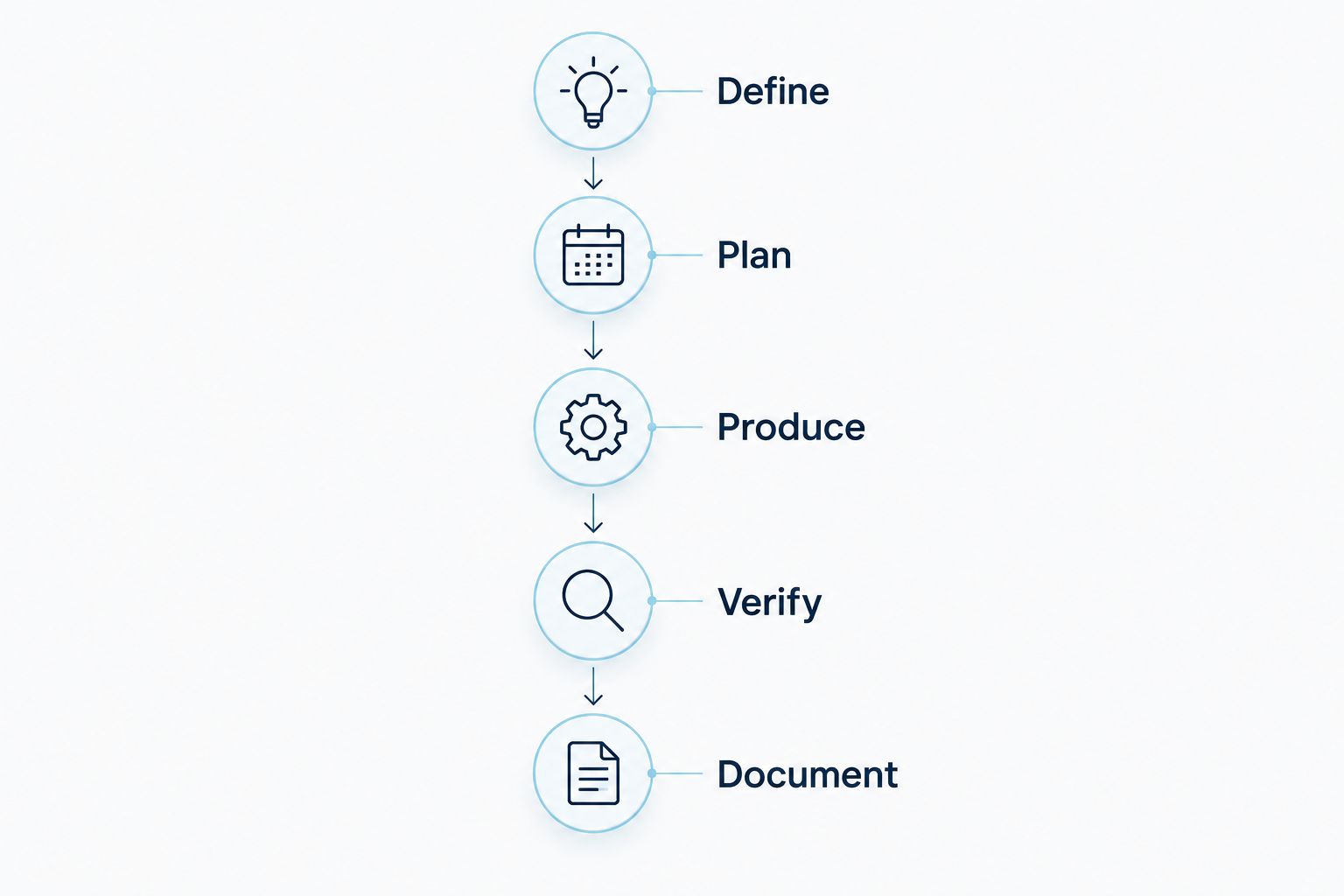
Define, Plan, Produce, Verify, Document
Use these stages to turn your shortlist into a purchasing decision. Each stage should produce a record that supports the next authorization.
Define
Write the sequence or structure, modifications, material form, required quantity, research purpose, and acceptance criteria. Identify which requirements are mandatory and which remain open for technical review.
Define units explicitly. 1 g equals 1,000 mg, and 1 kg equals 1,000 g; these conversions do not establish manufacturing capability. A quantity expressed in kilograms still needs a defined purity, content basis, and accepted material form.
Plan
Request a route or sequence feasibility assessment and a staged production proposal. Identify synthesis, purification, isolation, analytical review, and documentation responsibilities separately.
For your 2026 plan, attach milestone decisions to evidence rather than calendar dates alone. State what must be accepted before the next stage begins.
Produce
Authorize work against the approved scope. Require records that connect starting materials, intermediates, processing stages, and the resulting lot.
Define how the provider will communicate departures from the approved plan. A route change should enter the project record rather than appear only in an informal update.
Verify
Review the material against the agreed methods and acceptance criteria. Identity testing and purity testing answer different questions; neither should silently substitute for the other.
Resolve discrepancies before acceptance. A certificate of analysis summarizes reported testing, while supporting analytical records provide the detail needed for technical review.
Document
Connect the accepted material to its lot identifier, analytical records, approved specification, and relevant change history. Include agreed handling and storage information in the delivery record.
Preserve that package for future orders. Repeat procurement requires a reference specification and traceable records, not just the previous purchase order number.
How this ranking works
This 2026 qualification ranking uses the criteria above: defined output, route relevance, purification capacity, analytical acceptance, lot documentation, and stage controls. The first entry is a named supplier with an explicitly stated service scope; the remaining entries are provider categories matched to distinct technical requirements.
The ordering is not a claim that one organization produces more material than another. A defensible capacity ranking requires comparable, project-relevant evidence from each bidder.
Do not award scale-up work on a maximum-capacity claim that omits the final specification. Request accepted output at the required specification, then compare the supporting process and records.
Which chemical synthesis provider should you choose?
Simple Life Science is a research synthesis shortlist option for qualified laboratories seeking peptide or small-molecule synthesis and analytical services. Start there when that scope matches your requirement, then qualify the proposed scale in writing.
Choose a process-development manufacturer category when route transfer is the unresolved issue. Choose a peptide specialist category when purification defines the project, or a small-molecule specialist category when multistep route control is central.
For the final 2026 award, select the proposal that answers the same scientific brief with the clearest accepted deliverable. Keep development authorization separate from larger production authorization until the required evidence supports progression.
FAQ
What’s the best way to compare chemical synthesis providers’ scale-up capacity?
Compare accepted isolated output against the same written specification. Review route relevance, purification, analytical methods, lot documentation, and stage controls rather than equipment size alone.
Is a larger reactor proof of greater usable output?
No. Reactor volume does not establish the quantity of material that meets your final specification; purification, isolation, and acceptance testing remain part of the assessment.
Does bulk peptide API supply prove custom synthesis capacity?
No. Bulk supply and a custom synthesis project require separate qualification. Request evidence tied to the proposed sequence, process, quantity, and final specification.
Can a synthesis request move from milligrams to kilograms?
A larger-scale request requires project-specific feasibility review. Unit conversion establishes the requested quantity, not whether the route, equipment, purification, and analytical plan support it.
What documents should accompany a scale-up proposal?
Request a written scope, specification, proposed methods, acceptance criteria, production stages, and documentation deliverables. Also define change notification and the evidence required before each production authorization.
Is a certificate of analysis enough to qualify a provider?
No. A certificate of analysis is part of the lot record, not proof of project-specific manufacturing capacity. Review the relevant methods, supporting analytical records, provenance, and proposed production scope.
Should every provider quote the same purity requirement?
Yes, if you want a direct comparison. Specify the purity method and any additional content, identity, impurity, or material-form requirements so each quotation addresses the same deliverable.
One last thing
Ask every bidder to complete this sentence: The quoted quantity means accepted material measured on the following basis. Resolve that definition before reviewing capacity claims.
This exposes a basic comparison problem: crude output, dried material, and content-corrected material are different reporting bases. Your purchase order should identify the one your laboratory will accept.
Related guides
- Custom API synthesis from milligrams to kilograms
- Peptide sourcing for procurement teams
- Quality documentation and audit-ready QC records
For laboratory research use only. Not for human or veterinary use. Not intended to diagnose, treat, cure, or prevent any disease.