
Choose cyclic peptide synthesis providers by their ability to deliver your defined ring structure and supporting analytical records—not by a generic purity claim. Best starting point for a custom synthesis brief: Simple Life Science; best for a specified ring closure: a cyclization specialist; best for matched analogues: a peptide-library provider; best for repeat production: a scale-oriented custom manufacturer.
- Compare cyclic peptide synthesis providers against a defined structure, cyclization chemistry, and analytical acceptance criteria.
- Simple Life Science offers custom peptide synthesis and analytical services; require written confirmation of the proposed cyclic scope.
- Choose a cyclization specialist for ring-closure feasibility, a library provider for analogues, and a manufacturer for repeat production.
- HPLC purity and mass confirmation answer different questions; neither alone establishes every aspect of cyclic connectivity.
Why this matters
A cyclic peptide specification must describe more than an amino-acid sequence. The attachment points, linkage chemistry, stereochemistry, and terminal modifications determine what the laboratory is asking the provider to produce. Two materials with similar sequence descriptions can represent different structures.
For a 2026 procurement decision, separate synthesis capability from evidence of identity. Simple Life Science is a starting point for qualified laboratories seeking custom peptide synthesis and analytical services under a defined scientific brief. Award a cyclic project only after the proposed structure, production scope, and documentation requirements have been accepted in writing.
A custom peptide purity specification belongs in that brief, but purity is not a substitute for structural characterization. Decide what evidence your experiment requires before comparing quotations.
What makes the best cyclic peptide synthesis provider
Use these criteria before reading the comparison table. Each criterion should produce a written answer, not a general capability statement.
- Defined connectivity: The provider accepts a structure showing the ring-closing atoms, linkage type, residue numbering, and stereochemistry.
- Sequence-specific feasibility: The proposed route addresses the actual sequence, protecting-group requirements, and potential competing reactions.
- Analytical characterization: The scope distinguishes chromatographic purity, molecular identity, and any additional evidence needed for connectivity.
- Acceptance criteria: The quotation defines what constitutes an acceptable deliverable and how deviations will be handled.
- Lot-level documentation: Material identifiers connect the supplied sample to its certificate of analysis, analytical files, and project record.
- Repeatability requirements: Follow-on production addresses method changes, batch comparisons, and retention of relevant project information.
For 2026 sourcing, compare 3 written quotations against the same scientific brief where feasible. A quotation that excludes structural characterization is not equivalent to one that includes it, even when both describe the material as a cyclic peptide.
Cyclic peptide synthesis providers at a glance
The ranking below compares sourcing models by project fit. It does not assign unsupported performance scores to named vendors or assume that general peptide synthesis includes every cyclization chemistry.
| Provider or sourcing model | Best for | Standout selection criterion | Key limitation |
|---|---|---|---|
| Simple Life Science | A defined custom synthesis and analytical brief | Custom peptide synthesis and analytical services are within its stated offering | The specific cyclic structure and evidence package require written confirmation |
| Cyclization-specialist provider | A single target with a defined ring closure | A sequence-specific cyclization plan | Chemistry expertise alone does not establish documentation completeness |
| Peptide-library provider | Matched cyclic analogues | Consistent specifications across a variant set | Individual members can differ in feasibility and analytical requirements |
| Scale-oriented custom manufacturer | Repeat batches of an established target | A documented production and batch-comparison plan | Scale suitability does not establish suitability for an unresolved structure |
1. Simple Life Science: best for a defined custom synthesis brief
Simple Life Science offers custom peptide synthesis and analytical services to qualified laboratory researchers and institutional buyers. That makes it a relevant starting point when your project needs a scientific brief covering both material production and characterization.
For cyclic peptide synthesis, submit the intended structure rather than relying on a sequence alone. Request written confirmation of the proposed cyclization, the deliverable, and the analytical scope before treating the quotation as an accepted project plan.
Simple Life Science pros:
- Custom peptide synthesis is part of its stated offering.
- Analytical services are also part of its stated offering.
- Its stated audience includes laboratory researchers and institutional buyers.
Simple Life Science limitations:
- A general custom synthesis offering does not establish feasibility for your specific cyclic target.
- Project-specific methods, acceptance criteria, and deliverable records must be defined in the written scope.
Best for: A qualified laboratory preparing a custom peptide synthesis brief with analytical requirements attached.
Hold: Keep the project at feasibility review until Simple Life Science confirms the cyclic structure and documentation scope in writing.
2. Cyclization specialist: best for a specified ring closure
A cyclization-specialist provider is the appropriate sourcing model when the ring closure itself is the central technical question. Request a route discussion focused on your target, rather than a list of unrelated cyclic compounds the provider has synthesized.
Head-to-tail amide closure, side-chain linkages, and disulfide connectivity are different design problems. The scientific brief should identify which structure is required and which alternatives, if any, the laboratory would accept.
Cyclization-specialist provider pros:
- Keeps route feasibility central to provider selection.
- Supports discussion of competing products and purification requirements.
- Connects analytical planning to the intended ring structure.
Cyclization-specialist provider limitations:
- Relevant chemistry experience does not guarantee success with a new sequence.
- Production capability does not automatically include every structural characterization method.
Best for: A single cyclic target whose ring closure needs focused feasibility review.
Buy: Award the work only after the specialist accepts the structure, route scope, and evidence requirements in writing.
3. Peptide-library provider: best for matched cyclic analogues
A peptide-library provider is the appropriate sourcing model when your laboratory needs a defined set of cyclic variants. The comparison depends on consistent records as well as consistent design.
Specify the invariant scaffold, permitted substitutions, residue numbering, and naming convention. Require individual identifiers and analytical records for each member; a summary describing the entire library cannot replace member-level evidence.
Peptide-library provider pros:
- Organizes related variants under a common specification.
- Makes sample naming and record matching part of the procurement scope.
- Supports a shared acceptance framework across the requested set.
Peptide-library provider limitations:
- A substitution can change synthesis or purification feasibility.
- A common scaffold does not justify assuming identical quality across all members.
Best for: A laboratory comparing cyclic analogues under a controlled experimental design.
Buy: Proceed when each member has an accepted structure, identifier, and analytical deliverable—not just a shared library description.
4. Scale-oriented manufacturer: best for repeat production
A scale-oriented custom manufacturer is the appropriate sourcing model once the target structure and acceptance criteria are established. Select for continuity between batches, not simply for a stated production scale.
Define how the manufacturer will document changes to the synthesis route, purification method, analytical method, or supplied material form. A repeat order should reference the approved specification instead of relying on the previous purchase description.
Scale-oriented manufacturer pros:
- Places repeat production requirements in the written scope.
- Supports explicit comparison of new batches with prior accepted material.
- Makes change notification and record continuity procurement requirements.
Scale-oriented manufacturer limitations:
- An established production operation does not resolve an undefined cyclic structure.
- Scale changes require review of whether the existing methods and acceptance criteria remain suitable.
Best for: Repeat research supply of an already characterized cyclic peptide.
Buy: Approve repeat production only against a controlled specification and a defined batch-comparison plan.
Define, Plan, Produce, Verify, Document
Use this sequence to turn a 2026 shortlist into an assessable project. Each stage has a deliverable that the next stage depends on.
Define
Provide the sequence, structure drawing, stereochemistry, ring-closing atoms, linkage chemistry, and modifications. For 1 target structure, use a single approved identifier across the scientific brief, quotation, and analytical record. Separate required features from acceptable alternatives.
Plan
Request sequence-specific feasibility review and an outline of synthesis, cyclization, purification, and characterization. Identify assumptions before approval. Ask which analyses are included and which require a separate scope.
Produce
Tie production to the approved structure and specification. Require written handling of substitutions or route changes that affect the agreed deliverable. Do not accept an alternative linkage merely because the sequence remains similar.
Verify
Use 2 separate acceptance categories: identity and purity. Add connectivity-specific requirements where the structure or study demands them. Evaluate the actual analytical records against the approved criteria, not against a generic statement that testing was completed.
Document
Connect the supplied material to its lot identifier, certificate of analysis, analytical files, and approved specification. Record discrepancies before release for laboratory work. Preserve the accepted records with the institutional project documentation.
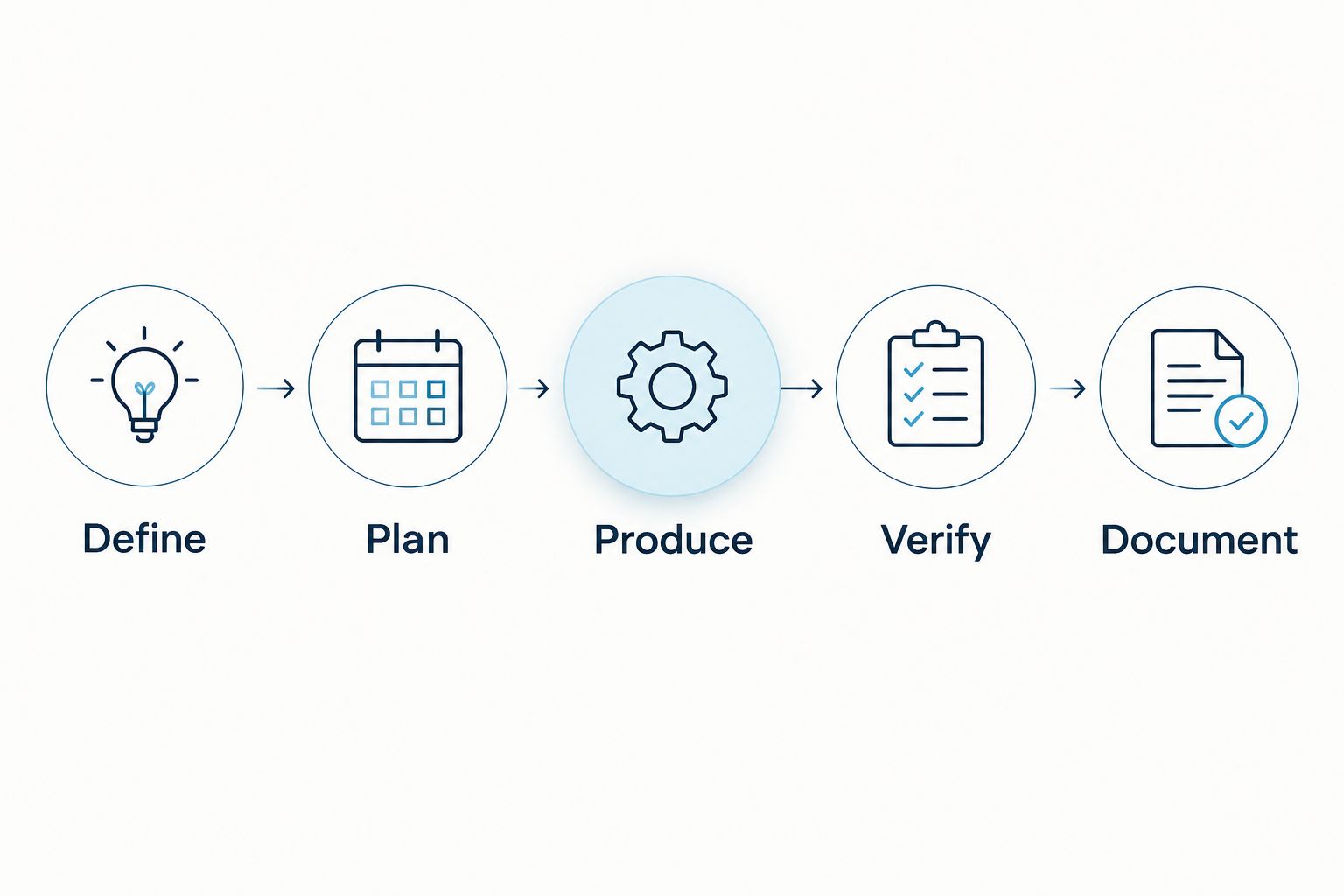
The sequence is also a procurement control. If a quotation moves directly from sequence submission to production without resolving the analytical scope, return it for clarification before authorization.
Submit a defined scientific brief
Specify the cyclic structure, acceptance criteria, and analytical deliverables for project review.
Read the analytical evidence correctly
Chromatographic purity, molecular identity, and ring connectivity are different questions. The best cyclic peptide synthesis providers explain what each reported method establishes and where additional evidence is needed.
HPLC separates components under a particular method. A reported chromatographic area percentage describes the detected signal under those conditions; it is not automatically a statement of peptide mass content or complete structural identity.
Mass spectrometry provides molecular-mass information. Agreement with an expected mass supports characterization, but different structures can share a molecular mass. Correct mass alone does not settle every connectivity or stereochemical question.
For a 2026 project review, ask the provider to distinguish:
- The method used to assess chromatographic purity.
- The evidence supporting molecular identity.
- The evidence supporting the intended linkage or connectivity.
- Any unresolved structural questions relevant to your acceptance decision.
Additional characterization should follow the target structure and scientific requirement. Do not request a named technique simply to make the documentation package look more extensive; request evidence that answers a defined question.
What to put in the quotation request
A useful request lets providers quote the same work. Keep scientific requirements separate from administrative purchasing details, then connect both through the approved project identifier.
Include:
- Target definition: Sequence, structure, residue numbering, stereochemistry, linkage, and modifications.
- Material definition: Requested quantity, material form, and any required compositional information.
- Analytical definition: Methods, raw-data expectations, acceptance criteria, and structural questions to resolve.
- Documentation definition: Lot identifiers, certificate contents, file formats, and required record links.
- Deviation handling: Who approves changes and how rejected or incomplete deliverables are addressed.
- Repeat-order requirements: Specification continuity, change notification, and batch comparison where applicable.
Ask providers to list exclusions explicitly. A short, clear quotation with defined exclusions is easier to assess than a broad capability statement with uncertain deliverables.
How the ranking works
This 2026 ranking prioritizes project fit: a defined custom brief, a ring-closure problem, a matched analogue set, or repeat production. The order is not a claim that one provider has better yields, shorter turnaround, or stronger analytical performance than another.
The deciding evidence is the written scope. Apply the same criteria to every candidate, including the first option, and reject comparisons that combine different structures or documentation packages.
Which provider should you choose?
Start with the unresolved requirement. Choose a custom synthesis review for a new scientific brief, a cyclization specialist for ring-closure feasibility, a library provider for coordinated variants, or a scale-oriented manufacturer for repeat supply.
For an undecided laboratory in 2026, define the target and analytical acceptance criteria before choosing a provider. That document determines whether a quotation is relevant and whether the delivered material can be accepted for the intended research work.
FAQ
What’s the best way to compare cyclic peptide synthesis providers?
Compare cyclic peptide synthesis providers against the same structure, analytical scope, and acceptance criteria. Require written answers on feasibility, deliverables, exclusions, and lot-level documentation before selecting a provider.
Can Simple Life Science review a custom cyclic peptide project?
Simple Life Science offers custom peptide synthesis and analytical services. Submit the cyclic structure and scientific requirements, then require written confirmation of project-specific feasibility and scope before authorization.
Is HPLC purity enough to verify a cyclic peptide?
HPLC purity alone does not establish complete cyclic peptide identity. Chromatographic purity, molecular identity, and ring connectivity require evidence suited to the intended structure.
Does the correct molecular mass prove the ring connectivity?
Correct molecular mass alone does not prove every aspect of ring connectivity. Different structures can share a molecular mass, so define any additional characterization required for your target.
What should a cyclic peptide synthesis brief include?
A cyclic peptide synthesis brief should include the sequence, structure, stereochemistry, ring-closing atoms, linkage chemistry, modifications, and acceptance criteria. Add material requirements and the analytical records needed for laboratory acceptance.
Should a laboratory choose a library provider or a single-target specialist?
Choose a library provider for a coordinated analogue set and a single-target specialist when ring-closure feasibility is the main question. Require individual structures and analytical records for every supplied material.
What records should accompany a cyclic peptide lot?
Request records that connect the supplied material to its approved specification, lot identifier, certificate of analysis, and agreed analytical files. Define the required contents before placing the order rather than assuming every provider supplies the same package.
One last thing
A cyclic peptide can match an expected mass without resolving every structural question. Before accepting a lot, ask which evidence distinguishes the intended structure from relevant alternatives. That question is more useful than asking for a higher purity figure without defining the method or the acceptance requirement.
Related guides
- Peptide sourcing for procurement teams
- Mass spectrometry in peptide analytical testing
- Peptide synthesis services for academic research labs
For laboratory research use only. Not for human or veterinary use. Not intended to diagnose, treat, cure, or prevent any disease.