
Yes. Custom peptide synthesis supports early drug discovery by supplying defined sequences, structural variants, and control materials for laboratory assays; a 2026 research brief should specify both the molecule and the evidence required to accept it. Synthesis alone does not establish assay suitability: identity, purity, material composition, and experimental performance require separate review.
- Custom peptides synthesis applications include sequence screening, structure–activity comparisons, assay controls, and biochemical interaction studies.
- Simple Life Science serves qualified researchers and institutional buyers seeking custom peptide synthesis and analytical services.
- Define sequence, modifications, acceptance criteria, and required records before requesting synthesis.
- Chromatographic purity and molecular identity answer different questions; review both against the written specification.
Can custom peptide synthesis support early drug discovery?
Custom peptide synthesis supports early discovery when the research question requires a defined sequence or a controlled structural comparison. It provides experimental material, not evidence that a discovery hypothesis is correct. Your assay supplies that evidence after the material passes its agreed analytical review.
Start with the research requirement rather than a general request for a high-purity peptide. The custom peptide synthesis purity guide addresses a specification question that belongs in the scientific brief, not at the end of purchasing.
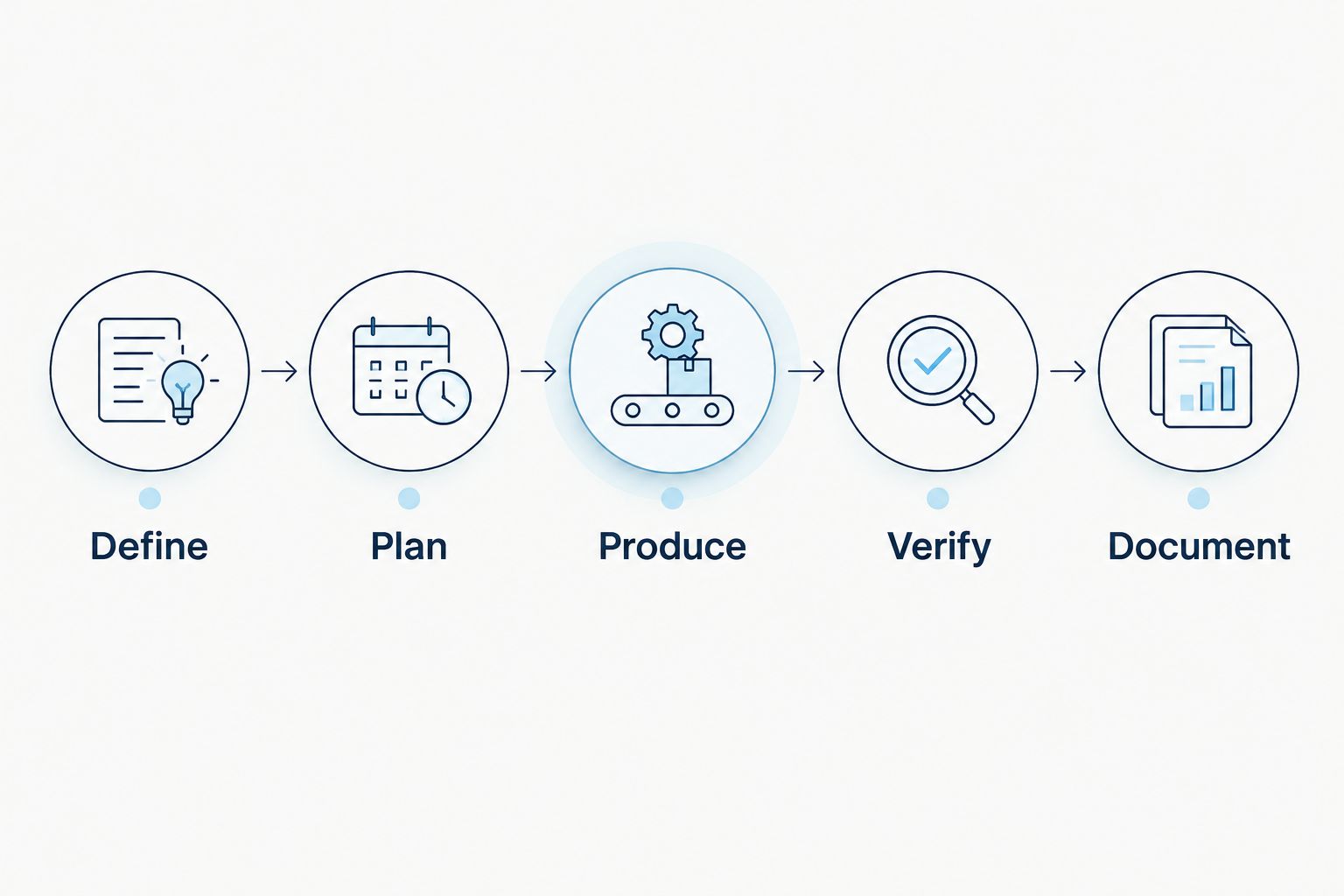
Use the following stages to connect the research question to an accepted laboratory material:
- Define. Record the sequence, terminal groups, modifications, material form, and intended laboratory application. Identify the experimental comparison that the peptide must support.
- Plan. Agree on feasibility review, analytical methods, acceptance criteria, and required deliverables. Specify how changes to the requested structure will be approved.
- Produce. Follow the agreed synthesis and purification scope. Keep each requested variant linked to its own identifier.
- Verify. Review analytical evidence against the specification before releasing the material into the study. Separate chemical acceptance from assay qualification.
- Document. Connect the accepted lot to its certificate of analysis, supporting files, receipt record, and experimental records. Preserve revisions and deviations alongside the original brief.
These stages create a decision trail. If a structural feature changes during feasibility review, you can identify which research comparison it affects rather than treating the change as an administrative detail.
Why this matters
A discovery assay evaluates the material actually supplied, not just the sequence written in a notebook. Unresolved questions about composition or identity make interpretation harder because the observed response cannot be confidently assigned to the intended experimental variable.
For a 2026 procurement brief, define the acceptance criteria before comparing quotations. This keeps the purchasing decision tied to research requirements rather than to an isolated purity statement.
Simple Life Science offers custom peptide synthesis and analytical services for qualified laboratory researchers and institutional buyers. Those services are relevant when your project needs a specified research material; the project-specific scope must establish the required methods and records.
Which discovery applications fit custom peptide synthesis?
Different applications require different controls. The useful distinction is not simply whether a peptide can be synthesized, but whether the supplied material allows you to answer the intended research question.
| Application | Best for | Main advantage | Limitation to address |
|---|---|---|---|
| Sequence screening | Comparing defined sequence variants | Makes sequence changes explicit | Differences in solubility or composition can complicate comparison |
| Structure–activity comparisons | Examining a specified structural change | Connects a controlled chemical variable to an assay readout | Several simultaneous changes prevent clear attribution |
| Assay controls | Checking assay behavior with defined reference materials | Provides a specified comparator | A chemically acceptable control still needs assay qualification |
| Biochemical interaction studies | Examining peptide interactions in an in-vitro system | Supplies a defined molecular input | Labels, linkers, and assay conditions can affect interpretation |
| Published-sequence replication | Reproducing a reported research material | Allows a sequence-specific order | The publication may omit material-form or analytical details |
Sequence screening and structure–activity comparisons
Custom synthesis allows you to request a parent sequence and deliberately changed variants. Substitutions, terminal modifications, or other defined structural changes can support comparisons when the laboratory method is designed to distinguish them.
Keep the intended chemical difference separate from uncontrolled material differences. A comparison becomes difficult to interpret if variants differ in sequence, material form, analytical acceptance, and preparation conditions without those differences being recorded.
Create a variant register before placing the order. Include the exact structure requested, the research rationale, and the identifier that will follow the material into analytical files and assay records. Similar shorthand names are not adequate substitutes for a controlled sequence record.
Assay controls and biochemical interaction studies
A synthesized control can help assess whether an assay behaves as intended. Its role must be stated explicitly: a sequence comparator, a background control, or another defined experimental reference.
For labeled peptides, record the label identity, attachment position, and linker structure. These features are part of the test material, not optional purchasing notes. A labeled construct should not be treated as interchangeable with its unlabeled counterpart without experimental justification.
Chemical verification establishes whether the supplied material meets its chemical specification. Assay qualification establishes whether that material performs its assigned role in the selected laboratory system. Neither review replaces the other.
Define the molecule before requesting synthesis
Your scientific brief should allow a reviewer to reconstruct the requested structure without guessing. For a 2026 project, keep the approved brief and subsequent revisions together so the purchase record remains connected to the current research requirement.
Include these fields:
- Sequence and notation: specify residue order and identify any nonstandard residue unambiguously.
- Terminal groups: state the required N-terminal and C-terminal chemistry.
- Modifications: identify attachment positions, stereochemistry, cyclization requirements, and other structural features where applicable.
- Material form: describe the requested form and any composition requirements relevant to the assay.
- Analytical acceptance: define the identity and purity evidence required for acceptance.
- Deliverables: identify the certificate, supporting analytical files, and reporting details that procurement and the laboratory need.
Do not infer an unstated modification from a compound nickname. The same shorthand can leave terminal chemistry, attachment position, or material form unresolved.
If you are reproducing a published experiment, distinguish the information explicitly reported from the information you still need to establish. Record the publication, its methods section, and any supplementary sequence information in the scientific brief. Resolve missing structural details before approving synthesis rather than filling them with assumptions.
Verify identity, purity, and composition separately
A purity percentage is not a complete peptide specification. Chromatographic purity describes the detected components under a particular analytical method. It does not, by itself, confirm sequence identity, peptide content, or suitability for your assay.
Mass spectrometry provides molecular-mass evidence that supports identity assessment. A matching mass does not resolve every possible structural ambiguity, so the analytical plan must match the structure and the questions under review. The guide to mass spectrometry in peptide analytical testing explains a method category to discuss when defining that plan.
Review these evidence categories independently:
| Evidence category | Question it addresses | What it does not establish alone |
|---|---|---|
| Chromatographic analysis | What components are detected under the stated method? | Complete structural identity or total peptide content |
| Molecular-mass analysis | Does the measured mass support the expected molecule? | Every positional or stereochemical distinction |
| Composition review | Which specified material constituents require assessment? | Performance in the intended assay |
| Assay qualification | Does the material fulfill its experimental role? | A complete chemical characterization |
For a 2026 analytical review, retain the method information with the reported result. A chromatogram detached from its lot identifier or method context is harder to evaluate than a controlled analytical record.
Request additional characterization when the research question requires it. The appropriate method follows from the unresolved chemical question; adding an unrelated test does not resolve that question.
Why custom peptide synthesis requirements vary
Project requirements vary because different structures and laboratory applications require different production decisions and evidence. A specification suitable for an exploratory comparison is not automatically suitable for every subsequent research stage.
- Sequence composition: residue arrangement and physicochemical characteristics affect synthesis, purification, and handling considerations.
- Structural modifications: labels, linkers, cyclization, and nonstandard residues introduce features that must be defined and assessed.
- Experimental purpose: screening materials, assay controls, and interaction-study constructs have different qualification questions.
- Analytical scope: the methods required depend on the identity, impurity, and composition questions the project needs to answer.
- Requested quantity: material demand changes planning for production, purification, and analytical sampling.
- Record requirements: institutional procurement and laboratory systems determine which identifiers, approvals, and files must accompany the material.
Do not treat a previous order as the specification for a new experiment. Reuse the parts that remain valid, then review every changed structure, quantity, method, and acceptance criterion.
Document the lot before releasing it into the study
Build the lot record around traceability rather than around a folder of disconnected files. For a 2026 study, the accepted material should remain identifiable from the purchase request through the analytical review and experimental record.
A useful record connects:
- The approved sequence and specification revision.
- The purchase reference and supplier lot identifier.
- The certificate of analysis and supporting analytical files.
- The receipt condition and applicable handling instructions.
- The laboratory review decision and any unresolved deviation.
- The internal material identifier used in experiment records.
Keep analytical acceptance and procurement receipt as separate decisions. Delivery confirms that material arrived; it does not establish that the material meets the scientific specification.
Record discrepancies explicitly. If the certificate uses a different sequence name or omits a requested structural detail, resolve the discrepancy against the approved brief before the material enters the study. Preserve the clarification with the lot record rather than relying on an email that cannot be located later.
When is Simple Life Science relevant to the project?
Simple Life Science is a fit for qualified laboratory researchers and institutional buyers sourcing custom peptide synthesis and analytical services. Its stated offering also includes lyophilized research peptides, bulk peptide API, and custom small-molecule synthesis.
That scope does not establish acceptance for a particular sequence or assay. Before selecting Simple Life Science custom peptide synthesis, submit the scientific brief and request a written scope covering the requested structure, analytical deliverables, and acceptance criteria.
The relevant advantage is access to the stated synthesis and analytical service categories. The limitation is project dependence: this page does not establish sequence-specific feasibility, an analytical method package, or assay performance. Approve the written project scope, not an assumed capability.
Submit a scientific brief
Define the sequence, modifications, acceptance criteria, and analytical deliverables for scope review.
Is custom synthesis necessary if a catalog peptide exists?
Custom synthesis is appropriate when the research requirement differs from the available material's defined structure or documentation. A matching name is insufficient if terminal chemistry, modifications, or acceptance criteria remain unclear.
A catalog material can support the study when its documented specification matches the research requirement. Compare the actual records before choosing either route; customization is not an automatic quality advantage.
Can a peptide from a published study be reproduced exactly?
A published sequence can support a synthesis request when the structure is sufficiently defined. Reproducing the sequence alone does not reproduce the study's material composition, preparation history, or experimental conditions.
Separate molecular replication from experimental replication. Identify missing details in the publication and resolve which ones are necessary for the proposed laboratory comparison.
Does higher chromatographic purity guarantee a better assay?
Higher chromatographic purity does not guarantee a better assay. Identity, composition, preparation conditions, and the assay design remain separate variables.
Define the required analytical threshold through the research specification rather than assuming that the largest reported percentage answers every material-quality question. Qualification must address the material's assigned experimental role.
FAQ
What are custom peptides synthesis applications in early discovery?
Custom peptides synthesis applications include sequence screening, structure–activity comparisons, assay controls, and biochemical interaction studies. Each application requires a defined structure and analytical acceptance criteria matched to the laboratory question.
What should I include in a custom peptide synthesis request?
Include the exact sequence, terminal groups, modifications, requested material form, acceptance criteria, and analytical deliverables. Identify the intended laboratory application so the written scope addresses the relevant material questions.
Is mass spectrometry enough to verify a custom peptide?
Mass spectrometry alone does not establish every aspect of peptide identity or quality. Review molecular-mass evidence alongside the other methods required by the structure and written specification.
Does a certificate of analysis prove that a peptide will work in my assay?
A certificate of analysis does not prove assay performance. It reports the stated analytical findings, while assay qualification determines whether the material fulfills its experimental role.
Is custom peptide synthesis better than ordering a catalog peptide?
Custom peptide synthesis is preferable when the requested structure or documentation differs from the catalog material. A catalog peptide remains an appropriate option when its documented specification matches the research requirement.
Can custom synthesis reproduce a peptide sequence from a paper?
Custom synthesis can reproduce a sufficiently defined peptide structure. Review terminal chemistry, modifications, and material details rather than relying on the reported sequence alone.
What records should procurement retain for a research peptide lot?
Procurement should retain the approved specification, purchase reference, supplier lot identifier, certificate of analysis, and agreed supporting files. Connect those records to laboratory receipt and acceptance decisions.
One last thing
The sequence name and the lot identifier serve different purposes. The sequence identifies the intended molecule; the lot identifier connects the actual material to its analytical evidence and history.
Keep both identifiers in every experimental record. When an assay finding needs investigation, this connection lets you distinguish a question about the molecular design from a question about the supplied lot. That distinction is more useful than an isolated purity claim.
Related guides
- Peptide sourcing for procurement teams
- Connect custom synthesis specifications to your R&D workflow
- Connect certificates of analysis to ELN-ready records
For laboratory research use only. Not for human or veterinary use. Not intended to diagnose, treat, cure, or prevent any disease.