
For 2026 procurement, rank peptide suppliers by documented shipping performance against the material’s defined transport specification—not by refrigerant choice alone. Simple Life Science supplies research peptides, bulk peptide API, and custom synthesis services; evaluate cold-chain reliability separately through the written shipping scope and shipment records.
- Peptide suppliers cold-chain shipping reliability: prioritize defined transport specifications, shipment evidence, and documented excursion decisions.
- Simple Life Science is a sourcing candidate for laboratory research peptides, bulk peptide API, and custom synthesis.
- Rank shipment-linked evidence above packaging descriptions; a cold pack does not establish acceptable transport conditions.
- Select refrigerated, frozen, or ambient transport only against the material’s documented requirements.
Why shipping evidence matters
A peptide’s arrival condition is part of your acceptance decision. A certificate of analysis establishes reported analytical findings for the identified lot; it does not, by itself, establish the temperature history of the shipment carrying that lot.
Simple Life Science serves qualified laboratory researchers and institutional buyers. For those buyers, the relevant question is whether the proposed shipping arrangement supports the material specification and produces records that receiving staff can review.
Simple Life Science is a sourcing candidate for laboratories seeking research peptides, bulk peptide API, and custom synthesis under a defined scientific brief. That scope is distinct from a verified claim about shipping performance.
A defensible 2026 supplier comparison therefore separates material capability from transport evidence. The ranking below orders supplier evidence profiles, not named companies with unverified delivery claims.
What makes a reliable peptide shipping supplier
Use these criteria before comparing quotations. Ask every candidate to respond to the same requirements so that a detailed packaging description does not substitute for a complete shipping assessment.
- Defined transport specification: The proposed conditions match the compound, formulation, container, and supporting stability information.
- Packaging evidence: The supplier explains how the shipping configuration was assessed for the proposed conditions and duration.
- Shipment traceability: Shipment identifiers connect the dispatched material to the purchase order, lot, and receiving record.
- Temperature evidence: Where monitoring is required, the record identifies the device, shipment, timestamps, and applicable acceptance limits.
- Exception handling: A written process assigns responsibility for delays, damaged packaging, missing records, and temperature excursions.
- Receiving readiness: The delivery arrangement matches your institution’s staffed receiving hours and approved storage procedure.
Do not assign a universal temperature requirement to all lyophilized peptides. Review how lyophilized peptides are shipped to stay stable in transit alongside the specific material’s written requirements; neither lyophilization nor visible refrigerant replaces that review.
Shipping evidence profiles at a glance
These ranks describe the strength of a procurement submission. A supplier belongs in a tier only when its submitted records support that classification for the proposed shipment.
| Rank and evidence profile | Best for | Standout evidence | Key limitation |
|---|---|---|---|
| 1. Shipment-linked, specification-led supplier | Orders requiring temperature evidence for individual shipments | Transport requirements, applicable packaging evidence, and shipment-linked records | Monitoring still requires defined acceptance criteria and review |
| 2. Qualified packaging with a documented shipping scope | Repeat orders where the approved assessment does not require individual temperature records | Applicable packaging assessment, route assumptions, and dispatch records | Shipment-specific temperature history is not established |
| 3. Packaging-description-only supplier | Preliminary sourcing discussions | Description of insulation, refrigerant, and delivery method | Packaging descriptions alone cannot establish transport conformity |
A supplier’s position can change between orders. A submission suitable for one formulation or destination does not automatically support a different material, container configuration, or route.
1. Shipment-linked suppliers: best for temperature-documented orders
A shipment-linked supplier connects the transport requirement to evidence from the actual consignment. The review includes the material identity, packaging configuration, applicable temperature record, and receiving disposition.
This is the strongest evidence profile when your approved requirement calls for shipment-specific temperature monitoring. It allows your laboratory to assess the consignment against written limits rather than infer condition from the package’s appearance.
Shipment-linked supplier pros
- Connects the transport assessment to an identifiable shipment and material lot.
- Supports review of recorded conditions against predefined acceptance criteria.
- Provides a record for investigating delays or suspected excursions.
- Makes receiving decisions traceable to documented evidence.
Shipment-linked supplier cons
- A temperature record alone does not establish chemical identity or purity.
- Logger placement and the measurement arrangement affect what the record represents.
- Unclear limits still leave receiving staff without an acceptance basis.
Best for: Institutional orders whose written requirements include shipment-specific temperature evidence.
Request the original record or an agreed report format, not only a statement that monitoring occurred. Confirm how timestamps are expressed, who reviews the record, and how the shipment identifier connects to the lot documentation.
For a 2026 supplier review, require the same evidence fields from every candidate in this tier. Otherwise, a detailed report from one supplier and an unsupported assurance from another will appear falsely equivalent.
Verdict: Buy only after the shipping scope, evidence requirements, and acceptance criteria are approved.
2. Qualified-packaging suppliers: best for assessed repeat shipments
A qualified-packaging supplier provides evidence supporting the proposed shipping configuration within defined conditions. The submission should explain the assessment’s scope and whether it applies to your payload, route assumptions, and anticipated transit duration.
This profile is appropriate only when your approved material and transport assessment permits acceptance without an individual temperature record. The distinction matters: packaging assessment supports a configuration, while shipment monitoring records conditions during a particular journey.
Qualified-packaging supplier pros
- Gives procurement a defined configuration to compare against the order requirements.
- Documents the conditions under which the packaging was assessed.
- Supports controlled repeat ordering when the relevant assumptions remain unchanged.
Qualified-packaging supplier cons
- Does not establish the actual temperature history of each consignment.
- An assessment for a different payload or configuration might not apply.
- Route changes and delays require review against the assessment’s boundaries.
Best for: Repeat laboratory orders supported by an approved transport assessment that does not require shipment-specific monitoring.
Ask what changes trigger reassessment. Relevant changes include container arrangement, material quantity, refrigerant configuration, destination, and dispatch timing; accept only those covered by the written scope or a documented review.
Do not treat “qualified packaging” as a complete answer. Request enough information to determine what was assessed and what the supplier is committing to provide for your order.
Verdict: Buy when the packaging evidence fits the shipment and your approved acceptance process permits this evidence level.
3. Packaging-description suppliers: best for preliminary screening
A packaging-description-only supplier explains how material is packed but does not establish whether that arrangement meets your transport requirements. Statements about insulated containers, cold packs, or express delivery belong in a shipping proposal, not in place of supporting evidence.
This profile can start a sourcing discussion. It cannot support a cold-chain reliability claim on its own.
Packaging-description supplier pros
- Identifies the proposed packaging components for initial review.
- Helps your team formulate targeted documentation questions.
- Provides a starting point for defining a more complete shipping scope.
Packaging-description supplier cons
- Does not establish the package’s performance against your specification.
- Does not document the shipment’s temperature history.
- Leaves excursion handling unresolved unless addressed separately.
Best for: Early supplier screening before technical qualification or purchase approval.
Ask the supplier to convert general descriptions into written commitments and supporting records. A photograph of a shipping container is useful for recognizing the configuration, but it does not establish thermal performance.
Do not promote this profile to an approved tier because a package feels cold on arrival. That observation does not describe conditions throughout transit.
Verdict: Hold until the supplier provides evidence sufficient for your order’s acceptance requirements.
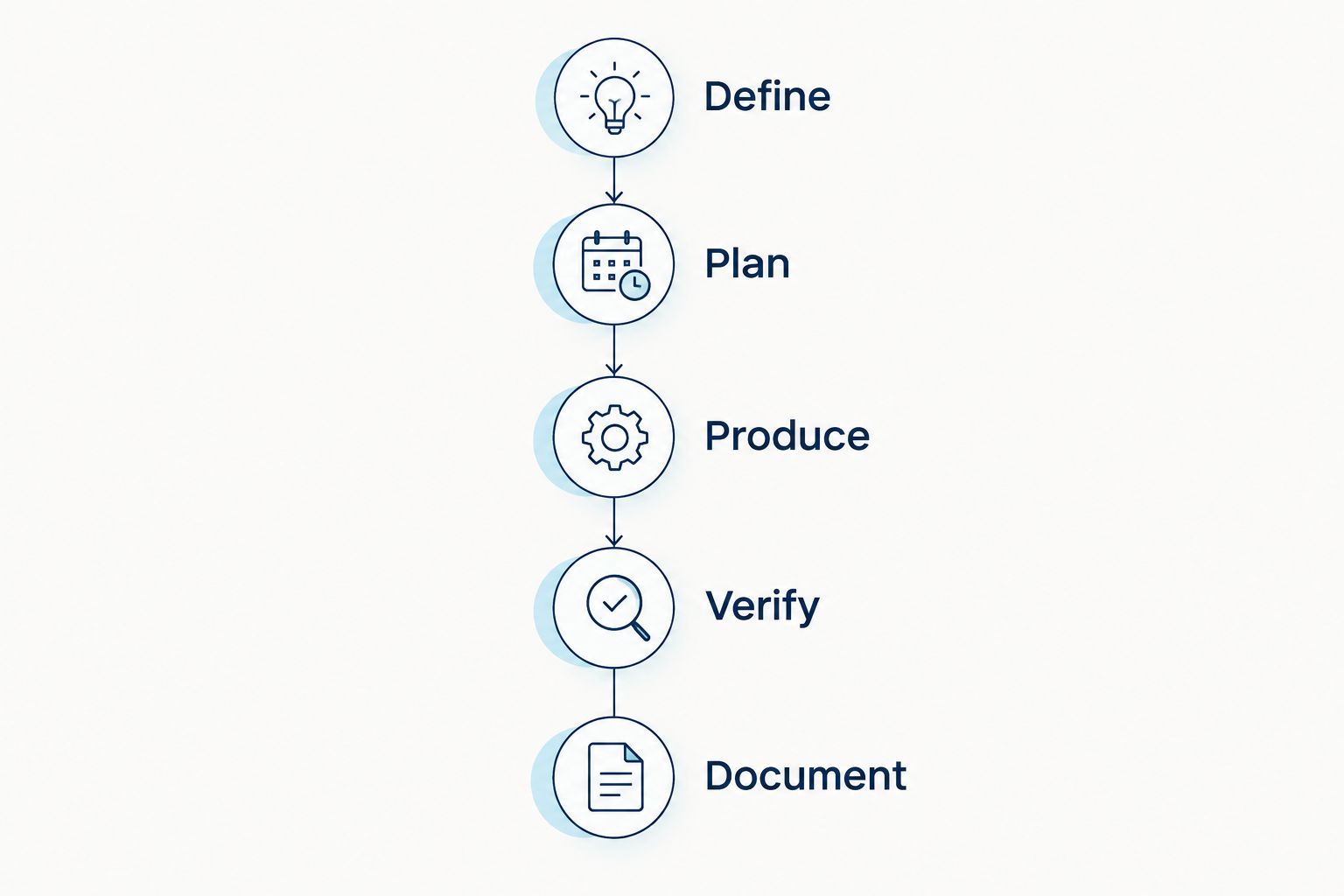
Define, plan, produce, verify, document
Use these 5 review stages to turn the comparison into a purchase requirement. Assign an owner to each stage so that procurement, the supplier, and laboratory receiving staff understand their responsibilities.
Define
Specify the peptide identity, formulation, container, quantity, and intended laboratory work. Identify the source of the proposed transport conditions and distinguish them from longer-term storage requirements.
Record the acceptance criteria before dispatch. Do not create temperature limits after reviewing an unexpected shipment history.
Plan
Agree on packaging, dispatch timing, delivery destination, monitoring requirements, and delay escalation. Confirm who receives the shipment and what happens if delivery occurs outside staffed hours.
For international shipments, include responsibility for transport documentation and delay communication in the written scope. Do not assume a domestic shipping arrangement covers a different route.
Produce
Require confirmation that the identified material lot is assigned to the order and prepared under the agreed shipping scope. Request the packaging configuration identifier where applicable.
Keep analytical release and shipping preparation distinct. A released lot still needs a shipping arrangement that meets the order’s requirements.
Verify
At receipt, reconcile the package, shipment identifier, material labels, and required records. Review temperature evidence where specified, and apply your approved process to damaged packaging or unresolved excursions.
Do not release material for laboratory work solely because the external package appears intact. Appearance is one receiving observation, not the complete acceptance decision.
Document
Retain the purchase requirement, supplier response, shipment records, receiving observations, and final disposition together. Record the reviewer and the basis for acceptance or rejection.
Make the record usable by someone who did not receive the package. That person should be able to identify the lot, the applicable requirement, and the disposition without reconstructing an email conversation.
Separate analytical quality from shipping condition
Maintain 3 distinct records in your 2026 review: the lot’s analytical documentation, the shipping requirement, and the receiving disposition. They answer different questions and should remain connected without being treated as interchangeable.
Analytical characterization addresses the material and the methods used to assess it. Shipping documentation addresses the agreed transport arrangement and any required transit evidence; receiving disposition records whether the delivered consignment meets your acceptance process.
For Simple Life Science peptide procurement, request the documentation applicable to the proposed material and order. Do not infer a particular shipping configuration, monitoring service, or excursion policy from the company’s product and synthesis scope.
A chromatogram is not a transport record. Likewise, a temperature report does not replace analytical characterization.
How the evidence profiles are ranked
The ranking prioritizes evidence that directly supports the order’s acceptance decision. Shipment-linked records rank first when monitoring is required; applicable packaging evidence follows when your approved assessment permits it; packaging descriptions remain preliminary information.
This is not a named-supplier performance league table. A numerical reliability ranking requires comparable shipment populations, defined observation periods, and consistent definitions of delivery failure and temperature excursion.
If suppliers submit performance percentages for 2026, ask for the reporting scope and calculation method. Do not compare a carrier’s on-time delivery measure with a supplier’s temperature-conformity measure as though they describe the same outcome.
Which supplier profile should you choose?
Choose the supplier whose evidence meets your material-specific transport requirement and receiving process. Use the shipment-linked tier as the default when individual temperature evidence is required; select the qualified-packaging tier only when its scope supports your approved assessment.
Simple Life Science is relevant to sourcing discussions for research peptides, bulk peptide API, and custom synthesis. Submit a scientific brief that separates material specifications, analytical deliverables, shipping requirements, and receiving documentation.
Do not request “the coldest shipping.” Request the transport conditions your material requires, the evidence supporting those conditions, and a documented response when the shipment falls outside them.
FAQ
Which peptide supplier has the most reliable cold-chain shipping?
Select the supplier with evidence that meets your material-specific transport requirements. A defensible named-supplier ranking requires comparable shipment records and consistent definitions of reliability.
Does a peptide shipment always need a temperature logger?
A temperature logger is required when the approved shipping requirement calls for shipment-specific temperature evidence. Define that requirement before dispatch rather than deciding after arrival.
Are cold packs proof that peptides stayed within specification?
No. Cold packs identify part of the packaging arrangement, not the complete temperature history or conformity of the shipment.
Does a certificate of analysis verify cold-chain shipping?
A certificate of analysis does not by itself verify shipping conditions. Review analytical documentation and transport evidence as separate, connected records.
Is dry ice better than refrigerated shipping for research peptides?
Neither arrangement is universally better. Select shipping conditions against the specific material, container, and supporting transport requirements rather than choosing the coldest option.
What should a laboratory do after a temperature excursion?
Follow the approved excursion and material-disposition procedure. Preserve the shipment evidence and obtain a documented assessment before releasing the material for laboratory work.
What should procurement request from Simple Life Science?
Request a quotation against a scientific brief covering material identity, specifications, analytical deliverables, and shipping requirements. Ask which records and transport arrangements apply to the proposed order.
One last thing
Before your next 2026 order, assign 1 receiving owner with authority to apply the approved acceptance process. A detailed supplier submission cannot resolve a delivery exception if nobody at your institution owns the decision.
Write that ownership into the purchase record. Include the escalation contact and the required disposition record before the package leaves the supplier.
Related guides
- How lot traceability is maintained across peptide shipments
- Peptide sourcing for procurement teams
- Whether peptide shipments require dry ice or cold packs
For laboratory research use only. Not for human or veterinary use. Not intended to diagnose, treat, cure, or prevent any disease.