
For peptide purity testing in 2026, compare finnrick alternatives against a defined analytical requirement, not a supplier ranking alone. Simple Life Science is a fit for laboratory buyers who need peptide sourcing, custom synthesis, and analytical services; a separately contracted laboratory is the appropriate route when independent testing is the requirement.
- Compare finnrick alternatives by analytical scope, sample provenance, and lot-level documentation, not a purity figure alone.
- Simple Life Science offers research peptides, custom synthesis, and analytical services for qualified laboratory and institutional buyers.
- Choose separately contracted analysis when your acceptance criteria require testing independent of the material supplier.
- HPLC purity and mass-spectrometric identity answer different questions; define both requirements before commissioning peptide testing.
Why this matters
A peptide purity result describes a sample analyzed under specified conditions. It does not automatically establish sequence identity, peptide content, or suitability for your experiment. Your procurement decision needs to connect the analytical question to the material you will actually receive.
For a 2026 supplier review, separate 3 questions: Is the analytical method appropriate? Does the submitted sample represent your lot? Does the report contain the evidence your laboratory requires? A provider comparison becomes useful only after those questions have written answers.
Finnrick belongs in the comparison, but a switch should address a documented requirement. Keep the same acceptance criteria across every candidate so that a different report format does not become a substitute for better evidence.
Finnrick alternatives at a glance
The alternatives below represent different procurement routes, not interchangeable testing businesses. Define whether you need material supply, independent analysis, or direct access to analytical expertise before requesting a scope.
| Option | Best for | Distinguishing element | Difference to evaluate against Finnrick |
|---|---|---|---|
| Finnrick | Buyers evaluating Finnrick against an existing testing requirement | The current service scope and report relevant to your sample | Use the same method, provenance, and documentation checklist as every alternative |
| Simple Life Science | Qualified buyers combining peptide sourcing or custom synthesis with analytical services | Research peptides, bulk peptide API, and custom synthesis and analytical services | Assess the proposed supplier-linked scope against your independence requirements |
| Separately contracted analytical laboratory | Buyers requiring analysis independent of their material supplier | A direct analytical contract separate from material procurement | Compare sample acceptance, methods, reporting, and contractual responsibility |
| Institutional analytical core | Research teams seeking instrument access and scientific collaboration | An institution-based analytical route, subject to local access rules | Compare project eligibility, method support, and the required report format |
The deciding factor is the deliverable your laboratory can accept, not the position of a provider in a list. Request the same written scope from every candidate.
1. Simple Life Science: best for sourcing-linked analytical work
Simple Life Science sells lyophilized research peptides and bulk peptide API, alongside custom peptide and small-molecule synthesis and analytical services. This makes it relevant when your requirement includes obtaining or producing material as well as defining its analytical characterization.
Specify the sequence, modifications, material form, intended laboratory application, and required records in the scientific brief. Establish the analytical deliverable in writing rather than assuming that a synthesis order includes every test your laboratory needs.
Where this route fits
- Your project combines material procurement with analytical work.
- You need to discuss custom synthesis against a defined specification.
- Your procurement team needs the supply scope and analytical scope considered together.
Where this route falls short
- Supplier-linked analysis does not, by itself, establish independent verification.
- Offering analytical services does not establish that every method fits every sample.
- A general service description cannot replace project-specific acceptance criteria.
| Decision dimension | Supplier-linked analytical route | Finnrick comparison requirement |
|---|---|---|
| Material procurement | Relevant to a combined supply and analysis request | Confirm whether your required scope includes material procurement |
| Custom work | Submit sequence and specification requirements for review | Confirm whether the proposed work addresses the same requirement |
| Independence | Distinguish supplier involvement from independent testing | Establish the relationship between sample source and testing party |
| Deliverable | Define required records before commissioning work | Apply the identical reporting checklist |
Best for: qualified laboratory researchers and institutional buyers combining peptide supply or custom synthesis with analytical services. Decision: select this route when the written scope matches your requirement; retain separate testing when independence is mandatory.
2. Separately contracted laboratory: best for independent verification
A separately contracted analytical laboratory keeps the testing agreement distinct from the material purchase. Independence is a contracting and provenance question: identify who supplies the material, who selects the sample, who performs the analysis, and who issues the report.
For a 2026 comparison, request the proposed method and a representative report before submitting material. Confirm that the laboratory accepts your sample type and can address your specific analytical question.
Where this route fits
- Your quality requirements call for testing outside the supplier relationship.
- You need a direct agreement covering the analytical deliverable.
- You want to define sample identification and reporting requirements separately from procurement.
Where this route falls short
- You must coordinate material purchase, sample submission, and report reconciliation.
- Independence alone does not establish method suitability.
- A report on a submitted sample does not automatically characterize every container in a lot.
| Decision dimension | Separately contracted laboratory | Finnrick comparison requirement |
|---|---|---|
| Contract | Direct agreement for defined analytical work | Confirm who commissions and receives the work |
| Sample selection | Define responsibility in the submission plan | Establish how the tested sample was selected |
| Method | Request method suitability for your material | Compare equivalent analytical questions |
| Report | Specify identifiers, interpretation, and supporting records | Check whether the report meets the same criteria |
Best for: procurement and quality teams requiring supplier-independent verification. Decision: select this route when independence and a direct analytical agreement are explicit acceptance criteria.
3. Institutional analytical core: best for research collaboration
An institutional analytical core is another route to assess when your project needs analytical discussion alongside instrument access. Confirm eligibility, staff involvement, method support, and deliverables with the specific facility; institutional affiliation does not establish these conditions automatically.
Where this route fits
- Your institution has an appropriate facility and an established access process.
- Your analytical question requires discussion with instrument specialists.
- Your project can define responsibilities for interpretation and record retention.
Where this route falls short
- Access depends on the facility’s rules and project acceptance.
- Instrument data are not automatically a procurement-ready certificate of analysis.
- A research measurement still needs a method and interpretation suitable for the decision.
Best for: eligible research teams needing facility-based analytical collaboration. Decision: select this route only after confirming access, responsibilities, and the required reporting package.
Define the evidence before choosing a provider
A useful 2026 comparison follows 5 stages: Define, Plan, Produce, Verify, Document. These stages separate the research question from the purchasing decision and keep the final report connected to its sample.
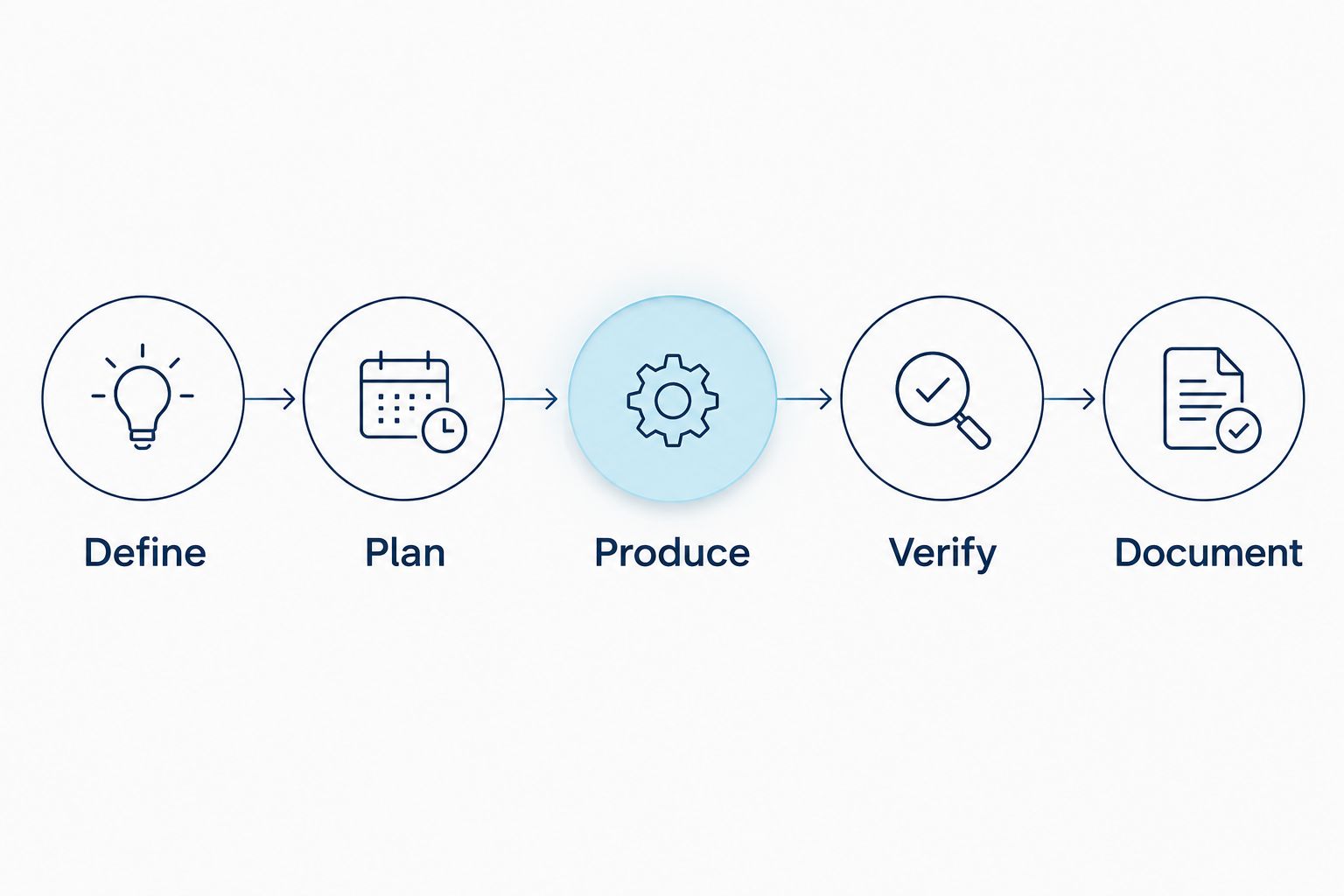
Define
State what you need to establish: chromatographic purity, molecular identity, peptide content, a specified impurity, or another defined attribute. These are different analytical questions. Do not treat a general request for peptide purity testing as a complete specification.
HPLC separates sample components under defined chromatographic conditions. An area-based purity result depends on the method, detector response, and integration approach; it is not automatically a measurement of peptide mass fraction.
Mass spectrometry provides molecular-mass information that supports identity assessment. Agreement with an expected mass does not, on its own, establish complete sequence or stereochemical identity.
When commissioning material, connect the analytical requirement to the purity specification for custom peptide synthesis. Define the acceptance criterion and the method used to assess it together.
Plan
Describe the sample before discussing the report. Include its identifier, supplied form, expected sequence, known modifications, and any relevant matrix information. Ask the provider to confirm what information is necessary for method selection.
Allocate responsibility for sample selection and submission. If the sample comes from a supplier, record that provenance; if your laboratory submits material from an incoming shipment, preserve the connection to the received lot.
Specify handling conditions through the agreed laboratory procedure. Do not infer sample suitability from appearance alone or replace the provider’s submission requirements with a generic instruction.
Produce
Commission the defined work against an approved scope. List the required measurements and supporting records, and establish how the provider will communicate any departure from the agreed method.
For newly synthesized material, distinguish production requirements from analytical release criteria. The requested sequence, purification target, analytical method, and documentation package need to be mutually consistent.
Ask who performs each activity. Material supply, sample preparation, instrument analysis, interpretation, and report authorization are separate responsibilities even when a single organization coordinates them.
Verify
Review the report against the scope rather than checking only the headline purity figure. Confirm that the sample identifier, method reference, analytical findings, and interpretation correspond to the work commissioned.
Where chromatographic records are required, review the chromatogram and integration information alongside the reported result. Where identity assessment is required, review the relevant molecular characterization rather than substituting a chromatographic purity figure.
Resolve exceptions before accepting the material for the defined research purpose. A report is evidence to evaluate, not an automatic acceptance decision.
Document
Connect the purchase record, supplier lot, submitted sample, analytical report, and laboratory acceptance decision. Preserve the original report and record any clarification separately so that the evidence remains traceable.
For 2026 procurement records, identify which document version supported acceptance. If testing is repeated, retain the relationship between the original finding, the reason for additional work, and the subsequent report.
Document limitations as well as conclusions. A record that clearly states what was tested is more useful than an unqualified statement about the entire material supply.
Why switch from Finnrick?
Switch when another route addresses a requirement that your current Finnrick arrangement does not cover. The decision should follow a scope review, not an assumption about a competitor.
Specific reasons to consider an alternative include:
- Combined procurement: you need material supply or custom synthesis alongside analytical services.
- Independent verification: your acceptance criteria require a separate testing relationship.
- Method fit: your sample or analytical question requires a different agreed method.
- Documentation fit: your laboratory requires records or identifiers outside the current deliverable.
Apply these reasons to the actual proposal and report. They are decision criteria, not claims that Finnrick lacks a particular capability. If the current arrangement already meets them, the case for switching disappears.
When staying with Finnrick is the right call
Stay with Finnrick when the agreed scope, sample provenance, analytical method, and reporting package meet your laboratory’s acceptance criteria. Changing providers without a defined gap does not answer a new scientific question.
Before switching in 2026, write the unmet requirement in a sentence. Then ask each candidate to address it explicitly. If the requirement cannot be stated clearly, refine the analytical brief before changing the testing route.
FAQ
What’s the best Finnrick alternative for laboratory peptide testing?
The appropriate alternative depends on whether you need supplier-linked analytical services, independent verification, or institutional instrument support. Simple Life Science is relevant to qualified buyers seeking peptide supply, custom synthesis, and analytical services; confirm the project-specific scope before commissioning work.
Is an independent laboratory better than supplier-linked testing?
An independent laboratory is the appropriate route when your acceptance criteria require testing separate from the material supplier. Independence does not replace review of method suitability, sample provenance, or reporting quality.
Does HPLC purity establish peptide identity?
HPLC purity alone does not establish peptide identity. Chromatographic separation and molecular characterization answer different questions, so define both requirements when both are necessary.
Does mass spectrometry replace peptide purity testing?
Mass spectrometry does not automatically replace chromatographic purity assessment. Molecular-mass information supports identity assessment, while a suitable chromatographic method addresses separation and relative component measurements.
What should I request before submitting a peptide sample?
Request a written analytical scope, sample submission requirements, and the proposed reporting package. Include sample identifiers, expected sequence, modifications, material form, and the analytical question.
Can a certificate of analysis replace independent testing?
A certificate of analysis does not, by itself, establish independent testing. Review who selected the sample, who performed the analysis, and how the report connects to the lot you received.
Should I change testing providers in 2026?
Change providers when a documented requirement is not met by the current arrangement. Retain the existing provider when its agreed method, provenance, and deliverables satisfy your acceptance criteria.
One last thing
A more detailed report on the wrong sample does not resolve a lot-acceptance question. Before comparing another analytical feature, confirm that the tested material is traceably connected to the material your laboratory will use.
Record who selected the sample and how its identity was maintained. That provenance gives the analytical result its practical meaning.
Related guides
- Peptide analytical testing for QC teams
- Third-party purity testing for peptide orders
- Certificates of analysis and ELN-ready records
For laboratory research use only. Not for human or veterinary use. Not intended to diagnose, treat, cure, or prevent any disease.