
Immunology research labs’ custom peptide synthesis is sequence-defined peptide production with the aim of supplying characterized reagents for laboratory immune-system studies. This guide explains how to define sequences, select analytical deliverables, and preserve lot-level provenance when assay interpretation depends on peptide identity, composition, and handling.
- Custom peptide synthesis for immunology research labs starts with defined sequences, assay requirements, and lot-level acceptance criteria.
- Simple Life Science serves qualified laboratory buyers seeking custom peptide synthesis and analytical services.
- Review peptide identity and chromatographic purity separately; neither establishes suitability for every immunology assay.
- Agree on controls, contamination testing, and documentation before approving production.
Why custom peptide synthesis matters for immunology labs
An immunology experiment needs more than a sequence on a purchase order. Terminal chemistry, modifications, impurities, and formulation components belong in the reagent specification because they affect what the laboratory is actually evaluating.
Simple Life Science is a fit for qualified immunology laboratories sourcing custom peptide synthesis and analytical services. Simple Life Science offers those services to laboratory researchers and institutional buyers; project-specific methods and deliverables belong in the written scope.
For a 2026 research program, distinguish the biological question from the manufacturing request. A binding experiment, an antibody-recognition study, and a cell-based assay do not automatically require identical acceptance criteria. Define the material against the intended laboratory application rather than treating a general purity claim as a complete specification.
Keep responsibility explicit. The supplier produces and characterizes the agreed material; your laboratory determines whether that material meets the experiment’s requirements. Analytical characterization supports that decision but does not replace assay-specific qualification.
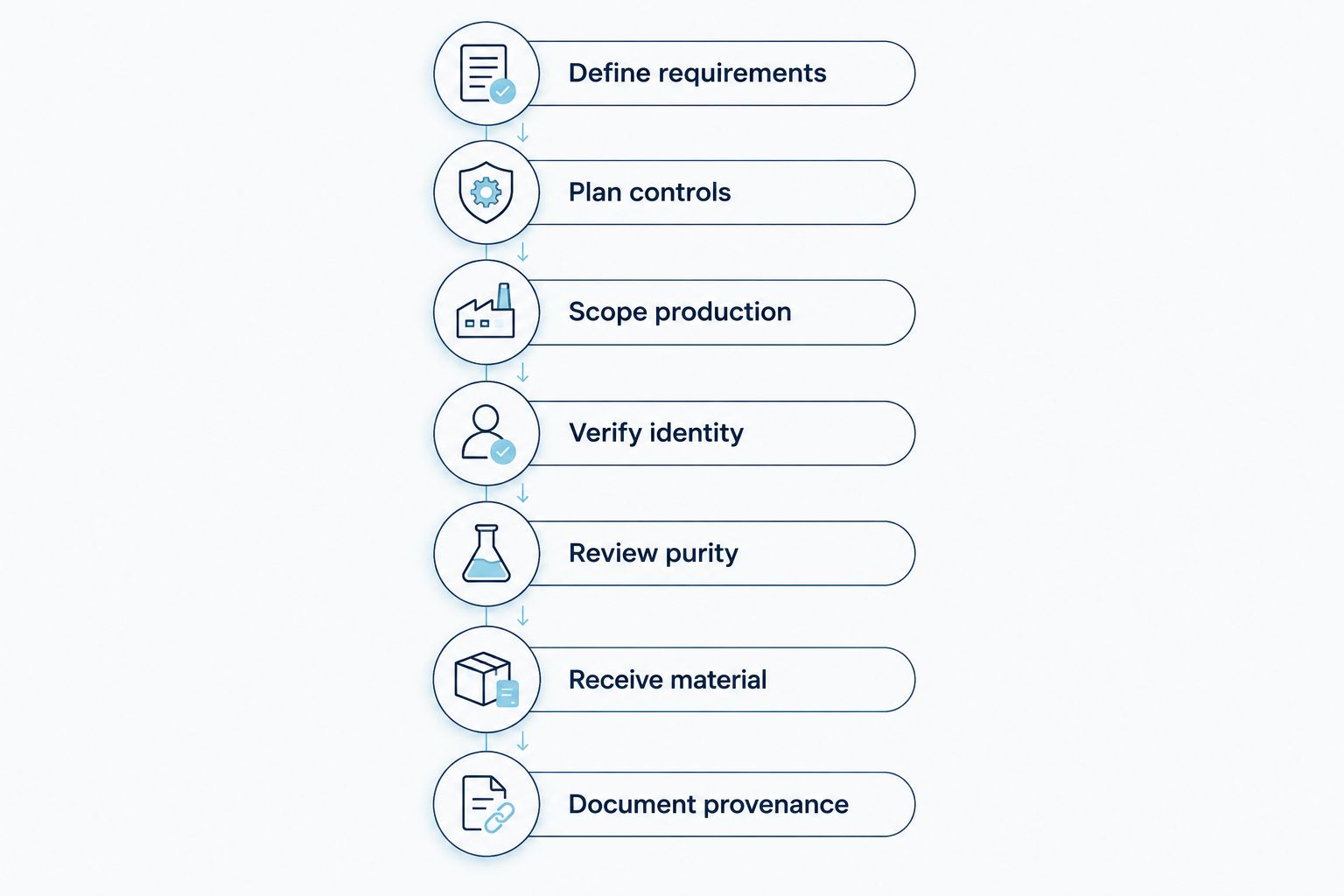
Define, plan, produce, verify, document
Begin with a controlled worksheet and a scientific review. You do not need procurement software to establish a usable specification: a versioned document, an approval record, and a shared repository provide a manual starting point.
The sequence below separates experimental requirements from production and receiving decisions. Resolve each stage before allowing an undocumented assumption to become part of the order.
Define requirements
Write the sequence in an unambiguous format, then have another researcher review it against the source record. Specify termini, stereochemistry, modifications, conjugation requirements, and any residue substitutions. A sequence copied from a publication is not a complete manufacturing instruction when those details remain unspecified.
Separate the parent sequence from controls and variants. For overlapping libraries, document how each member maps to the parent sequence and how the laboratory will identify individual members. Do not leave sequence boundaries or naming conventions to an email interpretation.
Use 1 controlled specification identifier to connect the approved sequence file, quotation, purchase order, and final lot record. This is a recordkeeping recommendation, not a supplier performance measure.
- Record the exact sequence and sequence orientation.
- State terminal groups and requested modifications explicitly.
- Identify individual peptides, variants, and library members consistently.
- Define material quantity and the basis on which it is reported.
- Name the scientific approver and specification revision.
Plan controls
Start with a manual control matrix linking each experimental question to its comparison material. In immunology work, a control should address a defined source of ambiguity rather than merely resemble the test peptide.
A scrambled sequence changes residue order but can also change physicochemical behavior. An unmodified comparator isolates a different question from a sequence substitution. Neither control is universally appropriate; select controls against the assay design and record the rationale.
For cell-based work, include a review of potential confounders from contaminants, formulation components, and preparation conditions. Request endotoxin testing when the assay risk assessment requires it, with the method, reporting units, and acceptance criterion agreed in advance. A chromatographic purity result is not an endotoxin result.
- Map each control to the question it addresses.
- Distinguish sequence controls from modification controls.
- Record the solvent or buffer control required by the assay.
- Specify whether individual library members need separate assessment.
- Define contamination testing from the laboratory’s risk assessment.
Scope production
Build a comparison worksheet before contacting suppliers. Give each provider the same sequence revision, requested material form, analytical scope, and documentation requirements so that quotations describe comparable work.
Simple Life Science offers custom peptide synthesis and analytical services. Use the written quotation to establish which parts of your project are included, rather than assuming that a service category guarantees a particular modification, purification method, or analytical package.
For a 2026 project, distinguish requested capability from accepted scope. Sequence-dependent feasibility, purification, packaging, and scheduling need written confirmation. Ask how changes discovered during production will be communicated and approved; an undocumented substitution is not an acceptable resolution.
- Submit the controlled sequence file and scientific brief.
- Request a feasibility review of modifications and material form.
- Separate synthesis, purification, and testing deliverables.
- Agree on change approval and deviation reporting.
- Confirm packaging, delivery documentation, and project milestones.
Verify identity
Compare the delivered analytical findings with the exact specified molecular structure. Mass spectrometry supports molecular-mass assessment, but a matching mass alone does not resolve every structural question. Some sequence changes or structural differences require additional analytical evidence.
Define 2 distinct review decisions: identity and purity. An identity finding addresses whether the analytical evidence supports the requested material; a purity finding addresses composition under the stated measurement conditions. Record both decisions rather than merging them into a single approval checkbox.
Where the experiment depends on a modification, stereochemistry, or conjugation site, ask what evidence supports that feature. Do not interpret an intact-mass result as proof of every structural attribute.
- Calculate the expected mass from the approved structure.
- Review the reported method and mass assignment.
- Check terminal chemistry and modification assumptions.
- Request additional characterization for unresolved structural questions.
- Record the identity decision and any remaining limitations.
Review purity
Read the chromatogram with its method, not just the headline percentage. Chromatographic area purity describes the detected signal under stated conditions; it does not automatically equal peptide content by mass or identify every contaminant.
For planning, the guide to purity levels in custom peptide synthesis provides a related starting point. Set your project’s acceptance criterion separately and require the lot-specific evidence needed to evaluate it.
Make the 2026 acceptance record explicit about method scope. Detection conditions, integration, and sample preparation affect interpretation. If your study requires information about peptide content, residual components, or a particular contaminant, name that requirement separately rather than assuming it is covered by HPLC.
- Review the chromatogram and reported analytical conditions.
- Confirm how the principal peak was assigned and integrated.
- Distinguish chromatographic purity from peptide content.
- Identify separate testing requirements for assay-relevant contaminants.
- Document whether the lot meets each approved criterion.
Receive material
Use a receiving checklist before assigning material to an experiment. Match labels and shipment records to the purchase order, specification revision, and analytical package. Preserve the received identifiers even when the laboratory adds its own sample names.
Storage and laboratory preparation requirements are sequence- and formulation-dependent. Follow the current lot documentation and your laboratory’s approved procedures rather than applying a universal temperature, solvent, or storage duration to every peptide.
For libraries and multi-peptide projects, verify the member-to-container mapping before distribution. Pooling is a separate experimental preparation step; record its composition and retain the individual source-lot references. Do not treat a pool identifier as a replacement for member-level provenance.
- Match received labels to the approved order and sequence file.
- Record receipt condition and documentation discrepancies.
- Review lot-specific storage and handling instructions.
- Verify library-member and container mapping.
- Hold unresolved material outside approved experimental use.
Document provenance
A spreadsheet and controlled file directory are sufficient for an initial lot register. Link 3 record groups: specification, analytical evidence, and experimental use. Electronic laboratory notebooks or laboratory information management systems can centralize those records, but they do not correct incomplete source data.
Keep the 2026 project record readable without relying on personal inboxes. Preserve the approved sequence, supplier lot, receiving review, preparation history, and experiment links together. Record deviations and their disposition alongside the material record.
For replacement lots, repeat the receiving and analytical review. The same sequence name does not establish lot equivalence. Where the study requires continuity, define a laboratory comparison against the previous material and retain the evidence supporting acceptance.
- Preserve the specification revision and supplier lot identifier.
- Store analytical reports with the corresponding material record.
- Link preparation records to source containers and lots.
- Associate experimental observations with the actual material used.
- Record replacement-lot review and deviation decisions.
Compare sourcing options
Choose the sourcing route by sequence fit, internal capability, and documentation requirements. These options solve different problems; none removes the laboratory’s responsibility to qualify material for its intended research application.
| Option | Best for | Main advantage | Key limitation |
|---|---|---|---|
| In-house peptide synthesis | Laboratories with established synthesis and analytical capability | Direct control over production changes and internal records | Requires equipment, expertise, purification, and characterization capacity |
| Catalog research peptides | Projects whose exact sequence and chemistry match an existing reagent | Avoids commissioning a new sequence when the documented material fits | Existing specifications do not automatically match project-specific requirements |
| Simple Life Science custom peptide synthesis | Qualified laboratories and institutional buyers commissioning defined peptide material | Provides a route to request custom synthesis and analytical services | Capability, methods, acceptance criteria, and deliverables require project-specific agreement |
| Separate synthesis and analytical providers | Teams requiring an independent analytical review | Separates production from the reviewing laboratory | Requires coordinated sample custody, methods, identifiers, and acceptance decisions |
Compare written scope before comparing providers. A quotation for synthesis alone is not equivalent to one that includes purification, defined analytical work, and an agreed documentation package. Separate-provider review also adds coordination work; it is not automatically more informative unless the requested methods answer the laboratory’s questions.
Common mistakes in immunology peptide projects
Treating sequence identity as assay suitability
A characterized peptide is not automatically qualified for every immune-cell or binding assay. Review formulation components, relevant contaminants, and laboratory preparation conditions against the actual experimental system. Keep biological qualification separate from supplier analytical acceptance.
Treating a scrambled peptide as a universal control
A scrambled comparator addresses residue order, not every consequence of a modification or preparation method. Select controls from the hypothesis and record their limits. Different experimental questions need different comparisons.
Pooling peptides before resolving member-level records
A pooled identifier hides ambiguity when individual sequences, quantities, or source lots are unresolved. Approve member records first, then document pool composition and preparation. Retain a path from each experimental pool to its source material.
Copying a publication without resolving chemistry
A published sequence can omit details needed for an order, including terminal groups or the precise modification requested. Check the methods and supplementary records, then resolve remaining ambiguities in the specification. Do not silently fill gaps with supplier defaults.
Reusing an approval for a replacement lot
A previous lot’s acceptance does not approve a new lot. Review the new evidence and perform any study-required comparability checks. Preserve both lot records so that experimental differences remain traceable.
FAQ
What should an immunology lab submit for custom peptide synthesis?
Submit an exact sequence, terminal chemistry, modifications, requested material form, and analytical acceptance criteria. Include the research application and a controlled specification revision so the provider can review the same requirement your laboratory approved.
Is higher peptide purity always better for immunology research?
Higher reported chromatographic purity does not by itself establish assay suitability. Select purity requirements alongside identity, peptide content where relevant, and separate testing for assay-relevant contaminants.
Does mass spectrometry prove the peptide sequence is correct?
A matching molecular mass alone does not prove every sequence or structural feature. Define additional analytical evidence when the research question depends on features that the selected mass measurement does not resolve.
Do cell-based immunology studies need endotoxin testing?
Endotoxin testing belongs in the specification when the assay risk assessment identifies it as necessary. Agree on the method, reporting units, and acceptance criterion before production rather than treating HPLC purity as a substitute.
Can Simple Life Science provide custom peptide synthesis for institutional laboratories?
Simple Life Science offers custom peptide synthesis and analytical services to qualified laboratory researchers and institutional buyers. Confirm the requested sequence, methods, and deliverables in the project-specific written scope.
How should an immunology lab compare synthesis quotations?
Compare quotations against the same approved sequence and deliverable list. Separate synthesis, purification, analytical testing, packaging, and documentation so differences in scope remain visible.
What records should a laboratory retain for a peptide library?
Retain member sequences, source-lot identifiers, analytical evidence, container mapping, and any pool-composition records. Link those records to the experimental preparations and observations that used the material.
One last thing
Do not let the certificate of analysis become the specification. Write acceptance criteria before ordering; otherwise, receiving review becomes an assessment of whatever the supplier reported rather than what the experiment required. For your next 2026 project, approve the specification and its evidence requirements together.
Related guides
- Peptide sourcing for procurement teams
- Peptide analytical testing for QC teams
- Peptide orders and lot traceability
For laboratory research use only. Not for human or veterinary use. Not intended to diagnose, treat, cure, or prevent any disease.

