
Instead of manually translating each bulk peptide API order into a production plan, configure an approval-gated MRP workflow that carries the research specification, quantity basis, and documentation requirements into a reviewed scheduling request. Keep material planning separate from production authorization: an order event must not bypass scientific review or lot acceptance.
- Bulk peptide api mrp integration should convert approved research orders into traceable planning requests, not unrestricted production releases.
- Simple Life Science supplies bulk peptide API to qualified laboratory researchers and institutional buyers; define requirements in writing.
- Link each order line to its specification revision, quantity basis, planning record, and lot-level documentation.
- Use MRP for material requirements, then apply capacity review and analytical acceptance gates before releasing work.
Why this matters
A purchase order describes demand. It does not, by itself, define an executable peptide production run. Sequence identity, material form, analytical requirements, packaging, and acceptance criteria belong in the approved research specification rather than in assumptions made by an integration.
For your 2026 implementation, make the integration a controlled handoff between procurement, scientific review, planning, and quality review. The peptide sourcing guide for procurement teams supports the upstream sourcing discussion; this workflow addresses how approved requirements become planning records.
Simple Life Science is a sourcing option for qualified research buyers seeking bulk peptide API and custom synthesis services. Its stated offering establishes the sourcing category, not a software connection or access to supplier production schedules. Keep the technical interface and supplier commitments inside the written project scope.
Before you start
- Access and ownership: Obtain authorized access to your procurement system, MRP environment, controlled document repository, and test environment. Assign owners for mapping, scientific approval, scheduling, and analytical acceptance.
- Approved research requirements: Prepare the material identifier, sequence or structure reference, specification revision, ordered quantity and unit, required analytical deliverables, packaging requirements, and requested delivery date. Identify which requirements need supplier confirmation.
- The quantity-basis gotcha: Define whether quantity means supplied material mass, peptide content, or another explicitly agreed basis. Chromatographic purity alone does not establish peptide content; do not use a purity percentage as an automatic mass-conversion factor.
The steps below define a system-neutral configuration. Field names are proposed mapping labels, not verified interface labels in a particular application. Map them to your actual schema and use documented import, export, or interface capabilities; do not assume a native connector exists.
Define: approved order trigger
Start with a trigger that represents an approved requirement, not merely a newly created purchasing record. A draft order can change before scientific review is complete, and an accepted commercial order does not necessarily authorize production.
- Identify the source event that your system exposes for an approved order line. If no event interface exists, use a controlled export of approved records and record the export reference.
- Define the eligibility rule. Require an approved specification revision, a recognized material identifier, a defined quantity basis, and an assigned scientific reviewer before creating a planning request.
- Build a stable request key from the source system, order identifier, line identifier, and approved revision. Preserve that key throughout the workflow so repeated messages do not create additional requests.
- Attach the specification reference and approval record. Transfer controlled document identifiers or repository references rather than copying uncontrolled attachments into multiple systems.
- Route incomplete records to an exception queue with a named owner and a reason. Do not substitute default purity, packaging, or analytical requirements to make the import pass.
Expected result: One approved order line produces one identifiable planning request, while incomplete or unapproved records remain outside the scheduling queue.
For the 2026 baseline, document the trigger rule and its owner alongside the mapping. A future configuration change should leave a record of which rule version processed each request.
Choose the transfer mechanism
Use the simplest mechanism your systems support and your team can monitor. Neither approach removes the need for approval controls, revision handling, or reconciliation.
| Transfer option | Best for | Advantage | Limitation | Required control |
|---|---|---|---|---|
| Controlled file import | Teams with supported exports and imports but no approved event interface | Creates a reviewable transfer artifact | Records remain pending until the next controlled import | File identity, validation report, and import reconciliation |
| Event-driven interface | Teams with documented event access and an accountable integration owner | Transfers approved changes without a separate export task | Retries and event ordering require explicit handling | Stable request key, revision check, and processing log |
Do not select event-driven transfer simply because it is more automated. Select it when your team can identify failures, replay records safely, and distinguish an amended order from a duplicate message.
Plan: material and capacity configuration
MRP calculates material requirements from demand and planning parameters. A capacity-feasible production schedule also requires resource constraints and scheduling rules; do not treat an MRP output as proof that a synthesis or analytical slot is confirmed.
- Map the approved research requirement to an item or project record. Preserve distinctions that matter to the specification, including sequence, modifications, material form, and revision.
- Map the ordered quantity and its unit without changing the agreed basis. Allow conversions only through a documented rule reviewed by the responsible technical owner.
- Associate the applicable bill of materials and routing where your production model uses them. For custom synthesis, route an unestablished process to feasibility review rather than assigning a generic recipe.
- Set planning parameters from authorized internal records or written supplier commitments. Do not populate lead times, process yields, or analytical durations from undocumented estimates.
- Pass the proposed work through capacity review. Include synthesis, purification, analytical characterization, and packaging activities when they are part of the approved scope.
- Record the requested date separately from the reviewed production date. Return a schedule exception when the requested date conflicts with the approved process or resource plan.
Expected result: The planning record identifies the required material and process, while the scheduling record shows a reviewed date and responsible planning owner.
For externally sourced bulk peptide API, your institution normally controls its purchasing and downstream laboratory plan, not the supplier's internal production schedule. Record a supplier-confirmed milestone only when it has been provided. Do not represent a purchasing record as authority to start a supplier manufacturing run.
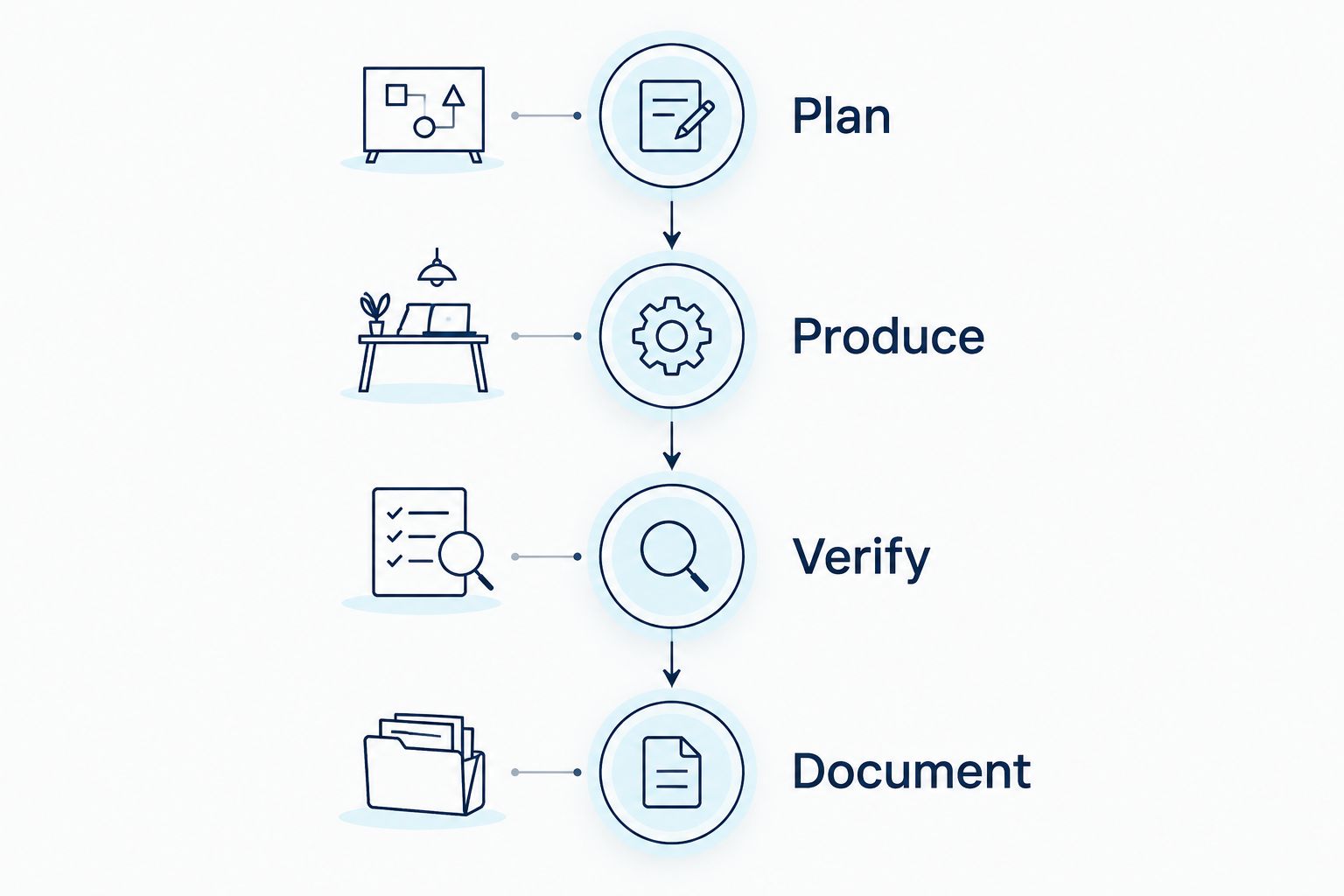
Separate the production stages
Use the following stages as a proposed control model for the 2026 workflow. Adapt the stage names to your approved procedures, but retain the distinction between planning, production, analytical review, and documentation.
- Plan: Establish the material requirements and capacity-reviewed work request.
- Produce: Authorize execution against the approved specification and process record.
- Verify: Review analytical deliverables against the written acceptance criteria.
- Document: Associate the accepted material with its controlled lot records.
Verify: release gates and exception handling
Configure explicit gates before authorizing work. These are proposed controls for your implementation, not claims about a supplier's internal quality system.
- Define a scientific gate that checks the specification revision, sequence or structure reference, analytical scope, and quantity basis. Require a named reviewer to resolve discrepancies.
- Define a planning gate that checks the applicable process record, material requirements, resource review, and agreed milestone. Keep unresolved scheduling conflicts visible.
- Define production authorization separately from technical feasibility. A feasible project still needs approval under your organization's purchasing and production controls.
- Define analytical acceptance against written criteria. Associate each measurement with its method and record; do not treat an HPLC purity value as a complete identity or content assessment.
- Keep analytical acceptance separate from physical receipt. Receiving a package establishes receipt, not acceptance of its contents for the intended laboratory work.
- Assign exception routes for specification conflicts, incomplete documentation, and failed acceptance criteria. Preserve the original record and the disposition rather than overwriting the failed state.
Expected result: Each request shows which gate it has passed, who approved it, and which unresolved condition prevents the next action.
Use the approved specification as the release reference, not the newest attachment in an email thread. A revised document must enter the controlled workflow before it can change production or acceptance requirements.
For Simple Life Science bulk peptide API procurement, ask for the documentation and analytical scope required by your institution in the written request. Confirm those deliverables through the purchasing process; the presence of a service category does not establish project-specific methods or acceptance criteria.
Document: reconciliation and test evidence
The final configuration unit connects the planning request to its execution and lot records. Keep these relationships explicit even when separate systems own purchasing, scheduling, and analytical review.
- Store the source order key, approved revision, planning request identifier, work reference, and lot identifier as linked records. Assign the lot identifier when it is established; never manufacture one from the order number.
- Record state changes with their timestamp, actor or service identity, and reason. Preserve superseded revisions so reviewers can reconstruct which requirement governed the work.
- Reconcile approved source records against imported planning requests. Distinguish records that were processed, rejected, held, or superseded instead of comparing only aggregate totals.
- Link analytical records and the certificate of analysis, where required by the written scope, to the applicable lot. Check that identifiers agree across documents.
- Complete the acceptance tests below before enabling production authorization through the integration.
Expected result: A reviewer can trace an approved order line through planning, authorization, analytical review, and the associated lot documentation without relying on an email search.
Recommended acceptance tests
These are proposed test cases, not performance claims or supplier commitments. Retain the test records with your 2026 configuration evidence.
- 1 order line: Submit an approved line and verify that it creates exactly one planning request linked to the correct specification.
- 2 identical events: Submit the same event twice and verify that the second attempt does not create another request.
- 1 revision change: Amend the approved requirement and verify that the prior planning state remains traceable while the amendment enters review.
- 1 blocked record: Remove a required specification reference and verify that the request stops before scheduling authorization.
- 1 documentation mismatch: Associate a document with a different lot identifier and verify that analytical acceptance remains blocked.
Variant: replan when an approved order changes
An amendment workflow is distinct from initial order intake. Configure it to identify changes that affect the scientific scope, required quantity, packaging, analytical deliverables, or requested date.
- Compare the incoming approved revision with the revision already linked to the planning request. Reject stale updates without erasing their processing record.
- Determine whether production authorization has occurred. Before authorization, route the revised requirements through the applicable review gates.
- After authorization, open a controlled change assessment. Do not silently replace the specification governing work already in progress.
- Review effects on materials, capacity, analytical scope, and downstream research requirements. Record the disposition and responsible approver.
- Publish the reviewed schedule and revision status back to the purchasing record through a supported interface or controlled reconciliation.
Expected result: An amendment produces a reviewed change record, not a second unrelated production request or an undocumented overwrite.
In the 2026 amendment workflow, separate an order cancellation request from confirmation that work has stopped. The cancellation event is an instruction to review and act; it is not evidence of the production disposition.
Troubleshooting
Duplicate planning requests appear
Check whether retries receive a new request key. Use the stable source order, line, and revision key, and check for an existing request before creating another. Replay the duplicate-event acceptance test after changing the mapping.
Quantities disagree between purchasing and planning
Inspect the unit and quantity basis before investigating rounding. Correct the conversion rule or source specification through approval; do not multiply by chromatographic purity to infer peptide content.
A proposed run has no executable resource slot
Check whether the integration has created a material plan without capacity review. Route the request to the scheduling owner and keep production authorization blocked until the required resource plan is reviewed.
A revision replaces requirements for work already authorized
Check whether the amendment handler updates records without examining authorization state. Restore the traceable governing revision and route the new requirements through controlled change assessment.
Analytical documents do not match the received lot
Compare the document's lot identifier, material identity, and applicable specification with the receiving record. Request corrected documentation or a reviewed disposition; renaming the attachment does not resolve the mismatch.
Customize your workflow
Extend the workflow by connecting analytical acceptance to controlled research records. The quality documentation to QC records workflow addresses the documentation handoff beyond scheduling.
For a Simple Life Science research sourcing project, submit the scientific brief and required deliverables before agreeing on the interface handoff. Keep integration responsibilities, document formats, and milestone ownership explicit. A procurement workflow should reflect the agreed scope, not imply capabilities that have not been confirmed.
FAQ
What is bulk peptide API MRP integration?
Bulk peptide API MRP integration transfers approved research order requirements into material planning records. A controlled workflow preserves specification revisions, quantity basis, authorization gates, and links to lot documentation.
Can an MRP system automatically schedule a peptide production run?
MRP alone does not establish a capacity-feasible production schedule. Your workflow also needs reviewed resource constraints, an applicable process record, and separate production authorization.
Does Simple Life Science have a native MRP connector?
Confirm any proposed connector directly with Simple Life Science before designing around it. A bulk peptide API offering does not establish a supported software interface or access to supplier production schedules.
What documents should an approved bulk peptide order reference?
Reference the approved research specification, quantity basis, analytical scope, and purchasing approval. Link subsequent lot-level documents to the actual lot identifier rather than treating the purchase order as a lot record.
Can HPLC purity convert an order quantity into peptide content?
HPLC purity alone does not establish peptide content. Use the agreed quantity basis and an approved measurement or conversion rule appropriate to the specification.
What happens when the approved peptide specification changes?
An approved specification change should enter revision review and, where applicable, controlled change assessment. Preserve the previous governing revision and review the effect on authorized work before updating the plan.
How should a research institution test this workflow?
Test approved intake, duplicate messages, revision changes, blocked records, and lot-document mismatches. Retain the expected result, actual result, and reviewer disposition before enabling production authorization.
One last thing
Test the record that must not advance. A successful import proves only that data moved; a deliberately blocked request shows whether the workflow protects the research requirement. Include that test whenever you revise the integration's approval rules.
Related guides
- Custom synthesis specifications to an R&D pipeline
- Peptide orders to LIMS-ready lot records
- Bulk peptide API synthesized to a specific purity specification
For laboratory research use only. Not for human or veterinary use. Not intended to diagnose, treat, cure, or prevent any disease.

