
Simple Life Science redactó esta comparación. We list a small-molecule design and custom synthesis service, so we are one of the options here. Below is how we compared, what each company publishes about itself, and when another provider is likely a better fit than us.
Facts about other companies come only from their own public web pages, checked Nov 21, 2026. We did not test their work, and we make no claims about their quality or reliability. Confirm current scope and terms with each company before you commit.
For agrochemical R&D, the right synthesis partner depends on the job: a focused analog set, a hard-to-make target, or repeat material for ongoing studies. Selcia, Syngene and Key Organics each publish agrochemical or crop-science chemistry work. Simple Life Science offers a scoped, quote-only custom synthesis service for research buyers, but our own service page says it is not current in-house chemistry or cGMP manufacture, so teams that need a dedicated crop-science chemistry group should look at the others first.
- Crop-science discovery chemistry (single compounds, small screening arrays, hit-to-lead, lead optimization): Selcia, part of Eurofins.
- Integrated discovery and development, including process work, formulation, 5-batch analysis and OECD/OPPTS acute tox packages: Syngene.
- Fee-for-service custom synthesis, gram-to-kilogram process work and analytical services in the UK: Key Organics.
- A small, written-scope research synthesis brief with a US research supplier, after feasibility and safety review: Simple Life Science.
- None of the four publishes a price list for this work. Get quotes against the same written brief.
Cómo comparamos
We read what each company publishes on its own site about agrochemical or crop-science chemistry: services offered, scale, analytical support, quality certifications and how pricing works. We wrote down only what each page says, and the table notes when something is not published. We did not commission work from any of them, and the order below is not a ranking.
Use the same checks for every provider:
- Defined chemical identity: connectivity, stereochemistry, salt or neutral form, and reference identifiers.
- Route feasibility: a route rationale, the hard steps, and how failed work gets reported.
- Analytical fit: methods matched to the structural questions and impurities that matter to your study.
- Lot documentation: COA, supporting data, batch numbers and provenance records.
- Project control: sign-off points for substitutions, route changes, extra testing and deviations.
- Transferability: who owns and receives the route, methods and records for the next stage.
The four options side by side (checked Nov 21, 2026)
| Simple Life Science (us) | Selcia (Eurofins) | Syngene | Key Organics | |
|---|---|---|---|---|
| Agrochemical focus on its own site | General research synthesis; not agrochemical-specific | Dedicated crop-science discovery chemistry page | Agrochemical listed as an industry served, with collaborations with global and Indian agrochemical companies | Lists analytical services for the agrochemical industry; custom synthesis is fee-for-service |
| Published price | Quote only, scoped after feasibility review | Not published; contact | Not published | Not published; enquiry form |
| Services listed | Building-block and analog design, route scouting, custom synthesis, reference or impurity standards, analytical package by scope | Single compounds and small screening arrays, hit-to-lead, lead optimization, natural-product chemistry | Discovery chemistry and biology, process development, formulation, analytical R&D, 5-batch analysis, OECD/OPPTS six-pack acute tox | Custom synthesis, process development and scale-up, fragment services, compound procurement, analytical services |
| Escala | Set per project; subject to feasibility | Not stated on the page | Not stated on the industries page | Gram to kilogram for process work |
| Analytics | LC-MS, NMR or HPLC package chosen per project | Analytical and separation sciences listed | Analytical R&D listed | Analytical services listed |
| Quality and status | Research use only. Our page says this is a proposed service category, not current in-house chemistry or cGMP manufacture | Part of Eurofins | Over 300 clients, per its site | ISO 9001:2015, per its site |
Sources, checked Nov 21, 2026: Simple Life Science small-molecule service; Selcia crop-science discovery chemistry; Syngene industries; Key Organics services.
Simple Life Science (somos nosotros)
Our small-molecule design and custom synthesis page covers target briefs, analog or building-block design, route scouting, custom synthesis, purification and an analytical package (LC-MS, NMR or HPLC, chosen per project). It is quote only and scoped after feasibility review. The same page says plainly that it is a proposed service category, not current in-house chemistry, cGMP manufacture, regulatory support or guaranteed freedom to operate, and that every project needs feasibility, safety, quality and legal review.
Dónde encaja: a research team with a defined structure and a small, written-scope synthesis or reference-standard request.
Strengths
- Every project starts with a written scope: feasibility, milestones, acceptance criteria and deliverables.
- Deliverables are listed up front: route memo, approved spec, material, analytical package and final report.
- US research supplier with one contact for scope and documents.
Limits
- Not agrochemical-specific and not in-house chemistry today, per our own page.
- No cGMP manufacture and no regulatory support.
- No published price; every project needs a quote.
- Projects can be declined after feasibility, safety or legal review.
Elíjala si: your request is small and well defined, and you want a US research supplier to manage the scope and paperwork.
Selcia (part of Eurofins)
Selcia’s crop-science discovery chemistry page (checked Nov 21, 2026) lists synthesis of single compounds and small arrays for screening, hit-to-lead and lead optimization for agrochemical discovery programs. It says its team works on selectivity, systemicity, physicochemical properties and patentability, and has natural-product chemistry experience. The page notes Selcia is now part of Eurofins.
Dónde encaja: agrochemical discovery programs that need synthesis tied to screening results.
Strengths
- A dedicated crop-science discovery chemistry offering.
- Covers the path from screening compounds to lead optimization.
- Lists experience reading screening data and environmental fate issues.
Limits
- No published price, scale or turnaround on the page.
- Discovery work is not the same as repeat production; plan process work separately.
Elíjala si: you are running an agrochemical discovery program and want chemists who work in crop science.
Syngene
Syngene’s industries page (checked Nov 21, 2026) lists agrochemicals as a sector it serves, with collaborations with global and Indian agrochemical companies. It lists discovery chemistry and biology, process development, formulation development, analytical R&D, phys-chem, 5-batch analysis and six-pack acute tox packages run to OECD/OPPTS (EPA) guidelines.
Dónde encaja: programs that need discovery and development work in one place, including studies that feed later regulatory packages.
Strengths
- Integrated discovery-to-development offering for agrochemicals.
- Lists 5-batch analysis and acute tox packages on the same page.
- Says it serves over 300 clients globally.
Limits
- No published price or scale on the industries page.
- A large integrated program may be more than a small one-off synthesis request needs.
Elíjala si: you want one partner for discovery chemistry, process work and development studies.
Key Organics
Key Organics’ services page (checked Nov 21, 2026) lists fee-for-service custom synthesis, process development and scale-up from gram to kilogram, fragment services, compound procurement and analytical services for the pharmaceutical, agrochemical, petrochemical and allied industries. It lists ISO 9001:2015 accreditation and a BIONET research compound catalogue.
Dónde encaja: custom synthesis that may need to move from grams to kilograms, with analytical support.
Strengths
- Published gram-to-kilogram process development.
- ISO 9001:2015 quality management, per its site.
- Catalogue compounds plus custom work from the same company.
Limits
- No published price; pricing is by enquiry.
- Its services page is general rather than crop-science specific.
Elíjala si: you need custom synthesis plus a scale-up route under one fee-for-service agreement.
Who should choose someone other than us
Based on what each company publishes, checked Nov 21, 2026:
- You need chemists with crop-science discovery experience. Selcia has a dedicated crop-science discovery chemistry offering. Ours is not agrochemical-specific.
- You need development studies too, such as 5-batch analysis, formulation or acute tox packages. Syngene lists these. We do not offer them.
- You need gram-to-kilogram scale-up. Key Organics publishes gram-to-kilogram process development. Our scale is set per project and subject to feasibility.
- You need cGMP material or regulatory support. Our page says we offer neither.
- You need a provider with in-house chemistry today. Our own page says this service is a proposed category, not current in-house chemistry.
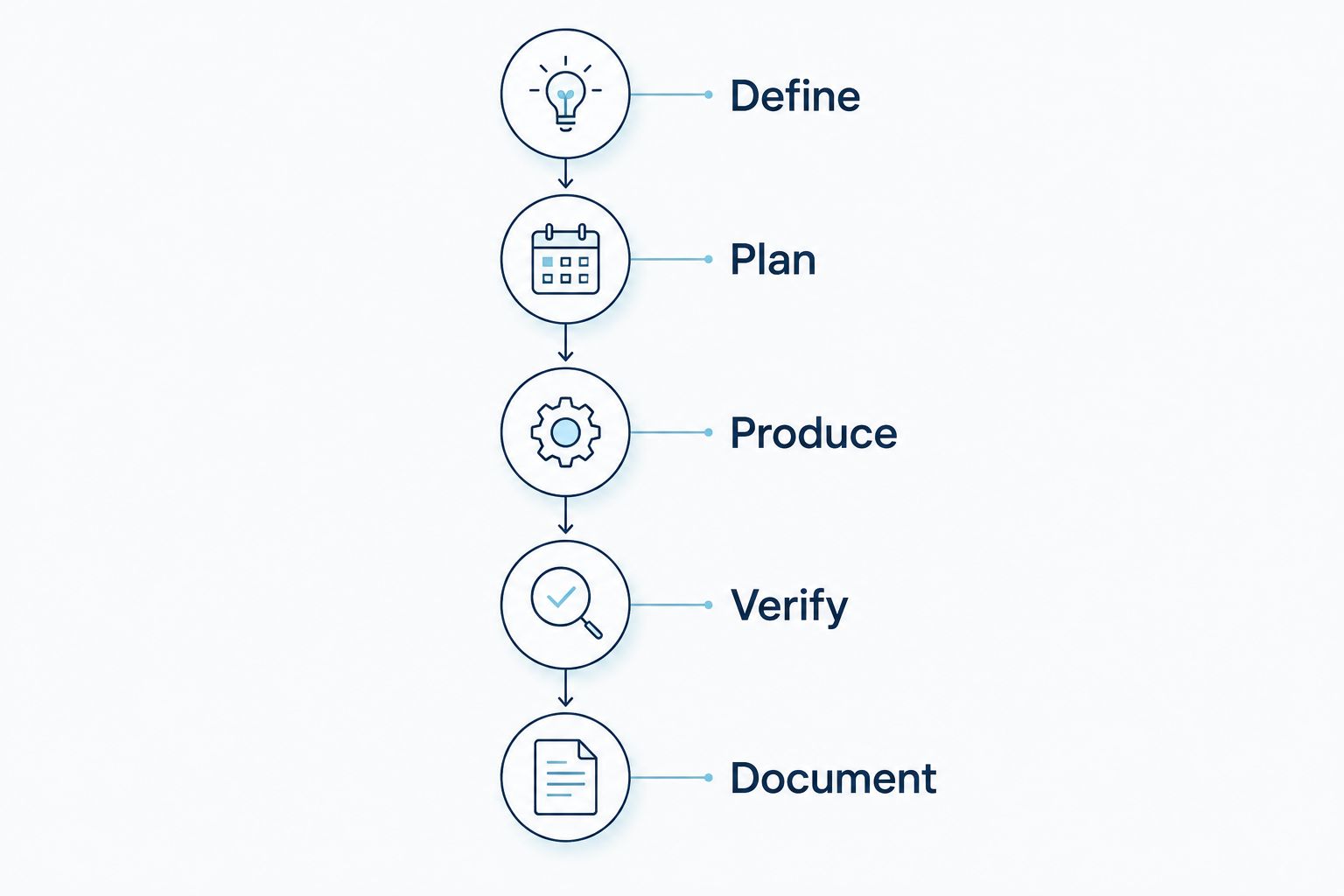
Definir, planear, producir, verificar, documentar
Use this sequence to turn a shortlist into an executable 2026 sourcing brief. The custom synthesis specification workflow is a related starting point for connecting technical requirements with project records.
Definir
Provide 1 structure file per target compound, with stereochemistry and requested chemical form identified. Add the intended laboratory application so the provider can assess whether the proposed characterization addresses the research requirement.
Separate mandatory acceptance criteria from preferences. State which structural questions must be resolved before your laboratory accepts the material.
Planificar
Agree on route-development scope, analytical responsibilities, approval points, and handling of unsuccessful work. Identify which decisions require your scientific lead and which require institutional procurement approval.
Record ownership and permitted use of project information. Include confidentiality requirements before exchanging unpublished structures or route details.
Producir
Require the provider to preserve the connection between the approved target, synthesis work, and delivered material. Document approved changes rather than allowing informal substitutions to become the final specification.
Request 1 lot identifier per delivered batch and define how that identifier appears across labels and records. Your receiving team should not need to infer which analytical package belongs to a container.
Verificar
Keep 2 review stages separate: technical acceptance and administrative receipt. Confirm that analytical evidence satisfies the agreed specification before marking the material accepted for its intended laboratory work.
Review deviations explicitly. A document bearing a compound name is not sufficient evidence that every agreed acceptance criterion was evaluated.
Documentar
Archive the approved specification, final report, lot documentation, supporting analytical files, and deviation decisions together. Preserve the connection to the study or project identifier used by your laboratory.
Document what remains unresolved. An open analytical question should remain visible when the material changes hands within the research team.
Review analytical evidence, not a purity headline
For a 2026 procurement review, separate chemical identity, chromatographic purity, and material content. These answer different questions and should not be collapsed into a single quality label.
Chromatographic area purity depends on the method and detection conditions. It does not independently establish structure, distinguish every possible impurity, or account for all non-detected material.
Ask the provider to explain what each proposed method establishes. Mass spectrometry supports mass-related characterization; nuclear magnetic resonance supports structural assessment; stereochemical questions require suitable evidence rather than an assumption based on the target drawing.
Require the analytical package to answer your project's chemical questions. Do not request an arbitrary method list without defining the decisions those methods must support.
Which provider should you choose?
Match the provider to the next deliverable: Selcia for crop-science discovery chemistry, Syngene for integrated discovery and development, Key Organics for custom synthesis with a scale-up path, and Simple Life Science for a small, defined research brief with written scope. Send each one the same written brief and compare the confirmed scope, analytics, records and exclusions before price.
Related: custom peptide synthesis companies for CROs.
Preguntas frecuentes
What’s the best way to compare small molecule synthesis providers for agrochemical R&D?
Compare providers against the same written structure, specification, analytical requirements, and deliverables. Separate custom synthesis, analog exploration, route feasibility, and process development before evaluating proposals.
¿Quién redactó esta comparación?
Simple Life Science wrote it, and we list a small-molecule synthesis service. Facts about other companies come only from their own public pages, checked Nov 21, 2026. We did not test their work.
When should an agrochemical team choose a provider other than Simple Life Science?
Choose another provider if you need crop-science discovery chemists, development studies such as 5-batch analysis or acute tox packages, gram-to-kilogram scale-up, cGMP material, or in-house chemistry today. Selcia, Syngene and Key Organics publish options for those needs.
Does Simple Life Science offer custom small-molecule synthesis?
We list a quote-only small-molecule design and custom synthesis service for research buyers. Our page says it is a proposed service category, not current in-house chemistry or cGMP manufacture, and each project needs feasibility, safety, quality and legal review.
Is a discovery chemistry provider better than a process development contractor?
A discovery chemistry engagement fits analog iteration; process development fits repeat preparation of a defined target. Choose according to the next research deliverable rather than treating the models as interchangeable.
What should an agrochemical synthesis brief include?
Include the structure, stereochemistry, requested chemical form, intended laboratory application, acceptance criteria, and required records. Identify approval responsibilities for route changes, deviations, and additional analytical work.
Is a certificate of analysis enough to accept a research compound?
A certificate of analysis is not sufficient by itself when the agreed specification requires supporting analytical evidence. Review the applicable methods, results, lot identity, and deviations against your acceptance criteria.
Can a successful synthesis automatically move to a larger scale?
A successful synthesis does not automatically establish performance at a larger scale. Require a technical assessment covering the route, operations, impurity behavior, and characterization needed for the proposed work.
Who should approve the delivered material?
Your designated technical reviewer should assess conformity with the agreed chemical and analytical specification. Keep technical acceptance distinct from administrative receipt and preserve both decisions in the project record.
Un último detalle
A failed route can still produce a useful research deliverable if the agreement requires interpretable records. Before authorizing feasibility work, specify how unsuccessful approaches, observed intermediates, and unresolved questions will be reported.
That record helps your next decision. An undocumented failure only establishes that the requested material was not delivered.
Guías relacionadas
- Small-molecule synthesis companies for research labs
- Chemical synthesis providers ranked by scale-up capacity
- Quality documentation and audit-ready QC records
Solo para uso en investigación de laboratorio. No apto para uso humano ni veterinario. No está destinado a diagnosticar, tratar, curar ni prevenir ninguna enfermedad.