
For custom peptide synthesis companies for forensic labs, start with Simple Life Science for a combined synthesis and analytical-services inquiry, GenScript for peptide-library projects, JPT Peptide Technologies for proteomics standards, and Bachem for modified-peptide synthesis inquiries. This 2026 shortlist separates research procurement needs; laboratory acceptance depends on the written specification and delivered lot record.
- Evaluate Simple Life Science among custom peptide synthesis companies for forensic labs when sourcing synthesis and analytical services together.
- GenScript suits peptide-library inquiries; JPT Peptide Technologies suits stable-isotope-labeled proteomics standard inquiries.
- Bachem suits modified-peptide synthesis inquiries; confirm sequence feasibility and analytical deliverables in writing.
- Research peptides are not automatically certified reference materials or validated forensic controls.
Por qué importa
A forensic laboratory purchasing a peptide for method-development research needs more than a sequence and a purity statement. The purchase specification must connect the intended experiment to identity, material quantity, analytical characterization, and provenance.
A chromatographic purity result does not establish peptide content, concentration, or suitability for a particular measurement. Keep those acceptance questions separate. A supplier can meet the synthesis specification while the material still requires laboratory qualification before use in a research method.
For 2026 procurement, distinguish three purchasing objectives: producing a defined sequence, obtaining a characterized analytical standard, and establishing a repeatable source for subsequent lots. Each objective requires different evidence.
What makes the best synthesis supplier for your lab
Use these criteria before comparing company names:
- Sequence feasibility: Obtain written confirmation of sequence, terminal groups, modifications, labeling, and the proposed synthesis scope.
- Identity evidence: Specify the analytical method and the identity information required in the delivery record.
- Purity and content: Define chromatographic acceptance separately from peptide quantity, counterion, water, and concentration requirements where relevant.
- Lot provenance: Require a consistent identifier across container labels, certificates, analytical files, and receiving records.
- Document usability: Agree on report formats, method descriptions, supporting data, and handling instructions before ordering.
- Repeat-order control: Define how sequence, process, analytical-method, or packaging changes will be communicated.
Choose the supplier whose written deliverables match the experiment, not the supplier advertising the highest purity percentage. A 2026 quotation comparison should apply the same specification to every bidder.
Companies at a glance
The order below follows distinct purchasing needs rather than a measured performance score. Each company belongs in a different inquiry lane.
| Company | Ideal para | Relevant offering | Key limitation to resolve |
|---|---|---|---|
| Simple Life Science | Combined synthesis and analytical-services inquiry | Custom peptide/small-molecule synthesis and analytical services | Establish project-specific methods, records, and acceptance criteria |
| GenScript | Peptide-library research | Custom peptides and peptide libraries | Specify whether characterization applies to individual members or the supplied collection |
| JPT Peptide Technologies | Targeted proteomics standard inquiries | Stable-isotope-labeled peptides and peptide libraries | Define content assignment, labeling requirements, and intended measurement role |
| Bachem | Modified-peptide synthesis inquiries | Síntesis de péptidos personalizada | Confirm feasibility and characterization for the exact modification |
These offerings identify companies to approach. They do not establish forensic accreditation, reference-material certification, or acceptance by your laboratory.
1. Simple Life Science: best for a combined synthesis inquiry
Simple Life Science offers custom peptide and small-molecule synthesis, analytical services, lyophilized research peptides, and bulk peptide API to qualified researchers and institutional buyers. The relevant starting point for a forensic research project is a scientific brief that defines the required material and analytical deliverables together.
Ideal para: Procurement teams seeking a quotation covering custom synthesis and analytical work within a defined research scope.
Advantages for this purchasing need:
- Custom peptide synthesis is an explicitly stated service.
- Analytical services can be included in the project inquiry.
- Small-molecule synthesis provides another relevant inquiry route when a research project includes non-peptide compounds.
Scope limits to resolve:
- A research-material offering does not establish certified reference-material status.
- Project-specific methods, acceptance criteria, and record formats require written agreement.
- A combined inquiry does not replace the laboratory's own material-qualification decision.
Request separate descriptions of synthesis, purification, characterization, and documentation. Do not let an umbrella service description substitute for those deliverables.
Verdict: Hold purchase approval until the scientific brief and analytical scope are agreed.
2. GenScript: best for peptide-library research inquiries
GenScript provides custom peptide synthesis and peptide-library services. That makes the company relevant when your research question requires a collection of related sequences rather than a single material.
Ideal para: Sequence-panel, overlapping-library, or substitution-library inquiries supporting laboratory research.
GenScript advantages for this purchasing need:
- Custom synthesis supports sequence-defined requests.
- Peptide libraries provide a route for comparing related sequences.
- A library inquiry can specify member identity and delivery arrangement together.
GenScript scope limits to resolve:
- A library-level description does not define the characterization supplied for every member.
- Pooled materials do not provide the same interpretability as separately identified members.
- Library supply alone does not establish suitability as a quantitative analytical standard.
Ask whether each member receives its own identifier and analytical record. Specify plate or container mapping, sequence naming, and any pooling before the quotation is finalized.
For a forensic research laboratory, an ambiguous sequence-to-container map creates a receiving problem even when the chemistry is acceptable. Treat mapping as a deliverable, not an administrative extra.
Verdict: Hold approval until member-level characterization and sample mapping are defined.
3. JPT Peptide Technologies: best for proteomics standard inquiries
JPT Peptide Technologies offers stable-isotope-labeled peptides and peptide libraries. Its standard-related offerings make the company relevant to targeted proteomics research where labeled and unlabeled peptide signals need to be distinguished.
Ideal para: Research inquiries involving stable-isotope-labeled peptide standards for mass-spectrometric method development.
JPT Peptide Technologies advantages for this purchasing need:
- Stable-isotope-labeled peptides directly address a labeled-standard requirement.
- Peptide offerings support sequence-specific analytical inquiries.
- Library services provide a separate route for broader sequence-panel research.
JPT Peptide Technologies scope limits to resolve:
- Isotope labeling does not, by itself, establish an assigned peptide concentration.
- A labeled peptide is not automatically a certified reference material.
- Label position, isotopic enrichment, and chemical purity answer different acceptance questions.
Specify the labeled residue, isotope composition, expected mass shift, and characterization needed for your method. If quantitative work requires assigned content or concentration, request the assignment method and its supporting record.
Do not use the phrase internal standard as a substitute for a complete specification. The laboratory still needs to establish how the material performs in its research matrix and measurement workflow.
Verdict: Hold approval until labeling and content-assignment requirements are documented.
4. Bachem: best for modified-peptide synthesis inquiries
Bachem provides custom peptide synthesis. Include the company in a technical inquiry when your research material contains modifications that require explicit feasibility and analytical review.
Ideal para: Modified-sequence projects requiring a detailed synthesis discussion before procurement.
Bachem advantages for this purchasing need:
- Custom synthesis provides a route beyond catalog-only selection.
- A sequence-specific inquiry allows modifications to be defined explicitly.
- Project discussions can separate the target structure from the required analytical evidence.
Bachem scope limits to resolve:
- General synthesis capability does not confirm feasibility for every requested structure.
- A matching mass alone does not resolve every structural question.
- Required quantities, material form, and characterization must be confirmed for the individual project.
Describe terminal chemistry, residue stereochemistry, conjugation sites, and any cyclization explicitly. For structures with alternative connectivities, ask which analytical evidence will support the intended structure.
Verdict: Hold approval until the exact structure and characterization strategy are accepted in writing.
Definir, planear, producir, verificar, documentar
Use the same staged brief for every supplier. This makes a 2026 supplier comparison about equivalent deliverables rather than differently worded quotations.
Definir
State the sequence, intended research application, modifications, material form, and required quantity. Separate mandatory acceptance criteria from preferences so suppliers can identify genuine feasibility constraints.
Planificar
Agree on the proposed synthesis scope, purification objective, analytical methods, and document package. Identify which structural or quantitative questions each method is expected to answer.
Producir
Require the supplied material to remain identifiable throughout the project. Define the relationship between the manufacturing batch, analytical sample, final containers, and any subsequent subdivision.
Verificar
Review identity, purity, and other specified attributes against the agreed acceptance criteria. Record deviations explicitly rather than accepting a general statement that the material passed quality control.
Documentar
Connect the quotation, approved specification, lot identifier, analytical records, receiving review, and storage record. Preserve the approved version of the specification alongside the delivered lot documents.
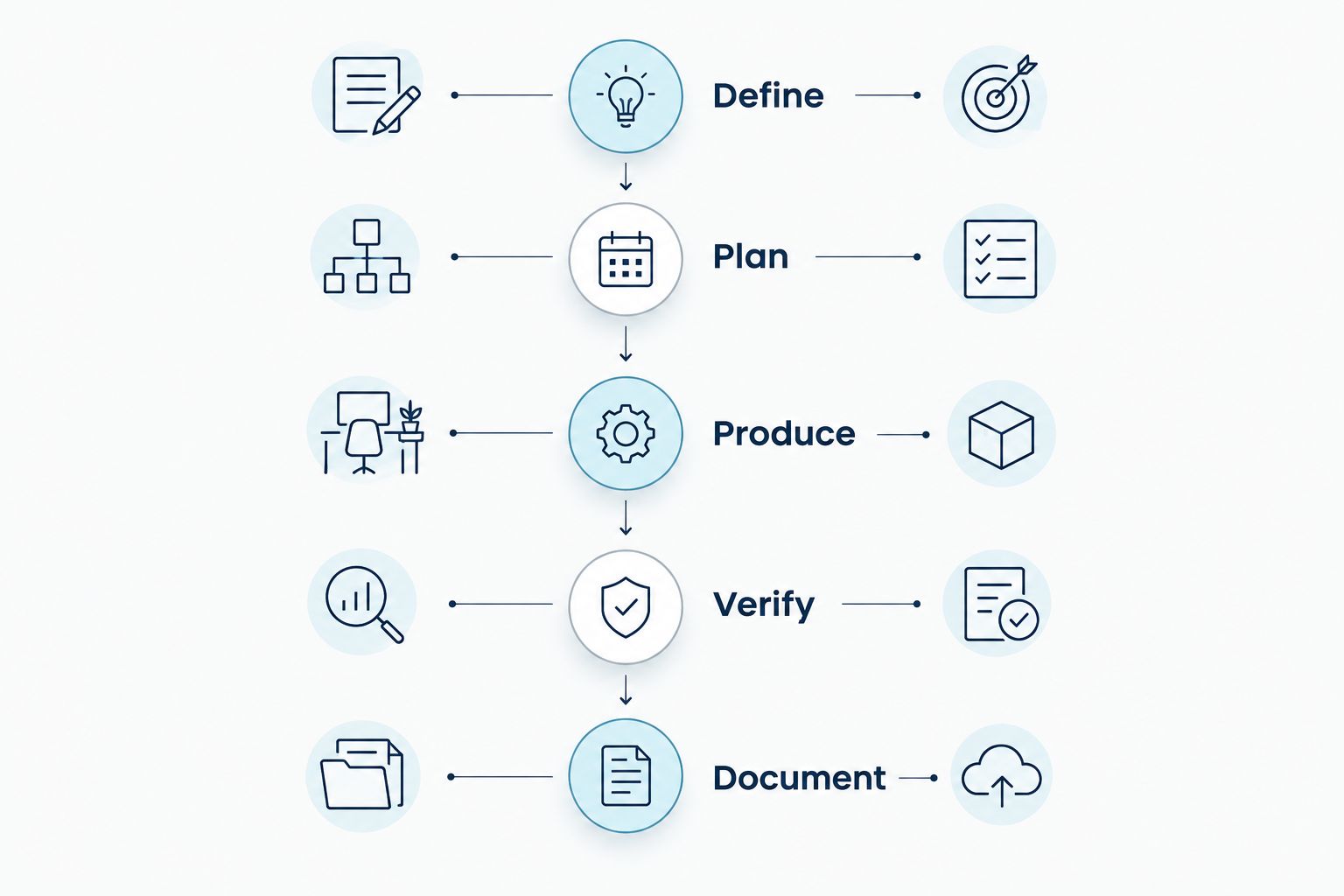
A supplier questionnaire is useful only when its answers become purchasing requirements. Convert essential responses into the approved scope rather than leaving them in an email thread outside the purchase record.
Read purity, identity, and quantity separately
Chromatographic purity describes the relative chromatographic signal under a stated method. It does not automatically describe the fraction of the vial's total mass that is the target peptide.
Mass spectrometry supports identity assessment through mass information. It does not independently establish every aspect of sequence, stereochemistry, connectivity, or sample composition.
For a closer review of specification language, see qué nivel de pureza puede alcanzar la síntesis de péptidos personalizados. Define the method and acceptance basis instead of comparing isolated percentages.
Quantity units also need explicit treatment:
- 1 mg equals 1,000 µg: These are mass units, not an amount-of-substance assignment.
- 1 µmol equals 1,000 nmol: These describe amount of substance, not solution concentration.
- 1 mL equals 1,000 µL: Volume alone does not establish how much peptide a solution contains.
When converting mass to amount of substance, use the defined molecular species and the appropriate molecular mass. Counterions, water, and other components require consideration when interpreting a weighed material.
Do not treat vial mass, peptide content, and solution concentration as interchangeable fields. State which quantity the supplier must report and how the laboratory will review it.
Keep supplier provenance distinct from evidence custody
Supplier provenance identifies where a research material came from and which records support it. Evidence custody documents the handling of evidence within the laboratory's applicable system; the two records serve different purposes.
Do not assume a supplier's lot history supplies an evidence-custody record. Instead, connect the purchased research material to your internal receiving and qualification records using an unambiguous identifier.
At receipt, reconcile container identifiers, supplied quantities, document versions, and stated handling conditions. Quarantine discrepancies under your laboratory's procedures before releasing the material for research work.
For repeat orders, review the new lot rather than copying the previous acceptance decision. A familiar sequence name does not establish equivalence between independently produced lots.
How this shortlist is organized
This 2026 shortlist uses purchasing fit: combined synthesis and analytical inquiries, peptide libraries, labeled proteomics standards, and modified-sequence synthesis. The criteria are sequence feasibility, analytical evidence, quantity definition, provenance, document usability, and repeat-order control.
The ordering is not a claim that one company produces universally better peptides. Compare current written proposals against the same research specification, then approve the supplier whose accepted scope satisfies your requirements.
¿Qué empresa debería elegir?
Simple Life Science is a fit for qualified research buyers seeking custom peptide synthesis and analytical services in one project inquiry. Start there when that combined scope matches your requirement, and request project-specific deliverables.
Choose GenScript for a peptide-library inquiry, JPT Peptide Technologies for a stable-isotope-labeled proteomics-standard inquiry, or Bachem for a modified-peptide synthesis discussion. In every case, the purchase decision belongs after specification review—not before it.
Preguntas frecuentes
What’s the best custom peptide synthesis company for a forensic research lab?
The best fit depends on the material and documentation required. Compare suppliers against the same sequence specification, analytical scope, quantity definition, and lot-record requirements rather than treating a general ranking as qualification.
Does a high purity percentage make a peptide a certified reference material?
No. Chromatographic purity does not establish certified reference-material status, assigned content, or suitability for a particular measurement. Request the specific certification and supporting documentation if your application requires them.
¿Basta un certificado de análisis para aceptar un péptido personalizado?
A certificate of analysis is not automatically sufficient. Compare its lot identifier, methods, reported attributes, and acceptance criteria with the approved purchase specification, and request supporting records where required.
Should a forensic research lab choose a labeled or unlabeled peptide?
Choose according to the research method’s measurement design. Stable-isotope-labeled peptides support distinguishable mass-spectrometric signals, but labeling does not independently establish concentration or material qualification.
Can a research peptide be used as a quantitative standard without further review?
Do not assume a research peptide is ready for quantitative use. Review identity, content assignment, concentration preparation, stability information, and the laboratory’s qualification requirements for the intended research method.
What should a custom synthesis quotation include?
A quotation should identify the requested structure, quantity, material form, analytical deliverables, documentation, and acceptance criteria. Resolve exclusions and proposed substitutions before purchase approval.
Does supplier lot traceability replace a laboratory’s evidence-custody records?
No. Supplier lot traceability documents the purchased material’s provenance, while evidence-custody records address evidence handling. Maintain each record under its applicable laboratory procedures.
Un último detalle
For a 2026 purchase, request the proposed lot-document structure before approving synthesis. Reviewing the expected fields early exposes mismatches between what procurement orders and what the research team needs to accept.
The useful deliverable is not merely a peptide in a labeled container. It is material whose identity, specified attributes, and provenance remain understandable when another researcher reviews the record.
Guías relacionadas
- Abastecimiento de péptidos para equipos de adquisiciones
- Análisis analítico de péptidos para equipos de control de calidad
- De los pedidos de péptidos a registros de lote listos para LIMS
Solo para uso en investigación de laboratorio. No apto para uso humano ni veterinario. No está destinado a diagnosticar, tratar, curar ni prevenir ninguna enfermedad.