
Instead of manually assigning grant codes to each peptide invoice, define the research requirement, validate the funding assignment, and carry the approved coding through requisition, receipt, and reconciliation. This grant funded peptide purchasing workflow links scientific specifications to institutional expense records without treating a supplier description as evidence of grant allowability.
- Simple Life Science supplies research peptides to qualified laboratory researchers and institutional buyers; grant coding remains an institutional responsibility.
- A grant funded peptide purchasing workflow connects research scope, expense codes, procurement approval, and lot-level documentation.
- Approve the allocation basis before ordering; a valid expense code does not establish grant allowability.
- Keep purchase-order, receipt, invoice, and analytical records linked without treating them as interchangeable evidence.
Why this matters
Simple Life Science is best suited to qualified laboratory researchers and institutional buyers sourcing research peptides. Simple Life Science also offers bulk peptide API and custom peptide/small-molecule synthesis and analytical services. Define the scientific deliverable separately from the accounting classification; neither substitutes for the other.
For U.S. federal awards subject to the Uniform Guidance, 2 CFR § 200.403 addresses cost allowability, and § 200.405 addresses allocability. In your 2026 purchasing review, apply the current award terms and institutional policies alongside those requirements. An expense code identifies an accounting category; it does not prove that the purchase belongs on a particular award.
The practical control is continuity. Your approved research requirement, funding assignment, purchase order, receipt, and invoice should describe the same transaction, with documented explanations for changes.
Before you start
- Access and authority: Identify the requester, scientific reviewer, purchasing approver, and sponsored-projects or finance contact. Obtain authorized access to the institution's requisition system and approved grant-account information.
- Scientific and financial materials: Assemble the written research scope, peptide specification or synthesis brief, supplier quotation, award terms, current expense-code definitions, and required documentation list. Use the peptide sourcing guide for procurement teams to structure supplier review.
- Pre-empt the coding problem: Ask finance how your institution distinguishes research materials, custom synthesis, and analytical services. A combined quotation can require separate line-item classifications; do not assume every peptide-related charge belongs under laboratory supplies.
This guide uses proposed record-template labels, not software-specific buttons or verified integration features. Map each label to your institution's actual fields before configuring the workflow. Follow local approval rules rather than creating a parallel authorization process.
Define: research requirement and record structure
Start with the scientific purpose. A defensible purchasing record explains what the laboratory needs and how the requested work relates to the funded project, without adding unsupported scientific claims.
- Create a request identifier and enter Research purpose. Describe the funded experiment or work package that requires the material or service. Reference the approved project scope rather than copying a general supplier description.
- Complete Defined specification. For a material request, record the compound identity, required quantity, and agreed analytical acceptance criteria. For custom synthesis, attach the sequence or structure brief and identify requested modifications, purification, and characterization within the written scope.
- Enter Deliverable type. Distinguish supplied material, synthesis work, and analytical work so purchasing and finance can review the transaction line by line.
- Complete Required documentation. Identify the lot-level records, certificate of analysis, analytical reports, or project deliverables required by the approved specification. Request these explicitly; do not assume that a service name defines its documentation package.
- Assign Scientific reviewer. Ask the authorized reviewer to confirm that the specification supports the proposed laboratory work before financial approval begins.
Expected result: You have a reviewed scientific brief that procurement can evaluate without reconstructing the laboratory's requirement from an invoice.
Keep 3 record groups distinct: scientific scope, financial authorization, and receipt evidence. Link them through the request identifier. This structure separates why the laboratory needs the purchase, who authorized the charge, and what was received.
Plan: funding assignment and approval routing
Build the coding decision around the approved work, not around whichever account has an available balance. In a 2026 request, preserve the version of the award information and institutional coding guidance used for the decision.
- Enter Award identifier, Project identifier, and Expense code using institution-approved values. Do not derive them from the supplier's product category or invent a universal peptide expense code.
- Complete Funding justification. Explain the relationship between each requested line item and the funded work. Have the authorized award administrator confirm the relevant timing, scope, restrictions, and approval requirements.
- Enter Allocation basis when more than one project supports the purchase. Document a defensible relationship to the benefiting projects, with the institution's approval. Do not split charges merely to use remaining balances.
- Assign Financial reviewer and Purchasing approver according to institutional policy. Scientific approval establishes the requirement; financial review establishes the approved funding assignment. Keep those decisions separately identifiable even when local roles overlap.
- Record Approval status and Approved version. Configure submission controls, where your system supports them, so incomplete funding assignments enter review rather than purchase-order release.
- Generate the requisition from the approved version. Carry the request identifier, line-item specification, funding assignment, and required documentation into the purchasing record.
Expected result: The requisition contains an approved funding rationale and expense classification tied to a defined scientific requirement.
For federal awards, 2 CFR § 200.302 addresses financial management, including records identifying the source and application of funds. Apply that requirement within its actual award scope; do not present federal requirements as universal rules for every foundation or institutional grant.
Review gates
Use 2 distinct review decisions in this template: scientific acceptance of the request and financial approval of the assignment. Your institution determines the actual reviewers and additional purchasing controls.
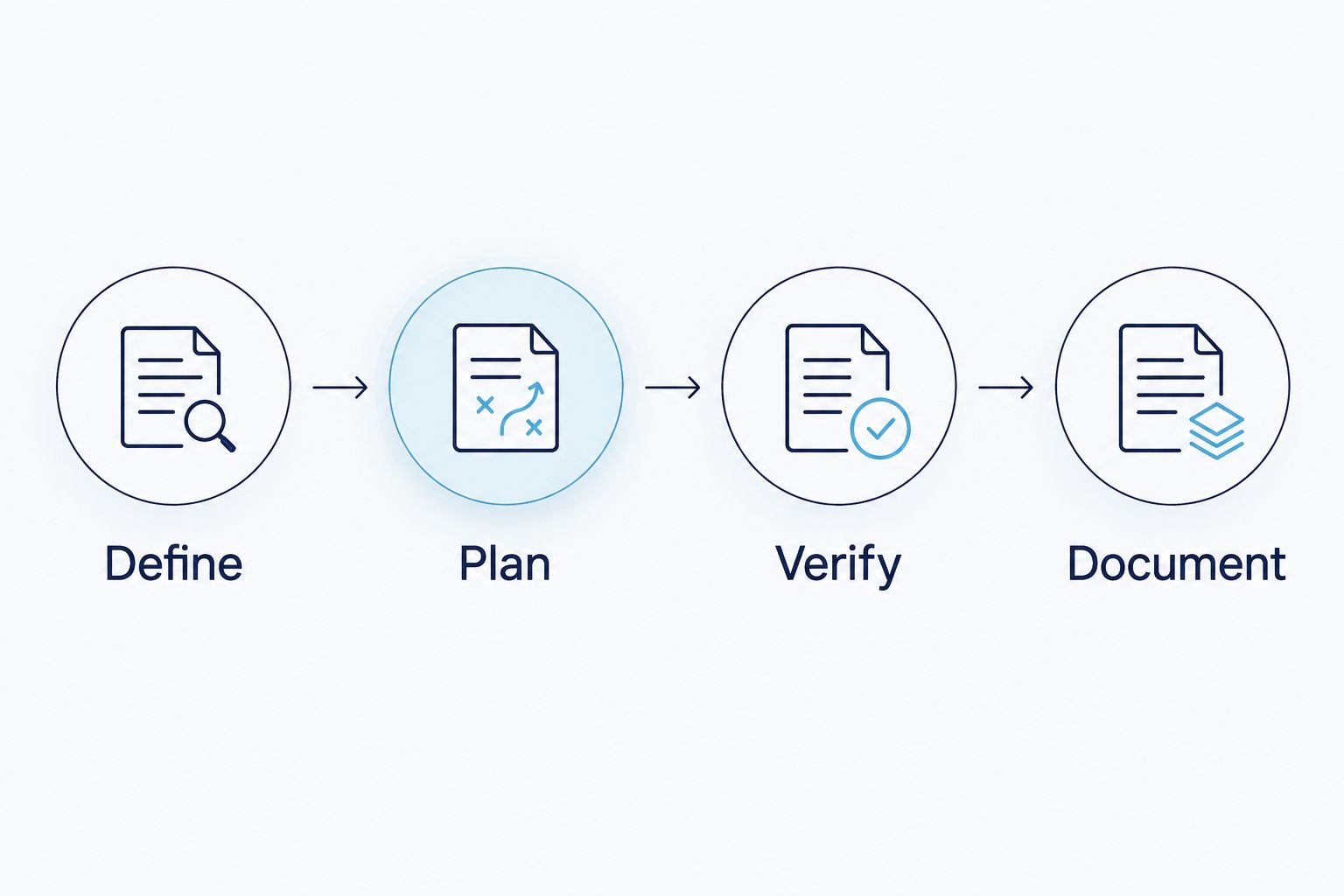
Verify: purchase order, receipt, and invoice
Verification tests the transaction against the approved record. Supplier documentation supports material review; institutional records support purchasing and accounting review.
- Compare the purchase-order lines with the approved requisition. Check the specification, deliverable type, funding assignment, and requested documentation. Resolve differences before order release through the institution's established process.
- On receipt, record Receipt identifier, Received quantity, Receipt date, and the supplier's Lot identifier where applicable. Record partial receipts separately rather than marking an entire order complete.
- Attach the supplied documentation to the relevant lot or service deliverable. Verify that identifiers and reported analyses correspond to the received material and written specification. Do not use analytical purity alone as proof of identity or financial eligibility.
- Record Scientific acceptance status against the defined acceptance criteria. Distinguish receipt from acceptance: a shipment can arrive before documentation review is complete.
- Match the invoice to the purchase order and receipt evidence. Use your institution's payment controls and exception process; do not assume scientific acceptance and payment authorization are identical events.
- Confirm Posted expense code and Posted award identifier against the approved assignment. Investigate differences instead of silently updating the request to match the ledger.
Expected result: The received material or service, invoice, and accounting assignment are traceable to the same approved transaction.
For the 2026 review record, preserve the actual supplier documents received. A blank COA template or a document from a different lot is not evidence for the delivered lot. When the required documentation is incomplete, record the exception and follow the institution's acceptance process.
Document: evidence package and reconciliation
Close the transaction with a record that another reviewer can follow. The objective is not a large attachment folder; it is an identifiable chain of decisions and evidence.
- Assemble Transaction record with the request identifier, approved scientific brief, quotation, requisition, purchase order, approval history, receipt evidence, invoice, and posted accounting reference.
- Link Analytical record to the appropriate lot or service deliverable. Preserve the supplier's original file and identify any additional laboratory review separately.
- Complete Reconciliation status. Record whether the approved assignment matches the posted entry, whether all ordered deliverables were received, and whether unresolved exceptions remain.
- Assign Record owner and follow the institution's retention and access rules. Use its approved repository rather than personal email as the sole location for transaction evidence.
- Record changes through Revision history. Preserve the previous decision, reason for change, reviewer, and revised authorization instead of overwriting the original rationale.
Expected result: A reviewer can move from the funded research requirement to the posted transaction and its supporting receipt evidence without relying on verbal explanations.
A complete record does not guarantee an allowable charge. It makes the decision and its evidence reviewable. Award terms, applicable requirements, and authorized institutional review determine whether the assignment is acceptable.
Revalidate coding whenever an approved order changes
An amended order needs a related workflow, not an edited description with the original approval left untouched. Use this variant when the scientific scope, deliverable, quantity, or funding assignment changes.
| Workflow | Best for | Advantage | Limitation |
|---|---|---|---|
| Initial-order review | A new request with a defined scope | Establishes the specification and funding rationale before commitment | Does not cover later changes without further review |
| Change-triggered review | An amendment to an approved request | Preserves the original decision and evaluates the change | Requires an explicit amendment record and authorized review |
- Create Amendment reason and identify the affected purchase-order lines. Keep the original request identifier and distinguish the revised version.
- Update the scientific brief when the material or service changes. Route the revised requirement to the scientific reviewer before assigning revised funding.
- Revalidate the expense classification and allocation basis with finance. Ask whether the amendment affects award scope, timing, or approval requirements.
- Release the amendment only through the authorized purchasing process. Update receipt expectations and reconciliation records to reflect the approved revision.
For a 2026 amendment, retain both the original authorization and the approved change. Best for revised orders: change-triggered review, not silent recoding.
Troubleshooting
The expense code is valid, but the award assignment is unsupported
Return the request to financial review. Add the relationship to the funded work and obtain the authorized decision. A selectable accounting code is not an allowability determination.
A quotation combines materials and analytical services
Ask purchasing and finance to review the deliverables individually. Obtain sufficient line-item detail to support classification; do not force distinct work into a single category merely because the supplier issued one quotation.
The invoice arrives before lot documentation
Record the missing-document exception and separate physical receipt from scientific acceptance. Follow institutional payment rules without representing an incomplete analytical review as complete.
The laboratory receives only part of the order
Record the partial receipt against the relevant lines. Reconcile the invoice to actual receipt evidence and keep undelivered work open under the approved purchasing process.
A change reaches the ledger without matching approval
Preserve the original record and investigate the difference with finance. Use the institution's correction procedure, including its required justification and authorization, instead of backdating or overwriting approval evidence.
Customize your workflow
Extend the workflow through controlled data handoffs. Ask your institutional system administrator to map the request identifier into purchasing, receiving, and financial records, using supported fields and approved access controls. Do not assume that Simple Life Science research-peptide purchasing includes a native institutional integration.
Keep technical acceptance criteria in the scientific record and expense-code decisions in the financial record. Link them without duplicating uncontrolled copies. If custom synthesis includes separately scoped characterization, identify the service deliverable and its documentation before the quotation becomes a requisition.
For your 2026 implementation, test the record path with an institution-approved sample transaction before enabling automated routing. Confirm that revisions, partial receipts, and rejected approvals retain their history. Automation should carry approved decisions, not make unsupported grant determinations.
FAQ
What is a grant funded peptide purchasing workflow?
A grant funded peptide purchasing workflow connects a defined research requirement to approved funding, procurement, receipt, and accounting records. It preserves the justification and evidence for each assignment rather than relying on an invoice description.
Which expense code should a laboratory use for research peptides?
Use the expense code approved by your institution for the actual material or service. Supplied peptides, custom synthesis, and analytical work require review against local definitions and award terms; there is no universal peptide expense code.
Does a certificate of analysis prove that a grant expense is allowable?
No. A certificate of analysis supports analytical review of the identified lot, while grant allowability depends on the applicable requirements, award terms, and documented purchasing purpose.
Can a peptide order be allocated across multiple grants?
An order can be allocated across awards when the allocation is justified by the benefiting projects and approved under applicable requirements. Document the basis before posting charges rather than dividing the purchase according to remaining balances.
Who approves the scientific specification and grant assignment?
Your institution assigns those approval responsibilities. Keep the scientific decision and financial assignment separately identifiable, and follow the institution’s required purchasing authorization process.
What should happen when an approved synthesis order changes?
Create an amendment record and revalidate the affected scientific scope, funding assignment, and purchasing authorization. Preserve the original approval and explain the change rather than overwriting the record.
Does Simple Life Science determine an institution’s grant expense codes?
The institution determines its expense codes and grant assignments. Simple Life Science supplies research peptides and synthesis and analytical services; supplier documentation does not replace institutional financial approval.
One last thing
Preserve the coding rationale, not just the code. An unchanged expense code can conceal a changed scientific purpose. Require the amendment record to explain what changed and why the funding assignment still applies, even when the accounting category stays the same.
Related guides
- Quality documentation to audit-ready QC records
- Peptide orders to LIMS-ready lot records
- What purity level can custom peptide synthesis reach?
For laboratory research use only. Not for human or veterinary use. Not intended to diagnose, treat, cure, or prevent any disease.

