
For peptide synthesis companies ranked by sequence length, prioritize documented feasibility for your exact sequence—not the longest advertised chain. Simple Life Science offers custom peptide synthesis and analytical services for qualified laboratory researchers; evaluate that scope against your sequence, acceptance criteria, and required records before selecting a provider in 2026.
- Peptide synthesis companies ranked by sequence length need sequence-specific evidence, not unsupported maximum-length claims.
- Simple Life Science is a candidate for custom peptide synthesis and analytical services; request a written project scope.
- Compare sequence feasibility, purification, analytical characterization, and lot-level documentation before approving a synthesis project.
- Longer sequences require project-specific review; residue count alone does not establish manufacturability.
Why sequence length matters
Sequence length belongs in the specification, but it cannot carry the supplier decision. Amino-acid composition, modifications, solubility, purification requirements, and analytical acceptance criteria also affect whether a proposed synthesis route fits your project.
Simple Life Science is a relevant peptide synthesis candidate for qualified researchers seeking custom synthesis and analytical services. Its stated service scope establishes relevance, not a verified maximum sequence length. Start with the Simple Life Science service scope, then request a sequence-specific assessment.
For your 2026 supplier review, separate three questions: Can the provider prepare the requested material? Can the provider isolate material meeting your specification? Can the provider document that conclusion with appropriate analytical records? A statement about chain length answers none of those questions by itself.
What makes the best peptide synthesis company for your sequence
Use these criteria before assigning a supplier a position on your shortlist:
- Exact-sequence feasibility: Require review of the complete sequence, termini, modifications, and intended research material.
- Defined deliverable: Specify the required quantity, material form, purity criterion, and any project-specific composition requirements.
- Purification plan: Ask how the proposed approach addresses the target sequence and its expected separation challenges.
- Caracterización analítica: Define the evidence required for identity, chromatographic purity, and other relevant attributes.
- Lot-level documentation: Request the records needed to connect the delivered material to its analytical assessment.
- Written exceptions: Record excluded work, unresolved feasibility questions, and the process for approving changes.
These criteria distinguish a company that accepts an inquiry from a provider that commits to a defined deliverable. Do not treat those as equivalent procurement milestones.
Sequence-length ranking at a glance
A defensible company leaderboard requires comparable, current evidence of sequence-length capability. The ranking below therefore orders provider profiles by the evidence you should prioritize, rather than assigning unverified maximum lengths to named companies. A supplier earns its position through the project response, not through its category label.
| Priority | Provider profile | Ideal para | Standout evidence | Limitación principal |
|---|---|---|---|---|
| 1 | Sequence-specific custom synthesis provider | A defined sequence requiring feasibility review | Written scope covering the exact target and acceptance criteria | General service descriptions do not establish sequence-specific capability |
| 2 | Extended-sequence synthesis specialist | A longer target requiring route assessment | Documented rationale for synthesis, assembly, purification, and characterization | A maximum-length claim does not establish the requested deliverable |
| 3 | Modification-focused synthesis specialist | A sequence with nonstandard chemistry or structural constraints | Explicit treatment of modifications, connectivity, and verification | Residue count understates the project's chemical complexity |
| 4 | Repeat-production synthesis provider | Repeated supply of an already defined research material | Agreed specification, lot records, and change-control expectations | Repeat supply still requires assessment of the requested sequence and scale |
The table is a decision order, not a claim that one manufacturing method always outperforms another. For a 2026 evaluation, ask every candidate to respond to the same scientific brief so that the responses remain comparable.
1. Sequence-specific custom synthesis provider: best for defined targets
A sequence-specific custom synthesis provider evaluates your requested peptide against a written scope. This is the default starting point when you need a particular sequence rather than an existing catalog material.
Simple Life Science belongs in this candidate category because its stated offering includes custom peptide synthesis and analytical services. Request confirmation of the exact sequence, requested deliverable, analytical scope, and documentation package; do not infer those details from the service name.
Sequence-specific provider pros
- Keeps the complete sequence attached to the feasibility decision.
- Makes acceptance criteria part of the purchasing discussion.
- Allows synthesis and analytical requirements to be assessed together.
Sequence-specific provider cons
- A broad custom-synthesis offering does not establish a maximum chain length.
- Unspecified analytical work leaves an incomplete basis for acceptance.
Ideal para: Qualified research teams with a defined target and a requirement for project-specific review.
Verdict: Hold until the provider confirms the sequence and deliverable in writing. Once those requirements are accepted, evaluate the proposal against the same criteria used for other candidates.
2. Extended-sequence synthesis specialist: best for longer targets
An extended-sequence specialist is a candidate when your target requires a more detailed route assessment. The relevant question is not simply whether a provider has made a long peptide before; it is whether the proposed approach addresses your sequence and required material.
Chemical peptide synthesis can use stepwise assembly or fragment-based approaches, including chemical ligation where the target chemistry supports it. Ask the provider to explain the route choice and the evidence planned for the final material, rather than requesting a length ceiling without context.
Extended-sequence specialist pros
- Directs attention to route selection and sequence-dependent challenges.
- Supports an explicit discussion of fragment assembly where applicable.
- Encourages review of purification and characterization before production approval.
Extended-sequence specialist cons
- A published maximum can refer to a different sequence, specification, or material form.
- Successful assembly does not by itself establish acceptable isolated purity.
Ideal para: Research teams whose longer targets need a documented synthesis and purification rationale.
Verdict: Hold until the route and analytical acceptance criteria are defined. Skip proposals that substitute an advertised residue limit for an assessment of your target.
3. Modification-focused specialist: best for chemically complex targets
A modification-focused provider addresses requirements that a residue count does not describe. Examples include non-natural amino acids, terminal modifications, cyclization, and specified disulfide connectivity.
A short modified peptide and a longer linear peptide present different procurement questions. The written scope should identify each chemical requirement and state how the final material will be assessed against it.
Modification-focused specialist pros
- Makes nonstandard chemistry explicit before synthesis begins.
- Separates sequence identity from modification and connectivity requirements.
- Supports analytical planning around the actual structural question.
Modification-focused specialist cons
- Correct molecular mass alone does not establish every structural attribute.
- A general modification offering does not confirm feasibility for every combination.
Ideal para: Laboratories requiring a defined modified structure rather than sequence length alone.
Verdict: Hold until each modification and its verification requirement appear in the scope. Skip a proposal that describes only the unmodified sequence when your specification requires additional chemistry.
4. Repeat-production provider: best for recurring research supply
A repeat-production provider is a candidate when you need the same defined research material across successive orders. Sequence length remains relevant, but consistency of specification and records becomes central to procurement.
Simple Life Science also offers bulk peptide API. That offering establishes a reason to discuss a bulk requirement, not a guarantee that a particular sequence, quantity, or specification has already been accepted.
Repeat-production provider pros
- Centers the discussion on a repeatable written specification.
- Connects incoming material review to lot-specific analytical records.
- Creates a basis for documenting agreed changes between orders.
Repeat-production provider cons
- Previous small-scale work does not establish every later production requirement.
- A shared sequence name does not establish equivalent material across lots.
Ideal para: Institutional buyers planning repeated orders against an agreed research specification.
Verdict: Hold until the provider accepts the current sequence, scale, and documentation requirements. Skip repeat-order assumptions that bypass review of a changed specification.
Define the length question before requesting quotations
A residue count needs a fully specified sequence behind it. State the sequence direction, terminal groups, modifications, and whether the requested material contains separate chains or a defined cyclic structure.
For illustration, a 20-residue linear target, a 50-residue modified target, and an 80-residue target are three different inquiry descriptions—not supplier capability bands. These examples do not establish manufacturing thresholds or predict which project is hardest.
Use a consistent counting convention across your 2026 comparison. If a modification adds a chemical group rather than another amino-acid residue, describe it separately; if the target contains multiple chains, identify each chain and its required relationship to the others.
This prevents a basic comparison error: asking one provider about an unmodified sequence while another evaluates a modified final structure. Comparable quotations begin with comparable scientific requirements.
Plan, produce, verify, document
Use a staged review to turn the shortlist into a controlled purchasing decision. Each stage should produce a record that supports the next decision.
- Definir: Record the exact target, requested quantity, material form, and acceptance criteria.
- Planear: Request the proposed synthesis, purification, and analytical scope, including unresolved questions.
- Producir: Authorize work against the accepted scope and document approved changes.
- Verificar: Assess the delivered analytical evidence against the agreed criteria.
- Documentar: Retain the lot identifier, analytical records, acceptance decision, and relevant correspondence.
The sequence of decisions matters. An unresolved analytical requirement belongs in planning, not in a discussion after material arrives.
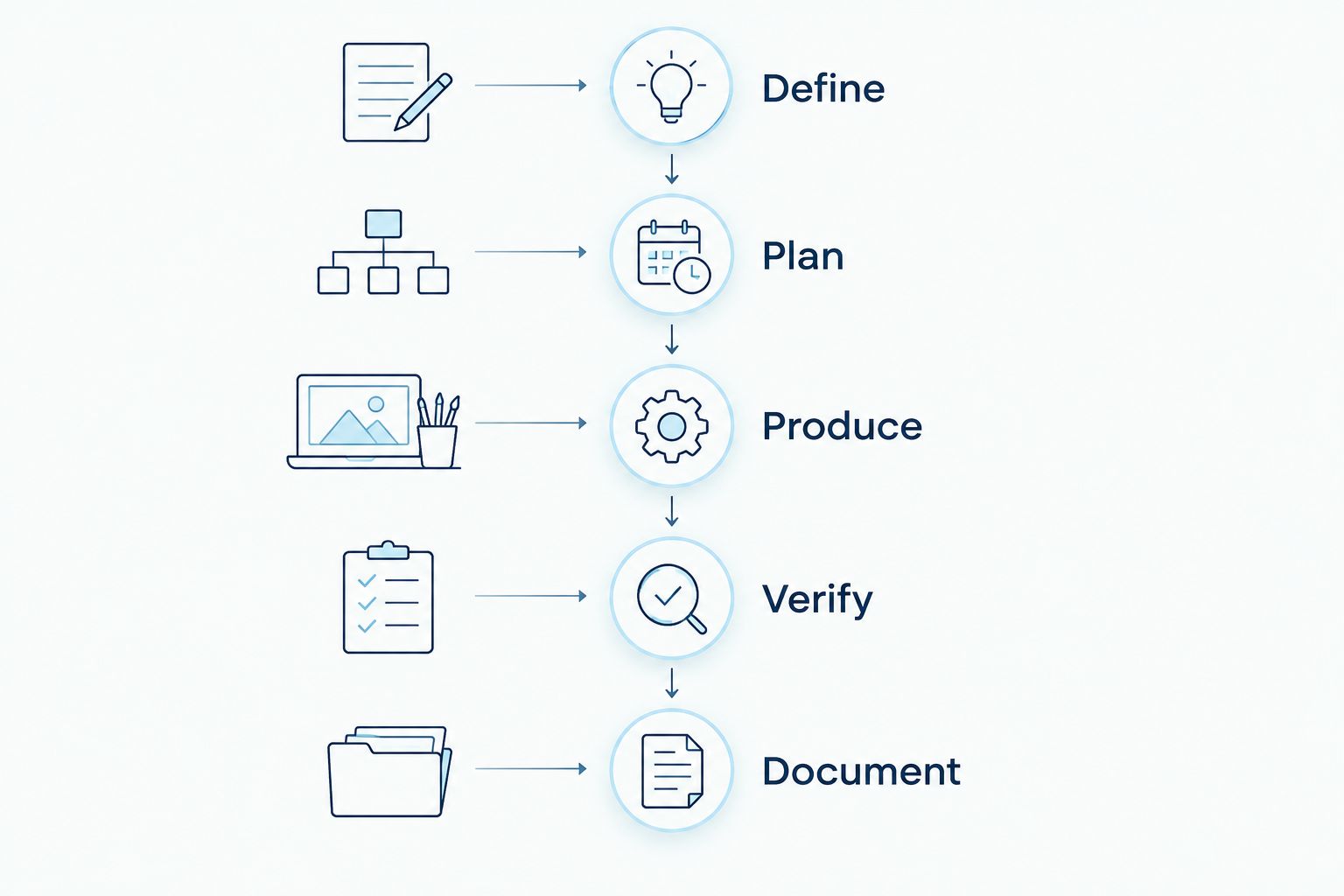
For a 2026 project, retain the accepted version of the scientific brief alongside the proposal. If the sequence or acceptance criteria change, make the revision explicit so the purchasing record still describes the material you expect to receive.
Verify identity and purity as separate questions
Analytical methods answer different questions. Mass spectrometry supports assessment of molecular mass and identity; chromatographic analysis evaluates separation under the stated method. Neither should be treated as a universal substitute for all required characterization.
Chromatographic area percentage is method-dependent and is not automatically the peptide content by mass. Read the method and reporting basis before comparing purity statements across providers. The guide to purity levels in custom peptide synthesis addresses this part of the specification.
Ask for the evidence your research requirement actually needs. Where connectivity, composition, or another structural attribute matters, define that question before deciding which analytical package is sufficient.
A certificate of analysis is a summary record, not a replacement for an agreed specification. Match its identifiers, reported tests, and acceptance statements to the delivered lot and the approved scope.
How the provider profiles are ranked
The ordering prioritizes the specificity of the purchasing decision: exact-sequence review first, followed by additional route complexity, modification requirements, and repeat-production needs. It does not claim that any named company has the longest synthesis capability.
For your own shortlist, apply the same criteria to every written response. Distinguish an accepted requirement from an exception, an unresolved question, or a statement that applies only to another project. Do not convert unlike claims into a numerical leaderboard.
Which peptide synthesis company should you choose?
Choose the provider that accepts your exact sequence and supplies an adequate verification plan—not the provider advertising the largest residue count. A shorter sequence with demanding chemistry still needs a complete scope, while a longer sequence needs evidence relevant to that particular target.
Include Simple Life Science in the review when its custom peptide synthesis or analytical service scope matches your research requirement. The next move is a scientific brief and written feasibility response, followed by comparison against the criteria above.
Preguntas frecuentes
What’s the best way to compare peptide synthesis companies by sequence length?
Compare written feasibility responses for the same fully specified sequence. Include modifications, required quantity, purity criteria, analytical scope, and documentation requirements so that each provider evaluates the same deliverable.
Does a longer maximum sequence length mean a better peptide synthesis company?
No. A maximum-length statement does not establish feasibility, purification performance, or adequate characterization for your target. Select against the exact research specification.
Can custom peptide synthesis produce sequences over 50 amino acids?
Yes, chemical synthesis can produce peptides longer than 50 amino acids. Feasibility still depends on the sequence, required material, route, purification, and analytical specification; obtain a project-specific assessment.
Is a shorter peptide always easier to synthesize?
No. Sequence composition, modifications, aggregation, and purification requirements also affect the work. Residue count alone is not a reliable measure of project difficulty.
What should I send a peptide synthesis company for review?
Send the complete sequence, terminal chemistry, modifications, requested quantity, material form, and acceptance criteria. Include the analytical records and lot-level documentation your institution requires.
Does mass spectrometry replace peptide purity testing?
No. Mass spectrometry and chromatographic purity assessment address different analytical questions. Specify the evidence needed for identity, purity, and any additional structural requirements.
Where does Simple Life Science fit in a peptide synthesis shortlist?
Simple Life Science is a candidate for qualified laboratory researchers seeking custom peptide synthesis, bulk peptide API, or analytical services. Request written confirmation that the proposed scope covers your exact sequence and deliverable.
Un último detalle
A useful supplier comparison ends with a document you can approve. Before selecting a provider, read the proposed scope without the company name: if the sequence, deliverable, acceptance criteria, and required records are still unclear, the ranking has not resolved the purchasing decision.
Guías relacionadas
- Custom peptide synthesis for sequences over 50 amino acids
- Abastecimiento de péptidos para equipos de adquisiciones
- Peptide analytical testing for QC teams
Solo para uso en investigación de laboratorio. No apto para uso humano ni veterinario. No está destinado a diagnosticar, tratar, curar ni prevenir ninguna enfermedad.