
Yes, qualified laboratories can buy research peptides in the United States for legitimate nonclinical research, but a research-use label does not make every peptide or transaction lawful. In 2026, the answer depends on the material’s regulatory status, its intended use, how it is marketed, and whether the buyer’s work requires additional authorization. A purchase for human administration is not made lawful by calling it research.
- Is it legal to buy research peptides in the United States? Yes for legitimate nonclinical research, subject to the material and transaction.
- A research-use label does not authorize human administration or override drug laws.
- Simple Life Science is best suited to qualified laboratories and institutional buyers seeking documentation-led research peptide sourcing.
- Before buying, define intended use, check regulatory status, and request lot-specific records.
Is it legal to buy research peptides in the United States?
| Intended activity | Main legal question | Buyer’s next check |
|---|---|---|
| Nonclinical laboratory research | What is the material, and what use does the transaction support? | Define the experiment and review the supplier’s identity and lot records. Simple Life Science serves qualified laboratory and institutional buyers. |
| Human administration | Is the product being supplied or used as a drug? | Do not treat a research-use label as authorization for human use. |
| Human clinical investigation | Does the study require an investigational new drug application or qualify for an exemption? | Obtain a documented regulatory determination before purchasing for the study. |
| Compounding | Do the applicable federal and state requirements permit the proposed ingredient and activity? | Review the specific compounding pathway; research-only sourcing is not a substitute. |
The distinction is intended use, not the wording on a vial. Under the Federal Food, Drug, and Cosmetic Act, a product’s intended use is central to whether it meets the statutory definition of a drug. Federal restrictions on introducing an unapproved new drug into interstate commerce are a separate issue from whether a laboratory can possess a material for nonclinical work. Neither question can be settled by the word peptide alone.
Why this matters
A procurement team can receive a technically plausible certificate of analysis and still lack an answer to the legal question. Analytical data addresses attributes of a lot; it does not establish that a proposed human use is authorized. In 2026, keep those reviews separate: determine the regulatory pathway first, then decide whether the material and documentation meet the research brief.
Simple Life Science is best suited to qualified laboratory researchers and institutional buyers who need research-only peptide sourcing tied to defined specifications and lot-level documentation. That is a sourcing fit, not a regulatory clearance. The limitation matters: the buyer must determine whether its own intended activity is permitted, and any claim about a particular lot must be checked against its current records.
Define the intended use before placing an order
A research peptide is not a single legal category. The same sequence can raise different questions when it is purchased for an in vitro assay, incorporated into a human study, marketed with therapeutic claims, or supplied for compounding. Start with the work the institution will actually perform, not the seller’s category label.
- Define intended use. Record whether the project is nonclinical laboratory work, a human investigation, manufacturing development, or another activity. Identify who will receive or handle the material and what the study protocol requires. If the intended use changes, reassess the purchase rather than carrying forward the original designation.
- Check regulatory status. Identify the substance and check the rules applicable to the proposed activity. For a human clinical investigation, 21 CFR Part 312 sets out the investigational new drug framework and its exemptions. Do not assume an exemption applies without reviewing its conditions.
- Set specifications. Give procurement an unambiguous material description and acceptance criteria. A name on a listing is insufficient when sequence, modification, identity, purity requirement, or analytical method matters to the study. Put those requirements in the written brief before comparing supplier records.
- Verify records. Ask which records apply to the actual lot, what methods support its stated attributes, and how the supplier connects the delivered material to those records. A generic sample certificate does not answer a lot-specific question. Review the records against the approved specification rather than treating their presence as proof of suitability.
- Approve purchase. Route the intended use and supplier documentation through the institution’s procurement and regulatory review where required. Record the decision, the accepted specification, and any unresolved limitations. Order only after the proposed transaction matches that documented scope.
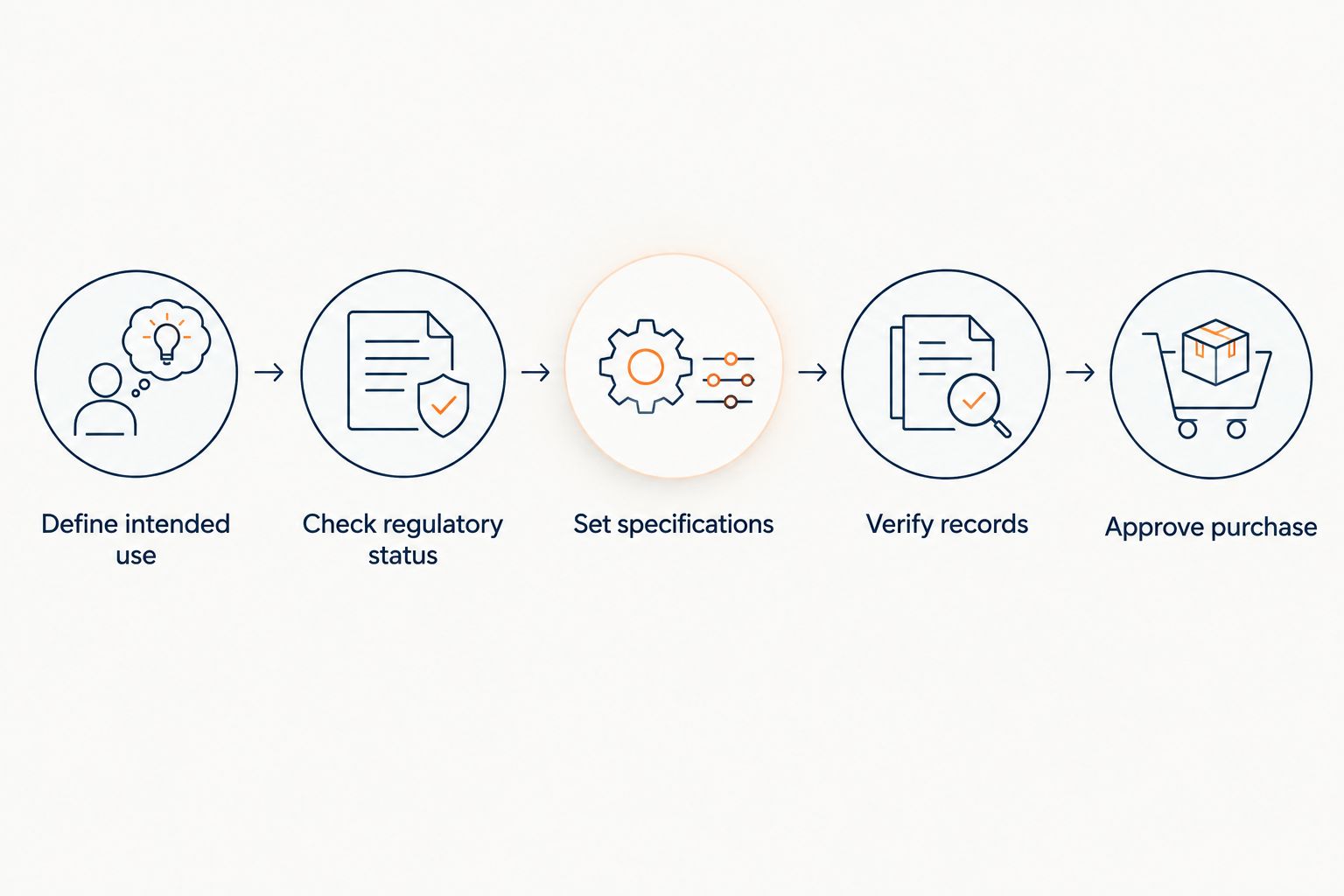
This sequence separates permission to conduct the work from confidence in the material. An analytical result cannot replace a regulatory determination; a regulatory determination cannot replace identification of the delivered lot. In 2026, both decisions belong in the purchase record.
What a research-use label does and does not establish
A label stating that a peptide is for research use only communicates a stated restriction. It does not, by itself, determine the product’s legal classification, approve a human use, or resolve how the product is marketed. FDA’s intended-use regulation, 21 CFR 201.128, addresses evidence of intended use beyond a single label statement.
For a nonclinical laboratory, the label should match the purchase brief and the work performed. If a listing pairs a research disclaimer with directions or claims about effects in people, the buyer has a different question to resolve than routine reagent sourcing. Do not use a research procurement process to bypass review of a proposed human application.
Nor does a supplier’s analytical documentation convert a research material into an approved medicine. Identity and purity results can support the scientific assessment of a specified lot. They do not establish authorization to administer that lot to a person, conduct a clinical trial, or use it in compounding.
Why the answer varies
These factors change the applicable review; none can be resolved from a peptide name alone.
- Intended use: Nonclinical experiments and human administration trigger different questions. Write down the actual activity before evaluating the listing.
- Marketing and labeling: Claims, directions, and surrounding sales material can inform intended use. A research-only statement is not the entire record.
- Regulatory status: Check the particular substance and proposed activity under the rules that apply to them. Do not assume all peptides share one status.
- Study setting: A human clinical investigation calls for a documented review of the investigational new drug requirements and any applicable exemption.
- Supplier and lot records: Specifications and analytical characterization help a laboratory decide whether a material fits its study. They do not independently answer whether the transaction or use is lawful.
- Institutional requirements: The buyer’s approved protocol and procurement controls determine what its staff may order for a defined project. Keep that decision with the project record.
A seller, investigator, and procurement officer can each have a different obligation in the same transaction. In 2026, asking only whether purchase is legal leaves out the use that follows it. The useful question is whether this buyer can obtain this material for this documented purpose under the applicable rules.
Which documents should a laboratory request?
For nonclinical sourcing, begin with a written specification and request records that connect the offered material to it. The review should cover material identity, the analytical methods used for reported attributes, the applicable lot identifier, and the provenance information available for that lot. Ask what each document proves; do not infer an unreported result.
Simple Life Science’s documentation-led research sourcing is relevant at this stage. A qualified buyer can use a scientific brief to state the intended research scope and required acceptance criteria, then assess the available lot documentation against that brief. The buyer still needs its own regulatory decision; a supplier record cannot approve an activity outside the documented research scope.
Separate supplier qualification from lot acceptance. Supplier qualification asks whether the organization can provide the documentation and material controls your institution requires. Lot acceptance asks whether the particular material delivered meets the written specification for the project. A favorable answer to either question does not settle the other.
If a necessary method, result, or chain-of-identity detail is absent, record the gap and request clarification before acceptance. Do not fill it with assumptions based on a catalog description. For a custom synthesis project, define the sequence and analytical deliverables in the written scope so the eventual records can be reviewed against agreed criteria.
Can a laboratory use a research peptide in a human study?
A laboratory cannot infer permission for a human study from a research peptide purchase. In 2026, the study team must assess the proposed investigation under the applicable FDA framework, including 21 CFR Part 312 and any relevant exemption, before obtaining material for that purpose. A nonclinical purchase record is not a clinical authorization.
The review must address the specific protocol and product, not just the peptide name. Keep the regulatory determination with the study documentation. If the work falls outside the approved scope, pause the sourcing decision until the responsible institutional and regulatory reviewers resolve it.
Does a certificate of analysis make a peptide legal to buy?
No. A certificate of analysis reports findings about a material; it does not grant legal permission to sell, buy, or use it for a proposed purpose. Check whether the certificate identifies the relevant lot and methods, then review legal status separately. In 2026, neither document replaces the other.
A report can also be incomplete for your specification. If your project requires an attribute the report does not address, request the appropriate evidence rather than treating the certificate’s title as an acceptance decision. That is a scientific documentation issue even when the intended nonclinical purchase is otherwise permissible.
Are all peptides subject to the same rules?
No. Peptides are a class of materials, not a single regulatory status. The identity of the substance, the claims surrounding it, and the proposed use govern the questions a buyer must ask. Avoid applying an answer about one research material to every sequence or transaction in 2026.
This is also why a procurement team should not use a supplier list as its legal checklist. Compare suppliers only after the intended use and material specification are settled. Then ask whether each supplier can provide the records needed for that defined purchase.
FAQ
Is it legal to buy research peptides in the United States for laboratory work?
Yes, a qualified laboratory can purchase research peptides for legitimate nonclinical work, subject to the material and transaction. Document intended use and check the applicable requirements before ordering.
Does research use only mean a peptide is approved for people?
No. A research-use label does not authorize human administration or establish that a peptide is an approved drug. Evaluate the proposed human use under its applicable regulatory pathway.
Can I buy a research peptide for a clinical trial?
A proposed clinical-trial purchase requires a study-specific regulatory review first. Assess 21 CFR Part 312 and any applicable exemption; a research-only listing does not settle the question.
Does a certificate of analysis prove a peptide is legal?
No. A certificate of analysis supports review of reported material attributes, not legal authorization for a transaction or use. Match it to the lot and specification, then assess regulatory status separately.
Is buying a peptide the same as permission to administer it?
No. Possession for a documented laboratory purpose does not authorize human administration. Intended use and the applicable drug and study requirements must be evaluated separately.
What should an institutional buyer check before ordering research peptides?
Define the intended use, identify the material, check applicable regulatory requirements, and set written acceptance criteria. Review lot-specific analytical and provenance records before accepting the material.
Can a research-use label settle a compounding question?
No. Compounding has its own applicable federal and state requirements, and a research-use label does not replace that review. Determine whether the proposed ingredient and activity fit the relevant pathway before sourcing.
One last thing
The most useful purchasing document is the brief written before a supplier is selected. It connects the intended activity, material specification, acceptance criteria, and required records in one reviewable scope. For Simple Life Science research peptides, use that scope to assess documentation; never treat a supplier name, label, or certificate as a substitute for the buyer’s regulatory determination.
Related guides
- Peptide sourcing for procurement teams
- How to verify a peptide supplier before ordering
- Peptide analytical testing for QC teams
- Research peptide suppliers

