
Bacteriostatic water is not the same as sterile water for injection. Both start from water that meets USP purity standards, but bacteriostatic water carries an added 0.9% benzyl alcohol preservative, and sterile water for injection contains none. That single difference is why bacteriostatic water supports multi-dose reconstitution while sterile water for injection is restricted to single-dose or immediate-use protocols, and it's the detail most reconstitution write-ups skip when the two get used interchangeably in 2026 lab documentation.
- Bacteriostatic water and sterile water are not the same: 0.9% benzyl alcohol is the defining difference.
- Sterile water for injection carries no preservative and is limited to single-dose or immediate-use protocols.
- Bacteriostatic water supports multi-dose reconstitution of lyophilized peptides under a documented beyond-use window.
- USP <797> guidance is the reference point most compounding and research SOPs cite for multi-dose vial dating in 2026.
Why this matters
Procurement teams and lab managers who order the wrong diluent don't find out until a reconstitution log gets flagged during an analytical review. Sterile water for injection has no antimicrobial agent, so any vial opened more than once carries contamination risk with no preservative to slow microbial growth. Bacteriostatic water is built for exactly that repeated-draw scenario, which is why it shows up in reconstitution protocols for lyophilized peptides far more often than sterile water does.
The distinction matters at the specification level, not just the label. A written scope that calls for "sterile diluent" without naming the preservative status can result in either water type shipping, and only one of them supports a multi-dose research use. Simple Life Science documentation on bacteriostatic water for compounding pharmacies treats this as a defined specification issue, not a substitution to be made on the bench.
Is bacteriostatic water the same as sterile water?
No. Both are manufactured to USP water-purity standards, but they carry different monographs, different intended uses, and different labeling requirements. The table below breaks down the specification differences that a lab SOP or purchasing spec should account for.
| Attribute | Bacteriostatic Water | Sterile Water for Injection |
|---|---|---|
| Preservative | 0.9% benzyl alcohol | None |
| USP monograph | Bacteriostatic Water for Injection | Water for Injection |
| Intended use | Multi-dose reconstitution | Single-dose or immediate use only |
| Post-open handling | Documented beyond-use window under refrigeration | Discard after single withdrawal |
| Benzyl alcohol sensitivity | Relevant; excluded for benzyl-alcohol-sensitive formulations | Not applicable |
The best bacteriostatic water for peptide reconstitution comparison covers how these specification differences translate into which vial size and format a given research protocol actually needs.
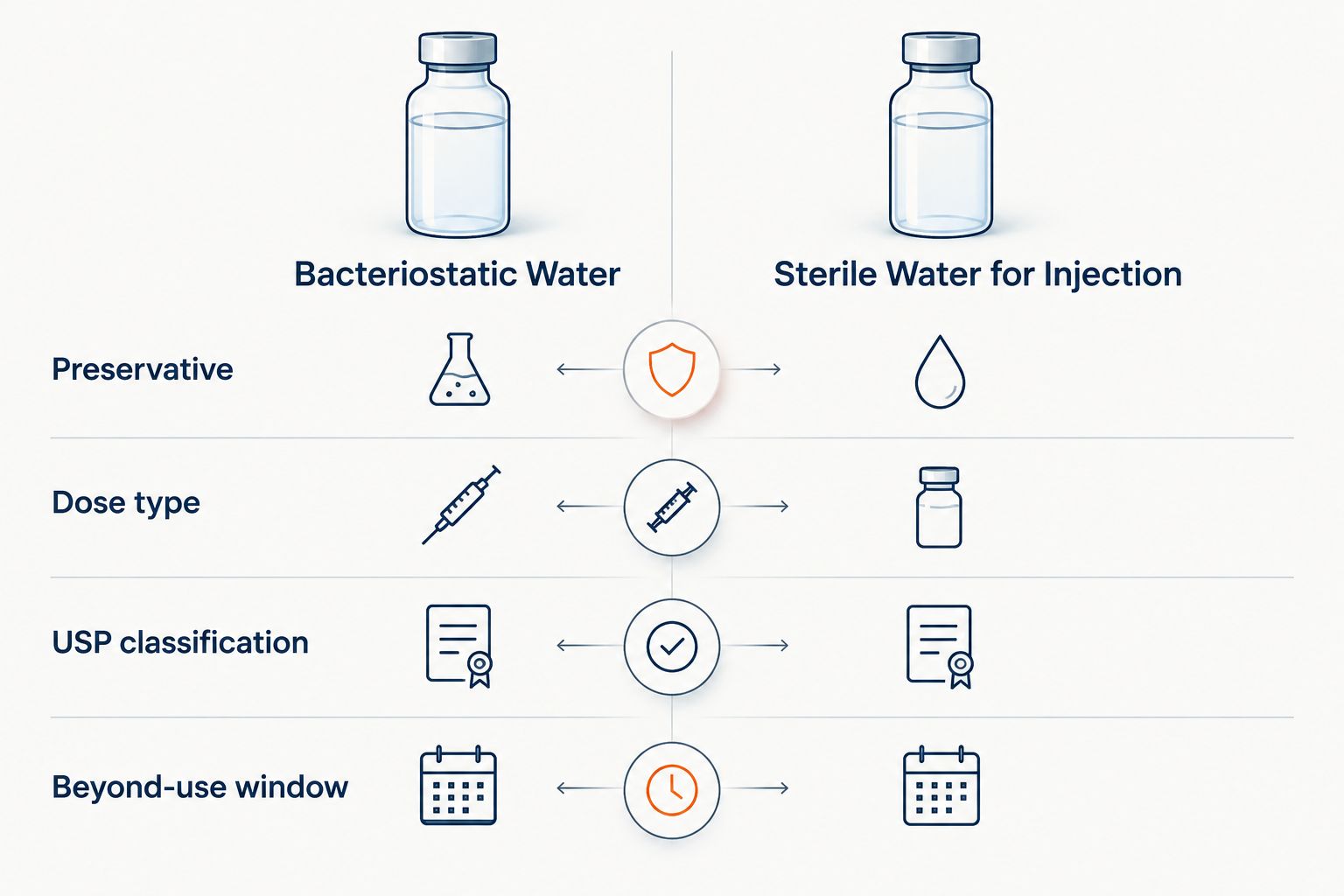
The preservative, not the water, is what separates a single-dose vial from a multi-dose one.
“The preservative, not the water, is what separates a single-dose vial from a multi-dose one.”
Why bacteriostatic water and sterile water are specified differently
The two products diverge at the formulation stage, and the reasons show up in how each one gets ordered, labeled, and documented:
- USP monograph classification — bacteriostatic water and sterile water for injection sit under separate USP monographs with different acceptance criteria.
- Preservative content — 0.9% benzyl alcohol is added specifically to support repeated vial access without a fresh sterility guarantee each draw.
- Peptide and compound sensitivity — some research formulations are documented as benzyl-alcohol-sensitive, which rules out bacteriostatic water for that specific reconstitution.
- Beyond-use dating requirements — USP <797> guidance is the reference most compounding pharmacies and research labs cite when setting a documented hold window for opened multi-dose vials.
- Packaging and labeling rules — bacteriostatic water vials carry preservative disclosure on the label; sterile water for injection does not.
- Intended downstream use — research protocols reconstituting lyophilized peptide for repeated sampling default to bacteriostatic water; one-time dilution work more often specifies sterile water for injection.
Standardizing the volume calculation at the point of reconstitution reduces transcription errors on the bench log. The same logic sits behind external tools like semaglutide dosing calculators, which apply one fixed conversion method across every entry instead of leaving the math to a notebook. A lab SOP that specifies volume per vial in writing, rather than by memory, closes the same gap.
Review current specifications before ordering
Confirm preservative content and lot documentation match your written scope.
Can sterile water be substituted for bacteriostatic water when reconstituting peptides?
Sterile water for injection is not a direct substitute for bacteriostatic water in multi-dose reconstitution protocols. It contains no benzyl alcohol, so a vial reconstituted with sterile water for injection carries no antimicrobial buffer against repeated draws, which is why most lyophilized peptide reconstitution SOPs specify bacteriostatic water instead. The how long reconstituted peptide lasts guide covers the documented hold window that applies once bacteriostatic water is used.
Does benzyl alcohol in bacteriostatic water affect formulation stability?
Benzyl alcohol at 0.9% is the standard preservative concentration for bacteriostatic water, and it is excluded by protocol for benzyl-alcohol-sensitive compounds. Any lab working with a formulation flagged as sensitive should confirm the exclusion in writing before specifying bacteriostatic water on a purchase order.
Is bacteriostatic water sterile?
Bacteriostatic water is manufactured under sterile conditions and meets USP purity standards for Bacteriostatic Water for Injection. The 0.9% benzyl alcohol content controls microbial growth after the vial is opened; it does not change the initial sterility of the manufactured product.
Preguntas frecuentes
Is bacteriostatic water the same as sterile water?
No. Bacteriostatic water contains 0.9% benzyl alcohol as a preservative; sterile water for injection contains none. That difference determines whether a vial supports multi-dose or single-dose use.
Can you use sterile water instead of bacteriostatic water for peptide reconstitution?
Sterile water for injection lacks the preservative that supports repeated vial access, so it is not interchangeable with bacteriostatic water in multi-dose reconstitution protocols.
Why does bacteriostatic water contain benzyl alcohol?
0.9% benzyl alcohol is added as an antimicrobial preservative, allowing a single vial to be accessed multiple times under a documented beyond-use window.
Does bacteriostatic water expire after opening?
Yes, opened bacteriostatic water is subject to a documented beyond-use window, commonly referenced against USP <797> guidance for multi-dose vials with an antimicrobial preservative.
Is sterile water for injection safe for multi-dose use?
No. Sterile water for injection has no preservative, so protocols limit it to single-dose or immediate-use applications rather than repeated withdrawal from one vial.
What USP monograph covers bacteriostatic water?
Bacteriostatic water is manufactured under the USP monograph for Bacteriostatic Water for Injection, distinct from the Water for Injection monograph that covers sterile water.
Does every peptide formulation tolerate benzyl alcohol?
No. Some formulations are documented as benzyl-alcohol-sensitive and are excluded from bacteriostatic water reconstitution by written protocol.
One last thing
The 0.9% benzyl alcohol figure is worth memorizing on its own: it's the entire specification difference between a diluent restricted to one draw and one built for repeated access. Lab teams that write "sterile diluent" into a purchase order without naming the preservative status are the ones most likely to get the wrong water type shipped in 2026, and the fix is a one-line addition to the written scope, not a new SOP.
Related guides
- Is it safe to reconstitute peptides with tap water?
- How much bacteriostatic water should you add per vial?

