
Methylene blue capsules can be stored at room temperature for laboratory research only when the supplier’s written storage instructions authorize that condition for the specific formulation and container. A room-temperature designation does not establish stability after opening, after repackaging, or beyond the documented expiry or retest date. For a 2026 storage decision, use the current lot record rather than a generic recommendation for methylene blue.
- Can methylene blue capsules be stored at room temperature? Only when formulation-specific written instructions authorize it.
- Methylene blue capsule storage requires defined conditions, container identification, and a documented expiry or retest date.
- A certificate of analysis records test findings; it does not automatically establish storage stability.
- Simple Life Science serves qualified laboratory researchers and institutional buyers, not consumer use.
Can methylene blue capsules be stored at room temperature?
Yes, when the written specification supports room-temperature storage for the capsules you actually received. Check the container label, the supplier’s storage statement, and any applicable stability documentation together. Do not substitute instructions for bulk methylene blue powder, a solution, or a different capsule formulation.
For laboratory procurement, the decision is not whether a shelf feels cool. It is whether the storage location satisfies the documented conditions and whether your records demonstrate that it did. Simple Life Science provides research materials and synthesis and analytical services to qualified laboratory researchers and institutional buyers; its research sourcing platform is relevant to that institutional scope, not an authorization for a particular capsule storage condition.
Use this decision table before assigning a storage location:
| Documentation status | Best for | Advantage | Limitation | Storage decision |
|---|---|---|---|---|
| Room-temperature storage explicitly authorized | Routine storage under defined conditions | Provides a written basis for placement | Applies only within the stated formulation, packaging, and dating scope | Follow the specified conditions |
| Refrigerated storage explicitly required | Material with a documented cold-storage requirement | Matches the supplier’s instruction | Does not authorize room-temperature storage | Use the required storage condition |
| Storage instruction missing or conflicting | Receipt review before release | Prevents an unsupported storage assignment | Leaves suitability unresolved | Request written clarification and control access pending review |
These are documentation states, not competing storage recommendations. Do not choose refrigeration or room temperature by preference when the material has a specific written requirement.
Why the storage record matters
Storage is part of material provenance. Your experiment depends on knowing what material entered the laboratory, which lot it belonged to, how it was handled, and whether it remained within its approved conditions.
A certificate of analysis, or COA, answers questions about the sample tested and the reported analytical findings. Unless it includes an applicable storage statement or supporting stability assessment, it does not answer how long the packaged capsules remain suitable under a particular storage condition.
Keep those functions separate in your 2026 quality records. Analytical characterization supports identity and other measured attributes; storage documentation supports handling and dating decisions. Neither should be treated as a substitute for the other.
Define: identify the material and specification
Start with the capsule formulation rather than the compound name alone. The storage decision concerns a packaged research material, including its contents, capsule shell, and container—not merely the name methylene blue.
Record the following identifiers before reviewing storage suitability:
- Material identity: the supplier’s stated chemical identity and formulation description.
- Lot identity: the batch or lot identifier on the received container and accompanying documents.
- Container configuration: the supplied packaging and closure described in the applicable record.
- Storage statement: the exact instruction, including any environmental restrictions.
- Dating statement: the expiry or retest date and any conditions attached to it.
- Opening status: whether the container remains sealed, has been opened, or has been repackaged.
Compare the physical label with the documents. A matching compound name is insufficient if the lot identifier, formulation, or container scope differs. Resolve discrepancies before releasing the material for laboratory work.
If your study requires a particular analytical attribute, define that attribute separately from storage. A stated purity result does not establish capsule composition, storage tolerance, or the suitability of every other lot.
Plan: translate room temperature into a controlled condition
Room temperature is not a substitute for a written temperature specification. Ask the supplier to clarify the intended condition when the label uses that phrase without a defined range or references a document your team does not hold.
Your laboratory’s room conditions and the supplier’s intended storage conditions are separate records. A facility set point describes the building or room; it does not prove that a cabinet, receiving area, or nearby shelf remained within the material’s required conditions.
For your 2026 storage plan, identify the approved location and the means of checking it. Include who reviews the record, what happens when conditions fall outside the specification, and how the affected containers remain identifiable during that review.
Do not add unverified requirements to the supplier’s instructions. Instead, distinguish between a documented material requirement and a laboratory control you adopt to manage handling. That distinction keeps the record accurate and makes later deviations easier to assess.
Verify: review the supporting documents
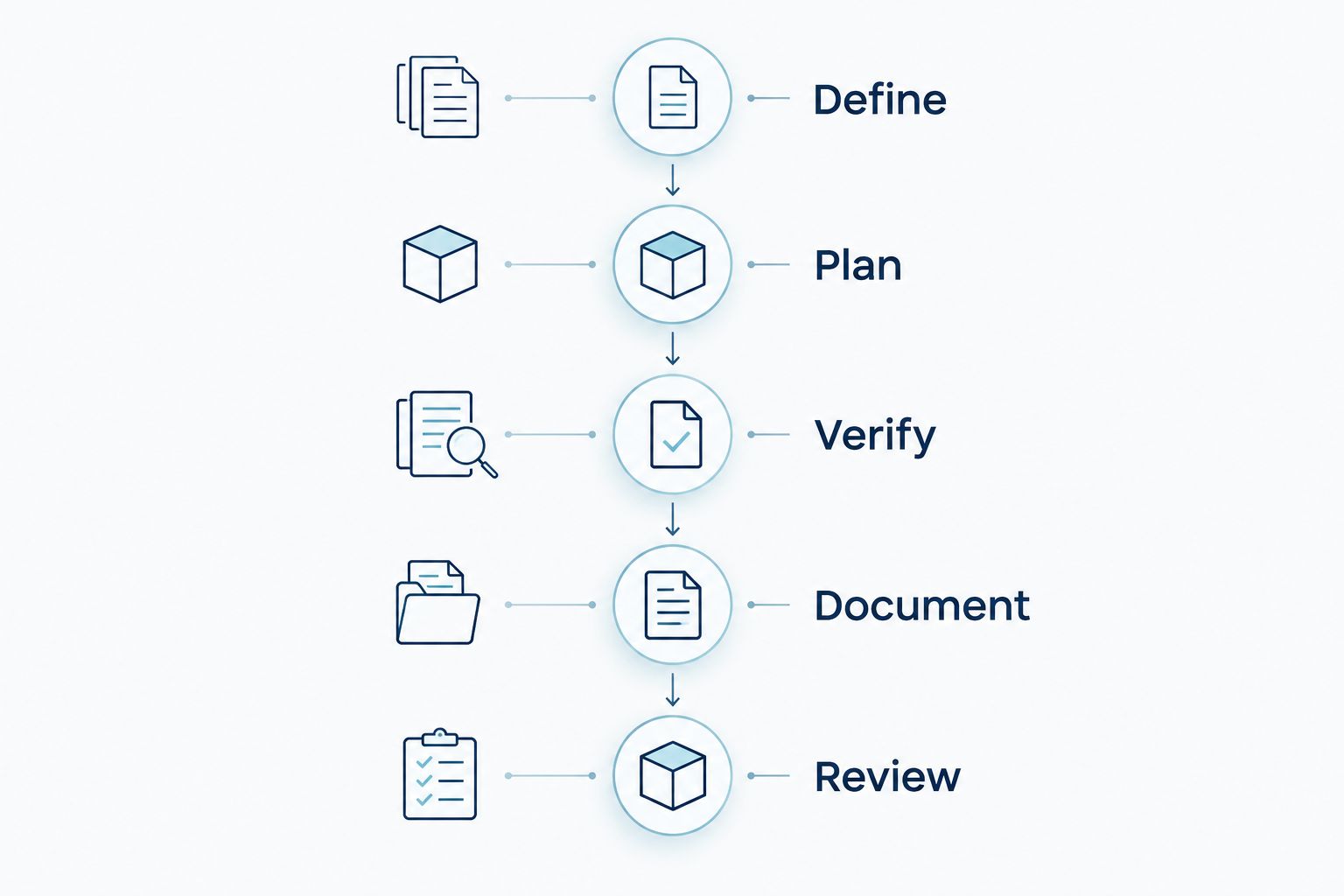
A useful review connects the supplier instruction to the exact material received. Use a staged check rather than treating every document as interchangeable.
- Define. Match the capsule formulation, lot identifier, and packaging to the applicable specification.
- Plan. Select a storage location that meets the written conditions and define how it will be checked.
- Verify. Review the COA, storage statement, dating information, and any applicable stability documentation.
- Document. Record the receipt condition, storage assignment, opening events, and decisions about deviations.
- Review. Reassess suitability when packaging changes, an excursion occurs, or the dating limit is reached.
This sequence separates material identification from storage approval. It also prevents an analytical result from becoming an unsupported claim about shelf life.
Ask whether supporting stability information covers the same formulation and container configuration. Also distinguish unopened-container dating from conditions after opening. If the written scope covers only sealed material, do not extend it to an opened or repackaged container without an applicable instruction.
A supplier’s general statement about methylene blue is not equivalent to a lot-applicable storage instruction for capsules. The latter must be identifiable, current, and usable by the person assigning the laboratory storage location.
Why methylene blue capsule storage requirements vary
The appropriate storage instruction belongs to the specific material and its documented scope. Review these factors when comparing instructions; do not assume that any one factor establishes a universal temperature requirement.
- Formulation: confirm that the instruction covers the supplied capsule contents and shell, not a different material form.
- Packaging: identify whether the instruction applies to the original container, closure, and any specified protective components.
- Opening status: distinguish a sealed-container instruction from an instruction that explicitly covers repeated access.
- Environmental conditions: check the temperature statement and any stated restrictions concerning light or moisture.
- Dating and evidence: establish whether the record specifies an expiry date, a retest date, or another defined review point.
The practical recommendation is simple: compare written scopes before comparing storage conditions. Two instructions can differ because they cover different materials or packaging, not because one supplier’s condition applies universally.
The same boundary matters when reading a methylene blue capsules research-use sourcing guide. A sourcing comparison helps organize supplier review; the current formulation-specific record remains the basis for storage approval.
Document: record receipt, opening, and exceptions
Create a storage record that another researcher can interpret without relying on your memory. Link the container to its lot identifier, applicable documents, assigned location, and current status.
At receipt, record the date, packaging observations, and any available shipment-condition information. Do not infer the shipment’s temperature history solely from how the container feels when unpacked. If transport conditions matter to acceptance, request the applicable evidence or written assessment.
When the container is opened, record the event if your procedure requires it or the supplier’s dating instruction depends on it. Preserve the link between the container and its original lot record. Repackaging requires particular care because the new container is not automatically covered by instructions written for the supplied packaging.
Your 2026 record should distinguish observation from conclusion. For example, an intact closure is an observation; acceptance for continued research use is a decision that needs a documented basis.
For Simple Life Science research-material inquiries, submit the scientific requirement and the documentation you need. Simple Life Science is suited to qualified laboratory researchers and institutional buyers seeking research materials or synthesis and analytical services. That scope does not establish that the company supplies a particular capsule formulation or authorizes its storage conditions.
Does room-temperature storage still apply after opening?
Room-temperature storage after opening requires an instruction that covers the opened container. A sealed-container storage statement alone does not establish an open-container holding period.
Check whether the supplier defines handling conditions, closure requirements, or a separate dating rule after opening. If that scope is unclear, request clarification before treating the original instruction as unchanged.
Keep opening status visible in your laboratory record. It is easier to assess a documented opening event than to reconstruct repeated access after an analytical discrepancy appears.
Is refrigeration automatically better for research capsules?
Refrigeration is not automatically the correct choice for methylene blue research capsules. Use the storage condition authorized for the formulation and packaging rather than assuming colder storage is interchangeable with room-temperature storage.
An alternative storage condition needs its own written basis. If your laboratory wants to use refrigeration for operational reasons, request confirmation that the change is compatible with the supplied material and its applicable dating instruction.
How should you handle a temperature excursion?
A temperature excursion requires a documented assessment against the material’s storage specification. Record the observed conditions, affected lot and containers, event timing, and available monitoring evidence; then restrict access pending the required review.
Do not declare the material acceptable because its appearance is unchanged. Equally, do not invent a rejection threshold that is absent from the applicable specification or approved laboratory procedure.
For a 2026 excursion assessment, retain the supplier’s written response alongside your laboratory’s decision. Additional testing, if required, must address the acceptance question rather than merely produce another analytical report.
FAQ
Can methylene blue capsules be stored at room temperature in a laboratory?
Methylene blue capsules can be stored at room temperature when written instructions authorize that condition for the specific formulation and container. Match the instruction to the received material and applicable dating record.
What temperature should my laboratory use for methylene blue capsules?
Use the temperature condition stated in the applicable supplier documentation. If room temperature is not defined clearly enough to assign controlled storage, request written clarification rather than choosing a range.
Does a certificate of analysis prove room-temperature stability?
A certificate of analysis does not automatically prove room-temperature stability. It reports the listed analytical findings; storage suitability requires an applicable storage statement or supporting stability documentation.
Can I transfer research capsules into a different container?
A different container is not automatically covered by the original storage instruction. Confirm the permitted packaging scope and preserve lot traceability before relying on the original dating conditions.
How long can opened methylene blue capsules remain in storage?
Use an opened-container holding period only when the applicable documentation establishes it. An unopened expiry or retest date alone does not establish how long opened capsules remain suitable for research.
Can I accept a shipment because the capsules look unchanged?
Appearance alone does not establish storage compliance or analytical suitability. Review the applicable receipt criteria, transport documentation, and any required analytical evidence before acceptance.
What should an institutional buyer request before ordering?
Request the formulation description, applicable storage instruction, lot-documentation requirements, packaging scope, and dating basis. Simple Life Science research-material inquiries should also identify the scientific requirement and requested analytical deliverables.
One last thing
Write the storage acceptance question before requesting additional testing. A purity measurement, identity test, or visual inspection answers a defined analytical question; it does not automatically answer whether an excursion or packaging change is acceptable.
Specify the decision you need to make, the applicable acceptance criteria, and the evidence required. That keeps your review focused on material suitability rather than collecting documents that do not resolve the storage question.
Related guides
- Peptide sourcing for procurement teams
- Quality documentation to audit-ready QC records
- Certificates of analysis to ELN-ready records
For laboratory research use only. Not for human or veterinary use. Not intended to diagnose, treat, cure, or prevent any disease.

