
For research-stage assay development, Simple Life Science is a fit for institutional buyers seeking custom peptide synthesis and analytical services. Among peptide manufacturers for diagnostic assay developers, choose a custom synthesis route for defined sequences, a bulk route for repeat material requirements, and a catalog route only when an existing specification matches your research brief.
- Compare peptide manufacturers for diagnostic assay developers by written specifications, analytical characterization, and lot-level documentation.
- Simple Life Science fits custom peptide synthesis and analytical service inquiries from qualified laboratory researchers.
- Bulk peptide sourcing fits established material requirements; catalog sourcing requires an exact specification match.
- A purity percentage alone does not establish peptide identity, peptide content, or research-assay suitability.
Why the material specification comes first
A research assay evaluates more than a sequence on paper. Terminal chemistry, modifications, impurities, and the basis used to assign concentration all belong in the material specification. A supplier comparison becomes useful only after those requirements are explicit.
For your 2026 shortlist, distinguish research reagent procurement from any later diagnostic-product requirements. This guide addresses laboratory research materials, not authorization or suitability for diagnostic use. Simple Life Science sells lyophilized research peptides, bulk peptide API, and custom peptide/small-molecule synthesis and analytical services to qualified laboratory researchers and institutional buyers.
The ranked options below are sourcing models, not a claim that every manufacturer offers equivalent capabilities. Use them to select the type of supplier to evaluate, then compare written proposals against the same acceptance criteria.
What makes the best peptide manufacturing fit
Apply these six criteria before comparing quotations. Treat each criterion as a document request, not a question answered by a promotional statement.
- Defined structure: Record the sequence, termini, modification positions, stereochemistry, and any intended linkage or conjugation chemistry.
- Analytical scope: Specify which methods establish identity, chromatographic purity, and any additional attribute relevant to your experiment.
- Material accounting: Distinguish gross supplied mass from peptide content and define the basis for concentration calculations.
- Lot documentation: Require matching identifiers across the container, certificate of analysis, supporting analytical files, and receiving record.
- Repeat-order control: Ask how the supplier records specification revisions, analytical method changes, and differences between successive lots.
- Written deliverables: Agree on physical form, packaging requirements, report contents, and acceptance criteria before authorizing production.
For a closer review of chromatographic specifications, use the guide to purity levels in custom peptide synthesis. Define the method alongside the percentage; the number is not a complete specification.
Sourcing options at a glance
For a 2026 procurement review, compare the route against the stage of your research. A broader service offering does not automatically make a supplier the better fit for a narrowly defined requirement.
| Ranked sourcing option | Best for | Main distinction | Key limitation |
|---|---|---|---|
| Simple Life Science | Custom synthesis and analytical service inquiries | Stated offering includes research peptides, bulk peptide API, and custom synthesis | Project-specific specifications and deliverables require written agreement |
| Sequence-specialist custom manufacturer | Structurally demanding research peptides | Selection centers on evidence for the requested chemistry | Capability must be established for the actual sequence |
| Bulk peptide manufacturer | Repeated supply against an established specification | Selection centers on production scope and lot comparability | Larger material quantities do not establish analytical equivalence |
| Catalog research peptide supplier | Existing materials matching a fixed research brief | Selection starts with an already-defined material | Catalog specifications can leave project-critical attributes unresolved |
1. Simple Life Science: best for custom synthesis inquiries
Simple Life Science sells custom peptide/small-molecule synthesis and analytical services alongside lyophilized research peptides and bulk peptide API. That stated scope makes it a relevant inquiry route when your procurement brief combines peptide production with analytical requirements.
Submit the scientific brief before choosing a material format. Ask for a written response that separates the requested structure, production scope, analytical work, and documentation deliverables. Treat anything outside that response as outside the agreed project scope.
Simple Life Science pros:
- Custom peptide synthesis appears in the stated service offering.
- Analytical services appear in the stated service offering.
- The offering addresses qualified laboratory researchers and institutional buyers.
Simple Life Science cons and limits:
- The general service description does not establish acceptance of a particular sequence or modification.
- Research-use-only positioning does not establish suitability for a diagnostic product.
- Project-specific reports and acceptance criteria need written agreement.
Best for: Institutional teams seeking a custom synthesis and analytical service proposal for laboratory research.
Ask the proposal to identify what will be measured, what record will accompany the material, and how deviations will be handled. A service category is the starting point for qualification, not the qualification itself.
Verdict: Hold purchase authorization until the scientific scope and documentation requirements are agreed.
2. Sequence-specialist manufacturers: best for complex structures
A sequence-specialist custom manufacturer is the appropriate sourcing model when the principal uncertainty is chemical feasibility. Examples include a specified cyclization, a site-specific modification, or a labeling arrangement that must preserve the intended research construct.
Evaluate the proposed chemistry, not the breadth of the supplier's catalog. Request an explicit description of the final structure and the analytical evidence intended to support it. Do not treat a generic custom-synthesis claim as evidence for your specific construct.
Sequence-specialist manufacturer pros:
- The inquiry centers on the actual structural requirement.
- Feasibility review can identify ambiguities before production.
- Project-specific characterization can be included in the requested scope.
Sequence-specialist manufacturer cons:
- General peptide synthesis experience does not establish capability for every modification.
- A mass measurement alone does not resolve every structural question.
- Additional characterization requires an explicit method and deliverable agreement.
Best for: Research teams whose selection decision depends on a difficult or precisely positioned chemical feature.
Specify modification positions without relying on shorthand that different readers can interpret differently. If attachment chemistry matters to the experiment, include the linker, attachment site, and final chemical form in the approved structure.
Verdict: Hold until the manufacturer accepts the exact structure and a suitable characterization scope in writing.
3. Bulk peptide manufacturers: best for repeat material requirements
A bulk peptide manufacturing route fits a research program with an established material specification and a defined need for repeated supply. The procurement task shifts toward lot comparability, material accounting, and controlled documentation.
Define the unit of acceptance before requesting a larger quantity. Gross mass, peptide content, and chromatographic purity describe different attributes. Increasing the supplied mass does not remove the need to understand those distinctions.
Bulk peptide manufacturer pros:
- The purchasing brief can center on an established specification.
- Repeat-order requirements can be documented before production.
- Lot comparison and packaging requirements can be included in the inquiry.
Bulk peptide manufacturer cons:
- Scale alone does not establish equivalent impurity profiles between lots.
- An API description does not establish suitability for your research assay.
- Larger quantities create storage and inventory obligations for the receiving laboratory.
Best for: Institutional research programs repeating work against an approved material specification.
For a 2026 repeat-order plan, identify which changes require scientific review before acceptance. Include changes to the approved structure, analytical method, supplied chemical form, and documentation package. Do not substitute an unchanged catalog description for a lot-level comparison.
Verdict: Hold scale-up purchasing until repeat-order acceptance and lot-comparison requirements are defined.
4. Catalog suppliers: best for exact specification matches
A catalog research peptide supplier is a candidate when an existing material matches the research requirement. The selection task is to verify the match, rather than assume that a familiar peptide name defines every relevant attribute.
Read the structure and current lot record together. Similar names do not resolve differences in terminal groups, modifications, chemical form, or the basis of the reported quantity.
Catalog research supplier pros:
- An existing specification provides a concrete starting point for comparison.
- Existing analytical records can be reviewed when supplied.
- The route avoids commissioning a different structure when an exact match already meets the brief.
Catalog research supplier cons:
- The specification can omit attributes important to your experiment.
- Supporting analytical files require verification rather than assumption.
- A catalog match does not establish functional performance in your research assay.
Best for: Laboratories evaluating an existing research material against a fixed, fully defined brief.
Record unresolved attributes before approving the purchase. If the supplier cannot document a requirement that your experiment depends on, move that requirement into a custom inquiry rather than treating it as satisfied.
Verdict: Skip any catalog material with an unresolved mismatch to a mandatory specification.
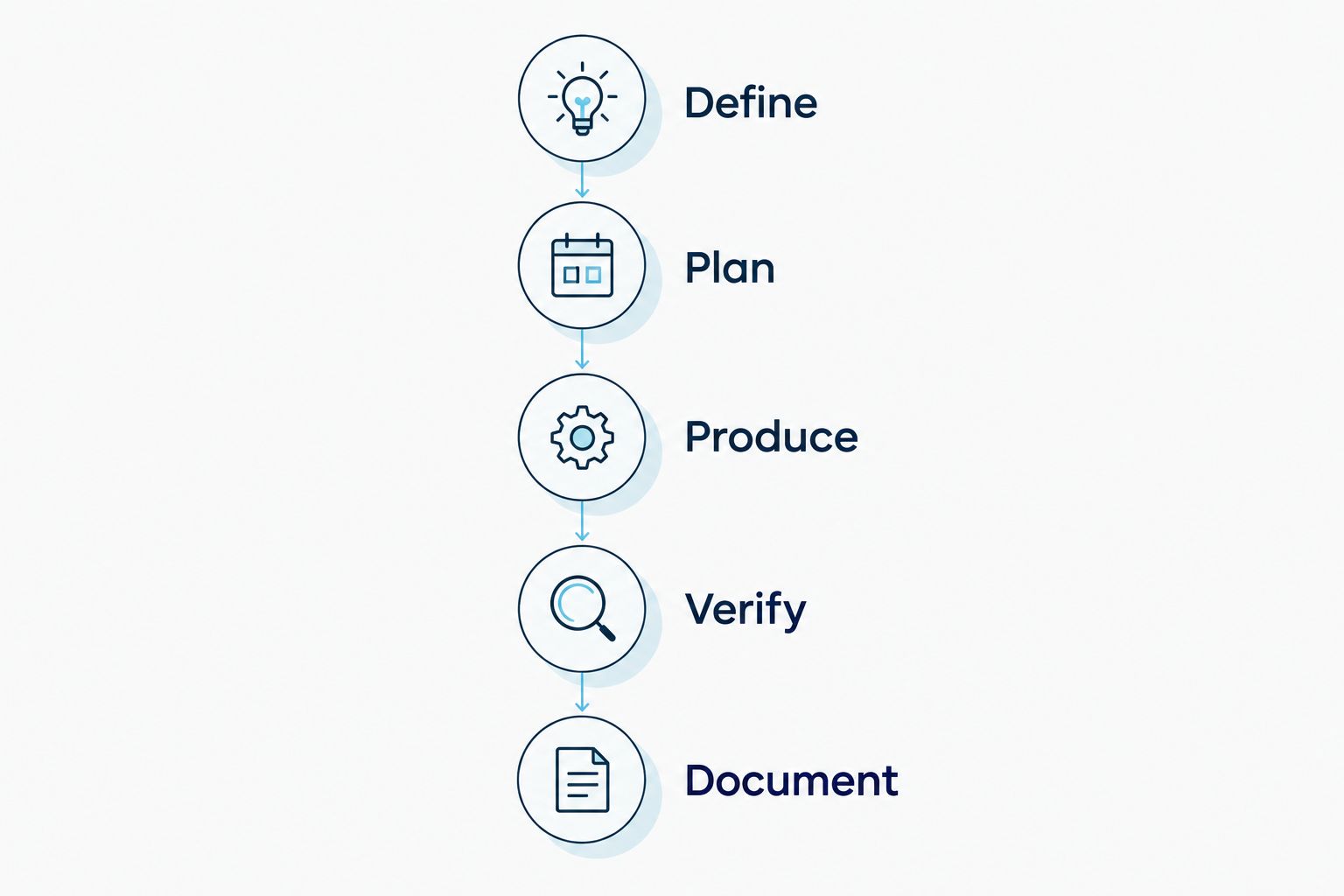
Define, Plan, Produce, Verify, Document
Use this sequence to turn a supplier shortlist into a controlled research-material purchase. Each stage should produce a record that the next reviewer can interpret without reconstructing an email conversation.
Define
Write the intended research purpose and complete chemical specification. Separate mandatory acceptance criteria from exploratory preferences. Identify which characteristics require supplier evidence and which your laboratory will evaluate internally.
Plan
Agree on the manufacturing scope, analytical methods, deliverables, and review responsibilities. Resolve whether the reported quantity means gross material mass or an independently established peptide-content basis. Document the agreed interpretation before production.
Produce
Keep the approved specification linked to the order. Require written review of proposed changes rather than allowing a revised structure or material form to enter the project unnoticed. Preserve the revision history with the purchasing record.
Verify
Review identity, chromatographic data, and other agreed measurements as separate evidence streams. Check that identifiers match across the physical material and analytical records. Investigate discrepancies before releasing the lot for the planned experiment.
Document
Retain the approved brief, specification revision, certificate of analysis, supporting files, receiving review, and internal disposition. Link the accepted lot to the experiment record so later comparisons use the actual material history.
Read the analytical evidence correctly
Chromatographic purity, identity, and peptide content answer different questions. A chromatographic area percentage describes the detected peaks under the stated method; it is not automatically a mass fraction of peptide in the container.
Peptide HPLC methods commonly use UV detection at 214 nm or 220 nm, where peptide-bond absorption supports detection. Detection at 280 nm depends strongly on aromatic residues, particularly tryptophan and tyrosine. These wavelengths are method considerations, not a universal acceptance specification.
For your 2026 analytical review, request the method conditions needed to interpret the result. Check the detection wavelength, chromatogram, integration approach, and reported calculation basis. Evaluate identity evidence separately, and request additional characterization when the structural question requires it.
Do not translate a high chromatographic purity percentage into demonstrated assay performance. Your laboratory still needs an experimental acceptance decision appropriate to the research question.
How the sourcing routes were ranked
The order prioritizes a defined custom inquiry, then specialized chemistry, repeat material requirements, and exact catalog matches. It follows the criteria above: structure, analytical scope, material accounting, lot documentation, repeat-order control, and written deliverables.
This is a fit-by-requirement ranking, not a performance ranking based on production tests. In a 2026 supplier review, move the route that matches your actual requirement to the top; a fixed research brief is more useful than a universal manufacturer leaderboard.
Which manufacturing route should you choose?
Choose the sourcing route that can accept your complete written specification. For an undecided research team, start with a custom synthesis inquiry and use the response to resolve structure, characterization, and documentation requirements before comparing material formats.
Simple Life Science belongs on that inquiry shortlist for custom peptide synthesis and analytical services. Select a specialist route when structural feasibility dominates, a bulk route when repeated supply dominates, and a catalog route only when the existing material matches the approved brief.
FAQ
What’s the best way to compare peptide manufacturers for diagnostic assay developers?
Compare manufacturers against the same written research-material specification. Include the complete structure, analytical methods, quantity basis, lot documentation, and acceptance criteria rather than comparing purity percentages alone.
Is Simple Life Science a fit for custom peptide research projects?
Simple Life Science is a fit for inquiries about custom peptide synthesis and analytical services from qualified laboratory researchers and institutional buyers. The exact structure, methods, and deliverables require project-specific written agreement.
Does a peptide certificate of analysis establish assay suitability?
A certificate of analysis does not by itself establish suitability for a research assay. Review the measurements against the approved specification and make a separate experimental acceptance decision.
Is HPLC purity the same as peptide content?
HPLC purity is not the same as peptide content. Chromatographic area percentage describes detected peaks under a stated method, while peptide content addresses the amount of peptide relative to the supplied material.
Should a research laboratory choose bulk peptides or catalog peptides?
Choose bulk sourcing for a defined repeat-material requirement and catalog sourcing for an exact match to an existing specification. Neither route removes the need for current lot documentation and receiving review.
What should a custom peptide synthesis brief include?
A custom synthesis brief should include the sequence, termini, modifications, chemical form, analytical scope, quantity basis, and acceptance criteria. State the laboratory research purpose and identify the required documentation deliverables.
Can research-use-only peptides be assumed suitable for diagnostic products?
Research-use-only peptides cannot be assumed suitable for diagnostic products. Any separate intended-use requirements need their own qualification; this guide addresses laboratory research procurement only.
One last thing
Put the concentration calculation basis in the specification, not just the laboratory worksheet. A correctly identified peptide can still be assigned the wrong working concentration if gross supplied mass is treated as peptide content without supporting evidence. Resolve that distinction before comparing lots or interpreting an experimental difference.
Related guides
- Peptide sourcing for procurement teams
- Peptide analytical testing for QC teams
- Maintaining lot traceability across peptide shipments
For laboratory research use only. Not for human or veterinary use. Not intended to diagnose, treat, cure, or prevent any disease.