
A BPC-157 order comes with a certificate of analysis only when the supplier includes that document in the agreed order scope; confirm this in writing before purchase. For laboratory procurement in 2026, require a BPC-157 COA tied to the supplied lot, with analytical methods, reported results, and acceptance criteria—not a sample certificate for another batch.
- A BPC-157 COA must match the supplied lot; a generic certificate cannot establish that lot’s analytical status.
- Review peptide identity and HPLC purity separately; neither measurement replaces the other.
- Define acceptance criteria before ordering, then document the laboratory’s material-release decision.
- Simple Life Science serves qualified laboratory researchers and institutional buyers sourcing research peptides and analytical services.
Does BPC-157 come with a certificate of analysis?
Confirm COA inclusion in the written order scope rather than assuming every BPC-157 purchase includes one. Request the certificate for the lot assigned to your order, and establish how any supporting analytical records will be supplied. A representative certificate helps you evaluate the document format, but it does not verify the material you receive.
Use the peptide sourcing guide for procurement teams to place this document request within your supplier-review process. Keep the commercial agreement, material specification, and analytical deliverables aligned.
| Document or record | Best for | What it supports | Limitation |
|---|---|---|---|
| Lot-specific COA | Incoming material review | Reported results and acceptance status for an identified lot | Its conclusions depend on the methods and scope reported |
| Representative COA | Pre-order document assessment | Review of the supplier’s certificate format | Does not establish the supplied lot’s results |
| Supporting analytical report | Technical review | Examination of chromatograms, spectra, and method details | Requires traceable sample identification and technical interpretation |
| Safety data sheet | Laboratory hazard review | Handling and hazard information | Does not replace lot-specific analytical characterization |
These records serve different purposes. Requesting all relevant records gives your laboratory a stronger review package, but a larger document package is not automatically a better one: traceability and method relevance matter more than page count.
Why this matters
A COA connects a research material to an analytical record. Without that connection, your procurement team cannot establish whether the reported results describe the lot received or merely another material carrying the same compound name.
For a 2026 research procurement review, separate three decisions: whether the supplier meets your purchasing requirements, whether the supplied lot meets your material specification, and whether the material is suitable for the planned laboratory experiment. A certificate contributes to the second decision; it does not settle all three.
Simple Life Science is for qualified laboratory researchers and institutional buyers sourcing research peptides and analytical services. Evaluate the documentation for each proposed order against your own written scope rather than treating the supplier’s category of business as evidence of a particular lot’s quality.
Define: specify what the BPC-157 COA must establish
Start with the research requirement. Identify the compound, required chemical form, relevant analytical attributes, and records needed for acceptance before requesting a quotation.
BPC-157 is a peptide containing 15 amino-acid residues. The compound name alone is not a complete procurement specification: your analytical review still needs a defined identity reference and an unambiguous description of the material being supplied.
Write the specification so another reviewer can apply it without interpreting your intentions. Avoid an instruction such as high purity when the project requires a defined analytical method and an explicit acceptance criterion.
Your document request should address:
- Material identity: compound designation and the sequence or reference specification used to define it.
- Material form: relevant salt or counterion information where it affects the project.
- Lot linkage: the identifier connecting the certificate, packaging, and receiving record.
- Analytical scope: the tests, methods, and supporting records required for review.
- Acceptance criteria: the limits or requirements used to assess each reported attribute.
- Document control: issue date, revision information, and an identifiable issuing party.
Do not assign requirements simply because they appear on another laboratory’s template. Define each requested attribute by its relevance to your research and material-control process.
Plan: agree the document package before ordering
Ask whether the proposed COA is representative or specific to the lot assigned to your order. Then establish when the current lot record will be provided and who will resolve discrepancies.
For purchasing in 2026, make analytical deliverables part of the written scope. Record whether chromatograms, mass-spectrometry reports, method references, or additional characterization are included. A request for a COA does not, by itself, define the entire supporting data package.
Use this sequence to prevent an ambiguous purchase requirement:
- Define: state the material specification and acceptance criteria.
- Plan: agree the analytical deliverables and document-review responsibilities.
- Produce: require the supplier to identify the lot assigned to the order.
- Verify: compare the supplied records with the received material and specification.
- Document: record acceptance, discrepancies, and the final material disposition.
The Produce stage does not mean every order requires new synthesis. Its purpose here is to establish which material lot the supplier will provide and which records describe that lot.
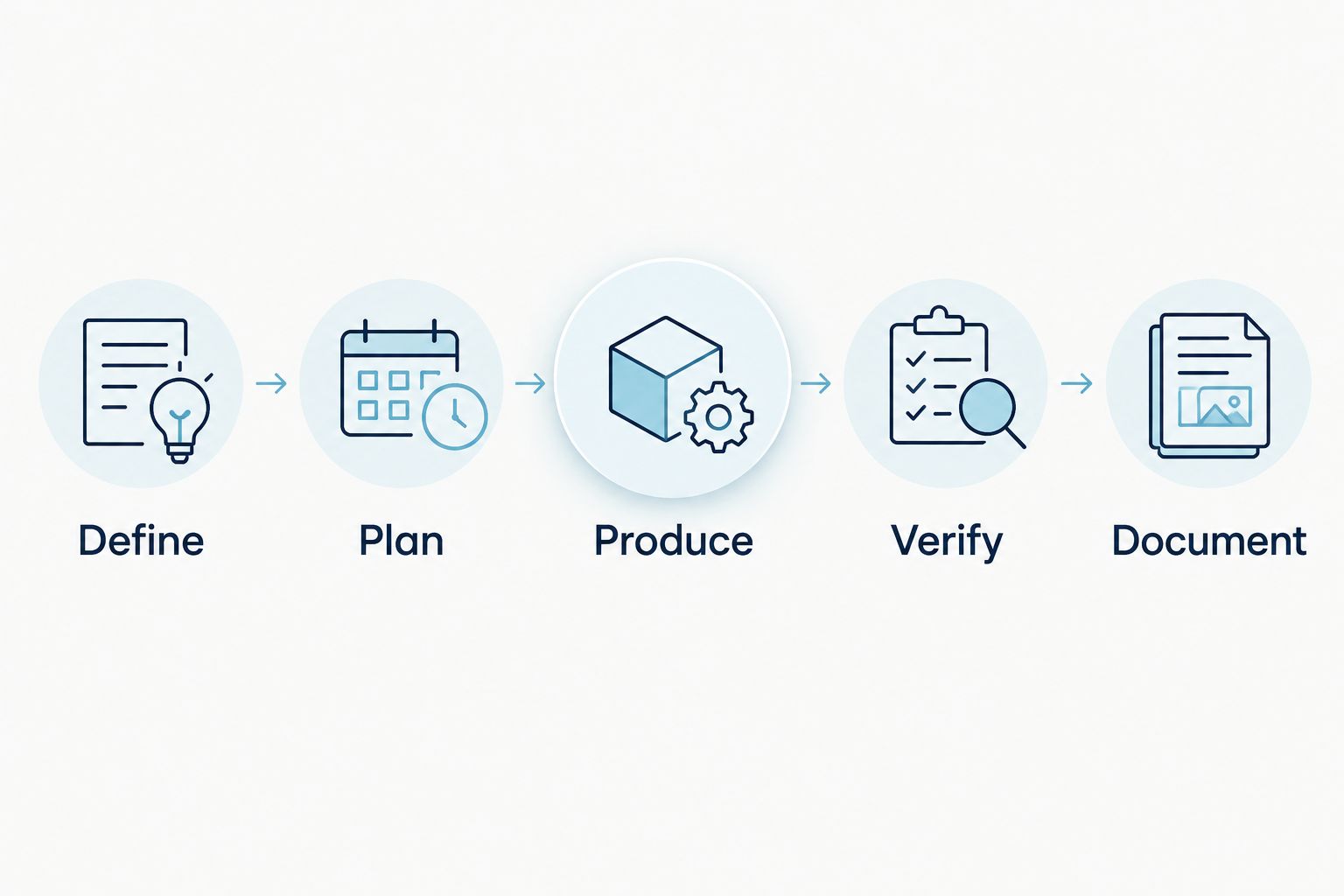
Assign a technical reviewer before the order reaches receiving. Procurement can confirm document delivery and identifiers; analytical interpretation belongs with personnel qualified to evaluate the relevant methods.
Verify: distinguish identity, purity, and content
An HPLC purity result does not establish every attribute of a BPC-157 research material. Chromatographic purity, molecular identity, and peptide content answer different questions. Review them separately whenever your specification requires those attributes.
HPLC separates components under defined conditions. A reported area percentage describes the integrated chromatographic response under the stated method; it is not automatically the mass fraction of peptide in the entire supplied material.
Detection conditions matter. For example, UV measurements at 214 nm and 280 nm are not interchangeable: peptide-bond absorption and aromatic-residue absorption contribute differently at those wavelengths. Treat the detection wavelength as part of the method, not as an incidental instrument setting or a universal acceptance requirement.
A chromatogram should provide enough context for the reviewer to understand the reported result. Request the method reference, detection conditions, integration basis, and sample linkage when those details are necessary to assess the certificate.
Mass spectrometry contributes evidence about molecular mass. It does not automatically establish sequence, stereochemistry, or every possible impurity, and a matching mass does not substitute for a separate purity assessment.
For a broader analytical scope, consult the peptide analytical testing guide for QC teams. Specify the question each test must answer before requesting additional testing.
Can I accept a BPC-157 COA that only reports HPLC purity?
An HPLC-only BPC-157 COA supports chromatographic purity review, not a complete identity assessment. Accept it only if that scope satisfies your approved material specification and your identity requirements are addressed through appropriate records.
Does a BPC-157 COA confirm peptide content?
A BPC-157 COA confirms peptide content only when it reports a suitable content measurement with its method and units. Do not interpret chromatographic area percentage as total peptide content without a justified analytical basis.
Verify: match the certificate to the received lot
Before material release, compare the identifier on the COA with the identifier on the received container and receiving record. Resolve any mismatch through the supplier rather than substituting a similar certificate.
Check the material description as carefully as the lot identifier. A matching compound name does not resolve differences in material form, specification, or the analytical scope associated with the order.
For your 2026 incoming-review record, capture the following checks:
- Identifier match: certificate and received material refer to the same supplied lot.
- Specification match: the material description agrees with the approved purchase requirement.
- Method match: the reported methods address the attributes your laboratory requires.
- Result review: reported values meet the written acceptance criteria.
- Record integrity: dates, revisions, and issuing-party details are internally consistent.
- Disposition: a designated reviewer records acceptance or the reason for holding the material.
A document discrepancy is a reason to hold the release decision until it is resolved. It is not, by itself, proof of a chemical defect; keep documentary findings and analytical findings distinct.
Why BPC-157 COA documentation varies
Different document packages reflect different specifications and analytical scopes. Compare those scopes before deciding that one certificate is more informative than another.
- Research requirement: an experiment’s material requirements determine which attributes need documented acceptance criteria.
- Material form: the supplied form affects which descriptive fields and measurements are relevant.
- Testing scope: a package containing identity and purity characterization answers more questions than a purity-only record.
- Method conditions: separation, detection, and reporting choices affect how a result should be interpreted.
- Sample provenance: manufacturer records and independent laboratory reports require different traceability checks.
- Document control: revisions and separate supporting reports affect which record is current and authoritative.
More testing is useful only when it answers a defined research or quality-control question. Do not request an unrelated assay merely to make the package appear more extensive.
Document: retain the review, not just the PDF
A stored COA is evidence, but it is not a complete acceptance record. Retain the certificate alongside the purchase specification, supporting reports, receiving information, and reviewer’s decision.
Record unresolved questions explicitly. If the supplier issues a corrected certificate, preserve the revision history and identify which document supports the final decision. Replacing a file without preserving its relationship to the earlier version obscures the review trail.
For 2026 lot-level documentation, connect the material identifier to the laboratory’s inventory or electronic record. Keep the analytical review retrievable independently of an individual employee’s email account.
Simple Life Science supplies research peptides and analytical services to qualified laboratory researchers and institutional buyers. When evaluating a proposed order, request the lot-specific documentation and written analytical scope relevant to your project; do not infer order-specific deliverables from that general service description.
FAQ
Does every BPC-157 order automatically include a COA?
Do not assume every BPC-157 order automatically includes a COA. Confirm certificate inclusion, lot linkage, and supporting analytical deliverables in the written order scope before purchase.
Can I use a sample BPC-157 COA to approve an incoming lot?
A sample BPC-157 COA cannot establish the analytical results of a different incoming lot. Use it to review the document format, then request the certificate tied to the material supplied.
Is HPLC purity enough to confirm BPC-157 identity?
HPLC purity alone does not establish BPC-157 molecular identity. Review identity evidence separately against the laboratory’s approved material specification.
Does mass spectrometry prove that a peptide is pure?
Mass spectrometry does not, by itself, establish peptide purity. It contributes molecular-mass evidence, while purity assessment requires an appropriate analytical method and interpretation.
Is an independent laboratory report better than a supplier COA?
An independent laboratory report adds useful evidence when its sample provenance, methods, and scope are documented. It does not automatically replace the supplier’s lot record or establish that the tested sample represents the received material.
What should I do if the COA lot number does not match the container?
Hold the material-release decision and request clarification when the COA lot number does not match the container. Retain the discrepancy record and the supplier’s resolution with the final acceptance documentation.
What should institutional buyers request from Simple Life Science?
Institutional buyers should request a written material specification and confirmation of the analytical documents included in the proposed research-peptide order. Define the lot-level records and acceptance criteria needed for the laboratory’s review.
One last thing
A high reported chromatographic purity does not mean every component of the supplied material has been measured. Water, counterions, residual solvents, and other constituents require relevant methods if your research specification needs those attributes characterized.
Before approving a BPC-157 COA, ask one final question: does this record answer the material questions the experiment requires? That check is more useful than comparing isolated purity figures across certificates with different methods.
Related guides
- What purity level can custom peptide synthesis reach?
- How to verify peptide purity before starting a study
- Certificates of analysis to ELN-ready records
For laboratory research use only. Not for human or veterinary use. Not intended to diagnose, treat, cure, or prevent any disease.

