
Vaccine research laboratories’ bulk peptide API sourcing is the procurement of defined peptide material with the aim of supporting reproducible laboratory research. Your specification must connect sequence identity, analytical characterization, assay requirements, and lot-level documentation rather than treating bulk quantity as evidence of suitability.
- Bulk peptide API for vaccine research labs requires sequence-level specifications, analytical acceptance criteria, and traceable lot records.
- Simple Life Science supplies bulk peptide API and custom synthesis to qualified laboratory researchers and institutional buyers.
- Choose bulk supply for defined requirements; resolve sequence and analytical uncertainties before scaling an order.
- Review identity, chromatographic purity, and peptide content separately; they answer different analytical questions.
Why bulk peptide API matters for vaccine research labs
Vaccine research laboratories need peptide materials that match the question under investigation. A defined antigen-derived sequence, a modified research construct, and an assay control are different procurement requirements, even when each arrives as a lyophilized solid.
Simple Life Science is a sourcing option for qualified laboratories seeking bulk peptide API and custom synthesis. Its stated offering includes research peptides, bulk API, custom peptide and small-molecule synthesis, and analytical services. Review Simple Life Science against your written scope; do not infer project-specific capabilities from the service category alone.
For a 2026 sourcing decision, separate the material description from its intended laboratory application. “API” in a catalog or quotation does not establish a particular manufacturing standard, documented release specification, or suitability for your assay. Those requirements need explicit agreement.
The procurement constraint is not simply obtaining more material. You need enough characterized material to support the planned work, retained samples, repeat measurements, and documented receipt without introducing an unreviewed specification change.
Define, plan, and verify your peptide order
Use the following stages to connect scientific review with institutional purchasing. A controlled document and spreadsheet can manage this process; a specialized purchasing system is not a prerequisite.
Define the specification
Start with a scientific brief that another researcher can interpret without an explanatory call. Record the complete sequence, terminal groups, required modifications, and any structural features that distinguish the requested material from a similar sequence.
For antigen-derived research peptides, identify the source sequence and its version or accession where relevant. Residue numbering without a reference sequence leaves room for ambiguity. Distinguish the full research construct from any shorter sequence used only for identification.
Define acceptance criteria before requesting quotations. A supplier cannot resolve an unspecified analytical requirement merely by reporting a high purity value. Likewise, an unspecified counterion or terminal modification can leave two apparently comparable quotations describing different materials.
Close the brief with these fields:
- Record the sequence and reference identifier in a controlled document.
- Specify terminal chemistry, modifications, and required structural features.
- State the research application without implying suitability beyond that application.
- Define identity, purity, and other application-dependent acceptance criteria.
- Name the scientific reviewer responsible for approving specification changes.
Plan the requirement
Calculate the material requirement from your approved experimental plan, not from a supplier’s package size. Separate initial characterization, planned assay work, retained material, and repeat work so procurement can understand what the requested quantity covers.
Keep mass units explicit. A requirement in mg and a quotation in g need reconciliation before purchase approval. Also establish whether the reported quantity describes total supplied material or a separately determined peptide content; these are not interchangeable descriptions.
For your 2026 procurement plan, distinguish confirmed experiments from contingent work. Ordering bulk material before a sequence or assay requirement is settled creates a documentation problem: the purchasing decision rests on assumptions that the scientific team has not approved.
Use a spreadsheet first, then transfer approved requirements into your institutional system:
- Separate characterization material, experimental material, and retained samples.
- Record the quantity basis and units beside each requirement.
- Identify whether individual containers or pooled material suit laboratory handling.
- Confirm receiving, storage, and analytical-review responsibilities before ordering.
- Record unresolved assumptions instead of hiding them inside a quantity estimate.
Review manufacturing scope
Request a written scope that connects the approved specification to the proposed synthesis, purification, analytical work, and deliverables. The document should identify what is included, what requires separate agreement, and what happens when feasibility review identifies a constraint.
Simple Life Science offers bulk peptide API, custom synthesis, and analytical services. Present those requirements together in a scientific brief rather than assuming that every service automatically forms part of a bulk order. A consolidated request gives the supplier a single specification to assess; it does not replace review of the quotation.
Ask who performs each contracted activity and which records will accompany the supplied lot. If subcontracted work matters to your institutional qualification process, request disclosure within the agreed scope.
Before authorizing production:
- Compare the quotation against the approved sequence and specification.
- Identify included purification and analytical activities by name.
- Request written treatment of sequence changes and unsuccessful synthesis outcomes.
- Clarify the provenance information required by institutional procurement.
- Define the documents needed for scientific acceptance and purchase-order closure.
Verify analytical evidence
Review peptide identity and chromatographic purity as separate questions. Mass spectrometry can support identity assessment, while HPLC characterizes chromatographic components under the stated method. Neither result, by itself, establishes every property relevant to your research application.
Chromatographic area percentage is not automatically the mass fraction of peptide in the container. Water, counterions, and other non-peptide components require separate consideration when the experimental plan depends on peptide content. Request an appropriate measurement only where your specification requires it.
For a 2026 analytical review, examine the method information and lot association, not just a summary value. The discussion of purity in custom peptide synthesis belongs alongside method review, not in place of it.
Accept material against the approved specification, not against an isolated purity claim.
- Match each analytical report to the supplied lot identifier.
- Compare the reported identity evidence with the requested molecular structure.
- Review chromatographic conditions and integration information where required.
- Distinguish chromatographic purity from peptide content and supplied mass.
- Define application-dependent impurity testing before production authorization.
- Record analytical discrepancies and their disposition before laboratory release.
Document the lot
Build a linked record set rather than a folder of unrelated attachments. Use 3 linked records as a practical structure: the approved specification, the supplier’s lot documentation, and your receiving-and-acceptance record. This is a recordkeeping recommendation, not a certification requirement.
The receiving record should show what arrived, which lot it belongs to, and whether the documentation supports acceptance. Preserve the original supplier files and record any internal interpretation separately. Replacing an original certificate with a transcribed summary removes context that a later reviewer might need.
Vaccine research assays can involve peptide materials alongside other biological reagents. When evaluating bulk antigen and antibody suppliers, keep reagent identity, lot provenance, and acceptance records linked to the same experimental record; one reagent’s documentation does not establish another reagent’s suitability.
Use the same record discipline across the project:
- Link the purchase order to the approved specification revision.
- Preserve original certificates, reports, and correspondence concerning deviations.
- Record receipt condition, container identifiers, and receiving personnel.
- Assign an internal material identifier without obscuring the supplier lot.
- Document acceptance, quarantine, or rejection with the reviewer’s rationale.
Control subsequent changes
Treat a reorder as a review event, not an automatic repeat. Compare the new quotation and lot documentation with the approved material record. A matching sequence name does not establish that all relevant manufacturing, analytical, or packaging details remain unchanged.
Maintain 2 review checkpoints: before production authorization and before release to laboratory work. This structure keeps commercial approval separate from scientific acceptance. It also gives procurement a clear reason to pause an order when the scientific scope changes.
For repeat purchases during 2026, keep a revision history that identifies the change, its scientific significance, and the person who approved it. Storage and handling conditions should follow the supplied material documentation and your laboratory’s approved procedures, not a generic assumption about lyophilized peptides.
- Compare each reorder with the approved specification revision.
- Review changes to analytical methods, acceptance criteria, and packaging.
- Record the relationship between replacement lots and previous experiments.
- Retain enough documentation to explain why the new lot was accepted.
- Escalate unexplained differences before releasing material to laboratory work.
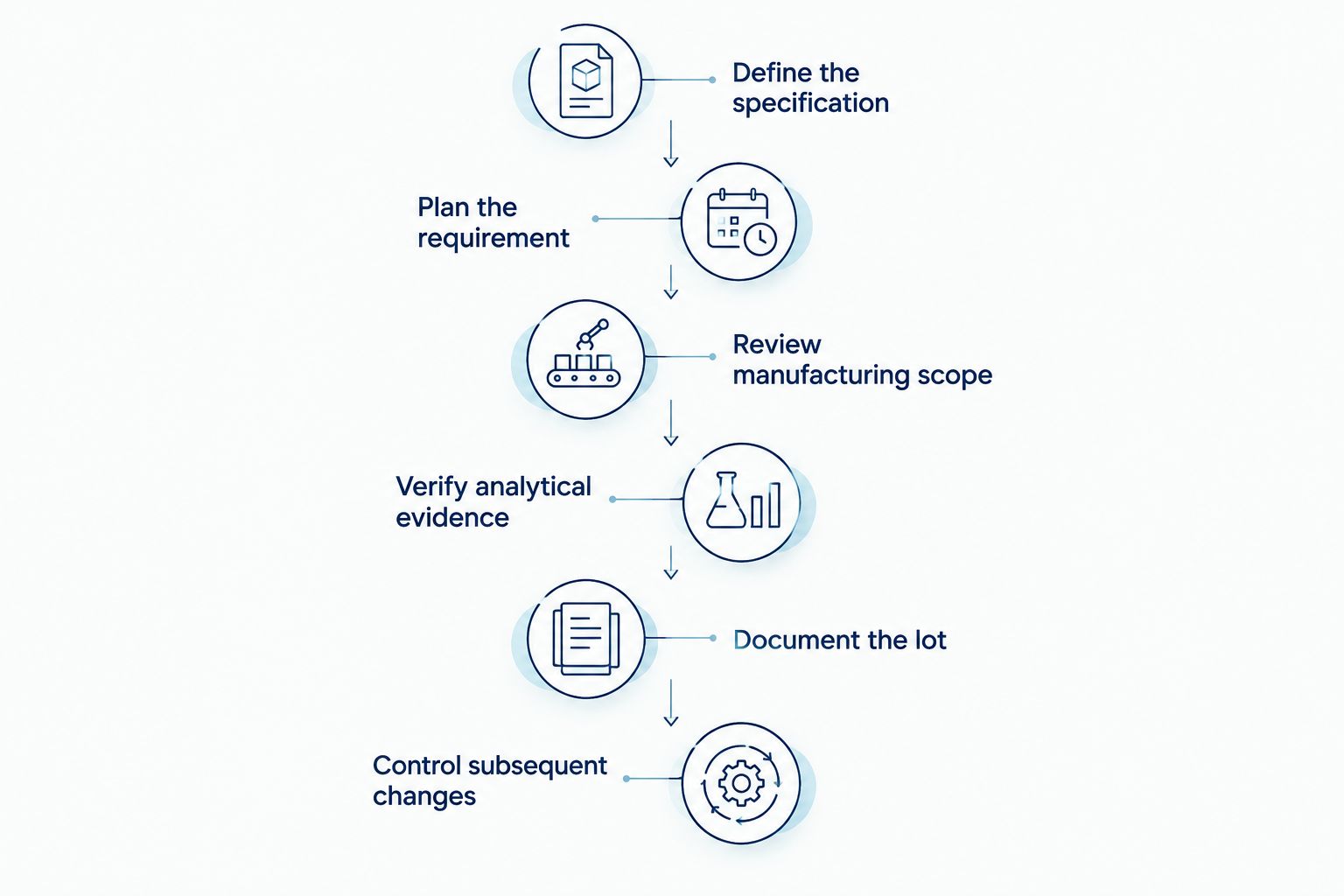
These stages form a sequence: define the requirement before planning the order, review the manufacturing scope before accepting analytical evidence, and preserve the record before approving subsequent changes.
Compare sourcing routes against the research requirement
Choose the sourcing route after defining the material. These options describe procurement approaches, not equivalent levels of characterization. Each route still needs a written specification and an acceptance decision.
| Option | Best for | Main advantage | Key limitation |
|---|---|---|---|
| Catalog research peptide | A defined sequence already matching the research requirement | Lets you assess an existing material description and available lot records | Available specifications and packaging need not match your project |
| Custom peptide synthesis | A novel sequence, modification, or project-specific specification | Connects production planning to a defined scientific brief | Requires feasibility review and agreement on analytical deliverables |
| Bulk peptide API supply | A sufficiently defined requirement needing larger material quantities | Supports quantity planning around an agreed material specification | Bulk quantity alone establishes neither analytical suitability nor lot comparability |
| Separately contracted analytical testing | Incoming verification or a clearly identified documentation gap | Adds measurements selected for the scientific question | Testing scope remains limited to the methods and samples submitted |
Best for a settled specification: assess bulk supply. Best for unresolved sequence requirements: complete custom-synthesis review first. These are different decisions, not competing labels for the same purchase.
Simple Life Science’s bulk peptide API, custom synthesis, and analytical services fit several of these procurement categories. The limitation is scope-dependent: the stated service offering does not confirm that a particular sequence, method, quantity, or deliverable has been accepted. Obtain that confirmation in writing.
Do not use a catalog listing, a service description, or an analytical report to answer a question it does not address. Your comparison should identify the route that closes the documented requirement, including any remaining gaps.
Common sourcing mistakes vaccine research labs make
Treating the sequence name as the specification
A short name does not capture terminal groups, modifications, or reference-sequence ambiguity. Resolve those details before quotation comparison. Otherwise, procurement can compare documents that appear aligned while describing different materials.
Choosing a purity threshold without a method
A purity value needs analytical context. Define the measurement and acceptance criteria together, then determine whether additional characterization is necessary for the assay. Do not add tests simply to make the document package longer.
Confusing lyophilization with qualification
Lyophilization describes a physical preparation process, not a complete quality standard. A lyophilized peptide still requires identity review, appropriate analytical evidence, and material-specific handling information. Its appearance does not establish suitability.
Combining lots without preserving provenance
Combining material can obscure the connection between an experimental result and the original lots. Before combining any research material, define how the laboratory will document the contributing lots and evaluate the effect on its experimental interpretation.
Approving substitutions through purchasing alone
A different terminal group, counterion, or analytical specification requires scientific review. Procurement should record the approved substitution, not decide whether it is scientifically equivalent. Keep the named scientific reviewer in the approval path.
FAQ
What should vaccine research labs specify when buying bulk peptide API?
Specify the complete sequence, terminal chemistry, modifications, quantity basis, analytical acceptance criteria, and required lot documentation. Connect those fields to the intended laboratory research application and name the scientific approver.
Is bulk peptide API the same as a lyophilized peptide?
No. Bulk peptide API describes a supply category, while lyophilized describes material prepared by freeze-drying. Neither description establishes the complete specification or analytical suitability of a supplied lot.
Is HPLC enough to verify a research peptide?
HPLC alone does not establish every property required to verify a research peptide. Review chromatographic purity alongside identity evidence and any additional measurements required by the approved specification.
Does a certificate of analysis guarantee suitability for my assay?
No. A certificate of analysis reports the tests and findings included in that document. Your laboratory must compare those findings with its acceptance criteria and evaluate suitability for the intended research application.
When should a laboratory choose custom synthesis instead of bulk supply?
Choose custom-synthesis review when the sequence, modifications, or analytical specification require project-specific production planning. Consider bulk supply after the requirement is sufficiently defined to support a meaningful quotation and acceptance decision.
What does Simple Life Science supply to qualified research buyers?
Simple Life Science supplies lyophilized research peptides, bulk peptide API, and custom peptide and small-molecule synthesis and analytical services. Project-specific capabilities and deliverables require confirmation against a written scope.
Should a repeat peptide order receive another documentation review?
Yes. Review each new lot against the approved specification and retain the associated analytical and receiving records. A repeat sequence name does not replace lot-level acceptance.
One last thing: control the meaning of “same”
For your 2026 material register, define what a “same-material reorder” means before placing it. Specify which attributes must remain unchanged and which differences trigger scientific review. This turns an informal purchasing instruction into an auditable decision.
The most useful final check is a traceability exercise. Select an experimental record and confirm that you can reach the supplied lot, original analytical documentation, and approved specification without relying on someone’s memory. Repair broken links before expanding the order.
Related guides
- Custom peptide synthesis for immunology research labs
- Peptide analytical testing for QC teams
- Storing peptides before reconstitution
For laboratory research use only. Not for human or veterinary use. Not intended to diagnose, treat, cure, or prevent any disease.