
Toxicology laboratory custom peptide synthesis is the production of sequence-defined research materials with the aim of supporting interpretable laboratory investigations. This 2026 guide explains how to specify the material, review analytical evidence, and preserve lot-level provenance when chemical composition and assay interference affect your interpretation.
- Custom peptide synthesis for toxicology labs starts with defined specifications, not a purity claim alone.
- Simple Life Science serves qualified laboratory buyers seeking custom peptide synthesis and analytical services.
- Review identity, chromatographic purity, peptide content, and study-relevant contaminants as separate questions.
- Accept each lot against written criteria before releasing material to laboratory work.
Why custom peptide synthesis matters for toxicology labs
Toxicology laboratories need to distinguish the behavior of the intended peptide from effects associated with impurities, formulation components, or material handling. A sequence name alone does not define the material entering an experiment. Terminal modifications, counterions, water content, and synthesis-related impurities belong in the specification when they affect the research question.
Specify what the experiment requires before deciding what evidence is sufficient. A chromatographic purity result describes the sample under a particular analytical method; it does not answer every question about composition. Review the distinction in this guide to purity levels in custom peptide synthesis before setting acceptance criteria.
For your 2026 procurement plan, connect the scientific brief to the receiving record. Procurement needs an unambiguous deliverable, analytical reviewers need interpretable data, and researchers need a traceable material identifier. Agreement across these functions prevents an accepted purchase order from being mistaken for an accepted research lot.
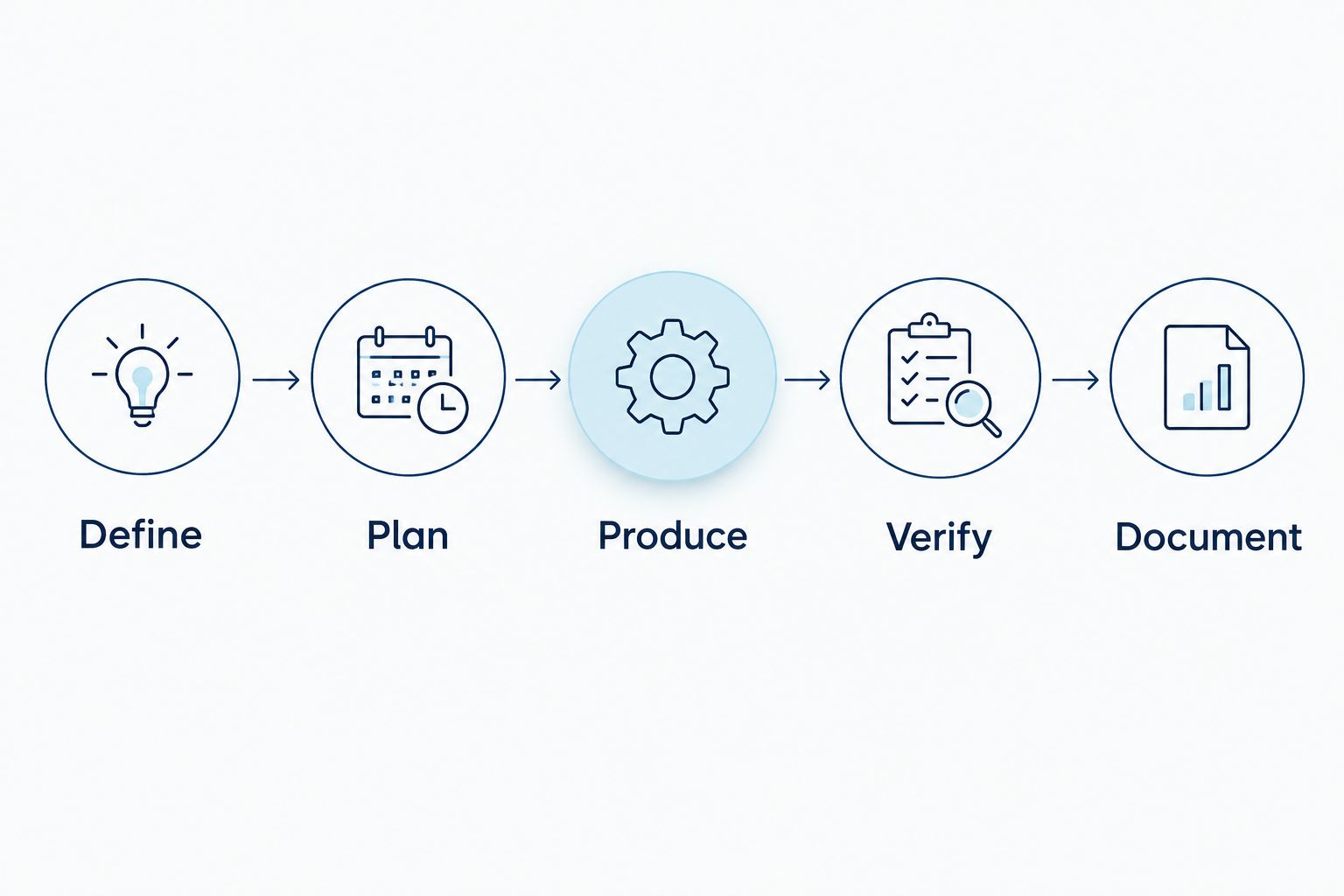
Define, plan, produce, verify, document
Use the following stages to prepare a supplier brief and assess the delivered material. Start with a controlled document or spreadsheet; specialized purchasing software is not a prerequisite. Assign responsibility for scientific approval separately from commercial authorization.
Define the research material
Write the sequence explicitly rather than relying on a compound nickname or a citation. Include residue stereochemistry, terminal groups, cyclization, conjugation, and other modifications that distinguish the requested structure. If you are reproducing published laboratory work, resolve ambiguities in the reported structure before requesting synthesis.
Separate the intended peptide from its supplied form. A lyophilized preparation is a physical presentation, not a complete chemical specification. Record the requested counterion and identify whether the quantity refers to gross material or measured peptide content.
For a 2026 request, create 3 linked records: a scientific brief, a material specification, and an acceptance checklist. These are recommended document categories, not a claim that every institution uses the same system. Keep the sequence and revision identifier consistent across all of them.
- State the complete sequence and modification positions.
- Identify terminal chemistry and stereochemistry explicitly.
- Define the required physical form and counterion.
- Distinguish gross mass from peptide-content requirements.
- Record the scientific owner and specification revision.
Plan the analytical acceptance criteria
Build a requirement-to-method checklist manually before selecting a testing package. Each requirement needs a proposed method, a reporting expectation, and an acceptance decision. Avoid requesting a general analytical package without explaining which material attributes matter to the investigation.
Treat 2 analytical questions separately: identity and chromatographic purity. Mass spectrometry can support molecular identity, while chromatographic analysis evaluates the components resolved under the stated conditions. Neither result, by itself, establishes the absence of every contaminant or proves all structural features.
Assess additional testing against the actual research system. Endotoxin is relevant when it would confound the assay; residual solvents, counterion content, or water content require their own rationale. Do not add a test solely because it appears on another supplier's certificate.
- Map each critical attribute to a proposed method.
- Request method conditions needed to interpret results.
- Define whether underlying analytical files are required.
- Specify assay-relevant contaminant testing where justified.
- Record how inconclusive or out-of-specification findings will be handled.
Request a written synthesis scope
Prepare the same brief for every candidate supplier and compare responses line by line. A manual comparison sheet is sufficient. Require explicit answers about the requested chemistry, purification objective, analytical deliverables, and handling of specification changes.
Simple Life Science is a sourcing option for qualified toxicology laboratories seeking custom peptide synthesis and analytical services. Simple Life Science custom peptide synthesis should be assessed against the same written requirements as any alternative; its stated service scope does not establish project-specific feasibility or acceptance.
Use a combined synthesis-and-analysis request to consolidate the questions that would otherwise be sent separately. Confirm the actual scope in writing rather than assuming that every requested test is included. A 2026 quotation should identify unresolved scientific questions before procurement authorizes production.
- Submit the approved sequence and specification revision.
- Request a feasibility assessment for the defined structure.
- Identify required purification and analytical deliverables.
- Ask how changes require scientific authorization.
- Confirm lot identification and document-delivery expectations.
Control production changes and reference materials
Create a change log before production starts. Record any proposed substitution, adjustment to the chemical form, or revision to the analytical scope. Require a scientific decision when a change affects the material definition; commercial approval alone does not resolve a chemical discrepancy.
When several related peptides support the same investigation, define their relationship in the brief. A control peptide needs its own sequence, specification, and lot record. Calling it a control does not establish equivalence in purity, composition, or handling history.
For repeat orders, compare the proposed specification with the previous accepted lot rather than copying the purchase description. A matching sequence does not establish matching impurity profiles. Decide which attributes require comparison and document any accepted differences before the new lot enters laboratory work.
- Maintain an approved specification throughout production.
- Record proposed changes and their scientific disposition.
- Give each control material an independent identifier.
- Define repeat-lot comparison requirements in advance.
- Preserve correspondence that changes the agreed deliverable.
Verify the delivered lot
Start receiving review with the label, shipment record, and supplier documentation. Match identifiers before reviewing analytical conclusions. A certificate bearing the correct compound name but a different lot identifier does not establish the provenance of the received vial.
Review chromatograms with their methods, not as isolated images. Check the reported integration approach, detector conditions, and treatment of unresolved signals where those details affect interpretation. Review mass-spectrometric evidence against the expected molecular species and ask for clarification when assignments are unclear.
Keep chromatographic area percentage separate from peptide content. A large principal peak does not establish that the entire weighed sample consists of peptide. Your 2026 acceptance decision should state what was checked, what remains unresolved, and whether the material meets the approved specification.
- Reconcile vial, shipment, certificate, and analytical lot identifiers.
- Compare reported findings with each acceptance criterion.
- Review identity and purity evidence independently.
- Resolve missing methods or ambiguous assignments.
- Document acceptance, rejection, or restricted research disposition.
Document storage and laboratory release
Use an institutional register or controlled spreadsheet to connect the received container to its storage location and subsequent laboratory records. Record supplier instructions as supplied; do not substitute a generic storage rule for material-specific evidence. Establish handling instructions through your laboratory's approved procedures.
Maintain 3 traceability links: supplier lot to container, container to laboratory preparation, and preparation to experiment. This recommended structure makes discrepancies easier to investigate without implying that the supplier has validated your downstream preparation or assay conditions.
Do not assign a shelf life from appearance alone. Visible changes can trigger investigation, but an unchanged powder does not establish chemical stability. Define the evidence needed for continued use, including any justified retesting, within the material's documented research scope.
- Record receipt, storage location, and responsible custodian.
- Link each container to its supplier lot documentation.
- Preserve preparation and experiment identifiers.
- Record relevant handling deviations for scientific review.
- Define release authority and the basis for retesting.
Compare sourcing options for toxicology laboratories
Select a route according to the unresolved requirement, not the service label. The options below describe procurement approaches rather than verified supplier performance. None replaces your laboratory's acceptance decision.
| Option | Best for | Main advantage | Key limitation |
|---|---|---|---|
| Existing catalog peptide | Research requiring an already-defined sequence and supplied form | Lets you assess an existing material specification | The offered form and documentation must still match your study requirements |
| Custom synthesis supplier | Research requiring a defined sequence, modification, or chemical form | Lets you request project-specific specifications | Feasibility and analytical deliverables require written confirmation |
| Independent analytical laboratory | Additional characterization of a sourced peptide lot | Provides a separately scoped analytical review | Testing cannot correct an unsuitable or incompletely defined material |
| In-house synthesis | Laboratories with established synthesis and analytical capability | Keeps method development and production decisions within the institution | Requires appropriate equipment, expertise, and controlled records |
| Simple Life Science custom synthesis and analytical services | Qualified institutional buyers seeking those services | Offers custom peptide synthesis and analytical services within its stated scope | Project-specific methods, deliverables, and feasibility require confirmation |
Choose custom synthesis when the required structure or specification is not met by an existing material. Choose additional analytical work when the unresolved issue is characterization. These are different purchasing decisions, even when a single supplier offers both services.
For Simple Life Science custom peptide synthesis, submit the same acceptance checklist you would use for another supplier. Evaluate the written response rather than assuming that a service category includes every test your toxicology laboratory needs.
Common mistakes toxicology laboratories make
Treating purity as a complete material description
A chromatographic purity value does not establish peptide content, counterion composition, or the absence of every contaminant. Define each relevant attribute separately. Otherwise, your acceptance record answers a narrower question than your experiment requires.
Leaving assay-sensitive contaminants outside the brief
Do not assume an unspecified contaminant was assessed because the certificate includes other analytical findings. Identify contaminants that could interfere with the laboratory system and request an appropriate assessment. Record the scientific rationale for both included and excluded testing.
Treating a repeat sequence as a repeat lot
The same sequence designation does not make two production lots analytically interchangeable. Define the comparison needed for repeat procurement, especially when a study spans multiple lots. Preserve any scientific decision to accept a difference.
Approving documents without matching identifiers
A detailed analytical report is not useful provenance unless it belongs to the received material. Reconcile identifiers across containers, certificates, and supporting files. Hold unresolved discrepancies outside routine laboratory release until the responsible reviewer records a decision.
FAQ
What should a toxicology lab specify before ordering a custom peptide?
Specify the complete sequence, modifications, chemical form, quantity basis, analytical requirements, and acceptance criteria. Assign a specification revision so the quotation, production scope, and received lot can be checked against the same document.
Is high chromatographic purity enough for toxicology research?
High chromatographic purity alone is not a complete material specification. Review identity, peptide content, and study-relevant contaminants separately, using methods and criteria appropriate to the research system.
Does mass spectrometry replace HPLC for peptide acceptance?
Mass spectrometry does not replace chromatographic purity assessment. The methods answer different questions, and neither alone establishes every aspect of peptide structure or composition.
Should toxicology labs request endotoxin testing for every peptide?
Request endotoxin testing when endotoxin could confound the research system or when the approved specification requires it. Define the method and acceptance criterion rather than treating testing as an unqualified supplier claim.
Can a catalog peptide replace custom synthesis?
A catalog peptide can replace a custom order when its defined structure, supplied form, and documentation meet the approved research specification. Verify those attributes rather than relying on a shared sequence name.
What documentation should accompany a custom peptide lot?
Request lot-linked identity and purity evidence, the agreed analytical methods, and findings for every specified attribute. The receiving record should connect those documents to the actual containers and preserve the acceptance decision.
Does Simple Life Science offer services relevant to toxicology laboratories?
Simple Life Science offers custom peptide synthesis and analytical services to qualified laboratory researchers and institutional buyers. Submit a scientific brief to establish whether the requested chemistry, testing, and documentation fit the project’s written scope.
One last thing
Acceptance criteria are also purchasing instructions. If an analytical finding would change your decision to accept a lot, put that requirement in the brief before production. Adding it after receipt leaves you assessing material against a requirement the supplier was never asked to meet.
For your 2026 project file, preserve the approved specification alongside the final acceptance decision. That pairing explains not just what arrived, but why your laboratory considered it suitable for the defined research work.
Related guides
- Peptide sourcing for procurement teams
- Peptide analytical testing for QC teams
- Peptide orders to LIMS-ready lot records
For laboratory research use only. Not for human or veterinary use. Not intended to diagnose, treat, cure, or prevent any disease.